


Israeli Police Prevent Catholic Leaders from Celebrating Palm Sunday Mass at Jerusalem Church

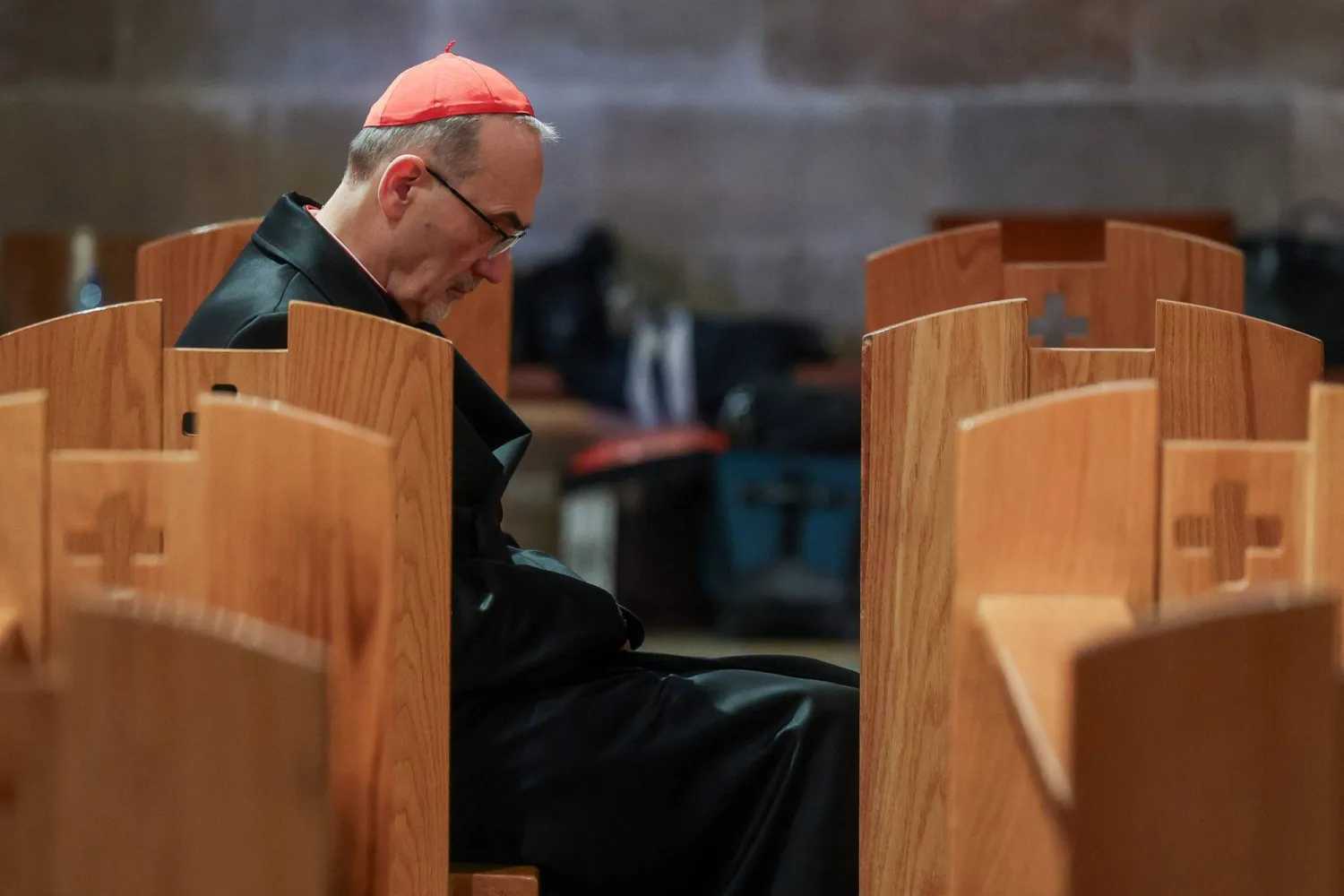
 Latin Patriarch of Jerusalem, Cardinal Pierbattista Pizzaballa, sits inside the Church of All Nations on the day of a prayer service to mark Palm Sunday in Jerusalem on March 29, 2026, following the cancellation of the traditional Palm Sunday procession from the Mount of Olives amid restrictions on gathering in large groups and the US-Israeli war on Iran. (AFP)
Latin Patriarch of Jerusalem, Cardinal Pierbattista Pizzaballa, sits inside the Church of All Nations on the day of a prayer service to mark Palm Sunday in Jerusalem on March 29, 2026, following the cancellation of the traditional Palm Sunday procession from the Mount of Olives amid restrictions on gathering in large groups and the US-Israeli war on Iran. (AFP)
TT

Israeli Police Prevent Catholic Leaders from Celebrating Palm Sunday Mass at Jerusalem Church

 Latin Patriarch of Jerusalem, Cardinal Pierbattista Pizzaballa, sits inside the Church of All Nations on the day of a prayer service to mark Palm Sunday in Jerusalem on March 29, 2026, following the cancellation of the traditional Palm Sunday procession from the Mount of Olives amid restrictions on gathering in large groups and the US-Israeli war on Iran. (AFP)
Latin Patriarch of Jerusalem, Cardinal Pierbattista Pizzaballa, sits inside the Church of All Nations on the day of a prayer service to mark Palm Sunday in Jerusalem on March 29, 2026, following the cancellation of the traditional Palm Sunday procession from the Mount of Olives amid restrictions on gathering in large groups and the US-Israeli war on Iran. (AFP)

The Israeli police prevented Catholic leaders from entering the Church of the Holy Sepulchre to celebrate Mass on the Christian holiday of Palm Sunday for the first time in centuries, the Latin Patriarchate said Sunday.

Jerusalem's major holy sites are closed because of the ongoing Iran war, including the church, as the city has come under frequent fire from Iranian missiles.

The Catholic Church called the police decision “a manifestly unreasonable and grossly disproportionate measure.” It prevented two of the church’s top religious leaders, including Cardinal Pierbattista Pizzaballa and the head of the Custos in the Holy Land, from celebrating Palm Sunday at the place where Christians believe Jesus was crucified.

Palm Sunday commemorates Jesus’ triumphant entry into Jerusalem and launches the Holy Week commemorations for Christians who follow the Latin calendar, which culminates in Easter next Sunday.

The Israeli police said it had notified the Catholic Church on Saturday that no Mass could take place on Palm Sunday because of safety considerations, the lack of access for emergency vehicles in narrow alleys of the Old City and lack of adequate shelter.

However, the Latin Patriarchate said the Church of the Holy Sepulchre has been hosting Masses that aren't open to the public since the Iran war began on Feb. 28, and it was unclear why Sunday’s Mass and access by the two priests was any different.

“It’s a very, very sacred day for Christians and in our opinion there was no justification for such a decision or such an action,” said Farid Jubran, the spokesperson for the Latin Patriarchate of Jerusalem.

Jubran said that the church had requested permission from the police for a few religious leaders to enter the church for a private Mass on Sunday — not one that was open to the public. The Patriarchate said that the decision impeded freedom of worship and the status quo in Jerusalem.

The traditional Palm Sunday procession normally sees tens of thousands of Christians from around the world walk from the Mount of Olives down the narrow, hilly streets toward the Old City, waving palm fronds and singing.

The Patriarchate canceled the traditional processional last week because of safety concerns, and has held Masses limited to fewer than 50 worshippers in compliance with the Israeli military’s guidelines for civilians.

Pizzaballa celebrated Mass in the nearby St. Savior’s Monastery, a soaring marble church which is located next to an underground music school that the Israeli military has deemed a safe shelter space. Later on Sunday, Pizzaballa held a prayer for peace at the Dominus Flevit Shrine on the Mount of Olives, but kept his homily concentrated on Jesus and didn't mention the morning’s incident.

Pope Leo XIV, at the end of Palm Sunday Mass in St. Peter’s Square, prayed for all Christians in the Middle East who he said were living through an “atrocious” conflict. He said that “in many cases, they cannot live fully the rites of these holy days,” though he didn’t elaborate.

The Vatican spokesman didn’t immediately respond when asked to comment on the Jerusalem incident.

Italy formally protested the incident to Israeli authorities. Premier Giorgia Meloni said that the police action “constitutes an offense not only against believers but against every community that recognizes religious freedom.”

“The Church of the Holy Sepulchre in Jerusalem is a sacred site of Christianity, and as such must be preserved and protected for the celebration of sacred rites,” Meloni said. “Preventing the Patriarch of Jerusalem and the Custos of the Holy Land from entering, especially on a solemnity central to the faith such as Palm Sunday, constitutes an offense not only against believers but against every community that recognizes religious freedom.”

Meloni’s conservative government tried to keep a balanced position with Israel during the war in Gaza, supporting Israel’s right to defense but condemning the toll on Palestinians.

The Italian leader has also said that Italy won't participate in the Iran war, while affirming that Tehran can't be allowed to possess nuclear weapons.

Foreign Minister Antonio Tajani instructed Italy’s ambassador to Israel to convey the protest “and to reaffirm Italy’s commitment to protecting religious freedom at all times and under all circumstances.”

In addition, Tajani summoned the Israeli ambassador to Italy for talks on Monday at the Italian Foreign Ministry to seek clarification about the decision.

Israeli Prime Minister Benjamin Netanyahu said on Sunday evening that there was no “malicious intent” and that the cardinal was prevented from accessing the church because of safety concerns, but that Israel would try to partially open the Church of the Holy Sepulchre in the coming days.

“Given the holiness of the week leading up to Easter for the world’s Christians, Israel’s security arms are putting together a plan to enable church leaders to worship at the holy site in the coming days,” Netanyahu wrote on X.

The Western Wall, the holiest site where Jews can pray, is also mostly closed because of safety issues, but authorities are letting up to 50 people at a time pray in an enclosed area adjacent to the plaza.

Smaller churches, synagogues, and mosques are open in Jerusalem’s Old City if they are located within a certain distance of a bomb shelter deemed acceptable by Israel’s military and, if gatherings are kept under 50 people.



Report: Iran’s Ambassador Won’t Leave Lebanon Despite Expulsion

Iranian Ambassador to Syria Mohammad Reza Sheibani, shows his ink-stained finger as he votes in the first round of the Iranian presidential election on June 14, 2013 at the Iranian embassy in the Syrian capital, Damascus. (AFP)
TT

Report: Iran’s Ambassador Won’t Leave Lebanon Despite Expulsion

Iranian Ambassador to Syria Mohammad Reza Sheibani, shows his ink-stained finger as he votes in the first round of the Iranian presidential election on June 14, 2013 at the Iranian embassy in the Syrian capital, Damascus. (AFP)

Iran's ambassador will not leave Lebanon despite being declared persona non grata and ordered to leave the country by Sunday, an Iranian diplomatic source told AFP.

"The ambassador will not leave Lebanon, in accordance with the wishes of the speaker of parliament Nabih Berri and of Hezbollah," the source said, speaking on condition of anonymity.

Hezbollah has denounced the decision while Berri's Amal party joined Hezbollah ministers in boycotting a cabinet session this week in protest at the order to expel Mohammad Reza Sheibani.

The foreign ministry this week gave Tehran's envoy until Sunday to leave in the latest unprecedented step by Lebanese authorities since a new war erupted on March 2 between Israel and Hezbollah.

The ministry accused him of making statements "interfering in Lebanon's internal politics".

French Foreign Minister Jean-Noel Barrot called the expulsion "a courageous decision".

The Lebanese authorities have banned Hezbollah's military and security activities. It is the only armed non-state group in the country and a close ally of Iran.

It has also banned the presence and operations of Iran's Revolutionary Guards whom Prime Minister Nawaf Salam accused of directing Hezbollah operations against Israel.


Netanyahu Says Israel Will Widen Its Invasion of Southern Lebanon

Israeli army soldiers walk next to a self-propelled Howitzer artillery gun positioned in the upper Galilee in northern Israel near the border with southern Lebanon on March 29, 2026. (AFP)
TT

Netanyahu Says Israel Will Widen Its Invasion of Southern Lebanon

Israeli army soldiers walk next to a self-propelled Howitzer artillery gun positioned in the upper Galilee in northern Israel near the border with southern Lebanon on March 29, 2026. (AFP)

Prime Minister Benjamin Netanyahu announced Sunday that Israel will widen its invasion of southern Lebanon.

Netanyahu said Israel would expand what he called the “existing security strip” in Lebanon as Israeli forces continue to target the Iranian-backed Hezbollah militant group.

“We are determined to fundamentally change the situation in the north,” he said on a visit to northern Israel.

Netanyahu said Hezbollah still retained "residual capabilities" to fire rockets at Israel, but the group had been severely hit by Israeli forces.

"Iran is no longer the same Iran, Hezbollah is no longer the same Hezbollah, and Hamas is no longer the same Hamas," he added.

"These are no longer terrorist armies threatening our existence -- they are defeated enemies, fighting for their own survival."

"We are determined, we are fighting, and with God's help -- we are winning," Netanyahu said.

There were no immediate details.

In Lebanon, officials say more than 1,100 people have been killed and more than one million displaced since the Iran war began.


France Condemns Houthis for Entering Middle East War

A satellite image shows Bab el-Mandab Strait off the coast of Yemen, February 27, 2026. (2026 Planet Labs PBC/Handout via Reuters)
TT

France Condemns Houthis for Entering Middle East War

A satellite image shows Bab el-Mandab Strait off the coast of Yemen, February 27, 2026. (2026 Planet Labs PBC/Handout via Reuters)

France condemned on Sunday two attacks by Yemen's Houthi militants on Israeli targets, accusing them of escalating tension in the Middle East by entering the regional war.

A Houthi spokesman said on Saturday the Iranian-backed group had fired missiles and drones towards "several vital and military sites" in Israel, the same day that Israel said it had intensified attacks on Iran's military industry.

The escalation came after more than a month of Israeli and US bombardment of Iran, to which Iran has responded by attacking US-linked interests in wealthy Gulf states.

"The Houthis should abstain from all attacks," French foreign ministry spokesman Pascal Confavreux said. He accused them of being "irresponsible".

He said everything should be done "to avoid an even greater escalation of the conflict", which has killed thousands across the region and sent energy markets into a tailspin.

The war has disrupted global maritime traffic through the Strait of Hormuz, a key waterway in the Gulf through which a fifth of the world's crude supplies pass, along with substantial shipments of gas and fertilizers.

The only alternative routes are to sail through the Red Sea on the other side of the Arabian peninsula or make the much lengthier journey around the tip of southern Africa.

From Yemen, the Houthis could potentially disrupt shipping through the Red Sea, as they did at the height of Israel's war on Gaza.

The European Union said on March 16 it would not extend the bloc's existing naval mission in the Red Sea to help re-open the Strait of Hormuz.

US President Donald Trump had lashed out at EU and NATO countries for not agreeing to escort ships through the strait.