


Israel Opens New Incursion Route from Syria into Lebanon via Mount Hermon

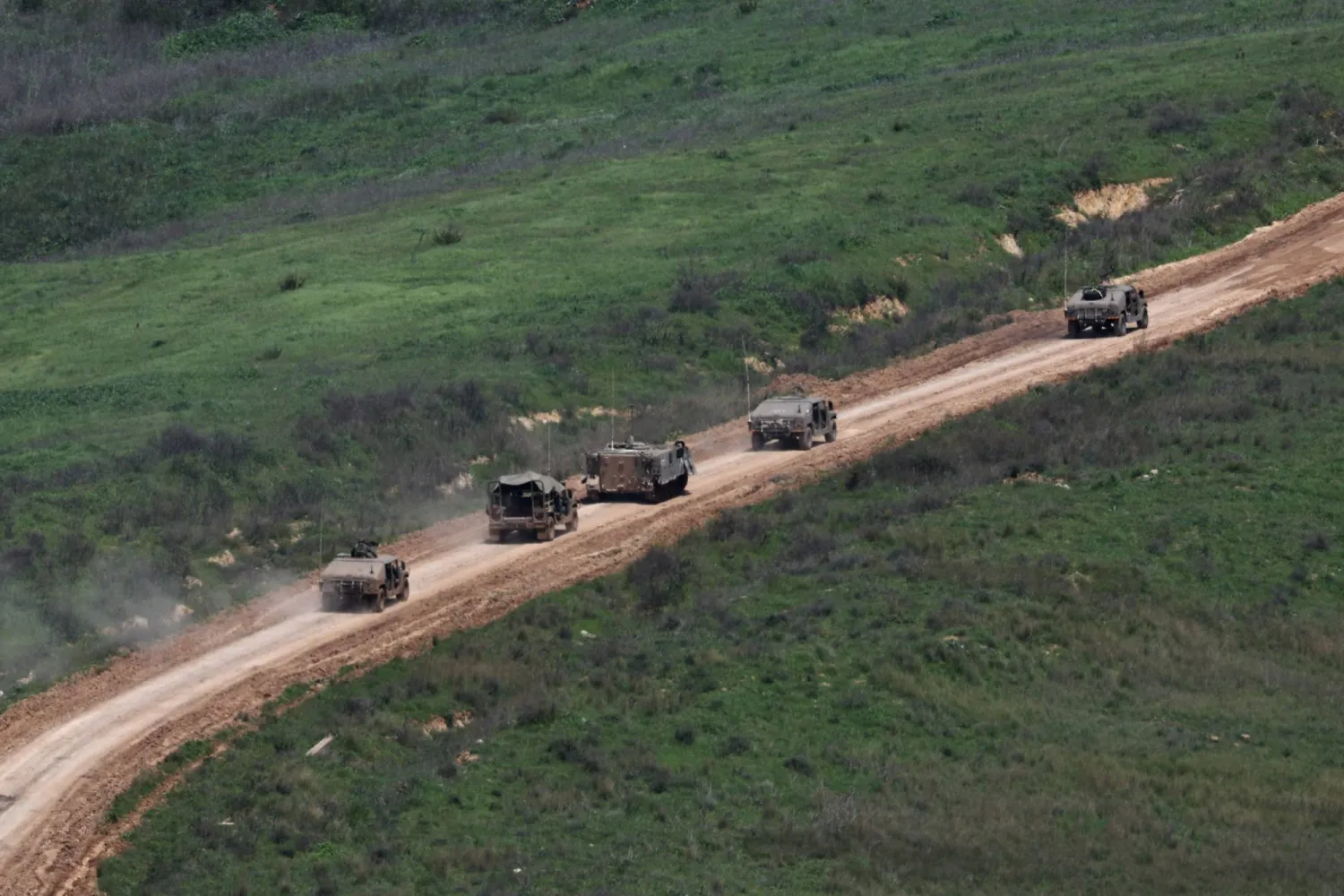
Israeli military vehicles on the Lebanese side of the border (EPA)
TT

Israel Opens New Incursion Route from Syria into Lebanon via Mount Hermon

Israeli military vehicles on the Lebanese side of the border (EPA)

The Israeli army said Sunday that it carried out a cross-border operation from the Syrian side of Mount Hermon toward the “Rous” mountain area inside Lebanese territory in the Shebaa Farms, in a move reflecting a push to expand operations into more complex terrain.

Israel has occupied the Syrian Hermon since the 2024 fall of longtime Syrian ruler Bashar al-Assad.

According to an Israeli military statement, a mountain commando unit climbed in snowy conditions to comb the area, gather intelligence and identify field infrastructure.

The move goes beyond a limited reconnaissance operation, because the elevated terrain allows oversight of wide areas and opens new routes that go beyond traditional front lines.

Geographic advantage and pressure on the south

A source familiar with developments told Asharq Al-Awsat that the most notable shift is the entry of Israeli forces via the Mount Hermon axis — a step long anticipated in military scenarios due to its geographic advantage.

The route allows potential advances toward the western Bekaa or a flanking maneuver down toward Kfarchouba on the mountain’s western slopes.

“This route could effectively sever geographic links between southern Lebanon and the western Bekaa within a relatively short time,” the source said.

Retired Brigadier General Naji Malaeb warned that the most dangerous scenario would be using the axis to encircle the south or cut supply lines between southern Lebanon and the western Bekaa, directly affecting Hezbollah’s logistical structure.

“The operational trajectory remains open, but the next phase carries significant risks of escalation,” he stated.

He added that Mount Hermon’s importance lies in being the highest elevation under Israeli control, offering broad intelligence-gathering capabilities to monitor missiles and drones and strengthen surveillance systems.

Malaeb said limited infiltration operations in mountainous terrain may aim to draw Hezbollah into deploying forces there to prevent wider incursions, while also opening the door to a new front.

Challenges of ground confrontation

The source said a key development could be opening a front toward the Bekaa through positions along the Syrian border near Mount Hermon, potentially expanding the scope of clashes and engaging Hezbollah on an additional front.

He warned that any incursion from the Syrian side into Lebanon — and any response — could place the Syrian army in a sensitive position, as any exchange of fire could be interpreted as targeting Syrian territory, requiring a clear stance from Damascus.

So far, there are indications that Syria is seeking to avoid involvement and has reiterated its rejection to allow its territory to be used in regional conflicts, reflected in reinforced deployments along its borders.

Avoiding dragging Syria into the conflict remains a key factor in preventing wider escalation, the source underlined.



Syria Foils Hezbollah Missile-Launching Operation

 Syrian soldiers inspect a tunnel on the Lebanon border in the Qusayr area. (AFP)
Syrian soldiers inspect a tunnel on the Lebanon border in the Qusayr area. (AFP)
TT

Syria Foils Hezbollah Missile-Launching Operation

 Syrian soldiers inspect a tunnel on the Lebanon border in the Qusayr area. (AFP)
Syrian soldiers inspect a tunnel on the Lebanon border in the Qusayr area. (AFP)

Syrian state media said Sunday that security forces thwarted a missile-launching operation by Iran-backed Lebanese group Hezbollah from its territory.

From March 2 until a 10-day ceasefire went into force on April 17, Hezbollah was battling Israel after drawing Lebanon into the Middle East war with rocket fire aimed at Israel in support of Tehran.

Syria's official SANA news agency, quoting an interior ministry source, said security forces "thwarted a sabotage plot orchestrated by a cell linked to the Hezbollah terrorist militia".

It alleged the group "intended to launch missiles across the border with the aim of destabilizing the country".

Syrian authorities are hostile to Hezbollah as the group played a key role in Syria's civil war that ended in 2024, fighting alongside the forces of now ousted leader Bashar al-Assad.

Last week, Damascus accused the group of being linked to a cell that attempted to plant an explosive device in front of a house belonging to an unidentified religious figure in the Bab Touma area of the Syrian capital.

But the movement denied the ministry's claims on Sunday, saying they were "false and fabricated".

Hezbollah said it has "no activity, no ties and no relationship with any party in Syria, and has no presence on Syrian soil".

The group called on Syrian authorities "to conduct a thorough investigation before making accusations without evidence".

It blamed "the presence of intelligence services" on Syrian soil that it said were "seeking to inflame tensions between Lebanon and Syria".

Under Assad, Syria was part of Iran's "axis of resistance" against Israel and enabled the transfer of weapons and money from Iran to Hezbollah.

But since taking over, Syria's new authorities have rejected Iranian influence.


Barghouti Remains Central Figure in Palestinian Politics After 24 Years in Prison

Marwan Barghouti waves as Israeli police bring him to court for a sentencing hearing in Tel Aviv, May 20, 2004. (Reuters)
TT

Barghouti Remains Central Figure in Palestinian Politics After 24 Years in Prison

Marwan Barghouti waves as Israeli police bring him to court for a sentencing hearing in Tel Aviv, May 20, 2004. (Reuters)

Twenty-four years after the arrest of Palestinian leader Marwan Barghouti, now 67, and after long stretches in solitary confinement, he remains a central figure in Palestinian politics.

His influence has outpaced that of other officials in decision-making roles, and he has topped Fatah elections in previous years, as the movement prepares for its eighth conference next month, a key test of what has changed over time.

Palestinians, the presidency, Fatah, and Barghouti’s family marked the 24th anniversary of his arrest late last week. President Mahmoud Abbas pledged to continue efforts to secure his release.

Fatah said Barghouti, known as Abu al-Qassam, had become a living symbol for Palestinians through his sacrifices, struggle, courage, and patience.

The anniversary came as a lawyer who visited Barghouti on April 12 said he had been assaulted three times in recent weeks, on March 24 and 25 and April 8, leaving him bleeding in several parts of his body without proper medical treatment.

Israeli lawyer Ben Marmarelli said Barghouti was severely beaten and left bleeding for more than two hours on one occasion. Israel’s prison service said it was “not aware” of such incidents.

Barghouti is believed to have been held in solitary confinement for two and a half years. Last year, Israel’s National Security Minister Itamar Ben-Gvir posted a video showing him confronting Barghouti in his cell, speaking in a condescending and threatening tone in what appeared to be an attempt to break him. The move backfired, drawing renewed attention to Barghouti to the point that US President Donald Trump said he was considering whether to release him.

Trump said last October he might ask Israel to release Barghouti, adding he had discussed the option with aides at the White House.

Trump’s intervention has further elevated Barghouti’s standing, with many viewing him as a potential “savior”.

Presidential contender

Informed Palestinian sources told Asharq Al-Awsat that Barghouti will almost certainly run in the next presidential election. “He will most likely be Fatah’s candidate, but even if that does not happen, he will run because he is Marwan,” the sources said.

Elections canceled at the last minute five years ago pointed to his chances. Barghouti formed a list with former Central Committee member Nasser al-Qudwa to challenge Fatah’s official slate.

The list was headed by al-Qudwa and lawyer Fadwa Barghouti, Barghouti’s wife, and included prominent figures from the movement. Barghouti’s name was not listed as he planned to run for president.

His stance underscored a rift dating back to 2005, when he briefly ran against Abbas before withdrawing, a divide that appears unresolved despite expectations of a reconciliation.

There is little sign his position has shifted, even as the broader landscape has. Since the Oct. 7, 2023, war, Israel has increased pressure on the Palestinian Authority, reshaped conditions in the West Bank, and imposed harsher measures on prisoners, including Barghouti. Israel has also rejected Trump’s remarks about his possible release.

Meanwhile, Abbas has moved to reshape the Palestinian Authority and Fatah, appointing senior Central Committee member Hussein al-Sheikh as vice president, launching reconciliation efforts, and allowing the return of previously dismissed members, including al-Qudwa, who has rejoined the Central Committee.

Abbas met Barghouti’s wife late last year and said he would continue working to secure his release.

The meeting sent a clear signal aimed at dispelling doubts over Barghouti, who enjoys strong support within Fatah. His backers present him as a unifying figure capable of bringing Palestinians together and as a potential successor to Abbas, an idea that has not previously gained traction within decision-making circles in Ramallah.

One shift since the war is that Hamas is expected to back him more strongly in any election. The group sought his release in prisoner exchange talks with Israel, placing him among five top-priority detainees, but Israel firmly refused.

Arafat loyalist

Barghouti, arrested in 2002, is serving five life sentences plus 40 years after being convicted of leading the al-Aqsa Martyrs Brigades, Fatah’s armed wing, which carried out attacks that killed Israelis during the second Palestinian uprising that began in 2000.

Before his arrest, he was close to Palestinian leader Yasser Arafat and is widely regarded within Fatah as an Arafat loyalist. This strengthens his standing among the movement’s base, though it may count against him with Israel and opponents of Arafat.

Abbas’s reconciliation push ahead of the eighth conference, scheduled for May 14, comes at a sensitive moment as he works to reorganize the Palestinian Authority and ensure a smooth leadership transition.

The conference will elect a new Central Committee, the movement’s top decision-making body, which will shape both Fatah and the broader Palestinian political landscape.

Selecting a new committee, alongside a new Palestinian National Council, will signal the scale of change and reveal the influence of key figures.

At Fatah’s seventh conference, Barghouti secured the highest number of votes, 930 out of about 1,100, underscoring his strong backing within the movement.

The upcoming conference will show whether he has maintained that standing or lost ground amid sweeping changes within the Palestinian Authority, Fatah, and Palestinian society.

His supporters had hoped he would be named vice president in recent years, but both roles went to others, with the leadership arguing the move was impractical given his imprisonment.

A source close to Barghouti said, “All Palestinians, not just Fatah members, see him as the one who can unite them, as do many countries in the region and beyond. Israel does not want that for well-known reasons.”

“His standing has not diminished over time; it has grown stronger. His presence will remain dominant. He will gain his freedom and unite the Palestinians,” he added.


Lebanese Army Restores Road, Bridge Damaged by Israeli Strikes

Displaced people cross a destroyed bridge which was hit few days ago in an Israeli airstrike, as they return to their villages on the second day of a ceasefire between Hezbollah and Israel in Qasmiyeh, near Tyre city, southern Lebanon, Saturday, April 18, 2026. (AP)
TT

Lebanese Army Restores Road, Bridge Damaged by Israeli Strikes

Displaced people cross a destroyed bridge which was hit few days ago in an Israeli airstrike, as they return to their villages on the second day of a ceasefire between Hezbollah and Israel in Qasmiyeh, near Tyre city, southern Lebanon, Saturday, April 18, 2026. (AP)

Lebanon's military said Sunday it had reopened a road and bridge damaged by Israeli strikes in the country's south, as a 10-day truce holds between Hezbollah and Israel.

In a statement, the military said it "fully reopened" a road linking the city of Nabatieh with the Khardali area, and had "partially reopened the Burj Rahal-Tyre bridge".

"Work is also underway to rehabilitate the Tayr Falsay-Tyre bridge... following damage caused by the Israeli aggression," the army added.

Israeli strikes on bridges that cross Lebanon's Litani river, which flows around 30 kilometers (20 miles) north of Israel, have largely cut off the area south of the waterway from the rest of Lebanon, according to the army.

On Friday a ceasefire between Israel and Lebanon took effect after the first direct talks between the two sides in decades, bringing a pause to weeks of fighting between Israel and Hezbollah that has killed nearly 2,300 people and displaced more than a million.

Since the truce began, Lebanon's military and local authorities have been working to reopen roads that were blocked due to Israeli strikes.

The vital Qasmiyeh bridge was also reopened on Friday morning, allowing countless people displaced from southern Lebanon by the fighting to return to the area and check on their property.

However, many residents have remained hesitant to venture back with the longevity of the truce uncertain.

On Saturday, an AFP correspondent in the southern city of Sidon saw heavy traffic heading to Beirut as displaced southerners returned to temporary homes and shelters in the capital after briefly visiting southern areas.

Earlier that day, Hezbollah official Mahmud Qamati warned that "Israeli treachery is expected at any time, and this is a temporary truce".

"Take a breath, relax a little, but do not abandon the places you have taken refuge in until we are completely reassured about your return," he said.

The Israeli military has carried out strikes and demolitions in southern Lebanon despite the truce.

It also said Saturday that it had established a "yellow line", similar to one in the Palestinian territory of Gaza that separates Israeli forces from areas held by the Hamas group.