


Air Strike Cuts Southern Iraq Off from Iran

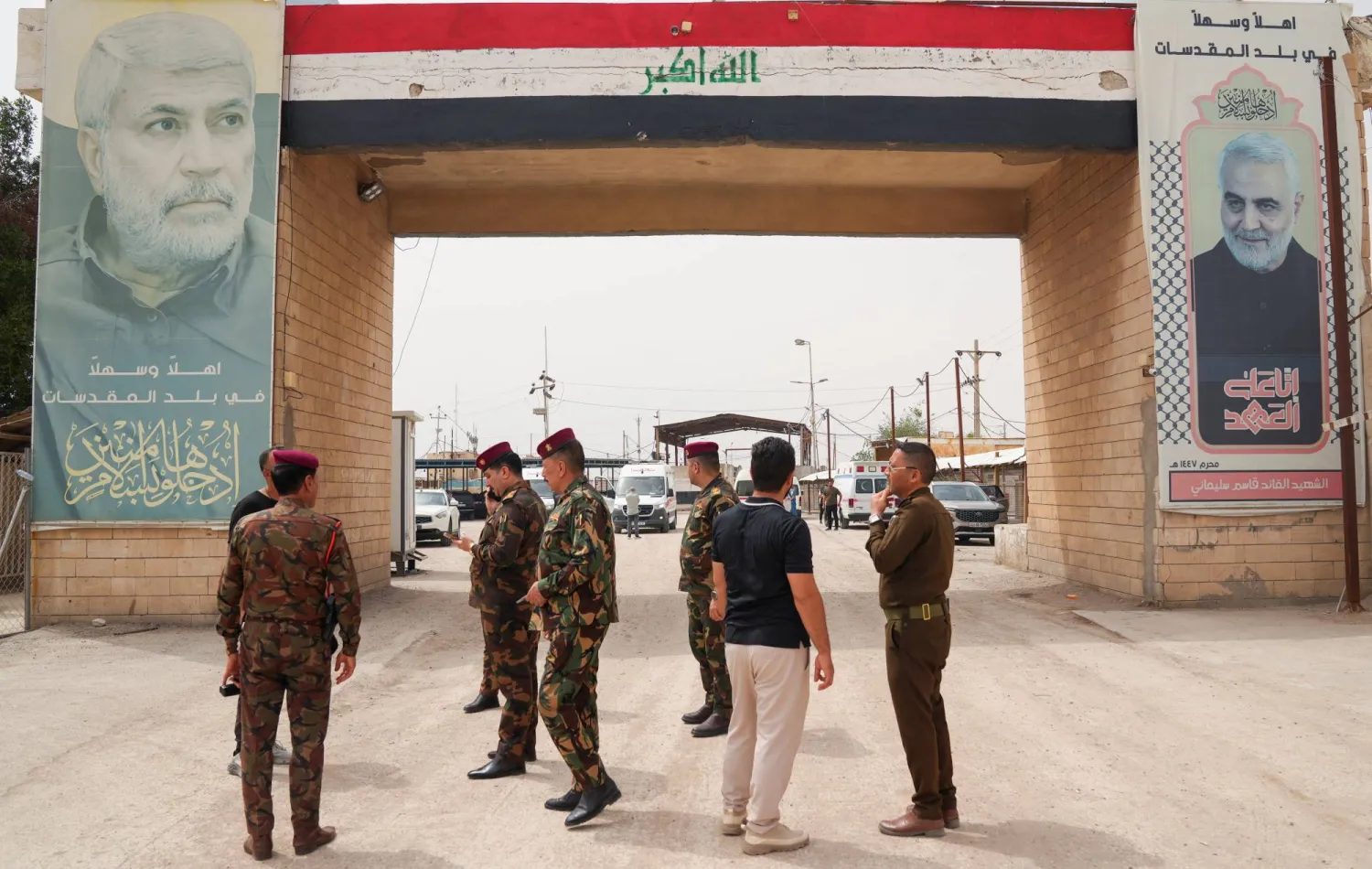
 Iraqi security forces stand at the Shalamcheh border crossing with Iran after Iraq closed the crossing following airstrikes on the Iranian side that security sources said killed an Iraqi citizen, Iraq, April 4, 2026. (Reuters)
Iraqi security forces stand at the Shalamcheh border crossing with Iran after Iraq closed the crossing following airstrikes on the Iranian side that security sources said killed an Iraqi citizen, Iraq, April 4, 2026. (Reuters)
TT

Air Strike Cuts Southern Iraq Off from Iran

 Iraqi security forces stand at the Shalamcheh border crossing with Iran after Iraq closed the crossing following airstrikes on the Iranian side that security sources said killed an Iraqi citizen, Iraq, April 4, 2026. (Reuters)
Iraqi security forces stand at the Shalamcheh border crossing with Iran after Iraq closed the crossing following airstrikes on the Iranian side that security sources said killed an Iraqi citizen, Iraq, April 4, 2026. (Reuters)

A US air strike hit the Shalamcheh border crossing with Iran on Saturday, killing and wounding several people and halting trade and travel, in a sharp escalation that could signal a push by Washington to sever links between the two countries.

The crossing, east of Iraq’s Basra and about 30 km (19 miles) from the city center, is a key trade artery, with more than 300 trucks passing through daily.

The Iraqi Border Ports Authority chief, Lieutenant General Omar al-Waeli, said the strike “directly hit the passenger hall,” killing one Iraqi and wounding five others, who were taken to a hospital in Iran. He said the attack forced a halt to passenger and trade movement.

Al-Waeli said alternative crossings, including Safwan, remain available to ensure the flow of goods.

Some media reports said the strike coincided with the passage of logistical support convoys heading into Iran.

Reports of a similar strike on the Mehran crossing on the border with Wasit province were denied by a medical worker there, who told Asharq Al-Awsat the strike occurred in the nearby Iranian city of Mehran.

A source said support convoys organized by factions and other groups continue to cross into Iran, but increasingly use small vehicles to avoid US strikes.

The Popular Mobilization Forces had previously sent aid through Shalamcheh, amid reports Iraqi fighters had crossed into Iran to assist authorities in their war with the United States and Israel, raising the risk of escalation inside Iran.

Reza Pahlavi criticized on Friday the presence of Iraqi armed factions on Iranian territory.

Political analyst Falah al-Mashaal said targeting crossings appears aimed at “isolating Iraq from Iran,” adding the escalation likely seeks to block aid and disrupt trade, effectively imposing isolation “by bombs” after political efforts failed.

Later on Saturday, Iraq said passenger movement at the crossing had resumed, reportedthe country’s state official news agency INA.

Drone strikes hit oil facilities

In Iraq’s Basra, drones believed to have been launched by Iran-aligned factions struck oil facilities, in what appeared to be an effort to pressure foreign companies, particularly US firms, to leave the country.

Two drones hit sites operated by al-Majal company, sparking fires in Burjesia and the North Rumaila oilfield, with no casualties reported.

A source said the attack set fire to a food storage warehouse in Rumaila and damaged company offices in Burjesia. Civil defense teams extinguished one fire and brought the other under control.

US strikes also hit positions linked to the Popular Mobilization Forces in Anbar, where the group said one fighter was killed and five others wounded in al-Qaim.

The PMF said four of its fighters were wounded, along with a Defense Ministry member.

Sources close to the group told Asharq Al-Awsat it had ordered members to keep their distance from headquarters and granted leave to about half its personnel over fears of further strikes.

Separately, the Interior Ministry said its forces had taken over security duties in al-Qaim and al-Rummanah, part of a shift from the Defense Ministry within city centers.

The ministry said the move aims to strengthen security, allow army units to focus on border duties and improve coordination among forces, calling on citizens to report suspicious activity.



Israel Arrests 175 Activists from Gaza Flotilla Far from its Waters

Global Sumud Flotilla vessels prepare to depart for Gaza at the port of Barcelona, northeastern Spain, 12 April 2026. EPA/MARTA PEREZ
TT

Israel Arrests 175 Activists from Gaza Flotilla Far from its Waters

Global Sumud Flotilla vessels prepare to depart for Gaza at the port of Barcelona, northeastern Spain, 12 April 2026. EPA/MARTA PEREZ

Israel's army arrested around 175 activists from a Gaza-bound aid flotilla in international waters off Greece, the Israeli foreign ministry and the flotilla's organizers said Thursday.

"Approximately 175 activists from more than 20 boats of the condom flotilla are now making their way peacefully to Israel," the ministry said in a statement, using its latest epithet to poke fun at the flotilla after prophylactics were found in a previous convoy.

The statement included a video of the activists aboard an Israeli navy ship.

The organizers of the latest flotilla of pro-Palestinian activists seeking to break Israel's blockade on Gaza had announced shortly beforehand that their boats were surrounded by Israeli military ships while off the coast of the Greek island of Crete.

"At the time of publishing this statement (06:30 Paris time, 04:30 GMT), at least 22 of the flotilla's 58 boats have been stormed by Israeli forces in complete violation of international law," AFP quoted the Global Sumud Flotilla as saying in a statement.

The flotilla set sail in recent weeks from Marseille in France, Barcelona in Spain and Syracuse in Italy.

Overnight from Wednesday to Thursday, the flotilla said its boats had been "illegally surrounded" by Israeli vessels.

The remaining boats in the flotilla are currently near Crete, according to the organization’s live tracking on its website.

"Our boats were approached by military speedboats, self-identified as 'Israel', pointing lasers and semi-automatic assault weapons ordering participants to the front of the boats and to get on their hands and knees," the organization had said.

"Boat communications are being jammed and a SOS was issued."

In the summer and autumn of 2025, a first voyage by the Global Sumud Flotilla across the Mediterranean towards Gaza drew worldwide attention.

The boats in that flotilla were intercepted by Israel off the coasts of Egypt and the Gaza Strip in early October.

The Israeli operation, described as illegal by the organizers and by Amnesty International, drew international condemnation.

Crew members, including Swedish activist Greta Thunberg, were arrested and then expelled by Israel.

Israel controls all entry points to Gaza, and has been accused by the United Nations and foreign NGOs of strangling the flow of goods into the territory, causing shortages since the start of the war in October 2023.

The Gaza Strip, governed by Hamas, has been under an Israeli blockade since 2007, and the war triggered by the Palestinian movement's attack on Israel has led to severe shortages of food, water, medicine and fuel.

A fragile ceasefire was reached last October after two years of devastating conflict.


Saudi Arabia Stresses Importance of Strengthening Lebanon’s Stability

Patriarch al-Rahi receives Ambassador Bukhari in Bkerke (NNA)
TT

Saudi Arabia Stresses Importance of Strengthening Lebanon’s Stability

Patriarch al-Rahi receives Ambassador Bukhari in Bkerke (NNA)

A meeting between Maronite Patriarch Beshara Boutros al-Rahi and Saudi Ambassador to Lebanon Walid Bukhari in Bkerke underscored the priority of consolidating stability in Lebanon by supporting the state and its institutions and fostering a climate of national unity.

A statement from the Maronite Patriarchate said the talks focused on “ways to strengthen stability in Lebanon and support the path of the state and its institutions.”

Bukhari conveyed greetings from the Saudi leadership and praised the patriarch’s “national and spiritual role,” stressing that the current phase requires wise leadership capable of reinforcing stability and supporting Lebanon’s constitutional authorities as they confront ongoing challenges.

He added that “building people comes before building infrastructure, and that fostering loyalty to the nation remains the fundamental pillar of any future recovery.”

The discussion also addressed Lebanon’s situation from a historical and intellectual perspective, drawing on the works of historians such as Philippe Hitti, Kamal Salibi and Asad Rustom.

The meeting’s participants raised the notion that Lebanon’s various communities may have reached a stage of “symbolic exhaustion” from recurring crises, potentially opening the door to renewed emphasis on shared national ground rather than division.

They stressed that Lebanon’s history, marked by repeated cycles, calls for drawing lessons to avoid future crises and move toward a new phase centered on national cohesion.

The meeting also highlighted the importance of supporting dialogue initiatives, particularly interfaith and national gatherings, given their role in reinforcing stability and promoting unity among Lebanon’s diverse communities.

Rahi stressed the importance of upholding national principles and safeguarding the dignity and future of the Lebanese people.

He expressed appreciation for efforts to support Lebanon and its stability, saying the current phase “requires collective awareness and national responsibility to protect the country and rebuild it on solid foundations.”


Lebanon: Disagreements Over Israel Talks Strain Aoun-Berri Ties

Israeli soldiers operate in southern Lebanon, as seen from northern Israel, Wednesday, April 29, 2026. (AP Photo/Ariel Schalit)
TT

Lebanon: Disagreements Over Israel Talks Strain Aoun-Berri Ties

Israeli soldiers operate in southern Lebanon, as seen from northern Israel, Wednesday, April 29, 2026. (AP Photo/Ariel Schalit)

Disagreements between Lebanese President Joseph Aoun and Parliament Speaker Nabih Berri over negotiations with Israel have come to the surface as violence has continued despite a recently extended ceasefire between Israel and Hezbollah.

Aoun said Wednesday that he had coordinated all steps with Berri and Prime Minister Nawaf Salam. But Berri responded sharply, saying the president’s remarks were “inaccurate, if not otherwise.”

Aoun had said Israel must “understand that it must first fully implement the ceasefire before moving on to negotiations,” stressing that every step he had taken regarding talks “was coordinated and consulted on with Speaker Nabih Berri and Prime Minister Nawaf Salam, contrary to what is being reported in the media.”

Berri quickly pushed back in a statement: “With all due respect to the presidency and to what His Excellency the president is saying, the remarks attributed to him ... are inaccurate, if not otherwise - particularly regarding the November 2024 arrangement and the issue of negotiations.”

Aoun also said he was “making every possible effort to reach a solution far from violence and the bloodshed in the South,” adding that such a solution could be achieved through negotiations, “which are war without bloodshed.”

Amid mounting criticism over the decision to pursue direct negotiations with Israel, Aoun reiterated: “In every step I have taken, I was in coordination and consultation with Speaker Nabih Berri and Prime Minister Nawaf Salam, contrary to what is being reported in the media.”

He added: “As for the criticism that Lebanon, through the US statement issued after the trilateral talks in Washington, agreed to grant Israel the freedom to continue its attacks on Lebanon, I say that this wording appeared in a statement issued by the US State Department. It is the same text adopted in November 2024 and approved by all parties. It is a statement, not an agreement, because an agreement comes after negotiations are concluded.”

The Lebanese president stressed that if Israel believes it can achieve security through violations and the destruction of border villages, it is mistaken, noting that it has tried this approach before without success.

“The only thing that can protect the borders is when the Lebanese state, in full strength, is present throughout the entire south, up to the international border,” he underlined.

“Israel must definitively understand that the only path to security is through negotiations, but it must first fully implement the ceasefire before moving to negotiations.”

Aoun acknowledged “many difficulties” facing efforts to reach that goal, saying Lebanon is working to mitigate the consequences of Israeli attacks through intensive diplomatic contacts.

“It is unacceptable for Israeli attacks to continue after the ceasefire has been declared,” he said. “We are now awaiting the United States to set a date to begin negotiations. All European Union countries, along with Arab states, have supported our choice of negotiations. There is also broad consensus among the Lebanese people, especially in the south, on the need to end the war,” he added.

The president highlighted a positive development, saying that the Lebanon file is now on the desk of US President Donald Trump. “He holds a special regard for Lebanon and spoke highly, in a very moving way, about Lebanon and its people during our phone call. This is an opportunity we must seize to guide our country toward safety and peace,” Aoun said.

Hezbollah drew Lebanon into the Middle East war on March 2, and Israeli and Lebanese representatives have since met twice in Washington, the first such meetings in decades, for discussions that Hezbollah has categorically rejected.

After the first talks, Trump announced a 10-day ceasefire that began on April 17, and a three-week extension after the second round.

Israel has repeatedly bombed Lebanon, particularly the south, despite the truce, and has carried out demolitions of border villages inside a "Yellow Line" it established in southern Lebanon.

It said on Wednesday that it struck "approximately 20 command centers and military structures used by Hezbollah.”