


After Gaza Devastation, Israeli Attacks on Lebanon's Health Care System Feel Familiar for Many

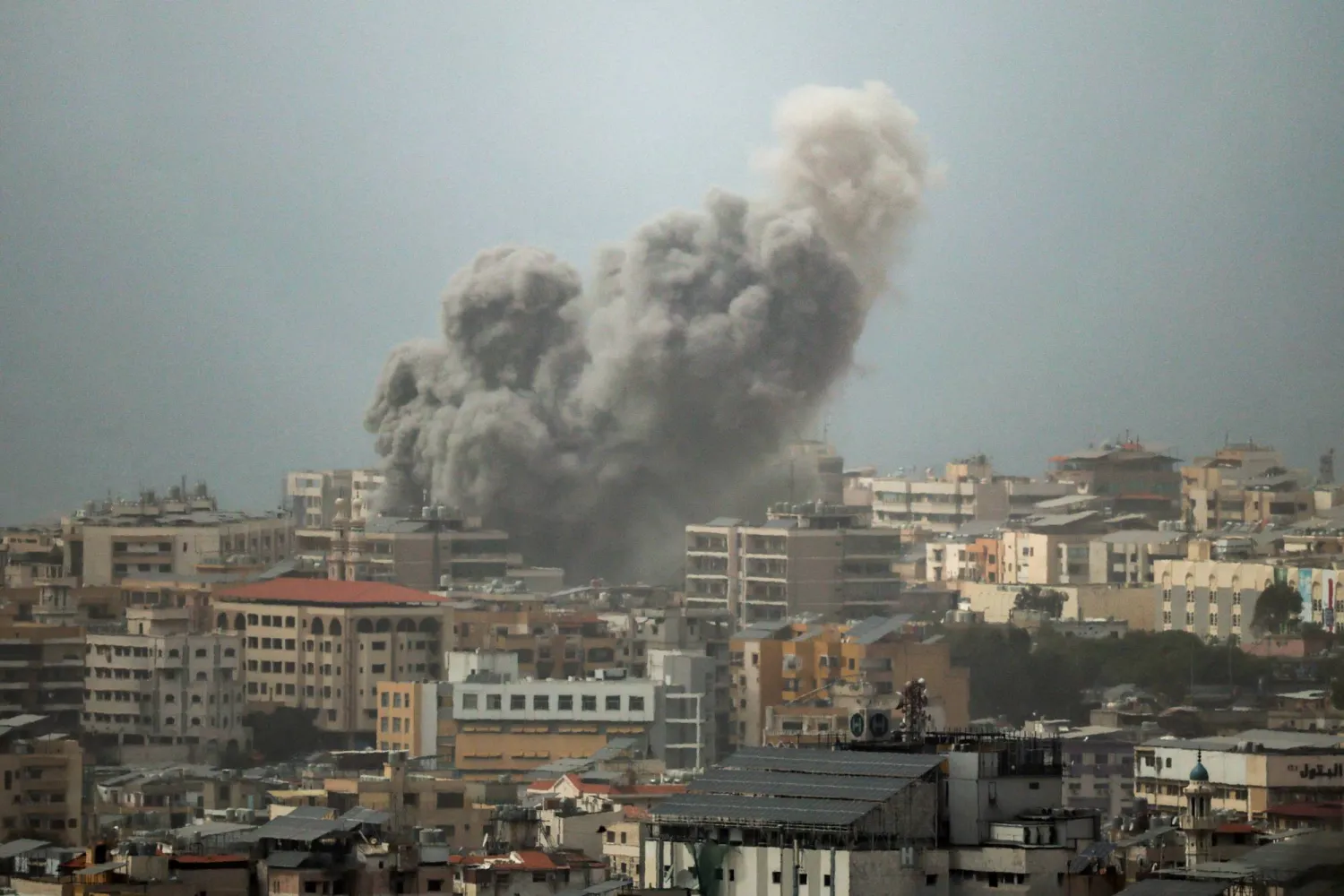
Smoke rises from Beirut's southern suburbs following an Israeli strike, amid escalating hostilities between Israel and Hezbollah, as the US-Israel conflict with Iran continues, Lebanon, April 5, 2026. REUTERS/Alkis Konstantinidis
TT

After Gaza Devastation, Israeli Attacks on Lebanon's Health Care System Feel Familiar for Many

Smoke rises from Beirut's southern suburbs following an Israeli strike, amid escalating hostilities between Israel and Hezbollah, as the US-Israel conflict with Iran continues, Lebanon, April 5, 2026. REUTERS/Alkis Konstantinidis

Two years ago, Dr. Mohammed Ziara watched Israel ravage Gaza's health care system, shelling hospitals, striking ambulances and forcing patients to evacuate.

Now Ziara — along with other medical workers, human rights groups and many civilians — warns that the same scenario is unfolding in Lebanon.

Israel is pushing deep into the southern part of the country in its campaign against the Iran-backed group Hezbollah, a powerful militant force and political party that long has exercised de facto control over much of Lebanon’s Shiite community.

To describe its strategy in this war, the Israeli military invokes the devastation it wrought in Gaza after the Hamas-led Oct. 7, 2023, attacks. Israeli warplanes dropped leaflets over Beirut last month warning that after “great success in Gaza, a new reality is coming to Lebanon, too.”

“I've lived this before,” Ziara, a burn surgeon from Gaza City, told The Associated Press on Thursday at the government hospital in the Lebanese port city of Sidon. “I cannot go back to Gaza now,” Ziara said. “But I can be here, in Lebanon.”

As it did with Hamas in Gaza, Israel accuses Hezbollah of hiding in and operating from civilian areas, and using hospitals and ambulances for military purposes. Israel has increasingly targeted first responders and medical centers, forcing several hospitals to evacuate.

“I was besieged in a hospital,” Ziara said of his work in Gaza. “I lost my brother in an airstrike. I feel what these people feel.”

An Israeli offensive threatens a health system, again Since the war between Israel and Hezbollah reignited on March 2, Israeli airstrikes have killed at least 54 health professionals as of Sunday, according to the Lebanese health ministry.

Israel has carried out 152 attacks against emergency medical workers and ambulances, and forced the closure of six hospitals and 49 health clinics through attacks or threats, the ministry says.

In Sidon, Ziara and his team from UK-based nonprofit Interburns have set up the Lebanese public health system's first specialized burn unit — a critical resource in this crisis-stricken country where the war between Israel and Hezbollah has already killed 1,461 people and wounded 4,430, according to the ministry. Israel claims to have killed hundreds of Hezbollah operatives in the latest bombardment and ground invasion.

The Israeli military argues that Hezbollah’s use of medical facilities makes them legitimate military targets under international law. It does not offer evidence to support its claims.

Hezbollah denies conducting militant activities within civilian sites. Although the group's presence in residential areas is well-documented, there has been no independent verification of its use of hospitals for military purposes.

Interburns, which trains local medics in burn care around the world, began building up the unit at Sidon Government Hospital during the 2024 Israel-Hezbollah war. Lebanese authorities asked the team to return when the war reignited last month.

As the first city just north of Israel’s evacuation zone that covers nearly all southern Lebanon, Sidon takes more wounded people every day.

The rising toll of rescue work Kamal Fakih, 27, hates when people ask him what happened on March 17.

It’s not that it pains him to recall the Israeli airstrike. It’s that he doesn’t remember anything at all. He regained consciousness a day later at the hospital in Sidon, his body burned and lacerated by shrapnel.

Once stabilized, Fakih tried to connect with the paramedic who pulled him and his friend Hassan from the burning rubble, hoping to hear his account and thank him for saving their lives. But by the time Fakih got his contact, Muhammad Tafili was already dead, killed with a fellow paramedic in an Israeli airstrike on ambulances in the southeastern village of Kfar Tebnit on March 28, according to Lebanon’s health ministry.

That same day, Israeli attacks killed seven other medics across four additional villages, the World Health Organization said. Among the dead was a medic targeted while responding to an Israeli airstrike that killed three journalists working for pro-Hezbollah TV channels. Footage of the incident shows two strikes in quick succession — the first hitting journalists in their car, the second crashing into paramedics as they rushed to the rescue.

Israel's military accused the two medics, and two of the three journalists killed, of being Hezbollah operatives. Its claim alarmed watchdogs that witnessed its similar justifications for killing more than 260 journalists and 1,700 health workers in Gaza, according to the United Nations humanitarian agency.

Although Lebanese medical workers and journalists were killed during the 2024 war with Hezbollah, “this time is different,” said Ramzi Kaiss, the Lebanon researcher at Human Rights Watch.

He pointed to a startling promise by Israeli Defense Minister Israel Katz last week that, to protect its border towns from Hezbollah rockets, Israel would flatten all the houses in southern Lebanon “in accordance with the model used in Rafah and Beit Hanoun in Gaza” — two cities that Israel almost entirely razed in its offensive against Hamas in the enclave.

“There’s a new kind of brazenness in declaring an intent to commit unlawful attacks,” Kaiss said. “It appears impunity has emboldened the Israeli military.”

Hospitals in the line of fire Sweeping Israeli evacuation orders in recent weeks have sent over 1 million Lebanese flocking north. As the south came under heavy bombardment, clinics shuttered or suspended operations. Nabih Berri Hospital was swamped by an influx of casualties. To make room, it evacuated dozens of patients.

Such transfers involve coordination with the Lebanese army, health ministry and UN peacekeeping force — a game of telephone, doctors say, that creates potentially life-threatening delays. Admitting patients isn’t easy either; the Sidon burn unit must discharge a patient to free up a bed.

But the referrals keep coming, straining a health system already crippled by economic collapse.

“The health system is on its knees,” Ziara said, as the hospital was plunged into darkness until backup generators kicked in 10 minutes later, a result of Lebanon’s long-running electricity crisis. “Now front-line hospitals are lacking staff and supplies. They're overwhelmed.”

Civilians search for answers Lebanese civilians say that Israeli bombs can come without warning and hit indiscriminately, leading to a growing feeling that Palestinians in Gaza know well — that nowhere is safe.

Mohammad Qubaisi, 53, said his neighborhood of Zuqaq al-Blat in central Beirut had not received Israeli evacuation guidance before March 18, when Israeli munitions slammed into his seventh-floor apartment.

Carrying his wife from the smoldering ruins, he shouted for his sons. His eldest, Adam, called to him. But he couldn’t hear Jad.

Qubaisi ran back into the skin-searing steam to search for his 15-year-old. When he woke up at the hospital hours later, his face raw with second-degree burns, he knew his son was gone.

The Israeli military said it was targeting Hezbollah. Qubaisi pushed back.

“These are civilian buildings, not military targets. They hit us and we still don’t know why,” he said from the Sidon hospital. “We were sleeping safely in our home, and look what happened to us.”



MWL Condemns Continued Israeli Attacks in the Region, Incursion into Syrian Territory

The Muslim World League (MWL) logo
TT

MWL Condemns Continued Israeli Attacks in the Region, Incursion into Syrian Territory

The Muslim World League (MWL) logo

The Muslim World League (MWL) strongly condemned the continued Israeli attacks in the region, most recently the incursion into Syrian territory and the artillery shelling of Quneitra and Daraa governorates, SPA reported.

In a statement issued by the MWL General Secretariat, MWL Secretary-General and Chairman of the Organization of Muslim Scholars Sheikh Dr. Mohammed Al-Issa denounced the attacks and the terror they inflicted on civilians.

He warned that such actions threaten security and stability in the region amid continued violations of international law and norms.

Al-Issa reaffirmed the MWL's full solidarity with the Syrian Arab Republic against all threats to its security, sovereignty, and territorial integrity.
-- SPA


Arab Water Ministers Agree on Roadmap for Secure Regional Water Future

The agreement came during the high-level ministerial session chaired by Minister of Environment, Water and Agriculture Abdulrahman Alfadley - SPA
TT

Arab Water Ministers Agree on Roadmap for Secure Regional Water Future

The agreement came during the high-level ministerial session chaired by Minister of Environment, Water and Agriculture Abdulrahman Alfadley - SPA

Arab water ministers agreed to formulate a roadmap to enhance joint Arab action toward a secure water future for the region by reviewing key challenges and opportunities, as well as Arab priorities in non-conventional water resources, nature-based solutions, training, institutional twinning, financing mechanisms, and inclusive governance, SPA reported.

The agreement came during the high-level ministerial session chaired by Minister of Environment, Water and Agriculture Abdulrahman Alfadley, with the participation of water ministers and their representatives from 11 Arab countries, in addition to several regional and international partners.

Held under the theme “Innovative Solutions, Financing, and Inclusive Governance for a Secure Water Future in the Arab Region,” the session was part of the Seventh Arab Water Forum, one of the main events of the inaugural Saudi Water Week taking place in Jeddah from June 28 to July 2.

The ministerial session discussed the growing challenges facing Arab countries in managing water resources amid climate change and increasing demand driven by population growth and urban expansion, as well as mounting pressures to provide food and energy while protecting the environment.

Participants emphasized the need to move beyond fragmented solutions and isolated national reforms toward integrated investments and regional partnerships capable of accelerating innovative solutions, securing financing, and strengthening inclusive governance, leading to a secure and equitable water future for the Arab region.


Yemeni Military Chief: We Rebuilt the Army, Military Decision-Making Is Now Unified

Bin Aziz said the relationship with Saudi Arabia goes beyond coordination and has become a genuine partnership on the ground (Saba)
TT

Yemeni Military Chief: We Rebuilt the Army, Military Decision-Making Is Now Unified

Bin Aziz said the relationship with Saudi Arabia goes beyond coordination and has become a genuine partnership on the ground (Saba)

Yemen's Chief of the General Staff and Commander of Joint Operations, Lieutenant General Sagheer bin Aziz, said the military leadership and decision-making process have been unified as part of efforts to bring all military formations under the umbrella of the Ministry of Defense and the General Staff.

He revealed that the Yemeni armed forces have completed about 80 percent of their operational and administrative arrangements since the 2022 truce began, adding that the military has continued over the past several years to rebuild its units, improve combat readiness, and strengthen its capabilities in confronting the Iran-backed Houthi group.

Speaking to Asharq Al-Awsat from Marib, bin Aziz said the effort included reorganizing military units, defining their sectors and missions in line with military standards, training and qualifying large numbers of armed forces personnel, and restructuring administrative systems in accordance with the Armed Forces Service Law.

The army chief stressed that "the leadership is now unified, the military decision-making process is unified, and we are on the right path toward bringing all military formations under the umbrella of the Ministry of Defense and the General Staff."

Restructuring

He added: "Since the truce began in 2022, we have made excellent progress in both operational and administrative arrangements. We reorganized military units, their sectors, and their missions in accordance with military standards. We also trained and qualified large numbers of armed forces personnel and restructured the administrative framework of military units in line with the law."

Bin Aziz explained that since 2015 the Yemeni military has fought a different kind of war from any it had faced before. The armed forces were assembled from former army units as well as newly established formations while fighting a conflict that continued until 2022, during which the military suffered "tens of thousands of martyrs and wounded."

He continued: "The army withstood an arsenal backed by Iran. There were setbacks, but our resilience was greater because it preserved what remained of the Republic of Yemen and the institutions of the state."

According to bin Aziz, one of the most significant achievements in recent years has been the introduction of a smart ID card system for armed forces personnel, which has now been implemented in about 95 percent of military units. He described it as an important step in eliminating overlap and duplication within the armed forces.

He said: "This is an important achievement because it removes doubts and concerns about overlapping units, duplication, and related issues. We are satisfied with what has been accomplished so far, and the work is continuing."

Integrating Military Formations

On integrating military formations, bin Aziz said unifying the administration of the armed forces is one of the most important requirements for success on the battlefield and for achieving security and stability in Yemen. He noted that the process requires time and multiple steps to incorporate the various formations under the umbrella of the Ministry of Defense and the General Staff.

He added: "Reforming the military establishment and unifying its administration is a goal shared by everyone. We believe that unifying the military's command structure is one of the fundamental pillars for achieving success in the battle and securing stability in the Republic of Yemen."

He said work on this effort is continuing under the leadership of the chairman of the Presidential Leadership Council, the supreme commander of the armed forces, together with the council's members. He stressed that the most important achievement at this stage is that the leadership has become unified, both within Yemen and across the Coalition to Restore Legitimacy.

He said: "What matters to us now is that the leadership has become unified and the military decision-making process is unified. We are on the right path toward bringing all military formations under the umbrella of the Ministry of Defense and the General Staff."

Lieutenant General Sagheer bin Aziz, Chief of the General Staff (Saba)

Lessons Learned

Asked about the military lessons drawn from years of war, Yemen's army chief said the nature of warfare has changed dramatically, with drones, ballistic missiles, electronic jamming systems, and smart weapons becoming decisive factors in modern warfare.

At the same time, he stressed that technology does not eliminate the role of ground forces. While smart weapons may influence offensive operations and the scale of losses, he said controlling and securing territory ultimately depends on personnel on the ground.

He said: "War today has become a different kind of conflict. Drones, ballistic missiles, electronic jamming systems, and smart weapons have become the decisive factors. But no matter how advanced technology becomes, ground forces, particularly the infantry, remain among the most important factors in success on the battlefield."

He added: "Drones, ballistic missiles, and smart systems cannot remain on the ground and secure it. The infantry soldier remains the decisive factor in holding territory, and controlling the ground is more important than any other weapon."

Modern Technologies

On the use of modern technologies, bin Aziz said the Yemeni armed forces are making "good" use of these capabilities. He said the military has specialized units for drones, smart weapons, and electronic jamming systems, in addition to experienced personnel who have gained extensive battlefield expertise over years of war.

He said: "Our training and qualification in this field are of the highest standard. We have specialized units for drones, smart weapons, and electronic jamming systems, along with highly capable personnel who possess extensive battlefield experience as well as advanced training."

Saudi Partnership and Support

The Yemeni army chief praised Saudi Arabia's support in military training and qualification, noting that the Kingdom has trained hundreds of Yemeni military personnel across various fields.

He said: "Our brothers in Saudi Arabia are also committed to training and qualification. We highly value and appreciate the continued military cooperation they have provided."

He added that the relationship with Saudi Arabia goes beyond coordination and has become "a genuine partnership on the ground" across multiple fields, particularly in confronting Houthi threats that target not only Yemen but also Saudi Arabia and the Arab region as a whole.

He continued: "The Saudis have stood with us through every circumstance and at every stage. We can never fully repay them for the support and cooperation they have provided in what we regard as our sacred battle against the Houthi group."

Bin Aziz stressed that Saudi Arabia's support for Yemen is not driven by political or economic objectives, but by its conviction that the security of Yemen and Saudi Arabia is indivisible.

He said: "We know that Saudi Arabia has no political or economic ambitions in its cooperation with the Republic of Yemen. Its primary objective is the belief that its security is inseparable from Yemen's, and Yemen's security is inseparable from its own. This is a sincere, brotherly stance and the response of generous men standing by their brothers in Yemen."

Concluding the interview, the Yemeni army chief said the current phase marks a transition from coordination to a genuine partnership.

He said: "Today, we are no longer in a phase of coordination alone. We are in a phase of genuine partnership on the ground, militarily, economically, politically, and socially, to defeat the enemy that threatens Yemen, Saudi Arabia, and the entire Arab world."