


Israeli Settlers Block Palestinian Kids’ Path to School with Tear Gas and Barbed Wire

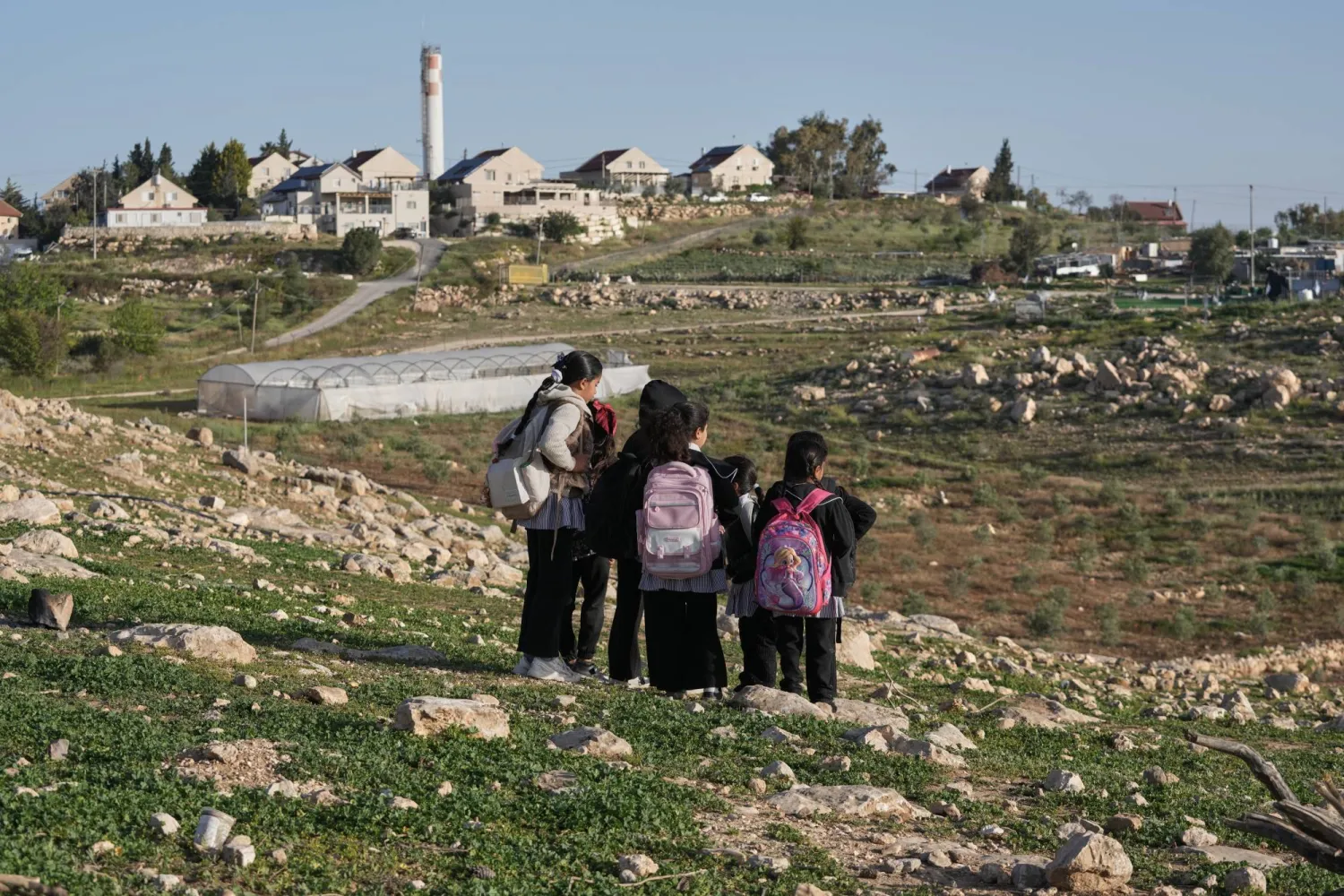
 Palestinian students walk to school using an alternative route that is nearly twice as long because a fence separates their village from the nearby Israeli settlement of Carmel, near the West Bank village of Umm al-Khair, Tuesday, April 14, 2026. (AP)
Palestinian students walk to school using an alternative route that is nearly twice as long because a fence separates their village from the nearby Israeli settlement of Carmel, near the West Bank village of Umm al-Khair, Tuesday, April 14, 2026. (AP)
TT

Israeli Settlers Block Palestinian Kids’ Path to School with Tear Gas and Barbed Wire

 Palestinian students walk to school using an alternative route that is nearly twice as long because a fence separates their village from the nearby Israeli settlement of Carmel, near the West Bank village of Umm al-Khair, Tuesday, April 14, 2026. (AP)
Palestinian students walk to school using an alternative route that is nearly twice as long because a fence separates their village from the nearby Israeli settlement of Carmel, near the West Bank village of Umm al-Khair, Tuesday, April 14, 2026. (AP)

Hajar and Rashid Hathaleen have always walked to school from their neighborhood on the outskirts of Umm al-Khair. But when classes resumed this week for the first time since the Iran war began, coiled barbed wire blocked the Palestinian siblings' path to the village center.

Israeli settlers had installed it overnight, according to video that Palestinian residents provided to The Associated Press. Palestinians say the improvised fence is just the latest attempt by settlers to expand control in part of the occupied West Bank where state-backed demolitions, arson and vandalism regularly occur and settler violence, at times lethal, is rarely prosecuted.

The villagers' plight was covered in the 2024 Oscar-winning documentary “No Other Land," but the publicity has done little to stem the bloodshed or curb land grabs. They say Israel has used the cover of the Iran war to tighten its grip over the territory, as settler attacks surge and the military imposes additional wartime restrictions on movement, citing security.

Khalil Hathaleen, head of the village council and a member of the extended family that makes up much of Umm al-Khair’s population, said settlers were exploiting the war to seize land, cut down olive groves and raid nearby villages at night. “It was a good chance for settlers to do what they want, with no rules,” he said.

Like in Israel, Palestinian kids stayed home before last week's ceasefire, with the threat of falling missile debris leading schools to close.

Hajar, her brother Rashid and their classmates sat waiting Monday and Tuesday near Israeli flags, the barbed wire and newly felled trees as their parents and village leaders demanded they be allowed to pass. On Monday, the children were met by plumes of tear gas and sound grenades hurled by armed men in an unmarked white truck, including some uniformed soldiers, according to the video.

Israel’s military said troops used “riot dispersal means” outside Carmel, the settlement next to Umm al-Khair. It acknowledged that children were present but said the measures — which it didn't detail — were directed at adults in the area, not the children. The Har Hevron Regional Council, the settlements' local government in the area, did not respond to questions about the fence.

Bedouins and other villagers have been using the 3-kilometer (1.8-mile) path from the neighborhood of Khirbet Umm al-Khair to the village center for decades. “We are determined to keep it,” Khalil Hathaleen said.

The fence is just another way that Palestinian movement is being restricted as Israeli settlements multiply in the occupied West Bank. Palestinians say it follows a well-worn pattern in which settlers erect fences or claim farmland that Palestinians say is theirs, and then move to enforce this new reality with the backing of Israel’s military.

Hathaleen said Israeli forces sometimes restrain the settlers, but more often than not they defer to them.

“We are refused a solution,” he said.

The international community overwhelmingly considers the settlements illegal. Israel, meanwhile, views the territory as disputed and says its final status is subject to negotiations. The outposts are built without the permission of Israeli authorities, who sometimes dismantle them, but other times turn a blind eye or even legalize them retroactively.

Hathaleen said the military's civil administration unit told Umm Al-Khair to divert students to another path. But parents said the alternate route is roughly twice as long and more dangerous, requiring them to pass near Carmel.

“We have deep concerns as parents and as residents that the (Israeli) occupation and soldiers will attack students,” said Al-Mutasim Hathaleen, another parent.

On Tuesday, some students got to school on buses that took the alternate route. But classrooms sat half-empty and the playground was deserted. There was no school on Wednesday due to Palestinian Authority cuts to teacher salaries in the area. But on Thursday, kids will try again to get to school on their regular route, Khalil Hathaleen said.

Testing the settlers' resolve could be risky.

Israeli officials and military leaders have recently sounded the alarm over intensifying violence and lawlessness by extremist settlers in the occupied West Bank, where arsons and deadly attacks have continued unabated. At least 35 Palestinians have been killed by Israeli soldiers and settlers across the territory in 2026. Settlers have killed eight Palestinians — an equal number to all of 2025.

The Israeli rights group B’Tselem, following the killing of a 23-year-old Palestinian man by a settler, said that what it called “daily unbridled violence” amounted to Israeli government policy, noting that many of those involved are army reservists.

“These militias are fully backed by the state of Israel and enjoy complete impunity for killing, assaulting and looting Palestinian residents,” it said.



Aoun: Lebanon Appreciates Saudi Crown Prince’s Efforts to Promote Regional Stability

FILE - Lebanese President Joseph Aoun gestures to journalists at the Presidential Palace, in Baabda, east of Beirut, Lebanon, Wednesday, May 21, 2025. (AP Photo/Hassan Ammar, File)
TT

Aoun: Lebanon Appreciates Saudi Crown Prince’s Efforts to Promote Regional Stability

FILE - Lebanese President Joseph Aoun gestures to journalists at the Presidential Palace, in Baabda, east of Beirut, Lebanon, Wednesday, May 21, 2025. (AP Photo/Hassan Ammar, File)

Lebanese President Joseph Aoun hailed on Wednesday the “balanced and wise” efforts made by Saudi Crown Prince and Prime Minister Mohammed bin Salman, saying his endeavors have created an “atmosphere to support stability, which Lebanon appreciates as a source of pride”.

In a post on media platform X, Aoun added: “We hope that Lebanon will be an integral part of this effort. The Kingdom of Saudi Arabia, as the sponsor of the Taif Agreement, is trusted by the Lebanese, the countries of the region and the world”.


Syria's Kurds Register for Citizenship after Decades of Marginalization

"Unregistered" Kurds, who have been stateless since a controversial 1962 census, have been flocking to registration centers across Syria. Delil SOULEIMAN / AFP
TT

Syria's Kurds Register for Citizenship after Decades of Marginalization

"Unregistered" Kurds, who have been stateless since a controversial 1962 census, have been flocking to registration centers across Syria. Delil SOULEIMAN / AFP

In a packed hall in Qamishli's sports stadium in northeast Syria, Firas Ahmad is one of dozens of Kurds waiting to apply for citizenship after many in the minority were barred from doing so for decades.

Since last week, "unregistered" Kurds, who have been stateless since a controversial 1962 census, have been flocking to registration centers across Syria to apply for citizenship, based on the interior ministry's instructions.

"A person without citizenship is considered as good as dead," Ahmad, 49, told AFP.

"Imagine not being able to register my children or our homes in our names," he said, adding that "my grandfather never had citizenship, and we have been living without official documents ever since".

On the tables facing long queues of people, registration forms were scattered along with personal photos and old documents, while government employees were recording the data.

The new measure follows Syrian President Ahmed al-Sharaa's January decree granting citizenship to Kurds residing in the country, including those who have been unregistered for decades.

It also enshrines the Kurds' cultural and language rights, and recognizes Kurdish as a national language.

The decree came during weeks of clashes between Kurdish fighters, who once controlled swathes of northeastern Syria, and government forces after which an agreement was reached to integrate the Kurdish administration into the central state.

The integration included government forces entering the previously Kurdish-controlled cities of Hasakeh and Qamishli in February, and the appointment in March of senior Kurdish military leader Sipan Hamo as assistant defense minister for the eastern region, among other steps.

- 'We suffered greatly' -

The lack of citizenship affected many aspects of daily life, from the inability to register births and property ownership to difficulties in studying, moving around, travelling and working, leaving many without full legal recognition of their existence.

"We suffered greatly," says Galya Kalash, a mother of five, speaking in Kurdish.

"My five children could not complete their education, and we could not travel at all. Even now, our house is not registered in our name."

Around 20 percent of Syria's Kurds were stripped of their Syrian nationality in a controversial 1962 census in the northeastern Hasakeh province.

Ali Mussa, a member of Hasakeh's Network of Statelessness Victims, told AFP that there are around 150,000 unregistered people in Syria today.

There are around two million Kurds in Syria, most of them in the northeast.

Mussa called on authorities to show "flexibility in implementing the decision and to provide facilities for residents outside Syria" who may not be able to travel due to their refugee status in Europe or fear of flight disruptions due to the Middle East war.

Authorities are expected to keep registration centers open for a month.

Abdallah al-Abdallah, a civil affairs official in the Syrian government, told AFP the period could be extended.

"The most important compensation for these people is gaining citizenship after being deprived of it for all these years," he said.

In the registration center, Mohammed Ayo, 56, said not having citizenship made him feel "helpless", including being unable to get a driver's license or book a hotel room in capital Damascus as it required prior security clearance.

"You study for many years, and in the end they say you have no certificate," he said, adding that, after finishing high school, he was unable to obtain an official document to study at university.

"We did not even have the right to run for office or vote."


Trump Says Israel and Lebanon Leaders to Hold Talks Thursday

TOPSHOT - US President Donald Trump speaks to the press outside the Oval Office at the White House in Washington, DC, on April 13, 2026. (Photo by Brendan SMIALOWSKI / AFP)
TT

Trump Says Israel and Lebanon Leaders to Hold Talks Thursday

TOPSHOT - US President Donald Trump speaks to the press outside the Oval Office at the White House in Washington, DC, on April 13, 2026. (Photo by Brendan SMIALOWSKI / AFP)

US President Donald Trump ‌said leaders of Lebanon and Israel will speak, saying he was "trying to get a little breathing room" between the countries, after more than six weeks of war between Israel and the Lebanese armed group Hezbollah. 

"It has been a long time since the two leaders have spoken, like 34 years. It will happen tomorrow. Nice!," Trump wrote in a social media post published before midnight on Wednesday, Washington ‌time. 

It did ‌not say which Lebanese and Israeli ‌leaders ⁠would speak, or give ⁠any further details, Reuters reported. 

The Israeli Prime Minister’s office did not immediately respond to a request for comment. There was no immediate response to a request for comment from the offices of Lebanese President Joseph Aoun and Prime Minister Nawaf Salam. 

The conflict spiraled out ⁠of the US-Israeli war with Iran, with ‌the Iran-backed Hezbollah opening ‌fire in support of Tehran on March 2, prompting ‌an Israeli offensive in Lebanon just 15 months after ‌the last conflict.  

Washington on Wednesday expressed optimism about reaching a deal to end the war with Iran.  

Israel's security cabinet convened late on Wednesday to discuss a possible Lebanon ‌ceasefire, a senior Israeli official said. Another senior Israeli official and a senior ⁠Lebanese official said ⁠Israeli Prime Minister Benjamin Netanyahu's government was under heavy pressure from Washington to reach a ceasefire in Lebanon. 

Netanyahu, in a video statement released late on Wednesday, said the Israeli military continued to strike at Hezbollah and was about to "overcome" the southern Lebanese town of Bint Jbeil. 

The senior Lebanese official said that Lebanon’s assessment was that Israel wanted to secure a victory in Bint Jbeil before diplomatic progress could be made.