


Damascus Foils Smuggling of 6,000 Detonators to Lebanon

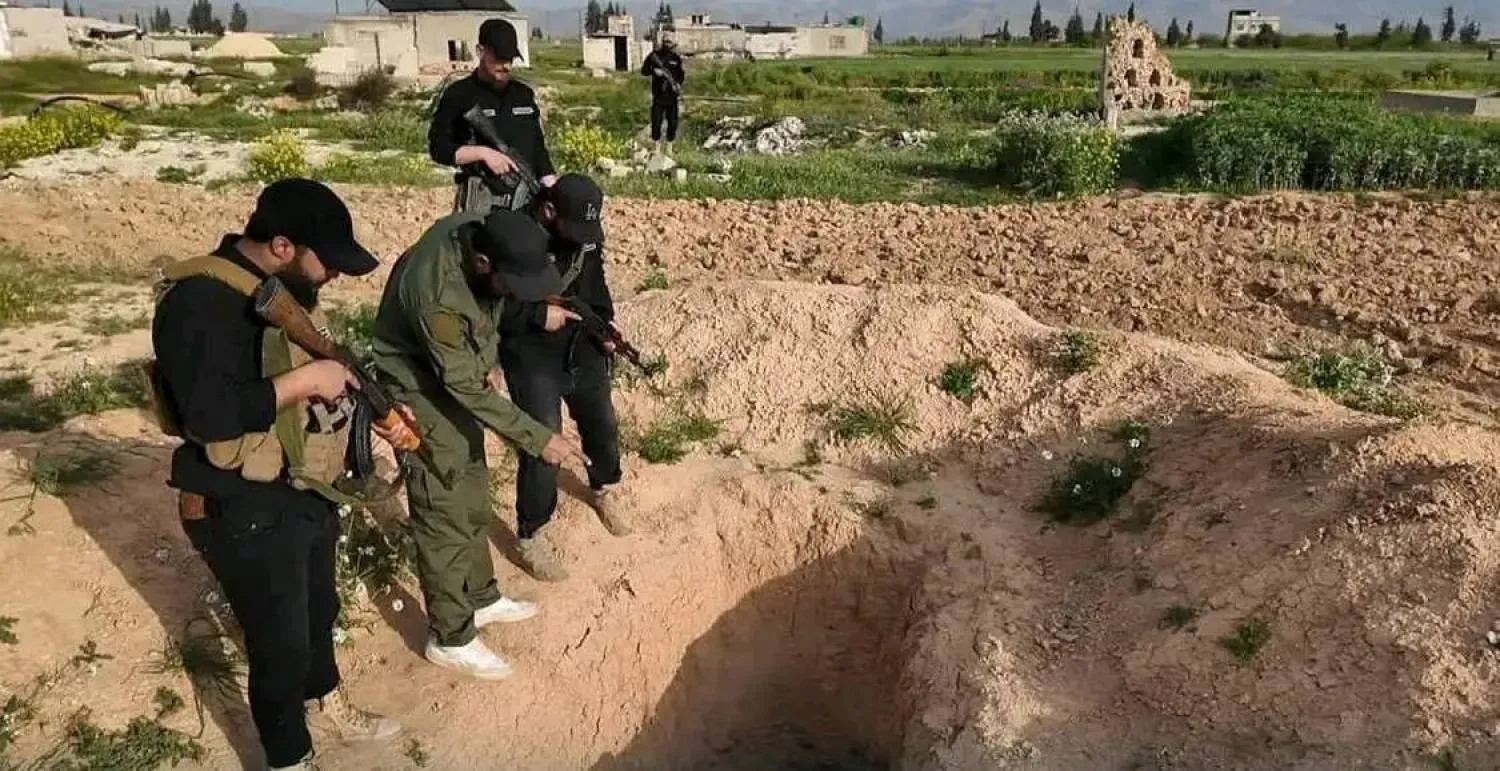
Tunnel found in Homs countryside linking Qusayr to Lebanon (Syrian media)
TT

Damascus Foils Smuggling of 6,000 Detonators to Lebanon

Tunnel found in Homs countryside linking Qusayr to Lebanon (Syrian media)

Syrian authorities said they had thwarted an attempt to smuggle a large shipment of military-grade detonators from the Nabk area in the Qalamoun region of rural Damascus into Lebanon.

They also uncovered a cross-border tunnel and seized weapons depots prepared for smuggling, state media reported on Wednesday.

The Internal Security Directorate in Nabk said it dismantled a plan to move a large quantity of explosive detonators used in making improvised explosive devices, adding the shipment was bound for Lebanon.

In a statement, it said the operation was carried out with “high professionalism” after precise technical and field surveillance, preventing the materials from reaching their destination.

Authorities said about 6,000 detonators were seized, without identifying the smugglers or the intended recipients in Lebanon.

The announcement came as internal security forces in Homs reported discovering a tunnel linking Syrian and Lebanese territory in the border town of Housh al-Sayyed Ali, in the Qusayr area of southern Homs province.

Weapons and ammunition depots prepared for smuggling were also seized, according to the Syrian Al-Ikhbariya channel, which gave no details on who dug the tunnel.

Earlier this month, Syria’s defense ministry said it had uncovered a network of tunnels in the Qusayr area used to smuggle drugs and weapons, adding that Hezbollah had used them.

Qusayr has been one of Hezbollah’s main areas of influence in Syria since 2013, until the fall of its ally Bashar al-Assad. The area served as a key supply route from Albu Kamal on the Iraqi border in Deir al-Zor, through Palmyra and Homs, to the Lebanese border.

Media reports say tunnels are widespread along the Qusayr border, alongside informal crossings used by residents to move between the two countries. For many, smuggling has become a source of income amid worsening economic conditions, poverty, and security instability, complicating efforts to secure the border.

The developments come amid fears Syria could be drawn into a wider conflict through Lebanon and efforts to disarm Hezbollah, with backing from the United States and Israel.

On April 11, Syria’s interior ministry said its counterterrorism department, working with internal security in rural Damascus, arrested five people in a cell linked to Hezbollah after tracking suspicious activity in the capital.

Authorities said a woman in the cell was caught attempting to carry out an attack by planting an explosive device near the home of a religious figure in Bab Touma, close to the Mariamite Cathedral. Media reports identified the target as Rabbi Michael Houri.

Earlier this month, the defense ministry allowed a photographer from Agence France-Presse to document the army’s deployment along the border for the first time since reinforcements were sent about a month earlier, including several cross-border tunnels that had recently been uncovered.

Mohammad Hammoud, a Syrian-Lebanese border official, told AFP the army had discovered “a network of tunnels linking the two countries” used to smuggle weapons and drugs. A Syrian army field commander also said Hezbollah had used the tunnels.

Hezbollah fought alongside Assad’s forces in the conflict that began in 2011 as a peaceful uprising before escalating into war.

An AFP photographer saw at least five tunnels crossing the border, including one that started in a house basement and led via concrete steps into narrow, dark passageways used for transit.

On March 28, Syrian authorities said they found a tunnel near a village west of Homs linking Syria to Lebanon, adding that “Lebanese militias” had used it for smuggling before it was closed.

In February, the interior ministry said it dismantled a cell behind attacks in the Mezzeh district of Damascus, adding the weapons used had come from Hezbollah, which denied involvement.



Lebanese President to Visit Rome for Talks on UN Force’s Future, Says Official

A UN vehicle drives, during a Reuters' visit at Camp Shamrock where Irish and Polish peacekeepers of the United Nations Interim Force in Lebanon (UNIFIL) are stationed near Maroun al-Ras village close to the Lebanese-Israeli border, in southern Lebanon November 29, 2023. (Reuters)
TT

Lebanese President to Visit Rome for Talks on UN Force’s Future, Says Official

A UN vehicle drives, during a Reuters' visit at Camp Shamrock where Irish and Polish peacekeepers of the United Nations Interim Force in Lebanon (UNIFIL) are stationed near Maroun al-Ras village close to the Lebanese-Israeli border, in southern Lebanon November 29, 2023. (Reuters)

Lebanese President Joseph Aoun will head to Rome this week for talks focusing on future of the United Nations peacekeeping force in south Lebanon, whose mandate ends this year, a Lebanese official told AFP.

The visit scheduled for Thursday comes after Italy and France said in June that they wanted to set up a multinational coalition to succeed the UN Interim Force in Lebanon (UNIFIL).

Both countries have large troop contingents in UNIFIL.

Aoun is to meet his counterpart Sergio Mattarella and Prime Minister Giorgia Meloni, to discuss "the future of the international forces, particularly in light of the French-Italian initiative to set up a force to replace UNIFIL", the official told AFP, speaking on condition of anonymity.

Aoun will also meet Pope Leo XIV at the Vatican and brief him on "the contacts Lebanon has been making since negotiations began" with Israel, the official added.

Lebanon and Israel launched US-sponsored direct talks after the Iran-backed Hezbollah group drew Lebanon into the Middle East war in March by attacking Israel, which responded with airstrikes and a ground invasion.

Rome has hosted the last two rounds of talks.

Aoun has said Lebanon's preferred choice is an extension of UNIFIL's mandate, a move opposed by Israel.

On Monday, he said that "the second choice is adopting a formula that ensures the continued presence of international forces in the south" alongside Lebanon's army "and in coordination with it".

A framework agreement reached in June between Israel and Lebanon calls for the disarmament of Hezbollah, a gradual withdrawal of Israeli forces from south Lebanon and the deployment of the Lebanese army to the region, starting in "pilot zones".

Despite a weeks-long lull in fighting, Israel has kept up intermittent strikes and heavy demolition operations in south Lebanon, where its forces are operating in a strip of territory around 10 kilometers (six miles) deep inside the Lebanese border.

Lebanon and several other countries fear a security vacuum if UNIFIL pulls out without an alternative in place.

In a June report, UN chief Antonio Guterres said peacekeepers would be needed after UNIFIL's mission ends and proposed three options ranging from nearly 2,000 to more than 5,500 UN personnel.

Last month, 86 Lebanese lawmakers signed a letter urging the Security Council to keep the peacekeepers.

UNIFIL, which now counts some 7,500 personnel from nearly 50 countries, has been in place since 1978, although its presence has not prevented repeated outbreaks of conflict.


UN Watchdog Excavates Suspected Syrian Nuclear Site as Damascus Pledges Safeguards

 International Atomic Energy Agency's director-general Rafael Mariano Grossi, left, and Syrian Foreign Minister Asaad al-Shibani attend a press conference in Damascus, Syria, Tuesday Aug. 18, 2026. (AP)
International Atomic Energy Agency's director-general Rafael Mariano Grossi, left, and Syrian Foreign Minister Asaad al-Shibani attend a press conference in Damascus, Syria, Tuesday Aug. 18, 2026. (AP)
TT

UN Watchdog Excavates Suspected Syrian Nuclear Site as Damascus Pledges Safeguards

 International Atomic Energy Agency's director-general Rafael Mariano Grossi, left, and Syrian Foreign Minister Asaad al-Shibani attend a press conference in Damascus, Syria, Tuesday Aug. 18, 2026. (AP)
International Atomic Energy Agency's director-general Rafael Mariano Grossi, left, and Syrian Foreign Minister Asaad al-Shibani attend a press conference in Damascus, Syria, Tuesday Aug. 18, 2026. (AP)

Inspectors with the United Nations' nuclear watchdog have begun excavating at a site believed to be linked to a clandestine nuclear program run by Syria's former government, the agency's chief said on Thursday.

The announcement came as Syria's new government has pledged to cooperate with the watchdog. Syria's top diplomat said Thursday that Damascus remains interested in developing a peaceful nuclear program and intends to keep any nuclear material in its custody under international safeguards.

Under former President Bashar al-Assad, Syria was believed to have operated an extensive undeclared nuclear program that included a nuclear reactor built by North Korea in the eastern Deir Ezzor province.

Syria under Assad allowed International Atomic Energy Agency (IAEA) inspectors to visit some sites, but the country under interim President Ahmed al-Sharaa has pledged full cooperation with the UN watchdog and given its inspectors access to suspected nuclear sites.

“Myself and my team, we were inside the site of Deir el-Zour, where very comprehensive work of excavation and exploration is taking place now,” IAEA director-general Rafael Mariano Grossi said at a news conference in Damascus.

Grossi said another site with nuclear material has also been discovered, but did not disclose any details.

Grossi said Syria's cooperation has “enormous importance.”

"We’re talking about a few tons of nuclear material that could be put to bad use and Syria has decided to open up this site to the inspectors of the IAEA,” Grossi said. “This material will be accounted for and will be put within the international safeguard system.”

Syria under its new leadership has expressed an intention to develop nuclear energy.

“Syria confirms, based on technical evaluations, that this material does not pose any danger,” Syrian Foreign Minister Asaad al-Shibani said. “It will remain in Syria’s custody and will remain subject to the agency’s safeguard system.”

The site in Deir Ezzor only became public knowledge after Israel launched airstrikes in 2007 that destroyed the facility. Syria later leveled the site and never responded fully to the IAEA’s questions about it.

However, in 2024, before Assad was deposed in December of that year, IAEA inspectors took samples at three locations and in 2025 said they had found traces of uranium at one site.

Israel is believed to be the Middle East’s only state with nuclear weapons, although it has not declared its own program.


Hamas Tells Kushner it Intends to Become a Social Political Party

A boy walks carrying a table on his back past salvage workers scrapping the rubble of a building that was destroyed during Israel's war against Hamas in Gaza, to use the recycled remains in the future, in Gaza City on August 16, 2026. (Photo by Omar AL-QATTAA / AFP)
TT

Hamas Tells Kushner it Intends to Become a Social Political Party

A boy walks carrying a table on his back past salvage workers scrapping the rubble of a building that was destroyed during Israel's war against Hamas in Gaza, to use the recycled remains in the future, in Gaza City on August 16, 2026. (Photo by Omar AL-QATTAA / AFP)

A Hamas source and another source from a Palestinian faction that took part in the latest Cairo negotiations revealed some details surrounding the summit meeting between US envoy Jared Kushner, President Donald Trump's son-in-law, Nikolay Mladenov, the senior representative for Gaza on the Peace Council, and council member Tony Blair, and the Palestinian movement's leadership, specifically Khalil al-Hayya, Khaled Meshaal, Mohammed Darwish, and Ghazi Hamad.

The two sources, in separate statements to Asharq Al-Awsat, said the Palestinian delegation held a meeting Saturday with Egyptian Intelligence Minister Hassan Rashad and representatives of the mediating countries. The meeting addressed all issues related to what remains of the first phase and the implementation of the second phase, Israel's failure to stop its violations of the ceasefire, its failure to withdraw to the original Yellow Line, and the humanitarian protocol that was supposed to have been implemented earlier.

The Hamas source described the meeting with Kushner, Mladenov, and Blair, attended by representatives of the mediating countries, as very positive, noting that the US envoy congratulated the movement's leadership on the elections that resulted in Khalil al-Hayya becoming head of the political bureau.

The source revealed that Kushner asked al-Hayya and the movement's leaders about their future during and after implementation of the 15-point "road map." The head of Hamas's political bureau said the movement would exercise its natural right to engage in political activity, alongside its involvement in social work.

Asharq Al-Awsat reported several days ago, citing Hamas sources, that the movement's leadership and the factions had received clear assurances regarding their political future and their ability to engage in political activity freely, without restrictions or the pursuit of their members.

Al-Hayya said Hamas had adopted arms as a means of achieving the goals of the Palestinian people, with the aim of reaching a clear political solution to the Palestinian issue that would lead to self-determination. He noted that this is also stipulated in President Trump's plan, which was agreed upon in September 2025, before being formally signed the following month, leading to the ceasefire in the Gaza Strip.

According to the source, Kushner praised Hamas's positions and considered what it had provided for its people to be very significant. He noted that Trump welcomed the movement's agreement to the "road map" and called on Israel to halt its strikes. Al-Hayya told him that nothing had changed on the ground and that killings were continuing despite a decline in their frequency, while there had been a noticeable increase of about 120 new trucks entering the Strip. He said what the movement wants is a path toward a political solution. He stressed that the "negotiations" on the provisions of the road map would not be "reopened" and that no amendments to it would be allowed.

Kushner asked Hamas's leadership to provide clarifications conveyed by Israel to the US envoy's team regarding the digging of a tunnel in an area near the Yellow Line. Al-Hayya and the movement's leaders denied this, saying it was merely a water well being dug to provide services to residents. He stressed that his movement was carrying out no military activities and was fully committed to everything that had been agreed upon.

The two teams, in the presence of the mediators, shared a meal before holding another meeting with Ali Shaath, head of the National Committee for the Administration of Gaza, and some members of the committee.

According to the Hamas source, Shaath told Kushner that the national committee's priorities were reconstruction and providing aid to residents of the Strip. He asked him to convey a message to Trump that all Palestinians aspire to live in peace and without wars.

Kushner also assured al-Hayya before leaving Cairo that he would work forcefully in Israel to ensure that it adhered to what had been agreed upon.

Following the conclusion of the meetings between the Hamas delegation, the US envoy, and officials from the Peace Council, the delegation met with the Palestinian factions on Monday evening and briefed them on those meetings.

On Monday, Kushner met with Israeli Prime Minister Benjamin Netanyahu, who, according to Israeli newspaper Israel Hayom, reprimanded him for holding meetings with Hamas's leadership in Egypt.

According to an Israeli political official, there will be no reconstruction in the Gaza Strip before disarmament takes place, with the process to be overseen by a US officer from the international stabilization force.

Speaking with a Fox News journalist in Tel Aviv, Kushner said: "We may see progress within about 30 days, with some of the weapons beginning to be withdrawn as we hope, and perhaps some tunnels being filled in during the next 60 to 90 days."

Kushner stressed that the United States "will not restrict Israel's right to defend itself if there are any imminent threats in Gaza."

Netanyahu is demanding that Hamas fully disarm, including its heavy and light weapons, a demand the Peace Council has repeatedly reaffirmed.

A senior Hamas source told Asharq Al-Awsat that there has been no change or alteration to the "road map" agreement, and that this had been confirmed by all parties, including Kushner. He said the Peace Council clarified that this meant Israel was not required to carry out any withdrawal from the original Yellow Line before the process of collecting and storing weapons begins, while it is required to withdraw from areas where it expanded its presence after the Yellow Line was recently extended.

The source said the agreement was clear in its wording and that anything beyond that was merely a play on words to serve Netanyahu politically as elections approach.

Hamas spokesman Hazem Qassem also told Agence France-Presse on Tuesday that the movement remained fully committed to the agreement following the Kushner-Netanyahu talks. He said: "(Hamas) is committed to this agreed-upon course," adding: "It is clear that the occupation has not yet given the mediators clear approval of the road map... There are timelines and procedural steps that need to be detailed, but there must be approval of the road map from the occupation."