



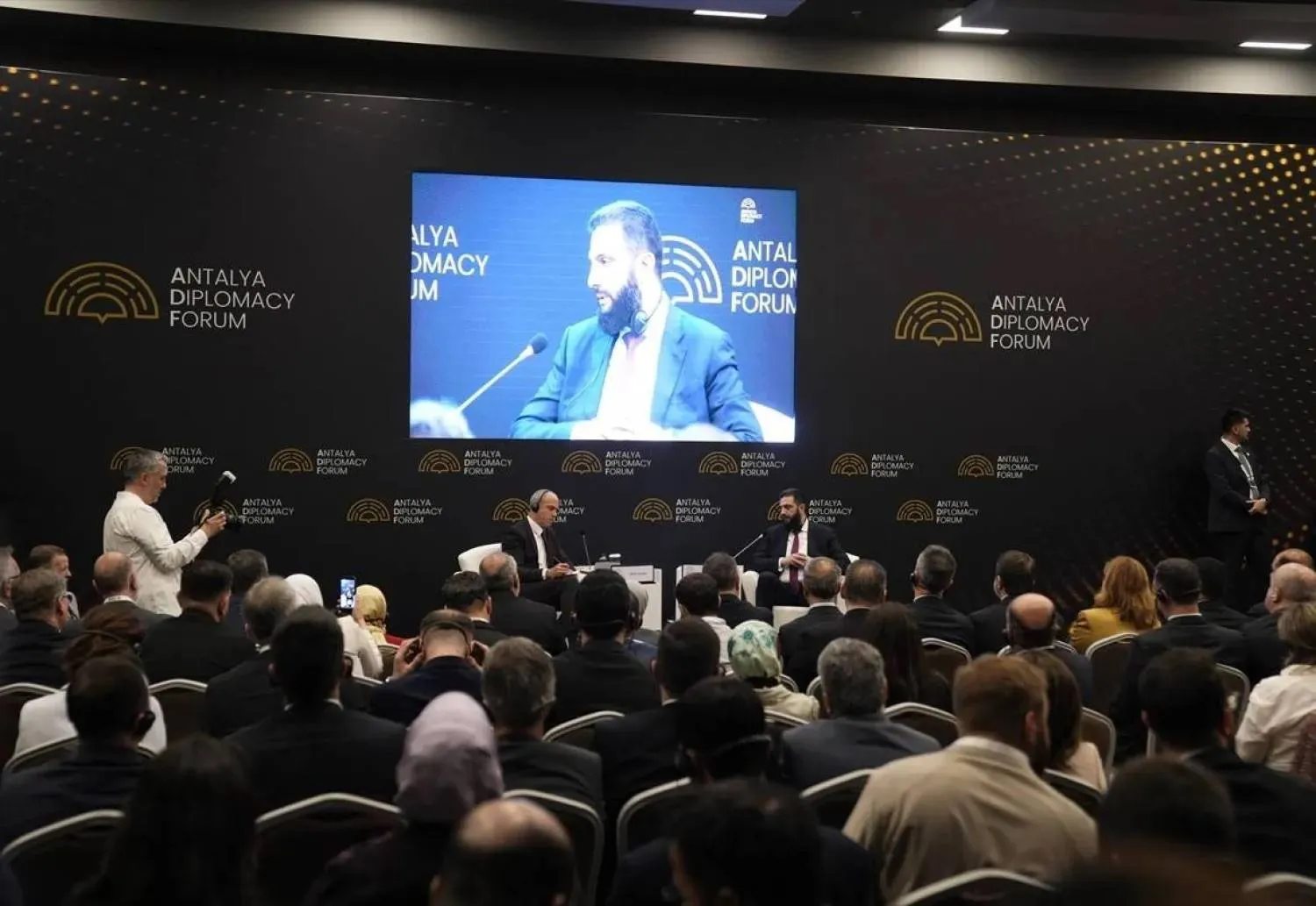

Syrian President Ahmad al-Sharaa said the Golan Heights are “occupied Syrian land” and that any recognition of Israeli sovereignty there would be “null and void,” stressing that the international community does not accept Israel’s claim.
Speaking at the fifth Antalya Diplomacy Forum, Sharaa said Israel was violating the 1974 disengagement agreement and that Damascus was working to secure a security deal ensuring Israeli withdrawal from areas it seized after the fall of Bashar al-Assad on Dec. 8, 2024, and a return to the 1974 lines.
“We are seeking to establish new rules — either revive the disengagement agreement or conclude a new deal guaranteeing both sides’ security,” he said, adding that success could open the door to long-term negotiations on the Golan issue.
Sharaa described current regional conditions as “difficult” and requiring exceptional solutions. He said conflicts in the Middle East have deep roots and that Syria aims to avoid alignment with rival blocs, positioning itself instead as a bridge between major powers.
He added that Damascus now maintains “ideal relations” with the US, Russia, China, Britain, France, Germany and regional states.
Sharaa said Syria had previously faced Iranian attacks linked to Tehran’s support for Assad against the Syrian people but had avoided being drawn into confrontation involving Iran, the US and Israel. “We pushed to prevent war because of its dangerous repercussions,” he said.
He also praised efforts by US President Donald Trump to end the war in Lebanon and expressed hope for a broader regional reset to prevent future conflicts.
Syria, he said, had suffered years of war, displacement and chemical attacks, and avoiding new conflicts was “the natural and correct path.”
US envoy to Syria and ambassador to Türkiye Tom Barrack said Washington had shifted its approach, reducing its military presence and withdrawing troops from its last base in Syria after years of fighting ISIS.
Barrack said Syria — once marked by internal divisions, tensions with Kurdish and Druze communities and close ties to Iran — had become one of the region’s more stable areas.
He noted that Syria had not fired “a single shot” at Israel since Dec. 8, 2024, while repeatedly signaling openness to a non-aggression pact and normalization.
Addressing the lack of an agreement despite Syria’s restraint, Barrack said Israel viewed Syria’s Druze community as closely linked and had crossed the border to “protect” them after unrest in Sweida. He cited Israeli Prime Minister Benjamin Netanyahu as saying everything changed after Oct. 7, 2023, with Israel less bound by previous lines, including those of 1967 and 1974.
Barrack argued that military solutions do not deliver lasting peace and criticized reliance on force, saying it fuels cycles of hatred. He cited Lebanon, saying Israeli strikes had strengthened Hezbollah, and warned that militias backed by states such as Iran cannot be eliminated militarily alone.
He said the ceasefire between Hezbollah and Israel was only a starting point and emphasized the need for regional solutions, pointing to the Abraham Accords as a potential framework for long-term stability.
Barrack described Syria’s transition as a “test case” developed in cooperation with Türkiye, highlighting Ankara’s economic strength and its role as a leading regional power and key member of NATO.
On the sidelines of the forum, Sharaa met Turkish Foreign Minister Hakan Fidan and intelligence chief Ibrahim Kalin, alongside Syrian officials including Foreign Minister Asaad al-Shaibani and intelligence chief Hussein al-Salama.
Sharaa said efforts were ongoing to integrate the Kurdish-led Syrian Democratic Forces into state institutions and that northeast Syria was now free of foreign bases.
He outlined plans for reconstruction driven by investment, stressing that aid should not be politicized or conditional. He also highlighted growing economic ties with Türkiye, including plans for a joint free zone in Idlib to boost industry and facilitate trade and transport links with cities such as Aleppo and Damascus.
Separately, Sharaa met with Kurdistan Region President Nechirvan Barzani and UN High Commissioner for Refugees Filippo Grandi.


