


Yemen: Houthi Infighting Exposes Deepening Fractures

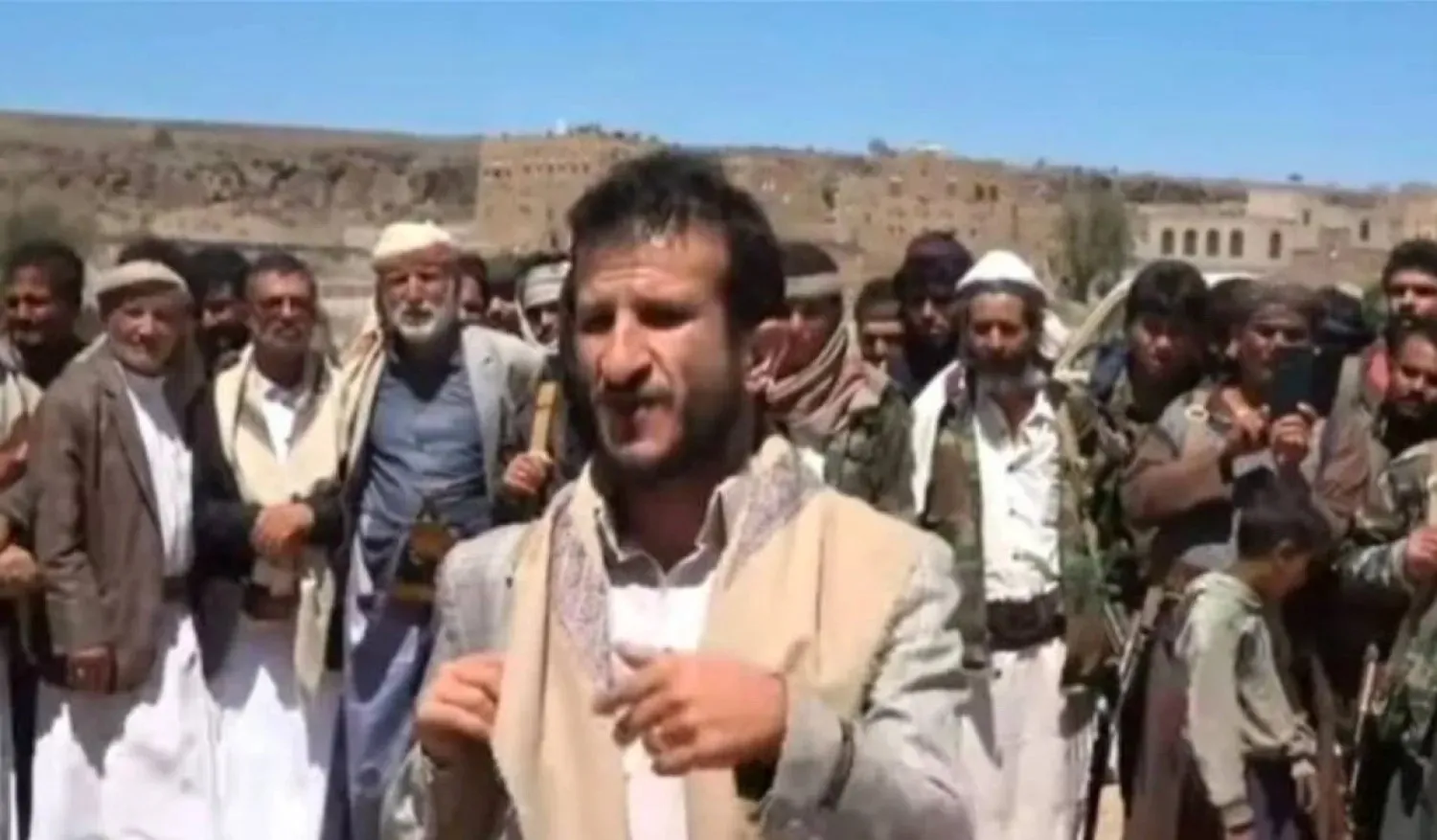
A gathering of Yemen’s Qaifa tribes rejecting Houthi death sentences against 11 of their members (X)
TT

Yemen: Houthi Infighting Exposes Deepening Fractures

A gathering of Yemen’s Qaifa tribes rejecting Houthi death sentences against 11 of their members (X)

Rising violence within Yemen’s Houthi movement is highlighting deep internal divisions, as competition over influence and resources intensifies amid growing isolation and public discontent, analysts and local sources say.

Recent incidents point to a weakness in managing internal disputes, with clashes increasingly erupting among the group’s own commanders. The absence of stable mechanisms to regulate rivalries, alongside declining trust in Houthi-run institutions, has fueled tensions.

One of the most serious episodes occurred last week in Jabal Ras district, south of Hodeidah province, where a local security headquarters turned into a battleground. Local sources said a dispute between Mohammed Abbas al-Qahif, the Houthi-appointed security chief, and field commander Abu Bashar Habib Mutlaq escalated into a gunfight inside the compound. Machine guns were used in a densely populated area, wounding fighters on both sides and critically injuring a civilian as the clashes spread outside.

The incident is part of a broader pattern. In recent weeks, several Houthi security and field leaders have been killed in the provinces of al-Jawf, al-Mahwit, Sanaa and al-Bayda.

Yemeni political researcher Salah Ali Salah said such conflicts “have become more frequent and visible,” reflecting the accumulation of competing power networks formed during years of war. These networks have reshaped internal hierarchies and weakened tribal and social actors that once supported or benefited from the group.

He added that tensions are increasingly shifting from the periphery into the core of the movement, with disputes among supervisors and commanders driven by competition over authority, resources and influence. These conflicts, he said, often require direct intervention from senior leadership to contain them.

Violence linked to personal disputes and widespread weapon ownership has also surged. In one case in Sanaa, tribal figure Abdulrazzaq al-Athri was killed by his brother Mohammed, described as a Houthi-affiliated gunman, following a land dispute in Arhab district.

In al-Bayda’s Radaa district, another tribal leader, Mohammed al-Rubaie, was killed in an ambush by unidentified gunmen, while an elderly man from Ibb province was shot dead in a separate incident. The district has become a hotspot for both lawlessness and confrontations between residents and Houthi forces.

Tensions have further escalated after a Houthi court sentenced 11 members of the Qaifa tribe to death over a previous tribal dispute with Sanhan tribes. Qaifa leaders say the ruling was issued without due legal process and accuse Houthi figure Yahya al-Razami of bias.

Analyst Bassem Mansour linked the growing chaos to the group’s isolation and leadership constraints. Senior figures, he said, are preoccupied with military and regional developments and often operate in secrecy for fear of Israeli targeting, leaving field commanders to act impulsively in the face of public resentment.

Residents report worsening living conditions and deteriorating services, fueling frustration that increasingly manifests in violent personal disputes. A Sanaa-based researcher, speaking anonymously for safety reasons, said public anger at Houthi policies is rising daily.

Security institutions, once tools of control, are now seen as arenas for settling scores, while judicial bodies have lost credibility due to perceived corruption and inefficiency. The proliferation of weapons have further undermined order.

As the situation persists, civilians remain the most vulnerable, caught between internal Houthi rivalries and unchecked violence, with little prospect of restored stability.



Jordan Says Shot Down Drone in its Airspace

AP file photo shows Jordanian soldiers
TT

Jordan Says Shot Down Drone in its Airspace

AP file photo shows Jordanian soldiers

The Jordanian military announced it had shot down a drone of unknown origin in its airspace on Wednesday. No casualties were reported.

"This morning, the Jordanian Armed Forces engaged with a drone of unknown origin that entered Jordanian airspace and was brought down in Jerash Governorate, without any injuries," the military said of an area located around 50 kilometres (30 miles) north of the capital Amman.


First of Hundreds of Detained Gaza Flotilla Activists Arrive in Israel

 Israeli soldiers are seen on a vessel bearing symbols of the Global Sumud Flotilla, with an Israeli military ship behind it, as seen from Ashdod, southern Israel, May 19, 2026. (Reuters)
Israeli soldiers are seen on a vessel bearing symbols of the Global Sumud Flotilla, with an Israeli military ship behind it, as seen from Ashdod, southern Israel, May 19, 2026. (Reuters)
TT

First of Hundreds of Detained Gaza Flotilla Activists Arrive in Israel

 Israeli soldiers are seen on a vessel bearing symbols of the Global Sumud Flotilla, with an Israeli military ship behind it, as seen from Ashdod, southern Israel, May 19, 2026. (Reuters)
Israeli soldiers are seen on a vessel bearing symbols of the Global Sumud Flotilla, with an Israeli military ship behind it, as seen from Ashdod, southern Israel, May 19, 2026. (Reuters)

Israeli authorities have begun detaining hundreds of activists seized from a Gaza-bound flotilla at the southern port of Ashdod on Wednesday, a rights group said, after Israeli forces intercepted their vessels at sea.

The Global Sumud Flotilla set sail from Turkey last week in the latest attempt by activists to breach Israel's blockade of the Palestinian territory, after Israeli forces intercepted a previous convoy last month.

Israeli authorities said 430 activists aboard the flotilla were en route to Israel, while rights group Adalah said some had already arrived at Ashdod port and were being held there.

"Having set sail toward Gaza to deliver humanitarian aid and challenge the unlawful blockade, these civilian participants were forcefully abducted from international waters and taken into Israeli territory entirely against their will," Adalah said.

"These acts are a direct extension of Israel's policies of collective punishment and starvation of Palestinians in Gaza."

The Israeli foreign ministry dismissed the operation as a publicity stunt serving the Palestinian movement Hamas.

"Another PR flotilla has come to an end. All 430 activists have been transferred to Israeli vessels and are making their way to Israel, where they will be able to meet with their consular representatives," a spokesman from the foreign ministry said late on Tuesday.

"This flotilla has once again proved to be nothing more than a PR stunt at the service of Hamas," the spokesman added.

Prime Minister Benjamin Netanyahu earlier denounced the flotilla as "a malicious scheme designed to break the blockade we have imposed on Hamas terrorists in Gaza".

The United States on Tuesday sanctioned four people associated with the Global Sumud Flotilla and accused them of being "pro-terrorist".

Around 50 ships had departed from southwestern Türkiye on Thursday.

Nine Indonesian citizens who were part of the flotilla "have all been reported arrested by Israel," a spokeswoman for Indonesia's foreign ministry said, citing information dated Wednesday.

Indonesia called on Israel to immediately release all vessels and crew members, adding that "every diplomatic channel and consular measure will continue to be fully utilized".

Indonesian newspaper Republika earlier said two of its journalists were among the nine Indonesians detained.

Türkiye and Spain have condemned the interception.

Organizers said the flotilla also included 15 Irish citizens, including Margaret Connolly, sister of President Catherine Connolly.

Israel controls all entry points into Gaza, which has been under an Israeli blockade since 2007.

During the Gaza war, triggered by Hamas's October 2023 attack on Israel, the territory has suffered severe shortages of food, medicine and other essential supplies, with Israel at times halting aid deliveries entirely.

A previous flotilla attempt was intercepted last month in international waters off Greece, with most activists expelled to Europe.

Two were brought to Israel, detained for several days and then deported.


Authorities Deny Existence of a Second Israeli Base in Iraq

An Iraqi shepherd leads a flock of sheep at sunset in the town of Mishkhab, south of Najaf, Iraq. (AFP)
TT

Authorities Deny Existence of a Second Israeli Base in Iraq

An Iraqi shepherd leads a flock of sheep at sunset in the town of Mishkhab, south of Najaf, Iraq. (AFP)

Iraqi authorities on Tuesday denied reports of a second Israeli military base in western Iraq, while acknowledging that an Israeli force had been stationed between the provinces of Najaf and Karbala for 48 hours in early March.

The controversy erupted after The Wall Street Journal reported earlier this month that Israel had established a makeshift secret military site in the desert between Najaf and Karbala to support its war against Iran that erupted on February 28.

The report fueled criticism over Baghdad’s ability to safeguard national sovereignty and prevent foreign military incursions.

The New York Times had previously reported that Israel had spent more than a year preparing clandestine sites in the Anbar province in western Iraq for aerial support operations, refueling, and medical treatment during the war with Iran.

At a press conference Tuesday, Iraqi Interior Ministry media director Miqdad Miri rejected claims that any foreign military camp exists in Iraq.

“The ministry denies the existence of any camp belonging to another country in Iraq,” he said. “What occurred was an airborne deployment lasting 48 hours during the war against Iran” in early March.

He added that the Joint Operations Command had resolved the issue and possessed “photos and documents confirming that the deserts of Najaf and Anbar are free of any military bases.”

Miri further stated that Iraq had strengthened security along its border with Syria by completing a 380-kilometer concrete wall and carrying out 12 anti-smuggling operations in coordination with Syria, Kuwait, and Saudi Arabia.

The media reports about the Israeli bases have embarrassed Iraqi authorities, leading to conflicting official statements that alternated between denying and acknowledging the sites before ultimately conceding that Israeli forces had briefly operated on Iraqi territory.

Officials continue to minimize the significance of the incident by stressing the short duration of the deployment.

Sources familiar with the matter had previously told Asharq Al-Awsat that “a foreign force remained stationed inside Iraqi territory for nearly a full week before it was discovered by chance.”

Iraqi security agencies are facing mounting public criticism for failing to prevent foreign military activity on Iraqi soil. Authorities have also been criticized for failing to stop attacks carried out by Iran-backed armed factions inside Iraq and against Gulf states.