
Lebanon, Israel to Hold Second Round of Talks in Washington on Thursday

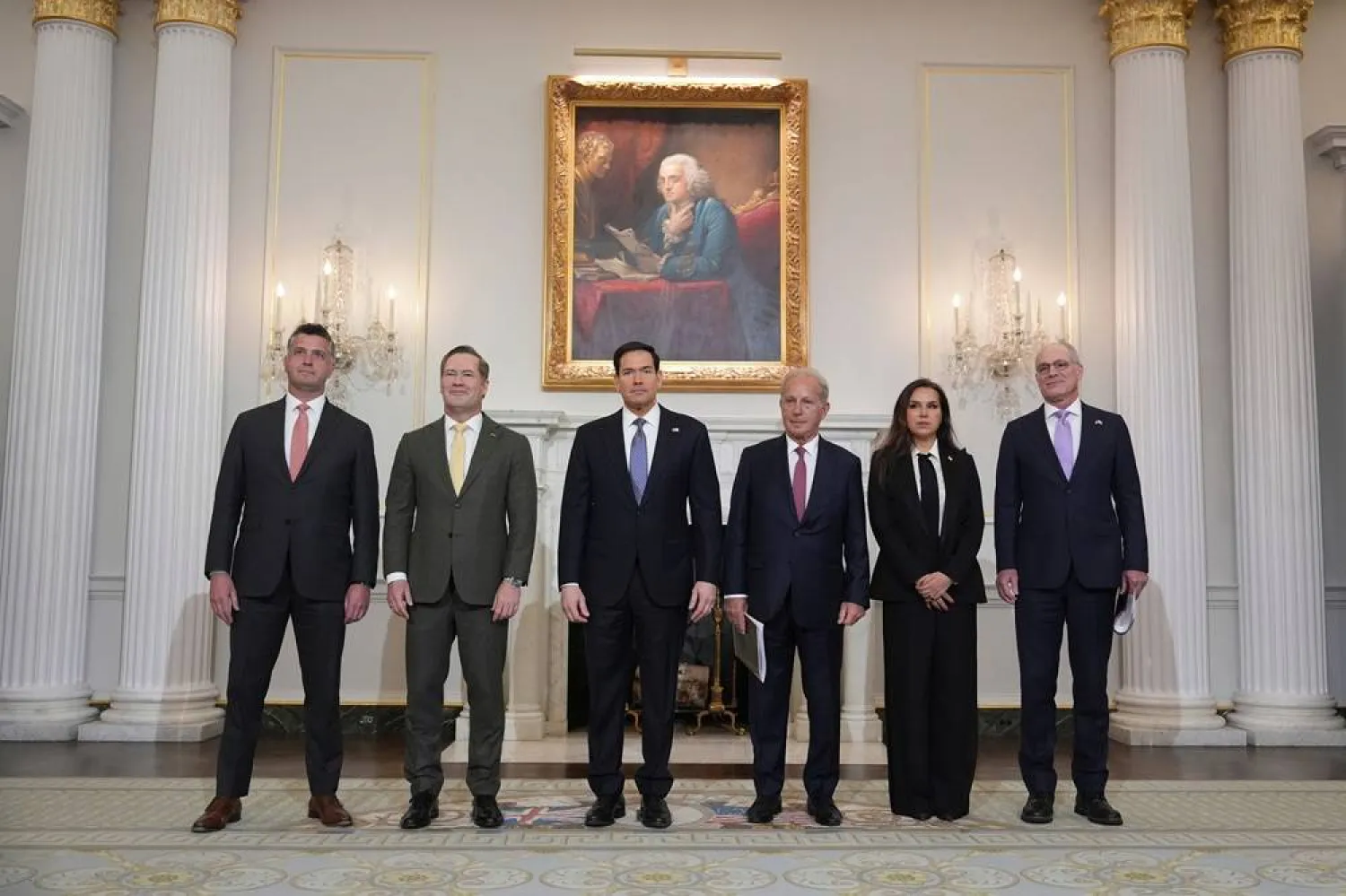
From left, Michael Needham, counselor for the US Dept. of State, US Ambassador to the United Nations Mike Waltz, Secretary of State Marco Rubio, US Ambassador to Lebanon Michel Issa, Lebanese Ambassador to the US Nada Hamadeh Moawad, and Israeli Ambassador to the US Yechiel Leiter pose for a photo before a meeting at the State Department in Washington, Tuesday, April 14, 2026. (AP)
TT

Lebanon, Israel to Hold Second Round of Talks in Washington on Thursday

From left, Michael Needham, counselor for the US Dept. of State, US Ambassador to the United Nations Mike Waltz, Secretary of State Marco Rubio, US Ambassador to Lebanon Michel Issa, Lebanese Ambassador to the US Nada Hamadeh Moawad, and Israeli Ambassador to the US Yechiel Leiter pose for a photo before a meeting at the State Department in Washington, Tuesday, April 14, 2026. (AP)

Lebanese and Israeli representatives will hold talks in Washington on Thursday, a US State Department spokesperson and an Israeli source speaking on the condition of anonymity told Reuters ‌on Monday.

The ‌US will host ‌the ⁠second round of ⁠ambassador-level talks between the two countries at the Department of State, the State Department spokesperson said.

US Secretary of State Marco Rubio hosted ⁠the first round of talks ‌between Israeli ‌ambassador to the United States ‌Yechiel Leiter and Lebanon's ambassador to ‌Washington Nada Moawad - the first direct talks between Israel and Lebanon in decades - on April 14.

"We ‌will continue to facilitate direct, good-faith discussions between the ⁠two ⁠governments," the spokesperson said.

The second round of talks will mark the first talks between the two countries since a 10-day ceasefire took effect on Thursday.

- Aoun defends talks - 

Lebanese President Joseph Aoun said Monday that planned talks with Israel aim to end hostilities and the occupation in the south, even as Hezbollah and its supporters rejected the negotiations. 

Hezbollah lawmaker Hassan Fadlallah told AFP Monday it was in Aoun's and Lebanon's "interest" to withdraw from the talks, however adding that his group also wanted the ceasefire to last. 

A ceasefire pausing more than six weeks of war between Hezbollah and Israel started on Friday after being announced by US President Donald Trump. 

"It is in the interest of Lebanon, the president of the republic and the government to move away from the path of direct negotiation and return to a national understanding about the best option for Lebanon," Fadlallah told AFP. 

"Perhaps through indirect negotiations, even via the United States of America, we can achieve" Lebanon's goals, Fadlallah stated. 

Aoun said Monday the goal of negotiations was to "stop hostilities, end the Israeli occupation of southern regions and deploy the (Lebanese) army all the way to the internationally recognized southern borders". 

Fadlallah said regional powers including Iran, Pakistan and Saudi Arabia have worked to build a US-Iran diplomatic track, which creates "a regional umbrella that can provide a kind of guarantee for Lebanon. 

"Going into direct bilateral negotiations, alone, amid deep Lebanese divisions and internal disagreements, constitutes a threat to internal consensus." 

He noted that there was no direct communication with the president, while Hezbollah's ministers remain in Lebanon's cabinet. 

Aoun's remarks on Monday came after an address to the nation Friday night, in which he said: "We negotiate for ourselves... we are no longer a pawn in anyone's game, nor an arena for anyone's wars, and we never will be again." 

The truce in Lebanon was also one of Iran's conditions for resuming talks with Washington to extend their separate ceasefire and work out the terms of a lasting peace. 

Lebanon is officially at war with Israel and has no diplomatic relations with its southern neighbor. 

- Aoun faces backlash - 

On the road to Beirut's international airport, in the southern suburbs where Hezbollah holds sway, AFP images showed fresh graffiti attacking Aoun and Prime Minister Nawaf Salam on Monday, following their endorsement of negotiations. 

"Joseph is a traitor, Nawaf is a turncoat," said one spray-painted sign. "Dealing with Israel is forbidden... no to normalization," another read. 

Senior Hezbollah official Mahmud Qamati blasted Aoun on Saturday, saying "defeated, you go to the Israelis and Americans, let's see what you will get out of it". 

Hezbollah supporters also heaped scorn on Aoun on social media. 

"You're going to hand over the south after two days of negotiations?" one user posted on X, adding "we won't let you" sign an agreement. 

"After all our sacrifices this guy wants to speak for us?" another user posted on X, with their profile picture showing a picture of Aoun and Salam with the words "they do not represent me". 

Israeli attacks killed nearly 2,300 people and forced over a million to flee their homes, Lebanese authorities said, since Hezbollah pulled the country into the Middle East war last month. 

"Any outcome of direct negotiations cannot be imposed on the people who made these sacrifices," Fadlallah told AFP. 

- 'I am full of hope' - 

Aoun on Monday named former Lebanese ambassador to Washington Simon Karam to head the negotiations with Israel. 

In December, Karam became the first Lebanese civilian representative to directly speak with Israeli representatives in decades, as part of a ceasefire monitoring mechanism set up at the end of a previous round of fighting between Israel and Hezbollah in 2023 and 2024. 

"Lebanon is facing two options: either the continuation of the war, with all its humanitarian, social, economic, and sovereign repercussions, or negotiations to put an end to this war and achieve lasting stability," Aoun said. 

"I have chosen negotiations, and I am full of hope that we will be able to save Lebanon," he said. 


Lebanon Says Two Paramedics Affiliated with Hezbollah Killed by Israeli Strikes in South

A photograph taken from the southern area of Marjeyoun shows trails of smoke during Israeli shelling on the outskirts of the village of Yohmor on May 10, 2026. (AFP)
TT

Lebanon Says Two Paramedics Affiliated with Hezbollah Killed by Israeli Strikes in South

A photograph taken from the southern area of Marjeyoun shows trails of smoke during Israeli shelling on the outskirts of the village of Yohmor on May 10, 2026. (AFP)

Lebanon's health ministry said two paramedics from the Hezbollah-affiliated Islamic Health Committee were killed and five others wounded on Sunday in two Israeli strikes on the country's south despite a ceasefire.

As the state-run National News Agency (NNA) reported Israeli airstrikes and artillery shelling on a variety of other south Lebanon areas, Israel's army warned residents of three villages to evacuate, saying it would act forcefully against the Iran-backed group there.

Israel has kept up strikes despite a ceasefire in place since April 17 that was supposed to halt hostilities with Hezbollah, while the armed group has pressed on with its own attacks, mainly on Israeli troops operating in southern Lebanon but also across the border.

A Lebanese health ministry statement said that Israel "directly targeted, with two strikes, two Health Committee sites", killing one paramedic and wounding three others in Qalaway, and killing another paramedic and wounding two others in Tibnin.

The statement decried what it called Israel's continued "violation of international laws".

The Israeli military said in a statement that on Sunday its forces had struck "more than 20 terror infrastructure" targets in southern Lebanon, including Hezbollah weapons storage facilities and headquarters.

Israel has expanded its strikes in recent days, and the health ministry on Sunday raised the overall death toll from Israeli strikes since war erupted to 2,846 killed, including 108 health and emergency workers.

Israeli raids have killed dozens of people in Lebanon since the ceasefire.

Under the terms of the truce released by Washington, Israel reserves the right to act against "planned, imminent or ongoing attacks".

Its troops are operating behind an Israeli-declared "yellow line" which runs around 10 kilometers (six miles) north of Lebanon's border.

Residents have been warned not to return to the area.

On Saturday, the NNA reported heavy Israeli strikes in various parts of Lebanon including one that killed seven people, and several raids around 20 kilometers south of Beirut outside Hezbollah's traditional strongholds.

Lebanon and Israel are preparing to hold a third round of talks on May 14-15 in Washington, with veteran Lebanese diplomat Simon Karam recently appointed by President Joseph Aoun to lead his country's delegation.

A first landmark meeting between the countries, which have no diplomatic relations, was held days before US President Donald Trump announced the ceasefire, while the second round came as he announced a three-week truce extension.

Hezbollah drew Lebanon into the Middle East conflict on March 2 when it launched rockets at Israel to avenge the killing of Iran's supreme leader in US-Israeli strikes.


Syria Court Charges Former Security Official with Acts Amounting to ‘War Crimes’

 Former head of political security in south Syria's Daraa province, Atef Najib attends the first trial session at the Palace of Justice, in Damascus last month. (AFP)
Former head of political security in south Syria's Daraa province, Atef Najib attends the first trial session at the Palace of Justice, in Damascus last month. (AFP)
TT

Syria Court Charges Former Security Official with Acts Amounting to ‘War Crimes’

 Former head of political security in south Syria's Daraa province, Atef Najib attends the first trial session at the Palace of Justice, in Damascus last month. (AFP)
Former head of political security in south Syria's Daraa province, Atef Najib attends the first trial session at the Palace of Justice, in Damascus last month. (AFP)

Syria's judiciary brought charges on Sunday against former security official Atef Najib for acts "amounting to war crimes" in 2011 against peaceful protesters in Daraa province, the cradle of the country's uprising.

Najib was the former head of political security in the south Syrian province and is accused of orchestrating a crackdown there. Washington sanctioned him for human rights abuses in April 2011, one month after the uprising erupted.

He appeared in a Damascus criminal court again on Sunday after the opening session last month in the trials of former senior figures, most prominently longtime president Bashar al-Assad and his brother Maher al-Assad, who are both being tried in absentia.

Judge Fakhr al-Din al-Aryan read out the charges at Sunday's session, part of which was broadcast on state television, as Najib stood in the docks.

"The accusations against you relate to events in Daraa province in early 2011, when the peaceful (protest) movement was met with an excessive use of force," Aryan said.

"As head of the political security branch then, you held direct and joint leadership responsibility for systematic acts that targeted civilians including killing, torture and arbitrary detention," he added.

He said abuses attributed to Najib, some of them deadly, include the arrest and torture of children due to "political writings on walls", involvement in "suppressing protests with excessive force" and "opening direct fire" on a peaceful sit-in at Daraa's Al-Omari mosque.

They also include "torture leading to death" in his branch's detention centers.

"You were the ultimate authority in Daraa province and hold direct responsibility for issuing orders to kill, arrest and torture... and for participating with political, security and military leaders in an organized hierarchical structure in committing these grave violations," the judge said.

The actions attributed to Najib and others not present "amount to war crimes... and crimes against humanity", he added.

The court heard statements from Najib and witnesses, state media said, after the judge halted media coverage.

Syria's more than 13-year civil war killed more than half a million people and displaced millions of others. Tens of thousands of people disappeared, some into the country's brutal prison system.

The uprising began in Daraa on March 15, 2011, after 15 students were arrested for allegedly writing anti-government slogans on the city's walls.

Residents said the children were tortured, leading to a protest to demand their release that ended in bloodshed.

Security personnel suppressed peaceful demonstrations with force and fired live ammunition to disperse sit-ins at several locations.

Najib was dismissed after the crackdown, as the protests spread to other provinces.

He was among the first Assad-era officials arrested by the new authorities after the December 2024 ousting of the longtime ruler.


Lebanese Army Arrests Iraqi Man for Impersonating a Security Official

A picture taken from the seaside promenade of the northern Lebanese coastal town of Dbayeh shows the skyline of the Lebanese capital Beirut on March 17, 2020. (AFP)
TT

Lebanese Army Arrests Iraqi Man for Impersonating a Security Official

A picture taken from the seaside promenade of the northern Lebanese coastal town of Dbayeh shows the skyline of the Lebanese capital Beirut on March 17, 2020. (AFP)

The Lebanese army said on Sunday that it had arrested an Iraqi national for impersonating an Iraqi security official in Lebanon, the second alleged high-level imposter caught in recent months.

A military source told AFP that the man had managed to network with Lebanese security and intelligence officials, telling them he worked at Iraq's Beirut embassy.

The scandals have highlighted the fragility of Lebanon's institutions, which are built on a sect-based power-sharing system in a country rife with foreign interference, and where personal connections often play a key role in gaining influence, money and privilege.

An army statement said the Iraqi man was arrested "for impersonating an Iraqi security official on Lebanese territory, as a result of a surveillance and security follow-up operation".

Preliminary investigations indicate that the man was using "forged documents", the statement said, adding that the military uniform he had been using was seized.

The military source told AFP on condition of anonymity that the man "is married to a Lebanese woman and managed to get close to an intelligence official in Beirut, presenting himself as an Iraqi officer in the counter-terrorism branch, and a security attaché at the Iraqi embassy".

The Lebanese intelligence official allegedly helped the man "make contact with security and military officials and meet them", the source said.

The suspect actually works at a popular cafe on the airport road in Beirut's southern suburbs, the source added, after he started out there doing valet parking.

It is the second recent high-level impersonation case to rock Lebanon.

For months, authorities have been investigating an imposter who posed as a prince, extorting several politicians with the help of a religious figure.

The military source said that in the latest case, preliminary investigations into the man and those who met him have not yet uncovered a motive, adding that during the meetings "he promised to provide financial assistance from Iraq".

The case's seriousness owes to the man's ability to "convince intelligence officers of his fake identity", the source added.