


Lebanese State Not Seeking Confrontation with Hezbollah but Won’t Be Intimidated, PM Says

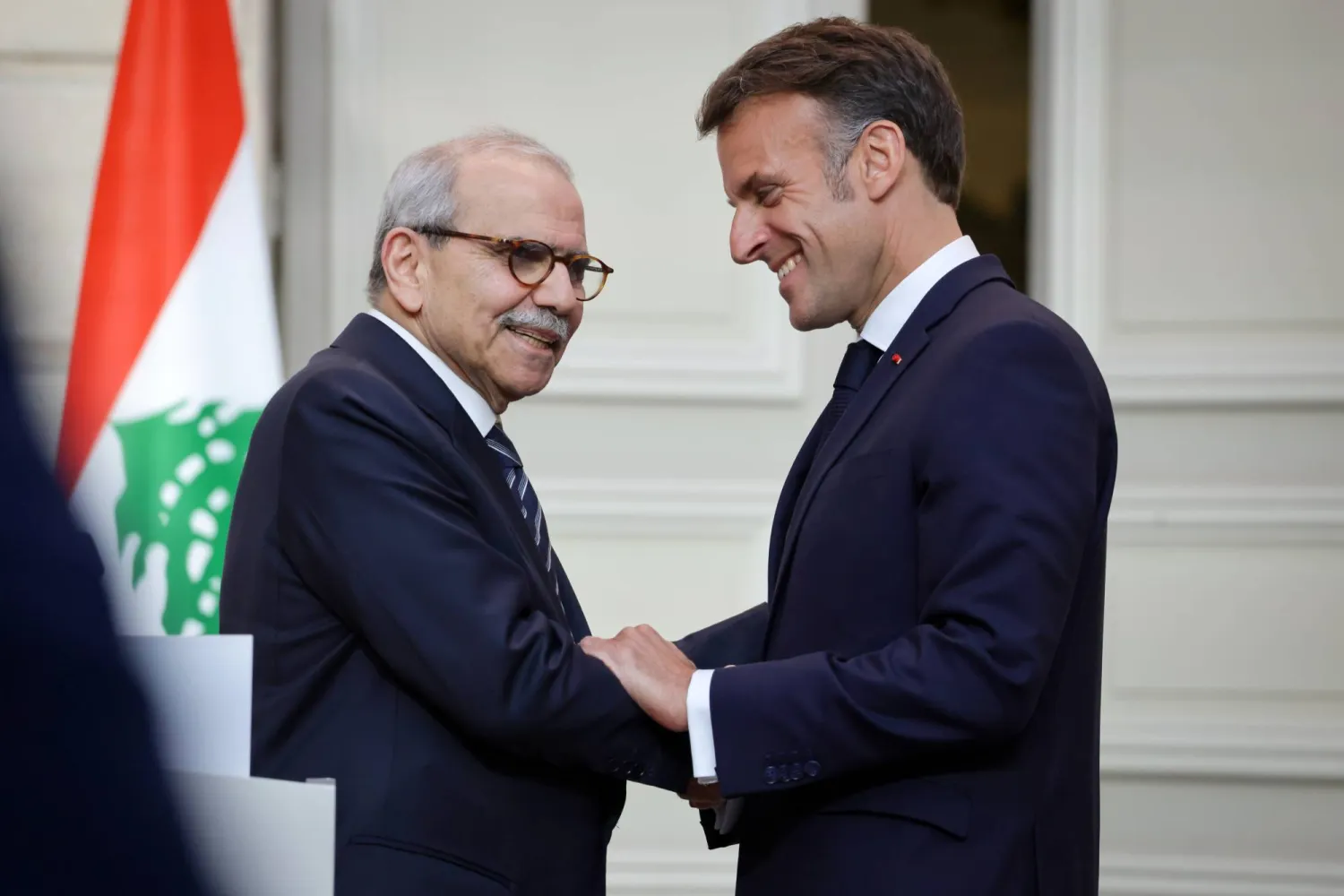
 France's President Emmanuel Macron, right, and Lebanon's Prime Minister Nawaf Salam shake hands after a joint declaration press event following their meeting at the Elysee Presidential Palace in Paris, Tuesday, April 21, 2026. (AP)
France's President Emmanuel Macron, right, and Lebanon's Prime Minister Nawaf Salam shake hands after a joint declaration press event following their meeting at the Elysee Presidential Palace in Paris, Tuesday, April 21, 2026. (AP)
TT

Lebanese State Not Seeking Confrontation with Hezbollah but Won’t Be Intimidated, PM Says

 France's President Emmanuel Macron, right, and Lebanon's Prime Minister Nawaf Salam shake hands after a joint declaration press event following their meeting at the Elysee Presidential Palace in Paris, Tuesday, April 21, 2026. (AP)
France's President Emmanuel Macron, right, and Lebanon's Prime Minister Nawaf Salam shake hands after a joint declaration press event following their meeting at the Elysee Presidential Palace in Paris, Tuesday, April 21, 2026. (AP)

Lebanon's Prime Minister Nawaf Salam said on Tuesday his government was not seeking confrontation with Iran-backed Hezbollah, but would not allow itself to be intimidated as it prepares direct talks with Israel to end the conflict.

Salam and French President Emmanuel Macron met in Paris to see how to strengthen Lebanon's hand in possible direct future negotiations with Israel, as Beirut turns to a trusted European ally.

The US will host ambassador-level talks with Israel and Lebanon on Thursday, although it remains unclear whether the objective is to extend a fragile 10-day ceasefire between Israel and Hezbollah or pave the way for deeper negotiations.

'NOT INTIMIDATED BY HEZBOLLAH'

"We are continuing along this path, convinced that diplomacy is not a sign of weakness, but a responsible act to leave no avenue unexplored in restoring my country's sovereignty and protecting ‌its people," Salam ‌said.

Israeli troops occupy territory deep in the south, aiming to create a buffer ‌zone ⁠to shield northern ⁠Israel from Hezbollah attack, while the group says it maintains the "right to resist" Israeli occupation.

Lebanon in 2025 said it would disarm Hezbollah, but its army treaded carefully, wary of igniting internal tensions. The United States and Israel criticized Lebanon for not moving fast enough.

"We are not seeking confrontation with Hezbollah. On the contrary, I wanted to avoid confrontation with Hezbollah, but believe me, we will not be intimidated by Hezbollah," Salam said when asked about the state's ability to disarm the group.

Salam said the country would need 500 million euros ($587 million) over the next six months to deal with the humanitarian crisis ⁠that has seen 1.2 million people displaced from Lebanon's south, east and the ‌southern suburbs of Beirut.

FRANCO-LEBANESE HISTORICAL TIES

France, which has deep historical ties ‌with Lebanon, has sought alongside Washington to mediate in the conflict, brokering the ceasefire in 2024 and helping establish a mechanism to ‌monitor it.

But relations with Israel have soured over France’s stance on Gaza and the West Bank, its ‌accusations that Israel’s actions in Lebanon are disproportionate, and its contacts with Hezbollah’s political wing.

Israel’s ambassador to Washington said last week that France should be excluded from any talks, describing Paris as having "no positive influence."

The US, while maintaining contact with France on the issue, has also sought to marginalize its role.

European and Lebanese diplomats say they fear that if direct negotiations begin, Lebanon’s government ‌could be too weak to resist unrealistic demands, potentially fueling domestic tensions given Hezbollah’s refusal to negotiate with Israel.

"We are trying our best to get them ⁠back in the discussions, but ⁠the US and Israel are adamant not to include them," said a Lebanese diplomat. France has pushed initiatives only to be rebuffed by the US and Israel.

Macron said the priority was to end the war and ensure stability for the future, promising to help Lebanese authorities prepare negotiations.

"France does not need to be at any negotiating table, wherever it may be, in order to stand by Lebanon," he said.

Echoing the need for French support, Salam said negotiations with Israel would be demanding, and as a result, Lebanon would need the "active" support of all its partners.

Paris argues that unlike Washington it has a significant presence on the ground in Lebanon with some 700 UN peacekeepers, and that any peace deal would still need a significant international presence to implement it. A French soldier was killed in southern Lebanon this week in an attack the French government said was carried out by Hezbollah.

In a sign of the ceasefire's fragility, Israeli troops have continued demolitions of homes in the southern Lebanese border strip they now occupy and the Israeli military said Hezbollah had fired rockets at Israeli troops in that zone on Tuesday. There was no immediate comment from Hezbollah.


Iraqi Kataib Hezbollah Denies Link to Man Charged in US

 Judge Sarah Netburn presides as Mohammad Al-Saadi, accused of planning an attack on a synagogue, appears in federal court in Manhattan, New York, US, May 15, 2026 in this courtroom sketch. (Reuters)
Judge Sarah Netburn presides as Mohammad Al-Saadi, accused of planning an attack on a synagogue, appears in federal court in Manhattan, New York, US, May 15, 2026 in this courtroom sketch. (Reuters)
TT

Iraqi Kataib Hezbollah Denies Link to Man Charged in US

 Judge Sarah Netburn presides as Mohammad Al-Saadi, accused of planning an attack on a synagogue, appears in federal court in Manhattan, New York, US, May 15, 2026 in this courtroom sketch. (Reuters)
Judge Sarah Netburn presides as Mohammad Al-Saadi, accused of planning an attack on a synagogue, appears in federal court in Manhattan, New York, US, May 15, 2026 in this courtroom sketch. (Reuters)

The Iran-backed Iraqi group Kataib Hezbollah, denied on Monday that a man accused of plotting attacks in the United States and Europe was a member of the group.

US authorities on Friday detailed charges against Mohammad Baqer Saad Dawood Al-Saadi, 32, who was identified as a senior figure in Kataib Hezbollah, which the US designates as a terrorist organization.

"The abductee, Mohammaed Baqer al-Saadi does not belong to Kataib Hezbollah," the group's security commander Abou Moujahed al-Assaf said in a statement.

But he added that Saadi "will return to his country with his head held high, because he is among the lovers and supporters of the resistance."

According to US court filings, Saadi and unidentified associates planned, coordinated and claimed responsibility for at least 18 attacks in Europe, and two in Canada, including a non-fatal stabbing of two Jewish men in London, and several arson attacks on synagogues in other countries.

He is most recently alleged to have also plotted attacks in the United States.

He appeared on Friday at a Manhattan court where he was charged with six counts including conspiracy to provide material support to Kataib Hezbollah and Iran's Revolutionary Guard Corps (IRGC).

A senior Iraqi security source told AFP that Saadi was arrested in Türkiye before being transferred to the US.

Kataib Hezbollah is part of the umbrella movement known as the “Islamic Resistance in Iraq”, which claimed hundreds of attacks against US interests in Iraq and the wider region during the Middle East war.

The attacks have ceased since a ceasefire was announced in April.

The US State Department announced last month that it was offering up to $10 million for information on the group's leader, Ahmad al-Hamidawi.


Lebanon Death Toll Reaches 3,000 in Fighting Between Israel and Hezbollah

Smoke rises following Israeli bombardment on the village of Zibdin in the Nabatieh district in southern Lebanon on May 18, 2026. (AFP)
TT

Lebanon Death Toll Reaches 3,000 in Fighting Between Israel and Hezbollah

Smoke rises following Israeli bombardment on the village of Zibdin in the Nabatieh district in southern Lebanon on May 18, 2026. (AFP)

The death toll in the latest round of fighting between Israel and the Iranian-backed Hezbollah in Lebanon has surpassed 3,000, Lebanon's health ministry said Monday.

The ministry said the toll is now 3,020 in the fighting that has not stopped despite a fragile ceasefire, including 292 women and 211 children. Fighting began on March 2 with the Hezbollah group firing at Israel, two days after the US and Israel attacked Iran.

Israel has since invaded southern Lebanon and bombarded the capital, Beirut, and other areas, saying it is targeting Hezbollah efforts to rearm. Hezbollah has resisted pressure, including by the Lebanese government, to disarm.

More than a million people have been displaced in Lebanon by the fighting, with some sheltering in tents along roads and the sea in Beirut. Israel, meanwhile, has struggled to halt frequent Hezbollah drone attacks.

Groundbreaking direct talks between Israel and Lebanon, facilitated by the United States, produced the ceasefire that began on April 17 and has been extended into June. The neighbors have been officially in a state of war since Israel was created in 1948.

Hezbollah, however, is not part of the talks.

Israeli officials have focused on disarming Hezbollah and described the negotiations as a precursor to a potential normalization of diplomatic relations. Lebanese officials have said they seek a security agreement or armistice that would stop short of normalization.

US President Donald Trump has publicly called for a meeting between Lebanese President Joseph Aoun and Israeli Prime Minister Benjamin Netanyahu, while Aoun has declined to meet or speak directly with Netanyahu at this stage — a move that would likely generate blowback in Lebanon, where talks with Israel were met with protests.

Twenty Israeli soldiers, two Israeli civilians inside Israel and a defense contractor working in southern Lebanon have been killed on the Israeli side.

UN peacekeeping forces in southern Lebanon have also been caught in the crossfire and six have been killed.


UN Demands Israel Prevent 'Genocide' in Gaza

Hundreds of thousands of people are still living in tents in the Gaza Strip, pictured in January, and conditions remain dire despite the ceasefire. Bashar Taleb / AFP/File
TT

UN Demands Israel Prevent 'Genocide' in Gaza

Hundreds of thousands of people are still living in tents in the Gaza Strip, pictured in January, and conditions remain dire despite the ceasefire. Bashar Taleb / AFP/File

The United Nations demanded Monday that Israel take measures to prevent acts of "genocide" in Gaza, and decried indications of "ethnic cleansing" in the Palestinian territory and in the occupied West Bank.

In a fresh report, the UN rights office said Israel's actions in Gaza since the start of the war in October 2023 involved "gross violations" of international law, amounting in many cases to "war crimes and other atrocity crimes".

UN rights chief Volker Turk called in the report on Israel to ensure compliance with a 2024 International Court of Justice order that it take measures to prevent acts of genocide in Gaza, AFP reported.

Israel, he said, should ensure "with immediate effect that its military does not engage in acts of genocide, (and take) all measures to prevent and punish incitement to commit genocide".

Israel has repeatedly and forcefully denied allegations of genocide, which have previously been brought by rights groups like Amnesty International and Human Rights Watch, as well as independent UN experts, but never by the United Nations directly.

- 'Unlawful killings' -

Monday's report, which covered the period from October 7, 2023, when Hamas's unprecedented attack inside Israel sparked the Gaza war, up to May 2025, also condemned "serious violations" including some amounting to war crimes, by Palestinian armed groups during the initial attack and after.

The Hamas attack resulted in the deaths of 1,221 people on the Israeli side, most of them civilians, according to an AFP tally based on official data.

Monday's report highlighted the abuse suffered by the hostages seized by the Palestinian armed groups, many of whom reported torture and sexual abuse as they were held "in inhumane conditions" for months on end.

"Most hostages who died in Gaza died while held in secret detention, either killed by their captors or impacts of the conflict occurring around them," it said.

Most of the focus however was on Israel's actions in Gaza, where its retaliatory military campaign has killed more than 72,000 people, according to the health ministry in the Hamas-run territory, whose figures are considered reliable by the UN.

Hundreds of thousands of people are still living in tents and conditions remain dire despite a ceasefire that took effect in October last year.

"The ceasefire diminished the immense scale of violence up to that point, and opened some modest humanitarian space," Ajith Sunghay, head of the UN rights office in the occupied Palestinian territories, told reporters in Geneva.

"But killings and the destruction of infrastructure have continued on an almost daily basis, and the overall humanitarian situation remains dire," he warned.

A large proportion of the killings since the start of the war "appear unlawful", the report said.

It also highlighted how Israel had "directed attacks on civilian or protected objects, including healthcare and medical facilities and attacks on civilians, including journalists, civil defenders, health workers, humanitarian actors and police in a routine and repeated fashion".

Israel's conduct in Gaza had rendered living conditions in much of the territory "incompatible with Palestinians continued existence as a group", it warned.

The report also looked at the situation in the West Bank, where violence has spiralled since the start of the war in Gaza, pointing out that "the use of unnecessary and disproportionate force (there had) led to hundreds of unlawful killings".

- 'Collective punishment' -

"Force displacement on a mass scale" had been seen in both Gaza and the West Bank, it said.

It charged that "the deliberate and unlawful destruction of wide swathes of Gaza", coupled with "the emptying and destruction of large parts of refugee camps in northern West Bank", had contributed to forcing Palestinians from their homes, "with strong indications that Israel intends their displacement to be permanent".

Taken together, Israel's repeated violations across the occupied Palestinian territories indicated a pattern aimed at doling out "collective punishment of Palestinians", and "forced displacement, emptying and ethnic cleansing of large parts of the Occupied Palestinian Territory", said the report.

"Incitement and derogatory and dehumanising language targeted at Palestinians as a group from Israeli officials was also observed with no accountability," it warned.

The rights office stressed that it was "essential that there is due reckoning" for all violations listed in the report through "credible and impartial judicial bodies".

Sunghay warned that "in a context like this, lack of action is not passivity. It is a license".