


Arab Foreign Ministers Condemn Hormuz Closure, Demand Iran Pay Reparations

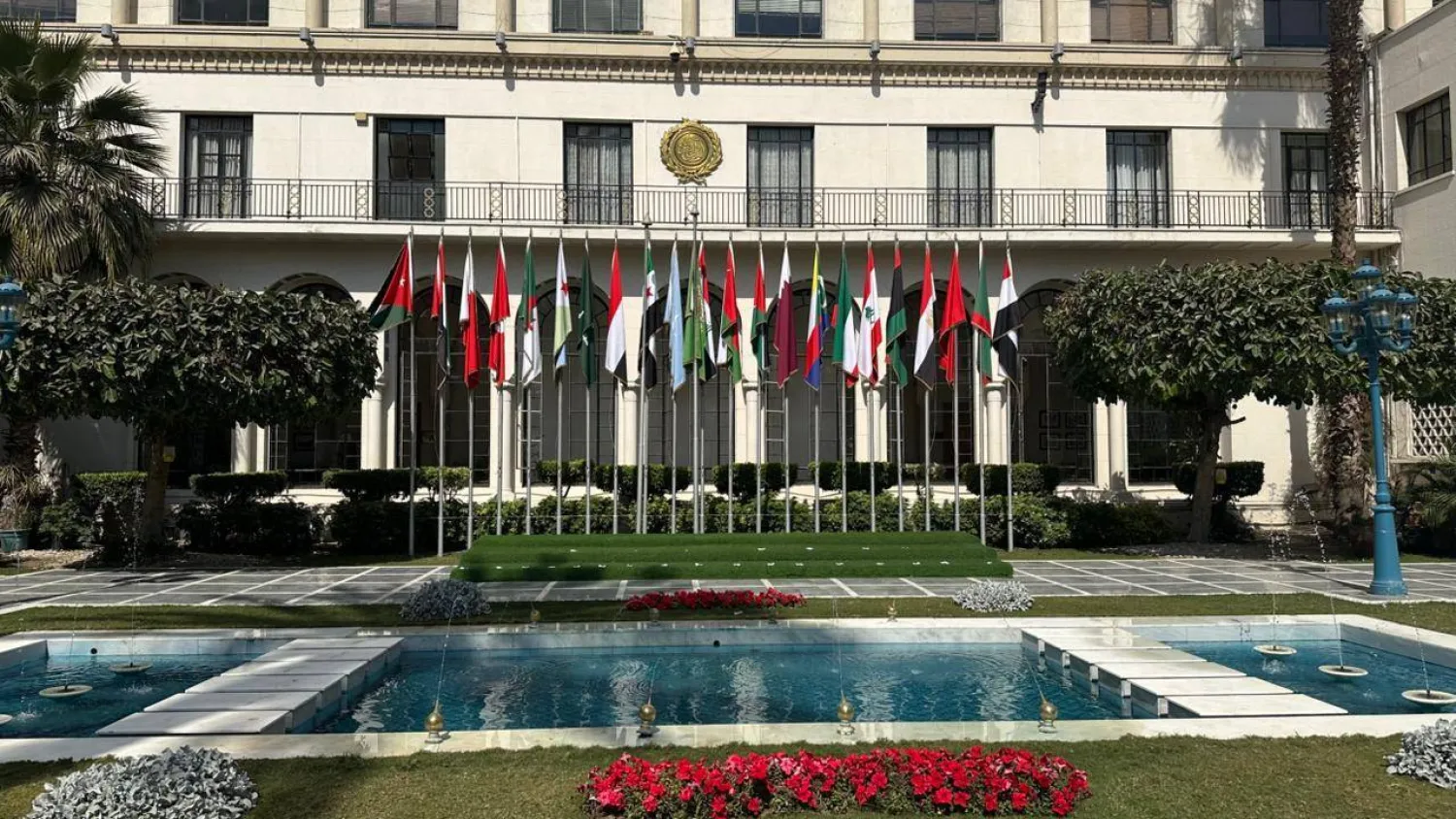
The Arab League headquarters in Cairo (Asharq Al-Awsat)
TT

Arab Foreign Ministers Condemn Hormuz Closure, Demand Iran Pay Reparations

The Arab League headquarters in Cairo (Asharq Al-Awsat)

Arab foreign ministers have condemned Iran's threats to close the Strait of Hormuz and disrupt international navigation, demanding, in a virtual meeting they held on Tuesday, that Tehran be compelled to compensate and make amends for the economic losses resulting from these threats.

The Secretary-General of the Arab League, Ahmed Aboul Gheit, affirmed that “Arab countries have not been, and will not be, hostages in the hands of Iran to settle scores.”

At the request of Bahrain, the Council of the League of Arab States, at the foreign ministers' level, held an extraordinary meeting on Tuesday to “discuss Iranian attacks against Arab countries, Iran's obligations under international law, and efforts made to end the crisis in the region.”

In a resolution, the ministers condemned Iranian threats to close the Strait of Hormuz and the Bab al-Mandeb Strait, calling on the UN Security Council to assume its responsibility in maintaining regional and international peace and security and to ensure accountability for attacks deliberately targeting civilian facilities and infrastructure.

They reaffirmed that these deliberate attacks constitute a grave violation of the sovereignty of those states, undermine regional peace and security, and represent a flagrant breach of international law, including international humanitarian law and the UN Charter.

Moreover, the ministers noted that Iran has failed to comply with Resolution 2817 to immediately cease its attacks against Arab states, adding that its continued deliberate targeting of civilians and civilian objects constitutes a violation of international law.

Tuesday’s resolution also stressed that Iran bears full international responsibility for its unlawful and unjustified attacks against Arab states, and is obligated under international law to make full reparation for all resulting damage and losses, including restitution and compensation.

It called on relevant Arab and regional bodies, in coordination with affected countries, to consider establishing mechanisms to document violations, assess damages and losses, and pursue avenues for redress through diplomatic, legal, and other peaceful means.

The resolution stressed that any attempt by Iran to obstruct lawful maritime passage constitutes a threat to the security of sea lanes and global energy supplies, affirming the right of Arab states to defend their vessels and means of transport in accordance with international law.

The council said that any attempt by Iran to obstruct lawful transit and freedom of navigation in the Strait of Hormuz would constitute an internationally unlawful act, adding that Iran would bear international responsibility and be obliged to provide full reparation for all resulting damage, injuries, and economic losses.

It reiterated that such actions threaten the stability of the Arabian Gulf region and its vital role in the global economy and energy supplies, as well as international peace and security.

The council also stressed its rejection and condemnation of Iran’s continued financing, arming, and mobilization of affiliated militias in several Arab countries in pursuit of its interests, describing this as a serious threat to the security and stability of those states and the region.

The Arab foreign ministers urged the Security Council to uphold its responsibility to safeguard regional and international peace and security, ensure accountability for deliberate attacks targeting civilian facilities and infrastructure, and work toward the full implementation of Resolution 2817, including requiring Iran to immediately halt all its attacks against Arab states and comply with its international obligations.

The council also affirmed the inherent right of affected Arab states to self-defense, individually or collectively, in accordance with Article 51 of the UN Charter, and to take all necessary measures to protect their sovereignty, security, and stability, stressing that the provisions of this resolution do not prejudice any rights or remedies available to states under international law.

The Secretary-General of the Arab League stated at Tuesday’s meeting that Iran has not complied with Security Council Resolution 2817 issued on March 11, calling for an immediate halt to aggression, nor has it acknowledged that its aggressions against Arab states in the Gulf, Jordan, and Iraq constituted a grave breach of international law, an unacceptable violation of state sovereignty, and a blatant disregard for all principles of good neighborliness.

Aboul Gheit demanded that Iran “immediately comply with the Security Council resolution and bear full responsibility for the damages and losses caused by these unlawful attacks, which necessitates compensation and reparation as stipulated by international law in such cases.”

He stated that “Iran's perceptions of controlling the Arabian Gulf and the Strait of Hormuz are legally null and void, lack any argument or justification, and are rejected outright.”

He emphasized that 'freedom of navigation in international straits and waterways, including the Strait of Hormuz, is guaranteed by international law... and Iran cannot give itself the right to control the Strait of Hormuz, because it simply does not own it.”

He added that the Arab League “considers aggression against any Arab state, or the practice of threatening and terrorizing its civilian population, as aggression against all Arab states,” affirming that “everyone stands united in solidarity with the countries that have been subjected to sinful attacks.”

This marks the third time, since the outbreak of Iran's war on February 28, that the Arab League Council has convened at the ministerial level to discuss developments in the region.

The foreign ministers had previously condemned Tehran's attacks on Arab countries in an emergency virtual meeting on March 8, affirming their support for all measures taken by those countries, including the option of responding to the attacks.

Again, they reiterated their condemnation of the attacks at the 165th regular session meeting end of last month.



Israeli Strike on Lebanon's Bekaa Kills One Despite Truce

A young boy walks amid the rubble of a building destroyed in an Israeli strike in the southern Lebanese village of Kfar Sir on April 21, 2026. (Photo by Anwar AMRO / AFP)
TT

Israeli Strike on Lebanon's Bekaa Kills One Despite Truce

A young boy walks amid the rubble of a building destroyed in an Israeli strike in the southern Lebanese village of Kfar Sir on April 21, 2026. (Photo by Anwar AMRO / AFP)

An Israeli drone strike on Lebanon's Bekaa region killed one person and injured two others on Wednesday, Lebanese state media reported, despite an ongoing truce between Israel Hezbollah.

"One person was killed and two others were wounded as a result of an attack carried out by an enemy drone at dawn on the outskirts of Al-Jabur in West Bekaa," the National News Agency (NNA) reported.

Hezbollah on Tuesday said it had launched rockets and attack drones at a site in northern Israel in response to "blatant" Israeli ceasefire violations, which it said included "attacks on civilians and the destruction of their homes and villages.”

The Israeli military said that day that Hezbollah "launched several rockets" towards soldiers stationed in south Lebanon and that the military struck the launcher in response.

NNA on Wednesday reported Israeli artillery shelling and demolitions in southern towns Israel continues to occupy.

Israel conducted huge strikes across Lebanon and invaded the south after Hezbollah entered the Middle East war in support of its backer Iran on March 2.

Despite the truce which began on Friday, Israeli soldiers are still active in south Lebanon, with Defense Minister Israel Katz saying on Sunday that they would use "full force" if threatened.

Under the truce terms, Israel says it reserves the right to act against "planned, imminent or ongoing attacks.”

Israeli attacks on Lebanon have killed at least 2,454 people since the start of the war, a Lebanese government body said in its latest toll.


Israel Destroys Infrastructure in Southern Lebanon to Prevent Residents’ Return

A nun inspects a Christian religious site hit by an Israeli strike in the southern Lebanese city of Nabatieh. (AFP)
TT

Israel Destroys Infrastructure in Southern Lebanon to Prevent Residents’ Return

A nun inspects a Christian religious site hit by an Israeli strike in the southern Lebanese city of Nabatieh. (AFP)

Israel is escalating its campaign in southern Lebanon beyond direct military operations, pursuing what Lebanese officials describe as a systematic destruction of infrastructure, particularly in villages along the so-called “Yellow Line.”

Hospitals, schools, and water, electricity and telecommunications networks have been repeatedly targeted, alongside the destruction of bridges and roads, severing links between towns and isolating communities.

Lebanese ministerial sources noted that the approach is part of a policy of displacement. Residents have been repeatedly warned not to return to more than 80 villages, in what appears to be an effort to create an uninhabited buffer zone lacking basic services.

Air strikes have also hit areas outside occupied zones, including Wadi al-Hujeir, which was struck on Tuesday.

Israeli demolitions using explosives and bulldozers have not been limited to homes, but health and education facilities, seen by Lebanese officials as part of pressure on Hezbollah’s support base.

Israel considers civilian infrastructure in these areas a form of indirect support for the group and a potential platform where it can renew its activity.

Hospitals hit

From the first hours after hostilities erupted on March 2, triggering large-scale displacement, the Israeli army targeted hospitals and health centers in the south.

MP Bilal Abdullah, head of the parliamentary health committee, said Isarel had “intensified the destruction of health institutions and the medical system in southern villages.”

He told Asharq Al-Awsat that available data indicate “partial destruction of eight southern hospitals, all of which are now completely out of service,” listing them as the Tebnin Governmental Hospital, Sheikh Ragheb Harb Hospital, Salah Ghandour Hospital, Hiram Hospital, Jabal Amel Hospital, Hasbaya Governmental Hospital and Bint Jbeil Governmental Hospital.

He added that “the greatest damage has affected primary health centers,” noting that more than 100 ambulances had been destroyed and 121 doctors and paramedics killed in the hospitals and medical centers he listed.

Education sector targeted

The destruction of infrastructure is also aimed at deterring civilians from returning to the area for years to come, Lebanese officials say.

The education sector has been among the hardest hit. A source at the education ministry told Asharq Al-Awsat that targeting schools and institutes aims “to undermine the population’s ability to remain in their towns.”

Israel sees strikes on education as an effective way to empty villages of residents, forcing families to relocate in search of schooling alternatives for their children, the source stated.

The war has resulted in the total destruction of public schools in Dhayra, Bustan, Yarin and Tayr Harfa, as well as partial damage to Naqoura Intermediate School. In vocational and technical education, the Khiam and Qantara institutes have been completely destroyed, while institutes in Bint Jbeil, Aita al-Shaab, Tebnin, Toul, Nabatiyeh, Zrariyeh, Jbaa, Maarakeh, Abbasiyeh, Jouaiyya, Qana and Ansar have sustained partial damage.

The extent of structural damage means some of these institutions may be beyond repair, the source added.

According to education ministry statistics, schools in Nabatiyeh and its district have suffered the most damage: one school has been completely destroyed, 18 heavily damaged and seven left unharmed, while no information is currently available on 61 others.

Electricity and water

Damage to electricity and water infrastructure has also been severe. A source at the energy and water ministry told Asharq Al-Awsat it is not yet possible to compile a precise assessment of losses, but it confirmed damage to a number of power transformers and water facilities.

“The biggest problem lies in water networks,” the source remarked, noting that losses in the sector during the 2024 war exceeded $100 million. “The damage in this war surpasses that figure,” due to the destruction or disruption of pumping stations, treatment plants, reservoirs and supply networks.

Israel is pressing ahead with turning dozens of southern villages into a scorched zone, in what observers see as an attempt to extract political or security concessions from Lebanon. The higher the cost of destruction, the greater the pressure on the Lebanese state to seek arrangements to halt the war and limit its losses.


Hezbollah Threatens to Derail Israel Talks, Invokes 1983 Scenario

A child wearing a military uniform at the funeral of a Hezbollah fighter in Beirut’s southern suburbs during the truce with Israel (Reuters)
TT

Hezbollah Threatens to Derail Israel Talks, Invokes 1983 Scenario

A child wearing a military uniform at the funeral of a Hezbollah fighter in Beirut’s southern suburbs during the truce with Israel (Reuters)

Hezbollah has stepped up its campaign against Lebanon’s authorities, objecting to their decision to pursue direct negotiations with Israel and insisting the government reverse course, while warning it could seek to bring down the process by force.

The group argues that such talks require a broad national consensus, which it says is lacking, and has warned that the fate of any negotiations and resulting agreement would mirror that of the May 17, 1983 accord.

That agreement, reached 43 years ago, was a peace treaty between Lebanon and Israel that included security arrangements aimed at ending the state of war, securing an Israeli withdrawal from Lebanon and regulating their shared border.

It followed Israel’s invasion of Lebanon in June 1982, when Israeli forces reached Beirut and occupied large parts of the country. The deal came after Palestinian factions withdrew from Lebanon and a new president, Amin Gemayel, was elected and led the negotiations.

However, the US-brokered accord was abandoned on March 5, 1984 after broad domestic opposition from Lebanese factions, particularly nationalist, leftist and Islamist groups, as well as outright Syrian rejection at a time when Syrian military presence in Lebanon was influential.

Different circumstances

Despite Hezbollah’s fierce opposition to direct negotiations, some observers say current conditions differ from those in 1983.

MP Salim Sayegh of the Kataeb Party said that in 1983 “the Lebanese government, presidency and parliament were facing Syria, the Warsaw Pact, Israeli ill intent and weak US commitment all at once.”

“Today, regional dynamics have changed. Hezbollah no longer has strategic depth, and its capabilities are very limited,” he told Asharq Al-Awsat, warning that “any misstep in the street would turn the entire Lebanese public against it.”

Sayegh added that the Lebanese government now holds a firm position and “will act decisively,” dismissing doubts about the army’s capabilities.

“The army knows the terrain, both land and people. What it lacked was a clearly defined battle. No army can throw itself into an open-ended conflict. But if Hezbollah chooses chaos and strife, it will face a cohesive army and a united people,” he said.

Anger and threats

Anger spread among supporters of the Shiite duo, Amal and Hezbollah, after images circulated of a meeting last Tuesday in Washington between the Lebanese and Israeli ambassadors.

Commentators and activists aligned with the two groups warned that the talks could meet the same fate as the May 17 agreement.

Hezbollah MP Hassan Fadlallah said: “A large segment rejects the authorities’ path, and it was this segment, along with national forces, that brought down the May 17 accord, and it will not allow the experience to be repeated.”

“This is not limited to the Shiite community, which is a core component of the Lebanese people and rejects direct negotiations. No one can bypass its role,” he added.

Sayegh said Hezbollah also lacks the ability to create alternatives, as in the past, when Syrian influence in Lebanon allowed disruptions to serve Damascus’ interests.

“At the time, Israel was also mired in internal contradictions that led it to prefer managing the Lebanese file through security arrangements with Syria, as seen in the red lines agreement that covered Syria’s entry into Lebanon in 1976,” he said.

“Today, chaos offers zero benefit after the separation of the Lebanese and Iranian tracks. Israel will not bargain over Lebanon, having concluded that strengthening the state in Beirut secures what it wants in the south while respecting Lebanese sovereignty,” he added.

Civil war risks

While agreeing that conditions differ from 1983, political science professor Hilal Khashan of the American University of Beirut expressed a more pessimistic outlook.

“The key Syrian role in bringing down the agreement back then is absent today, and there is no longer a Syrian-Israeli struggle over Lebanon,” he said.

Khashan said Israel now seeks a peace agreement that would provide cover and legitimacy to continue fighting Hezbollah, adding that “it is clear no one can stop it, and its decision to end the group’s military presence is final.”

He warned the escalation could push Lebanon toward civil war, with a possibility of Syrian intervention from the north, noting that Hezbollah fighters are spread across the country.

“We also fear this could lead to the army splitting and ultimately the division of the country,” he said.

Khashan added that Hezbollah’s potential move to ignite internal tensions is tied to developments in the Lebanon-Israel talks and their possible outcomes, even as Israel itself does not appear to be placing much hope in the negotiations.