

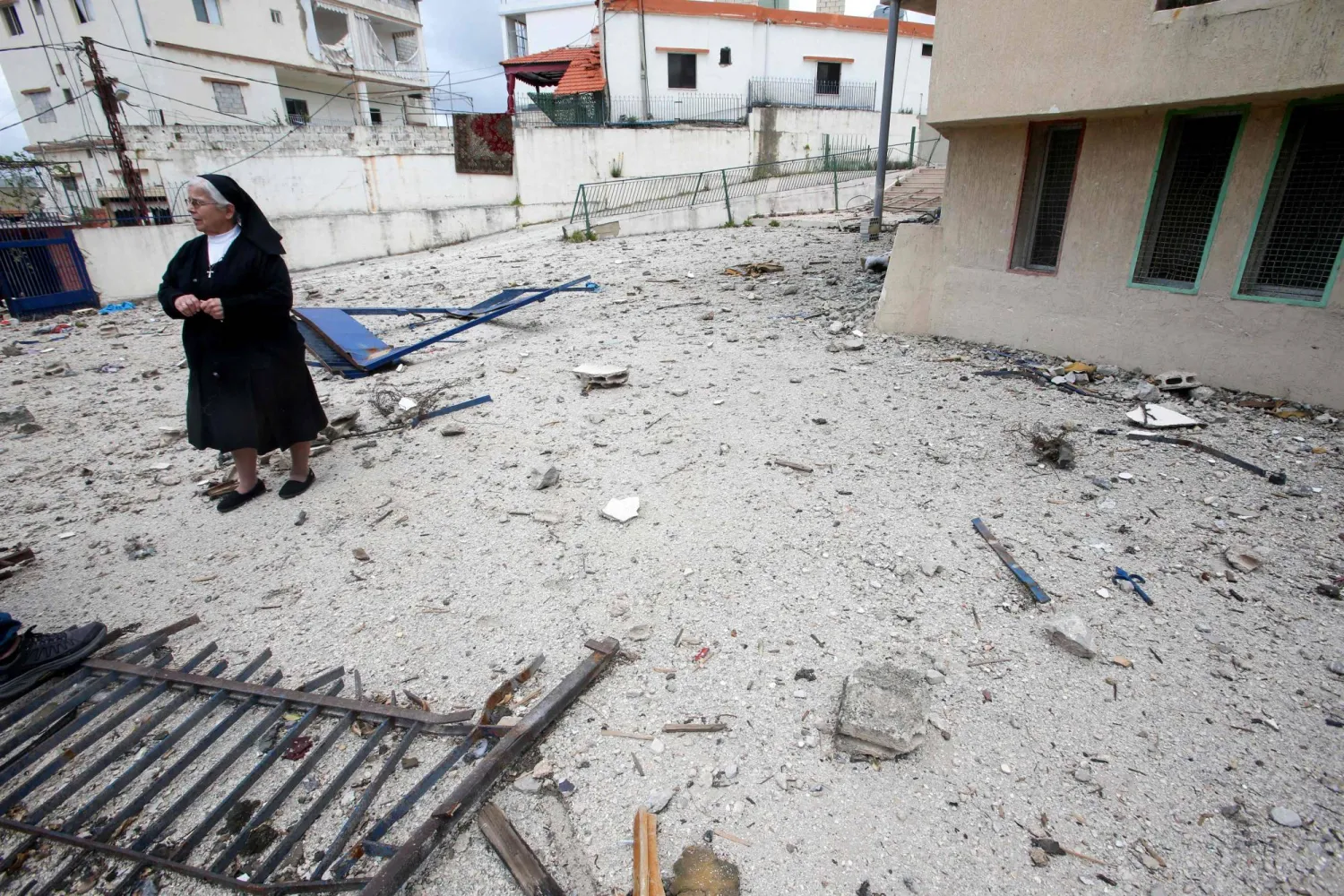

Israel Destroys Infrastructure in Southern Lebanon to Prevent Residents’ Return

A nun inspects a Christian religious site hit by an Israeli strike in the southern Lebanese city of Nabatieh. (AFP)
TT

Israel Destroys Infrastructure in Southern Lebanon to Prevent Residents’ Return

A nun inspects a Christian religious site hit by an Israeli strike in the southern Lebanese city of Nabatieh. (AFP)

Israel is escalating its campaign in southern Lebanon beyond direct military operations, pursuing what Lebanese officials describe as a systematic destruction of infrastructure, particularly in villages along the so-called “Yellow Line.”

Hospitals, schools, and water, electricity and telecommunications networks have been repeatedly targeted, alongside the destruction of bridges and roads, severing links between towns and isolating communities.

Lebanese ministerial sources noted that the approach is part of a policy of displacement. Residents have been repeatedly warned not to return to more than 80 villages, in what appears to be an effort to create an uninhabited buffer zone lacking basic services.

Air strikes have also hit areas outside occupied zones, including Wadi al-Hujeir, which was struck on Tuesday.

Israeli demolitions using explosives and bulldozers have not been limited to homes, but health and education facilities, seen by Lebanese officials as part of pressure on Hezbollah’s support base.

Israel considers civilian infrastructure in these areas a form of indirect support for the group and a potential platform where it can renew its activity.

Hospitals hit

From the first hours after hostilities erupted on March 2, triggering large-scale displacement, the Israeli army targeted hospitals and health centers in the south.

MP Bilal Abdullah, head of the parliamentary health committee, said Isarel had “intensified the destruction of health institutions and the medical system in southern villages.”

He told Asharq Al-Awsat that available data indicate “partial destruction of eight southern hospitals, all of which are now completely out of service,” listing them as the Tebnin Governmental Hospital, Sheikh Ragheb Harb Hospital, Salah Ghandour Hospital, Hiram Hospital, Jabal Amel Hospital, Hasbaya Governmental Hospital and Bint Jbeil Governmental Hospital.

He added that “the greatest damage has affected primary health centers,” noting that more than 100 ambulances had been destroyed and 121 doctors and paramedics killed in the hospitals and medical centers he listed.

Education sector targeted

The destruction of infrastructure is also aimed at deterring civilians from returning to the area for years to come, Lebanese officials say.

The education sector has been among the hardest hit. A source at the education ministry told Asharq Al-Awsat that targeting schools and institutes aims “to undermine the population’s ability to remain in their towns.”

Israel sees strikes on education as an effective way to empty villages of residents, forcing families to relocate in search of schooling alternatives for their children, the source stated.

The war has resulted in the total destruction of public schools in Dhayra, Bustan, Yarin and Tayr Harfa, as well as partial damage to Naqoura Intermediate School. In vocational and technical education, the Khiam and Qantara institutes have been completely destroyed, while institutes in Bint Jbeil, Aita al-Shaab, Tebnin, Toul, Nabatiyeh, Zrariyeh, Jbaa, Maarakeh, Abbasiyeh, Jouaiyya, Qana and Ansar have sustained partial damage.

The extent of structural damage means some of these institutions may be beyond repair, the source added.

According to education ministry statistics, schools in Nabatiyeh and its district have suffered the most damage: one school has been completely destroyed, 18 heavily damaged and seven left unharmed, while no information is currently available on 61 others.

Electricity and water

Damage to electricity and water infrastructure has also been severe. A source at the energy and water ministry told Asharq Al-Awsat it is not yet possible to compile a precise assessment of losses, but it confirmed damage to a number of power transformers and water facilities.

“The biggest problem lies in water networks,” the source remarked, noting that losses in the sector during the 2024 war exceeded $100 million. “The damage in this war surpasses that figure,” due to the destruction or disruption of pumping stations, treatment plants, reservoirs and supply networks.

Israel is pressing ahead with turning dozens of southern villages into a scorched zone, in what observers see as an attempt to extract political or security concessions from Lebanon. The higher the cost of destruction, the greater the pressure on the Lebanese state to seek arrangements to halt the war and limit its losses.



Israel, Hezbollah Exchange Fire after Trump Announcement

An Israeli strike hit near a hospital in south Lebanon's city of Tyre. KAWNAT HAJU / AFP
TT

Israel, Hezbollah Exchange Fire after Trump Announcement

An Israeli strike hit near a hospital in south Lebanon's city of Tyre. KAWNAT HAJU / AFP

Israel conducted strikes on south Lebanon and Hezbollah fired into northern Israel on Tuesday, after US President Donald Trump announced an agreement to halt attacks that neither side has publicly accepted.

According to Lebanon's authorities, Hezbollah would no longer fire into Israel under the agreement, while the Israeli military would cease striking south Beirut, long a bastion of the Iran-backed militant group.

The developments followed a dramatic escalation in violence that saw Israeli troops stage their deepest incursion into Lebanon in two decades, conducting waves of heavy bombardment and threatening to strike the south Beirut suburbs.

As the violence threatened to scupper a ceasefire in the wider Middle East war between the US and Iran, 24-year-old south Beirut resident Hadi told AFP he had hoped for some stability, but "that feeling did not last long".

The Israeli military said air defenses intercepted two projectiles that crossed from Lebanon into northern Israel, hours after Trump's announcement.

According to Lebanon's National News Agency, Israel conducted fresh air strikes on south Lebanon on Tuesday.

Lebanon's embassy in Washington had hours earlier said Hezbollah had accepted a US proposal for a "mutual cessation of attacks", though there has been no official confirmation by the militant group.

- 'For ETERNITY!' -

"Israel's strikes on Beirut's southern suburbs will cease, and in exchange Hezbollah will not attack Israel. And we will work to ensure the ceasefire expands to include all of Lebanon's territory," the Lebanese presidency said in a statement.

Israeli Prime Minister Benjamin Netanyahu said he had told Trump "that if Hezbollah does not cease attacking our towns and our citizens, Israel will strike terrorist targets in Beirut".

But Trump doubled down on his ceasefire push, posting on Truth Social that "hopefully" Israel and Hezbollah would stop fighting "for ETERNITY!"

"There will be no Troops going to Beirut, and any Troops that are on their way, have already been turned back," Trump said after what he described as a "very productive" call with Netanyahu.

According to Axios, however, Trump called Netanyahu "fucking crazy" and accused him of putting Iran peace talks at risk.

"Likewise, through highly placed Representatives, I had a very good call with Hezbollah, and they agreed that all shooting will stop -- That Israel will not attack them, and they will not attack Israel," Trump added.

Hezbollah drew Lebanon into the Middle East war on March 2 by firing rockets at Israel in retaliation for the killing of Iran's supreme leader, and Tehran has insisted that Lebanon be included in any peace deal with Washington.

According to Iran's Tasnim news agency, Tehran was no longer engaging in talks with Washington due to Israel's offensive.

- Trading blows -

The announcements came on the eve of a fourth round of US-hosted direct negotiations between Israel and Lebanon on Tuesday and Wednesday. Military delegations held security talks last week.

The threat of new strikes on south Beirut's suburbs sent people fleeing the densely populated area in huge traffic jams linking the area to the capital city, AFP images showed.

A truce to halt the fighting in Lebanon began on April 17, but has never been observed.

Both Israel and Hezbollah accuse each other daily of violating the ceasefire, justifying their attacks by blaming the other for breaches.

According to Lebanon's health ministry, Israeli attacks since March 2 have killed at least 3,433 people.

Israel's military said two of its soldiers had been killed in southern Lebanon, bringing to 27 the number of Israeli military deaths since early March.

- Peacekeepers? -

Stephane Dujarric, spokesman for UN Secretary-General Antonio Guterres, urged all sides "to respect the cessation of hostilities".

In a report to the UN Security Council seen by AFP, Guterres said it would be necessary to maintain peacekeepers in Lebanon after the mandate of the current mission expires at year-end.

France's Foreign Minister Jean-Noel Barrot said Tuesday that nothing could justify Israeli troops remaining deep inside Lebanon.

Israeli troops on Sunday seized the Beaufort castle, which commands sweeping views of south Lebanon.

Israeli forces used the castle, also known as Qalaat al-Chakif, as a base during their previous two-decade occupation of southern Lebanon that ended in 2000.


Lebanon Prioritizes Genuine Ceasefire, Ready to Consider a Security Agreement

Families leave Beirut’s southern suburbs after Netanyahu ordered strikes on the area in Lebanon (Asharq Al-Awsat) 
TT

Lebanon Prioritizes Genuine Ceasefire, Ready to Consider a Security Agreement

Families leave Beirut’s southern suburbs after Netanyahu ordered strikes on the area in Lebanon (Asharq Al-Awsat) 

For the second time, Lebanon’s negotiators are heading to Washington with one primary demand at the top of the agenda: a ceasefire with Israel.

The second round of talks, scheduled for June 2–3, comes with little expectation of a breakthrough amid escalating tensions between Israel and Hezbollah.

The deadlock had already undermined an American attempt to secure a ceasefire initiative led by Secretary of State Marco Rubio, before US President Donald Trump announced Monday that he had held separate phone calls with both sides and that they had agreed to stop the fighting, raising cautious hopes that negotiations could gain new momentum.

Lebanese President Joseph Aoun nonetheless defended the decision to pursue negotiations, calling it “the right choice” imposed by the realities of war. He stressed that negotiations remain the least costly path toward ending the military confrontation and alleviating the suffering of the Lebanese people.

Lebanese Assessment: Tehran and Netanyahu Converge

A senior Lebanese source familiar with the negotiations told Asharq Al-Awsat that Aoun is working intensively with the United States to secure a “real ceasefire.” But the source said Lebanese officials increasingly believe that Iran’s Revolutionary Guard Corps and Israeli Prime Minister Benjamin Netanyahu share a common interest in obstructing such efforts.

According to the source, Netanyahu’s calculations are driven by personal and electoral considerations, while Tehran seeks to keep Lebanon as a bargaining card to be used by Hezbollah in Iran’s negotiations with Washington.

The source added that Aoun remains convinced ceasefire efforts will eventually succeed despite current obstacles, describing them as “the inevitable outcome of the current trajectory.” The American proposal, the source said, also included an Israeli withdrawal within the framework of reciprocal understandings.

Lebanon’s delegation is expected to enter the talks with a single demand — a ceasefire — after technical discussions reinforced the belief that ending the fighting is ultimately a political decision rather than a security matter.

At the same time, Lebanese officials say the country is open to all options that could follow such a ceasefire, including a security agreement similar to arrangements currently being discussed with Syria, a formal agreement ending the state of war, or a permanent cessation of hostilities. Anything beyond that — namely peace with Israel — would remain tied to the broader Arab position led by Saudi Arabia.

Revolutionary Guard Escalation, Israeli Threats

The American initiative called for Hezbollah to halt fire first for 48 hours, after which Israel would stop targeting Beirut and its southern suburbs before gradually reducing military operations.

Asharq Al-Awsat reported that American officials informed Lebanese leaders on Sunday that Israel had threatened to strike targets in Beirut and the southern suburbs after providing Washington with intelligence alleging that Iran’s Revolutionary Guard had instructed Hezbollah to intensify and expand rocket attacks deeper into northern Israel.

Sources said Rubio spoke with Netanyahu in an effort to push for a ceasefire. At nearly the same time, Hezbollah launched its largest rocket barrage so far, including precision-guided missiles targeting Kiryat Shmona and Nahariya.

Washington also conveyed an Israeli message stating that if Hezbollah agreed to stop firing toward Israel, Beirut could avoid further strikes. Such a move, the message said, could then become part of a broader arrangement leading to a gradual reduction in hostilities and eventually a complete halt. If Hezbollah refused, Israel would intensify strikes on Beirut, particularly in the southern suburbs.

Berri: Obstruction or Legitimate Demand?

An American official told Axios that Aoun backed the initiative and asked Lebanese Parliament Speaker Nabih Berri to pressure Hezbollah into halting attacks on Israel.

The official described Berri’s response as evasive and disappointing, saying he insisted that Israel should cease fire first.

But sources close to Berri defended his position, saying it was fully aligned with Lebanon’s broader national stance. They told Asharq Al-Awsat that Berri responded to the American proposal by demanding a comprehensive ceasefire by land, sea, and air, along with an end to Israeli destruction, in order to resume negotiations under calmer conditions both in Lebanon and Israeli settlements near the border.

The sources added that Berri later sent a second message to US Ambassador to Lebanon Michel Issa, stating that Hezbollah was prepared to comply and that he personally guaranteed such a commitment. “If this is considered obstruction,” the sources asked, “then what constitutes facilitation?”

Who Stops Firing First?

AFP quoted a US official as saying Rubio had held contacts with both Aoun and Netanyahu to advance the negotiations. The official added that Hezbollah must stop firing first, while Lebanon continues to insist on a complete halt to Israeli attacks and full implementation of the ceasefire.

Meanwhile, former minister Wadih El-Khazen quoted Berri as saying that what southern Lebanon is experiencing constitutes “a direct challenge to Lebanese sovereignty,” stressing that continued Israeli attacks and repeated violations require serious international action.

Berri also insisted that any negotiations must produce “tangible results that preserve Lebanon’s rights” rather than remain merely a formal framework incapable of ending ongoing attacks.

Aoun: Negotiations Are Safer Than War

Aoun reiterated that Lebanon adopted negotiations because of the war itself.

“Negotiation is safer than war,” he stated. “It is neither surrender nor concession. It will not solve the problem overnight, but it is a process that takes time and remains the only way to stop the war with the least possible damage.”

He continued: “We will not retreat from this choice. All of us in Lebanon, as officials, are doing the impossible. Negotiations may stumble or take longer to achieve the goal we seek, but they are moving forward. Every issue is ultimately resolved through negotiations, however long it takes. War will not produce results for any side.”

Regarding Hezbollah’s weapons, Aoun clarified that the Lebanese Army has not declared southern Lebanon free of arms but has established operational control over the area. He said completing the mission requires time because of the region’s geography, while accusing Israel of violating the ceasefire agreement by continuing to occupy five positions and carrying out military operations.

Hezbollah Renews Rejection of Direct Talks

For its part, Hezbollah continues to reject direct negotiations with Israel.

Hezbollah MP Hussein Hajj Hassan said Lebanon “cannot be governed by the principle of majority and minority,” arguing that no national consensus exists in support of direct negotiations, even if some Lebanese factions favor the idea.

“From the beginning, we announced our categorical rejection of direct negotiations with the Zionist enemy under American sponsorship,” he said.

Hajj Hassan accused Lebanese authorities of “pleading with the Americans” for a ceasefire while arguing that Washington refuses to pressure Israel because it supports the continuation of Israeli military operations and violations.

He said the proper alternative lies in restoring national unity and understanding among Lebanese factions, including Berri, Hezbollah, and their allies. He also maintained that Lebanon and any ceasefire arrangement there would form “an essential part” of any future US-Iran agreement.


Hamas to Hold New Talks with Gaza Mediators in Egypt

Two Palestinian children walk through the site of an Israeli military strike on structures and tents housing displaced families, killing ten Palestinians, in Gaza City on May 28, 2026. (AFP)
TT

Hamas to Hold New Talks with Gaza Mediators in Egypt

Two Palestinian children walk through the site of an Israeli military strike on structures and tents housing displaced families, killing ten Palestinians, in Gaza City on May 28, 2026. (AFP)

A Hamas delegation is due to meet with mediators in Egypt on Wednesday to discuss ways of advancing the fragile Gaza ceasefire, Hamas officials told AFP.

“Egypt has invited Hamas and other factions to participate in talks with mediators on Wednesday... which will also include Qatari and Turkish officials,” a Hamas official said, declining to be identified as he was not authorised to speak publicly on the matter.

From the Palestinian side, participants include representatives from Hamas, the Islamic Jihad Movement, the Popular Front, the Popular Resistance Committees, the National Initiative, and the Democratic Reformist Stream in Fatah led by Mohammed Dahlan.

“The mediators have presented ideas for formulating a new, revised proposal acceptable to both Hamas and Israel,” the official added.

He said the Hamas delegation, headed by chief negotiator Khalil Al-Hayya, as well as representatives from other Palestinian factions, was expected to arrive in Cairo starting Tuesday for the talks to be held in the Mediterranean town of Al Alamein.

The official said mediators were planning a meeting between the group and Board of Peace’s high representative for Gaza, Nickolay Mladenov, in Egypt, where discussions would focus on reconstruction efforts and handing over administration of the Palestinian territory to the National Committee for the Administration of Gaza.

“Hamas believes a breakthrough and progress are possible if Israel does not create new obstacles and if there is a genuine Israeli will to reach a solution,” the official added.

A ceasefire was announced in the Gaza Strip on October 10 after a devastating war between Israel and Hamas that lasted more than two years. But the Palestinian territory remains gripped by daily violence meted out by Israeli troops.

A transition to the second phase of the ceasefire, which was supposed to involve a gradual withdrawal of the Israeli army, has been stalled for months.

One of the key sticking points to advancing the ceasefire negotiations has been the issue of Hamas' disarmament.

“The resistance factions will not accept disarmament under conditions imposed by the occupation,” a second Hamas official told AFP.

“Hamas is ready to positively engage with any proposal as long as it guarantees a comprehensive solution,” he said, adding that the movement has informed mediators of its openness to discuss the arms file within a comprehensive agreement that does not infringe upon the rights of the Palestinian people.

A Hamas official stated that “Israel must honor all obligations under the first phase of the ceasefire agreement before discussions for the second phase begin.”

He insisted on binding international guarantees from the US and mediators to compel Israel to fully implement proposed ceasefire terms.

Hamas political bureau member Osama Hamdan said in statement issued on Monday that “Mladenov's attempts to link the entry of the Palestinian administrative committee into Gaza with the disarmament of the resistance amount to political extortion and violate the terms of the initial agreement.”