


UN Project Supports Thousands of Coffee Farmers in Yemen's Taiz

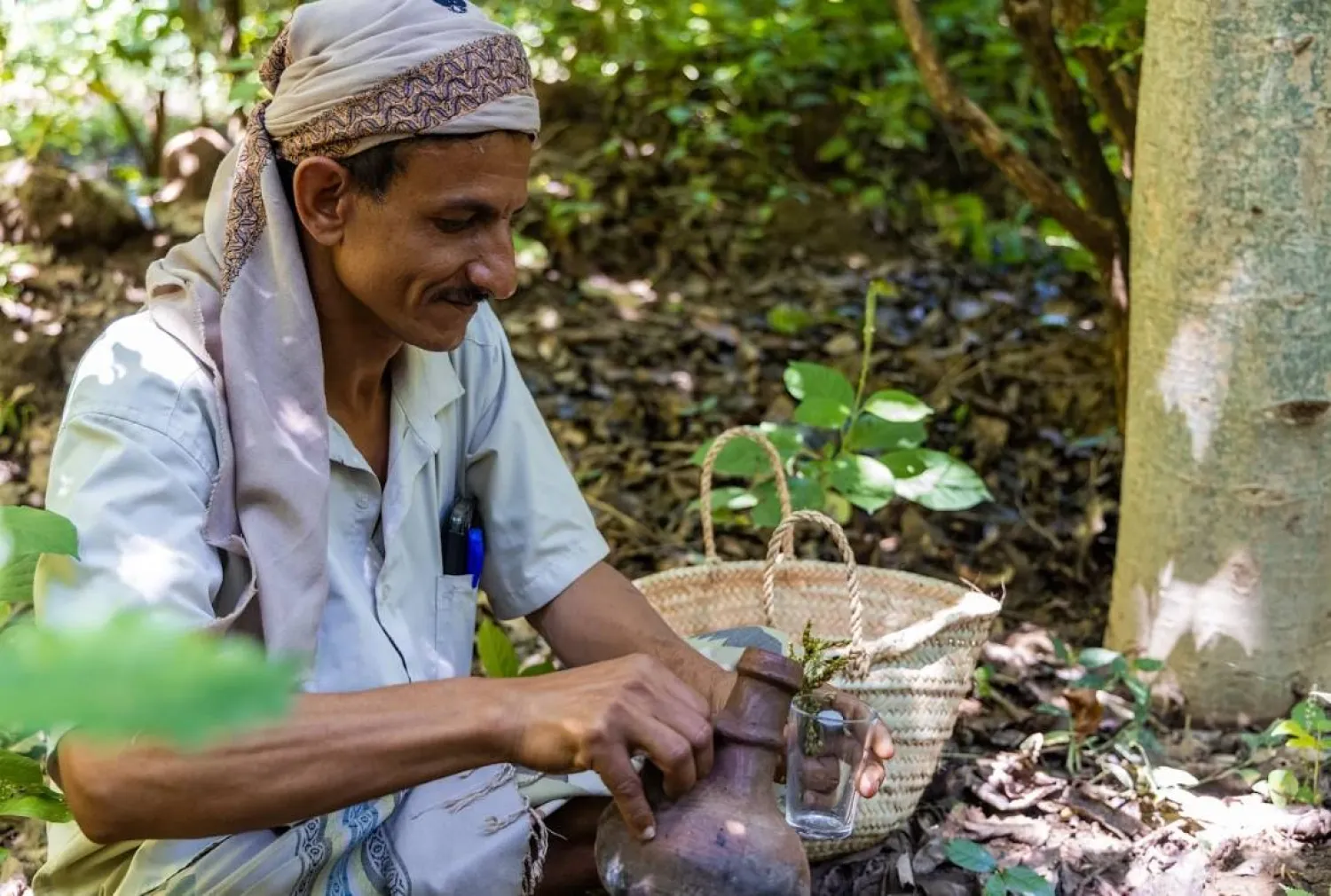
A Yemeni man in Taiz prepares coffee from the beans harvested on his farm. (United Nations)
TT

UN Project Supports Thousands of Coffee Farmers in Yemen's Taiz

A Yemeni man in Taiz prepares coffee from the beans harvested on his farm. (United Nations)

A UN-backed food security project in Yemen has become a model for creating jobs, helping farmers confront food insecurity, and developing coffee farming as a heritage and strategic crop.

The project, implemented by the United Nations Development Program in the Taiz governorate, southwest Yemen, and funded by the World Bank, has created direct job opportunities for more than 43,000 people, including 4,000 women.

It has also provided 200,000 cubic meters of water in newly built reservoirs and improved 8,351 hectares of land.

The Food Security Response and Resilience Project has enabled 17,000 farmers to regain the ability to use their land efficiently. It has also supported farmers in coffee-producing areas, especially in Taiz, by building water infrastructure that reduces the impact of declining rainfall.

According to a UNDP report, the project focuses on building rainwater-harvesting reservoirs that can be used during droughts to ensure continued irrigation. In the Sabir Al-Mawadim district, two reservoirs were built, each with a capacity of 400 cubic meters.

Project data showed that farmers who gained access to these resources recorded a notable improvement in production during the latest season compared with those who continued to rely on irregular rainfall.

The project is based on an estimated funding of $64 million and covers 47 districts across several Yemeni governorates, particularly areas among the most agriculturally fragile. Its work is scheduled to continue until next December.

The UNDP is focusing on developing agricultural infrastructure and strengthening rural communities’ ability to cope with climate change, in cooperation with the Social Fund for Development and the Public Works Project.

Yemeni agricultural engineer Saeed al-Sharjabi told Asharq Al-Awsat that coffee farming in Yemen needs a package of infrastructure measures, including linking production areas to a network of main, secondary, and agricultural roads to reduce transport costs.
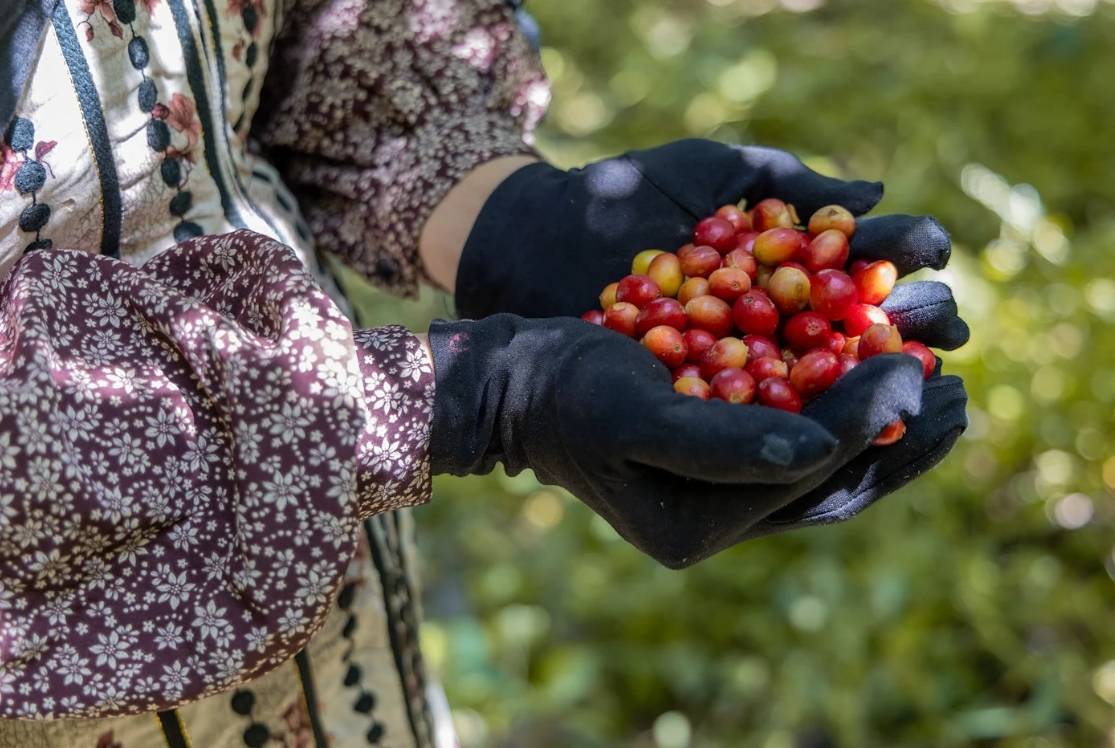
A Yemeni woman displays a sample of coffee beans harvested from her farm. (United Nations)

He said such roads could also support eco-tourism or agritourism.

Sharjabi called for building dams, barriers and water reservoirs, connecting them to suitable irrigation networks that help rationalize water consumption, establishing nurseries to produce coffee seedlings, setting technical standards for them, and encouraging investment in coffee-related fields such as production, marketing and the manufacture of environmentally friendly production supplies.

Project activities included rehabilitating more than 201 kilometers of agricultural roads, helping farmers reach their land and markets more easily. They also included building and improving water reservoirs with a total capacity of more than 200,000 cubic meters to reduce reliance on seasonal rainfall and support more stable irrigation.

According to UNDP data, the project provided more than 1.3 million workdays, including about 130,000 for women, while more than 22,000 farmers improved their access to water.

Samir al-Maqtari, an agricultural engineer and government employee, said many agricultural lands in rural Taiz have been abandoned due to water shortages or internal migration in search of services.

He warned that this threatens to leave the land exposed to deterioration and collapse because of sudden heavy rains after years of drought and desertification.

Speaking to Asharq Al-Awsat, Maqtari urged the government, the UN and international authorities to expand projects that support food security and to seize the opportunity created by thousands of farmers abandoning qat by supporting its replacement with coffee trees, especially since the environmental and climatic conditions needed for both crops are largely similar.

Initial results show that better water management is a decisive factor in protecting coffee farming, which has traditionally depended on fluctuating rainfall. These interventions also help reduce crop losses, stabilize farmers’ incomes and strengthen rural communities’ resilience.



Four Killed in Israeli Strikes on Southern Lebanon

Israeli tanks drive in Lebanon, as seen from the Israeli side of the Israel-Lebanon border, in northern Israel, April 25, 2026. (Reuters)
TT

Four Killed in Israeli Strikes on Southern Lebanon

Israeli tanks drive in Lebanon, as seen from the Israeli side of the Israel-Lebanon border, in northern Israel, April 25, 2026. (Reuters)

Four people were killed on Saturday in Israeli strikes on southern Lebanon, Lebanon's state news agency reported, while the Israeli military said Hezbollah had fired rockets at Israel, the latest challenges to a tenuous, recently extended ceasefire.

The ceasefire agreed between Israel and Lebanon has led to a significant reduction in hostilities, ‌but Israel ‌and Iran-backed Hezbollah ‌have ⁠continued to clash ⁠in southern Lebanon, where Israel has kept soldiers in the self-declared buffer zone.

The Israeli military said on Saturday that it had struck loaded rocket launchers belonging to Hezbollah in three locations in southern Lebanon overnight ⁠and targeted several Hezbollah fighters in ‌separate strikes.

It was ‌unclear whether the deaths reported by the ‌state news agency were linked to those ‌Israeli strikes.

The Israeli military restated its warning for Lebanese residents not to approach the Litani River area in southern Lebanon while it battles ‌Hezbollah.

It said it had intercepted a "suspicious aerial target" within the area its ⁠forces ⁠are presently occupying, and that two rockets were fired by Hezbollah into northern Israel, one of which was intercepted. There were no reports of casualties.

A Hezbollah lawmaker said on Friday that a US-mediated ceasefire in the war with Israel was meaningless, a day after it was extended for three weeks. The truce had been due to expire on Sunday.


Syria to Begin Trying Assad-Era Figures on Sunday, Says Justice Official

Residents gather in a street after Friday prayers to celebrate the arrest of Amjad Yousef, a key suspect in the 2013 Tadamon massacre, in Tadamon, Syria, April 24, 2026. (Reuters)
TT

Syria to Begin Trying Assad-Era Figures on Sunday, Says Justice Official

Residents gather in a street after Friday prayers to celebrate the arrest of Amjad Yousef, a key suspect in the 2013 Tadamon massacre, in Tadamon, Syria, April 24, 2026. (Reuters)

Trials of prominent figures from the rule of ousted Syrian leader Bashar al-Assad are set to begin this weekend, a justice ministry official told AFP on Saturday, starting with a former security official.

"The first trial sessions for symbolic former Syrian regime figures will begin on Sunday" with Atif Najib, who was arrested in January of last year, the official told AFP on condition of anonymity.

Najib is the former head of political security in south Syria's Daraa province, the cradle of the country's 2011 uprising, and is accused of orchestrating a crackdown there. He is also a cousin of the ousted leader.

The ministry official said trials would follow for Wassim al-Assad -- another of the former president's cousins -- and Amjad Youssef, the main suspect in a 2013 massacre who was arrested this week, as well as "pilots who took part in bombing Syrian cities and towns".

Syria's civil war began with a brutal crackdown on pro-democracy protests and spiraled into a 13-year conflict that killed more than half a million people.

Assad's forces pounded opposition-held areas, including with airstrikes and crude barrel bomb attacks, while tens of thousands of people disappeared, some into the country's brutal prison system.

Since seizing power in December 2024, Syria's new authorities have repeatedly announced the arrests of former officials, vowing to provide justice and accountability for Assad-era atrocities.

Assad fled to Russia with only a handful of confidants, abandoning senior officials and security officers, some of whom reportedly went abroad or took refuge in the coastal heartland of Assad's Alawite minority.

Syrian Justice Minister Mazhar al-Wais said Friday on X that the Damascus criminal court was ready "for the moment that victims have long waited for: the start of public trials", calling them "part of the transitional justice process".

Rights groups, activists and the international community have repeatedly emphasized the importance of transitional justice in the war-ravaged country.

The protest movement against Assad began in Daraa on March 15, 2011, after 15 students were arrested for allegedly writing anti-government slogans on the city's walls.

Residents said the students were tortured, leading to a protest to demand their release that ended in bloodshed.

Najib, blamed for the crackdown, was dismissed soon after. He was on a US Treasury sanctions list alongside other Syrian officials.

Wassim al-Assad was arrested last June. The US Treasury sanctioned him in 2023, saying he had led a paramilitary unit and was "a key figure in the regional drug trafficking network".


Palestinian Local Elections Give Some Gazans First Chance to Vote in Years

Palestinian electoral officials set up a polling station in a tent for municipal elections in Deir al-Balah, Gaza Strip, on April 25, 2026. (AFP)
TT

Palestinian Local Elections Give Some Gazans First Chance to Vote in Years

Palestinian electoral officials set up a polling station in a tent for municipal elections in Deir al-Balah, Gaza Strip, on April 25, 2026. (AFP)

Palestinians voted in local elections on Saturday that for the first time in two decades include Gaza and are a gauge of the political mood as Israel's government seeks to destroy any future for a Palestinian state. 

The West Bank-based Palestinian Authority has said it hopes the inclusion of the Gazan city of Deir al-Balah will reinforce its claim to authority over the territory from which it was ousted by Hamas in 2007. 

Some Gazans, who are struggling to meet their basic needs in the devastated enclave, welcomed the opportunity to vote. 

"As a Palestinian and a son of the Gaza Strip, I feel proud that after this war the democratic process is returning," said voter Mamdouh al-Bhaisi, 52, at the Deir al-Balah polling station.  

Turnout, however, was low at 13.8% in Deir al-Balah by 1 p.m. (1000 GMT) and at 25.3% in the West Bank, according to official figures.  

Voting will continue in the West Bank until 7 p.m., while in Deir Al-Balah it ends ‌an hour earlier ‌due to electricity constraints. 

Casting his ballot in a polling station in the Al-Bireh area, near Ramallah, Palestinian ‌President ⁠Mahmoud Abbas said eventually ⁠elections will be held across the Gaza Strip. 

"Gaza is an inseparable part of the state of Palestine. Therefore, we have worked by all means to ensure that elections take place in Deir al-Balah to affirm the unity of the two parts of the country together," he said. 

A Palestinian woman casts her ballot in a polling station during municipal elections in the Israeli-occupied West Bank city of Hebron on April 25, 2026. (AFP)


ISRAEL HAS EXTENDED CONTROL OVER GAZA AND WEST BANK  

Since a US-brokered ceasefire in Gaza between Hamas and Israel took effect in October, intermittent talks led by the United States have made little progress towards a settlement that envisages international supervision of Gaza. 

European and Arab governments broadly support an eventual return of Palestinian Authority governance in Gaza, together with the establishment of an independent Palestinian state. It would comprise Gaza, East Jerusalem and the ⁠West Bank, where the Palestinian Authority exercises limited self-rule under Israeli occupation. 

Western diplomats say local elections ‌could be a step towards the first national elections in nearly two decades and advance ‌reforms to increase transparency and accountability that the PA says are under way. 

"We hope that the procedure carried out today will be crowned with legislative ‌and presidential elections," said Munif Treish, one of the candidates in the West Bank. 

Saturday's vote is the first of any ‌kind in Gaza since 2006 and the first Palestinian elections to be held since the Gaza war started more than two years ago with a cross-border Hamas assault on southern Israeli communities.  

Municipal elections were last held in the West Bank four years ago. 


A Palestinian man shows his marked finger after casting his ballot at a polling station during municipal elections in the Israeli-occupied West Bank city of Al-Bireh on April 25, 2026. (AFP)

STRUGGLE TO PAY WAGES AS ISRAEL WITHHOLDS FUNDS 

The Palestinian Authority has struggled to pay wages as Israel withholds tax revenues it collects on its behalf, raising fears of economic collapse. 

Israel justifies withholding ‌the funds in protest at welfare payments to prisoners and families of those killed by its forces, which it says incentivize attacks. The Israeli government has also taken steps to help settlers acquire ⁠West Bank land.  

Finance Minister Bezalel ⁠Smotrich has repeatedly said: "We will continue to kill the idea of a Palestinian state." 

In Deir al-Balah, which has suffered less damage from Israel's assault since 2023 than other Gazan cities, banners bearing candidate lists hang from buildings. 

The Palestinian election committee cited widespread destruction among the reasons voting could not be held across the rest of Gaza, more than half of which is controlled by Israel, with the rest under Hamas rule. 

HAMAS BOYCOTTS VOTE BUT SOME CANDIDATES ARE ALIGNED 

Some Palestinian factions are boycotting the elections in protest at the PA's request that candidates back its agreements, which include recognition of the state of Israel. 

Hamas, which has ruled Gaza for nearly two decades, has not formally nominated any candidates but one list in the Deir al-Balah election is widely viewed by residents and analysts as aligned with it. 

Analysts say the performance of candidates linked to the group could gauge its popularity. Most candidates, including in the West Bank, are running under Fatah, the main political movement behind the PA, or as independents. 

Hamas has said it would respect the results. Palestinian sources told Reuters ahead of the vote that the group's civil policemen would be deployed to safeguard polling stations in Gaza. 

The Palestinian Central Elections Committee said more than one million Palestinians, including 70,000 in Gaza, are eligible to vote, with results expected late on Saturday or on Sunday.