Israel Strikes Southern Lebanon, Killing 6; Hezbollah Drone Wounds 2 Israeli Soldiers

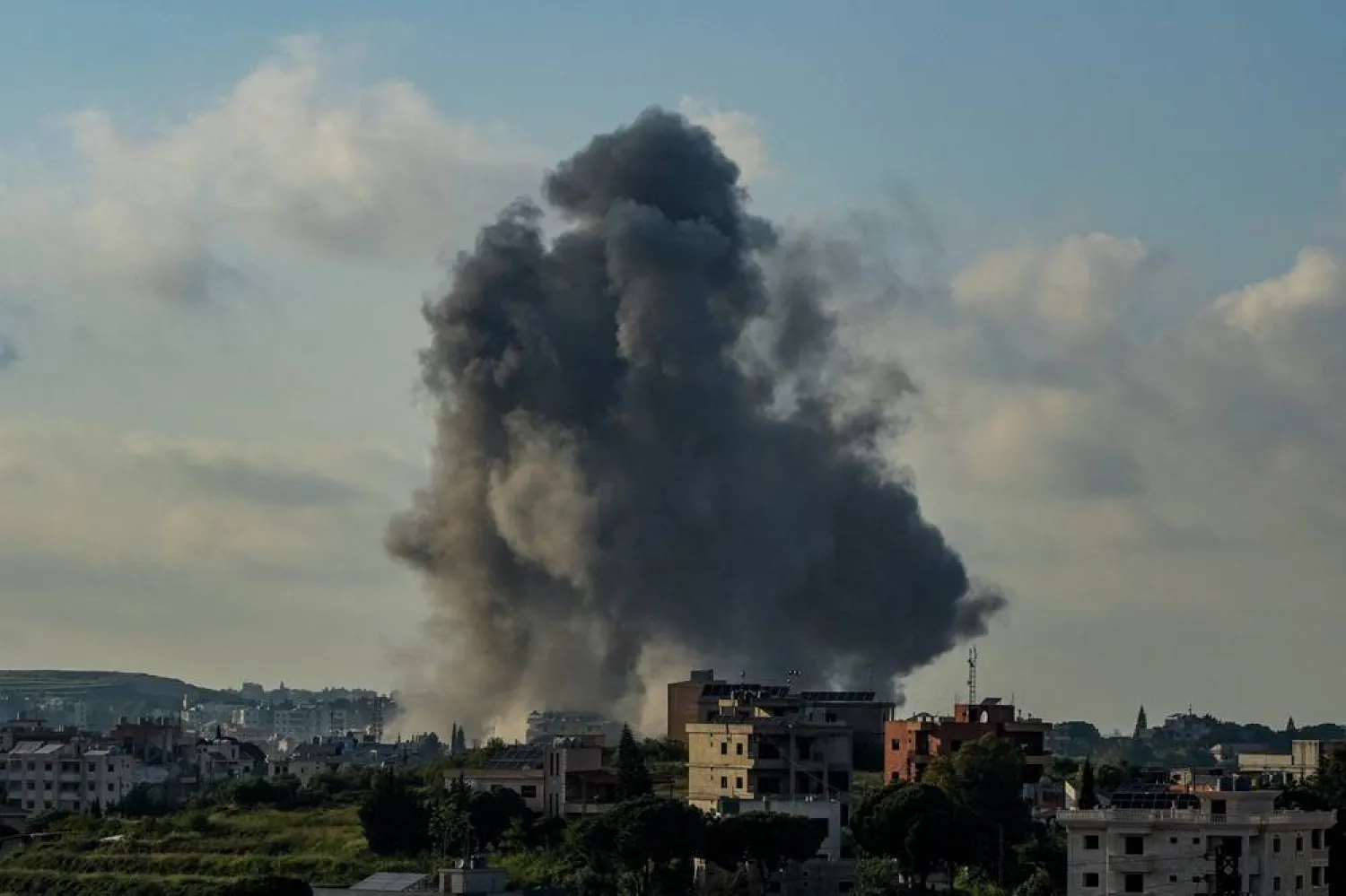
 Smoke rises in Habboush following Israeli strikes, as seen from Nabatiyeh, Lebanon, May 1, 2026. (Reuters)
Smoke rises in Habboush following Israeli strikes, as seen from Nabatiyeh, Lebanon, May 1, 2026. (Reuters)
TT

Israel Strikes Southern Lebanon, Killing 6; Hezbollah Drone Wounds 2 Israeli Soldiers

 Smoke rises in Habboush following Israeli strikes, as seen from Nabatiyeh, Lebanon, May 1, 2026. (Reuters)
Smoke rises in Habboush following Israeli strikes, as seen from Nabatiyeh, Lebanon, May 1, 2026. (Reuters)

Lebanon's health ministry said six people including a woman and a child were killed Friday in two Israeli strikes on a southern town where Israel's army had issued an evacuation order despite a ceasefire.

The ministry statement said eight other people including a woman and a child were wounded in the strikes on Habboush, where the state-run National News Agency had reported casualties after Israeli warplanes "launched a series of heavy strikes... less than an hour after warning" residents there to evacuate.

Meanwhile, the Hezbollah group said it fired rockets and drones, including one that crashed in northern Israel and wounded two soldiers.

Israel’s military and Hezbollah kept up their attacks despite a ceasefire in place since April 17. 

Israel’s military on Friday afternoon urged residents of the village of Habboush near the southern city of Nabatiyeh to evacuate, warning that those close to Hezbollah’s facilities would be putting their lives in danger if they stay.

Friday’s exchanges came after paramedics recovered the bodies of five people, including a man and his three sons, from under rubble in the village of Kfar Rumman, also near Nabatiyeh, a day after they were killed.

The NNA reported that the five were killed in an airstrike late Thursday on Kfar Rumman. The agency identified those whose bodies were recovered as Malek Hamza and his sons, Ali, Fadel and Hamza. It said the strike also killed a Lebanese soldier. The Lebanese army confirmed that a soldier, Ali Jaber, was killed in the strike.

By Friday afternoon, Hezbollah had issued six statements saying it launched drones and rockets at Israeli military positions.

The Israeli military confirmed that Hezbollah launched an explosive drone that fell in northern Israel near the border with Lebanon.

Israeli media reported a drone strike near Margaliot in northern Israel, saying it caused a localized fire, and that two soldiers were lightly wounded in a separate Hezbollah drone impact in the area.

Despite the war, residents have continued to return to homes in southern Lebanon after being displaced for weeks because of the hostilities.

One of them was Umm Ali Khodor, whose apartment in the southern port city of Tyre was damaged during the previous Israel-Hezbollah war in 2024 and again in the current conflict.

“We were displaced, we rented a house, but as you know the situation is very difficult,” the woman said. “We could not continue so we returned to our home.”

The latest war between Israel and Hezbollah began on March 2, when Hezbollah fired rockets into northern Israel two days after the United States and Israel launched a war on its main backer, Iran. Israel has since carried out hundreds of airstrikes and launched a ground invasion of southern Lebanon, capturing dozens of towns and villages along the border.

Since then, Lebanon and Israel have held their first direct talks in more than three decades. The two countries have formally been in a state of war since the founding of the state of Israel in 1948.

A 10-day ceasefire declared in Washington went into effect on April 17. The ceasefire was later extended by three weeks.

The Health Ministry said Friday that the war's death toll reached 2,618 while 8,094 were wounded.


US Withdrawal Fears Grip Baghdad

An American helicopter flies near the Harir Air Base in Erbil, Iraqi Kurdistan (Rudaw file photo)
TT

US Withdrawal Fears Grip Baghdad

An American helicopter flies near the Harir Air Base in Erbil, Iraqi Kurdistan (Rudaw file photo)

The Sept. 30 withdrawal of US forces will mark Iraq’s shift toward full security self-reliance and remove any justification for armed activity outside state control, the spokesman for the commander-in-chief of Iraq’s armed forces said on Saturday.

The transition would “eliminate any justification for operating outside state institutions and give those institutions the security and legitimacy needed to disarm unofficial groups,” Sabah al-Numan told the state news agency.

“The professional performance of the Iraqi armed forces has proven that they are the impenetrable shield protecting political decision-making and the primary guarantor of Iraq’s unity and national stability,” he said.

But the upcoming withdrawal has stirred fears in Baghdad, rattling markets and reviving concerns over the fate of armed factions. Sources close to the government say the warnings circulating publicly are exaggerated.

The Iraqi government and allied political forces are preparing to declare the withdrawal date a “day of Iraqi sovereignty.”

Much of the unease, however, centers on the possible repercussions of bringing weapons under state control — an initiative that Iraqi politicians say may be recast as a “plan to regulate and manage weapons.”

Qasim al-Araji, the prime minister’s national security adviser, said the government would regard anyone who continued to carry weapons illegally after the process was completed as an outlaw.

“Strict measures will be taken against them, potentially including treating them as terrorists,” al-Araji said in televised remarks.

He denied reports that the committee overseeing the process had been given a deadline, saying no timeframe had been set.

Al-Araji said the committee, formed by the Coordination Framework alliance, was working under the prime minister’s direct supervision.

Legal action against those carrying illegal weapons would begin only after the committee had completed its work and arms had been brought fully under state control, he added.

Government spokesman Haider al-Aboudi called Sept. 30 “a sovereign milestone” that would shift Iraq’s relationship with international coalition members toward bilateral ties based on respect for sovereignty and mutual interests.

The government was proceeding with plans to end the coalition’s military mission according to the agreed timetable and mechanisms, al-Aboudi told the state news agency.

“Iraq possesses the constitutional, political and diplomatic tools needed to manage its national security through its institutions and armed forces,” he said.

Al-Shorja wholesale market in central Baghdad, Iraq (Reuters)

Fears of sanctions

Despite repeated government assurances, religious leaders and experts have warned of possible repercussions after the withdrawal.

Abdul Wahab al-Samarrai, imam and preacher of Baghdad’s Abu Hanifa al-Numan Mosque, raised the prospect of economic sanctions resembling those tightened against Iraq in the 1990s.

“We sent a message to our government and its prime minister that this country and its people are a trust for which they are responsible,” al-Samarrai said.

“Honoring that trust requires placing the interests of the country and its people above those of groups and individuals.”

“Some are talking about economic sanctions and recalling the days of the embargo,” he added. “We therefore urge officials not to gamble with the country’s fate or place the wishes of some Iraqis above the interests of everyone.”

Concern has largely focused on whether efforts to bring weapons under state control could falter. Many link the risk of regional isolation or sanctions to failure, while political forces and armed factions have publicly rejected attempts to disarm them.

Sadr al-Din al-Qubanji, the imam and Friday preacher in Najaf, warned that “any political or security unrest in Iraq would trigger a crisis across the entire region and destabilize the global economy.”

“These issues must therefore be addressed rationally,” he said.

Politicians close to the government, however, said the public warnings were exaggerated, including reports that Washington and Baghdad had exchanged messages over possible sanctions.

President Donald Trump, gestures as he greets Iraq's Prime Minister Ali al-Zaidi at the White House, Tuesday, July 14, 2026, in Washington.(AP Photo/Alex Brandon)

Dollar rises as markets slow

The conflicting messages come as stagnation grips local markets, according to domestic trade organizations.

Eco Iraq, an economic monitoring group, said the dollar had risen to unprecedented levels against the dinar on the parallel market.

“The current increase is not linked to a single factor but is the result of an interplay of economic, financial and psychological factors,” it said in a statement.

The group cited speculation on the parallel market, where traders have capitalized on rising demand for dollars and shrinking supply.

“Fears and speculation related to developments after Sept. 30, discussions surrounding bringing weapons under state control and claims of possible US sanctions are increasing market uncertainty and prompting some traders to raise their demand for dollars,” it said.

The parallel exchange rate has climbed above 162,000 Iraqi dinars per $100 in recent days. Observers said the rise had disrupted trade in goods, compounding repercussions that have persisted for months since the outbreak of the US-Iran conflict.

Traders in Baghdad, Erbil and Basra told Asharq Al-Awsat that buying and selling had fallen to unprecedented levels, forcing some businesses to close until further notice.

Meanwhile, Prime Minister Ali al-Zaidi plans to travel to the United States for the United Nations General Assembly after ending a European tour that took him to France and Germany.

His schedule could include a meeting with US President Donald Trump, although authorities in Washington and Baghdad have yet to confirm one.


Israel Links Southern Lebanon Withdrawal to Stronger Lebanese Army

Israeli heavy machinery bulldozes houses in Mansouri, as seen from Hinniyeh, Southern Lebanon, September 19, 2026. REUTERS/Mohamed Azakir
TT

Israel Links Southern Lebanon Withdrawal to Stronger Lebanese Army

Israeli heavy machinery bulldozes houses in Mansouri, as seen from Hinniyeh, Southern Lebanon, September 19, 2026. REUTERS/Mohamed Azakir

From protecting northern Israeli communities to disarming Hezbollah and ensuring that the Lebanese army can assume responsibility for security, Israel has set a series of conditions for the future of its occupation of southern Lebanon.

Although Israel says it has no territorial ambitions in Lebanon, statements by its officials in recent months have offered no clear timetable for withdrawal, instead linking it to a succession of security and political conditions.

From protecting the north to a “security zone”

Amid repeated Israeli statements focusing on maintaining the occupation of southern Lebanon, Israeli Defense Minister Israel Katz said on June 21 that the Israeli military would continue operating there.

He said troops deployed in the “security zone” would not withdraw and would retain freedom of action to eliminate threats.

Israeli Foreign Minister Gideon Saar later said Israel had no territorial ambitions in Lebanon, while stressing that it would not withdraw from the “security zone,” citing the need to protect Israeli citizens from Hezbollah attacks.

Katz was more explicit in rejecting any imminent withdrawal. On June 24, he said the Israeli military will not withdraw from the security zone, even if the US demands it.

The following day, the language shifted from security necessity to an open-ended timeline. Katz said Israeli forces would remain in security zones in Lebanon, Syria and Gaza "without any time limit."

Disarming Hezbollah as a condition

At the end of June, Katz sought to reconcile Israel’s denial of territorial ambitions with its continued military control, insisting that Israel would not withdraw by a single millimeter before Hezbollah was disarmed.

Days later came his most direct statement. After US President Donald Trump raised the possibility of an Israeli withdrawal from Lebanon, Katz responded: “We did not ask permission from any party to enter Lebanon and we do not need permission to stay in Lebanon."

A new condition: Strengthening the Lebanese army

The latest US statement introduced another criterion for the future of Israel’s presence. US Ambassador to Israel Mike Huckabee said on Saturday that the Israeli military will remain in southern Lebanon until the Lebanese army “is strong enough to be the securing force.”

Israeli objectives extend beyond withdrawal

Retired Lebanese Army Maj. Gen. Abdul Rahman Chehaitli said Israel’s objectives went beyond maintaining a military presence in the south.

They included reaching “a military and security agreement between the two countries and abolishing everything that defines Israel as an enemy,” eventually establishing relations “like those between any two states,” in addition, of course, to disarming Hezbollah.

In remarks to Asharq Al-Awsat, Chehaitli said Israel was seeking to establish a joint border committee to monitor violations, followed by economic agreements.

Its most important objective, he said, was a meeting between the Lebanese and Israeli presidents. He viewed Israel’s pressure on the Lebanese state as serving that goal.

Chehaitli rejected linking an Israeli withdrawal to strengthening the Lebanese army, arguing that Israel itself was obstructing efforts to secure the support the army needed. He cited the Paris conference, which ended without final decisions.

The Lebanese army, including its officers and troops, was “fully prepared to carry out its duties,” he said.

The army and Hezbollah’s weapons

Chehaitli said Israel wanted the Lebanese army to act as an “advance detachment,” confronting Hezbollah first before Israeli forces took over — a role he said the army “will not perform.”

The natural sequence, he said, was that “once Israel says it has completed its military operations in Lebanon, the Lebanese army can then carry out its mission.” In other words, an Israeli withdrawal would allow the Lebanese state and its army to assume their responsibilities fully.

Addressing Hezbollah’s refusal to surrender its weapons and Israel’s use of the issue as justification for continuing the occupation, Chehaitli said Israel had previously tied its withdrawal to the Lebanese government adopting decisions establishing the state’s exclusive control over weapons.

“That has happened,” he said. “Parliament granted the government confidence for the third time, including the Shiite component and Hezbollah in particular, which did not withhold confidence from it and therefore did not reject its decisions.”

After an Israeli withdrawal, Chehaitli said, the government could implement its decisions throughout Lebanon “regardless of whether Hezbollah explicitly agrees.”

Israel’s continued presence made the task of the state and army more difficult, he added. “The occupation is the obstacle preventing the state from implementing its decisions and assuming its full responsibilities.”

Two Israeli soldiers were wounded

The statements came as Israeli attacks continued at varying levels of intensity in recent days.

Nabatieh came under a barrage of strikes on Saturday. Israeli warplanes carried out two rounds of strikes on the Old Square neighborhood in Nabatieh al-Fawqa before launching a third strike that targeted emergency teams from the Islamic Risala Scout Association and the Bayt al-Talaba ambulance service as they headed to the site of the earlier attacks.

Members of both teams escaped unharmed, and no casualties were reported.

In Khiam, the Israeli military carried out a large demolition operation in the morning, coinciding with a powerful explosion in the Mansouri area. Israeli warplanes also launched a series of strikes on Mansouri and Kfar Tebnit and bombed Wadi al-Salouqi.

Israeli artillery shelled the outskirts of the towns of Haddatha, Haris and Mayfadoun at dawn as part of a field escalation affecting several areas of southern Lebanon.

Later in the afternoon, the Israeli military said two soldiers were wounded when an explosive device detonated inside what Israel calls its “security zone” in southern Lebanon. It accused Hezbollah of planting the device and announced a series of strikes on sites across several parts of the south.

The Israeli military said its targets included observation posts and facilities it said had been used to prepare operations against its forces. It also confirmed that its troops remained deployed inside what it describes as the “security zone” in southern Lebanon and said it would continue acting against what it considers threats to its forces and Israeli residents.


Yemeni Army Grinds Down Houthis West of Taiz, East of Bab al-Mandab

This frame grab taken from AFPTV video footage shows a fighter from the Nation's Shield Forces deployed in Yemen's Al-Kadha area, west of Taiz province, on September 10, 2026. (Photo by AFPTV / AFP)
TT

Yemeni Army Grinds Down Houthis West of Taiz, East of Bab al-Mandab

This frame grab taken from AFPTV video footage shows a fighter from the Nation's Shield Forces deployed in Yemen's Al-Kadha area, west of Taiz province, on September 10, 2026. (Photo by AFPTV / AFP)

The Houthis suffered casualties and equipment losses over the past 24 hours as fighting intensified across Yemen’s western Taiz province and areas overlooking the Bab al-Mandab Strait.

The group is trying to consolidate newly seized positions and secure its rear lines in mountain ranges overlooking the western coast and the international shipping lane.

The heaviest clashes were reported in the Kahboub mountains and the districts of Al-Mudaraba and Al-Wazi’iyah, according to local and military sources.

Government forces and local tribesmen are seeking to secure strategic heights, while the Houthis have sent reinforcements and pushed toward elevated positions that would help protect their recent gains.

Military sources said government forces, backed by local fighters, thwarted a Houthi infiltration attempt in the Al-Aghbara sector of Al-Mudaraba district in Lahj province, inflicting casualties on the attackers.

On the Kahboub front near Bab al-Mandab, the Southern Giants Brigades struck Houthi concentrations and vehicles with air, drone, artillery and rocket attacks.

Field sources said a senior Houthi commander with the rank of major general was killed along with six of his escorts.

They identified him as Firaq Mohsen al-Assar, known as Abu Saqr al-Qafr, from Al-Qafr district in Ibb province. He had held several military posts, including commander of the First Commando Brigade, the sources said.

Battle for the heights

Government forces and the Houthis are fighting for a chain of heights in Al-Wazi’iyah district, west of Taiz, stretching eastward from the Kahboub mountains to Jardad.

Government forces are seeking to secure positions overlooking the western coast and Bab al-Mandab and drive Houthi fighters from the high ground.

The mountains are strategically important because they overlook areas near the strait and the plain extending toward Ras al-Ara.

The Houthis are trying to seize the heights to protect areas under their control and to use them as a launch point for any new southward advance, the sources said.

On the Al-Kadha front west of Taiz, government forces repelled a Houthi attack and forced the assailants to retreat after suffering casualties.

The army also recaptured positions on Jabal al-Shuhada, overlooking Wadi al-Ghail in Al-Wazi’iyah, after driving out Houthi fighters.

Government aircraft struck Houthi positions around Jawlat al-Qasr, east of Taiz city.

The fighting in western Taiz is not only about the current front lines. It is also a battle for high ground that would give the side holding it greater ability to defend its positions and move between the coast and inland areas.

Strikes continue in Marib

Government forces also continued ground and air operations against the Houthis in Marib province.

Warplanes struck Houthi concentrations and vehicles at the Umm Rish camp and Aqabat Mala’a in the south of the province.

Government forces said they thwarted three Houthi infiltration attempts on the Marib fronts as the two sides exchanged artillery fire.

On Friday, government forces said they had destroyed nine Houthi military vehicles on the western Marib fronts, killing those aboard.

Drones operated by the Seventh Military Region also targeted Houthi concentrations on the northern fronts, while other strikes hit the group’s vehicles in the Third Military Region’s area of operations.

Other fronts remained relatively calm compared with the fighting in western Taiz and Marib, although forces remained on high alert along the lines of contact.

The latest operations show government forces concentrating on preventing the Houthis from tightening their grip on heights overlooking Bab al-Mandab and the western coast.

At the same time, they are targeting Houthi reinforcements and vehicles in an effort to disrupt the group’s attempts to consolidate its new positions and advance toward the mountains overlooking the strait.