
Egypt Steps Up Regional De-escalation Contacts

Egypt Steps Up Regional De-escalation Contacts
TT

Egypt Steps Up Regional De-escalation Contacts

Egypt Steps Up Regional De-escalation Contacts

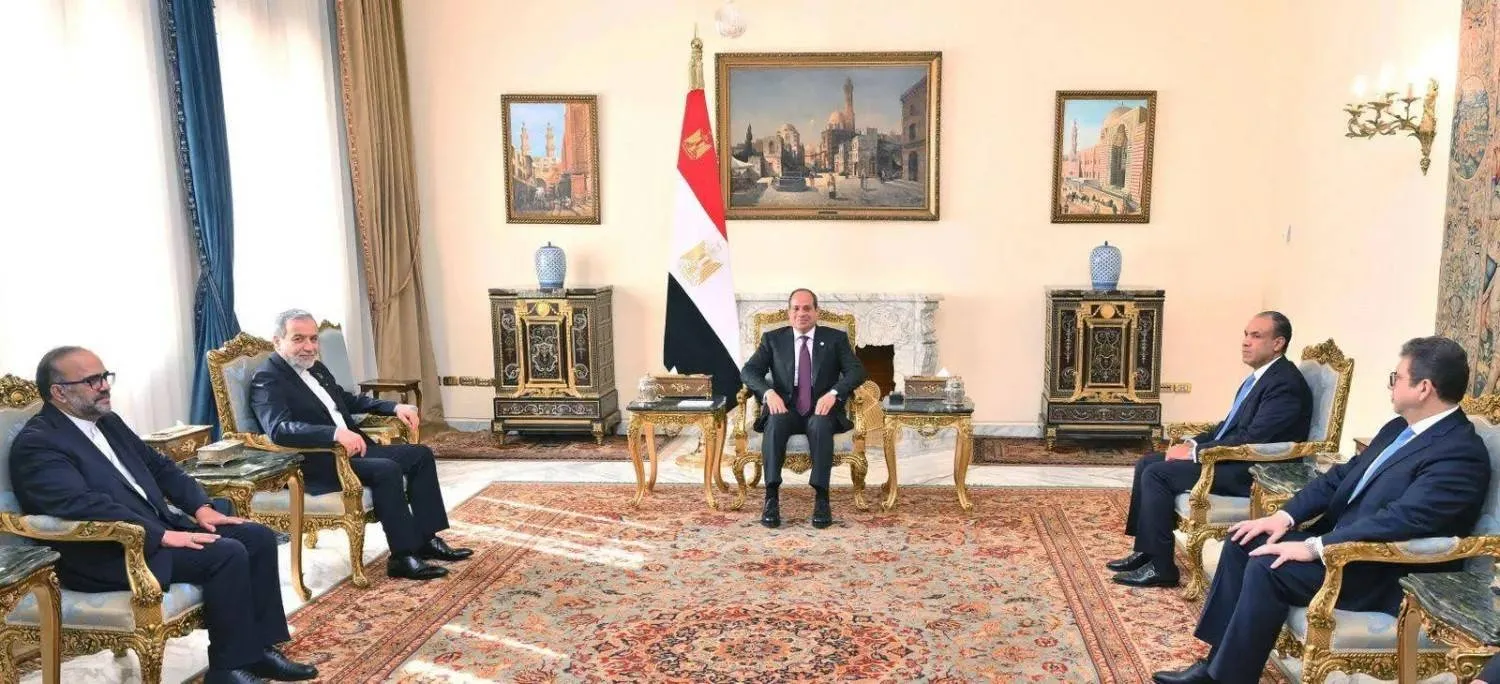
Egyptian contacts with regional leaders and officials continue as part of de-escalation efforts to calm tensions between Washington and Tehran and positive signals over a possible memorandum of understanding to end the war.


Egyptian President Abdel Fattah al-Sisi stressed the need to intensify efforts to reduce regional tension during a phone call with Oman’s Sultan Haitham bin Tariq.


During the call which highlighted the regional developments, Sisi praised Oman’s constructive role in this matter.


He also reviewed Egypt’s efforts toward the same goal. According to a statement by the Egyptian presidency, he stressed the importance of preserving peace and stability in the Middle East, avoiding escalation, and resolving the current crisis through peaceful means.


Egyptian Foreign Minister Badr Abdelatty also held a phone call with Qatar’s Prime Minister and Foreign Minister Sheikh Mohammed bin Abdulrahman Al Thani to discuss ways to advance de-escalation efforts in the region, Egypt’s Foreign Ministry said on Wednesday.


During the call, the two sides stressed the importance of continuing the negotiating track between the US and Iran. They said a political and diplomatic solution was the only and most effective way to address the current crisis.


Abdelatty welcomed a US decision to temporarily halt a military operation linked to reopening the Strait of Hormuz, saying it would provide space for ongoing efforts to reach a final agreement with Iran.


Responsibility and wisdom


The two sides said they hoped all concerned parties would act with responsibility and wisdom, and remain fully committed to diplomacy, negotiations, and dialogue as the main way to address all concerns.


They said lasting regional security and stability depend primarily on prioritizing political solutions that protect the resources of the region’s peoples and safeguard their interests.


At the end of the call, the two ministers agreed to continue their efforts, in cooperation with regional partners and in full coordination with the United States, to quickly reach an agreement on general principles between Washington and Tehran that would address all concerns. Negotiations would then begin on putting those principles into effect.


Abdelatty stressed the need to take into account the security concerns of Gulf states and other countries in the region.


The Egyptian foreign minister also briefed German National Security Adviser Günter Sautter during a phone call on Wednesday on Egypt’s efforts to stop the escalation and contain tensions.


Abdelatty stressed the importance of continuing the negotiating track between the United States and Iran, describing it as the most suitable way to resolve the current crisis.


Continuing contacts


Egyptian contacts have continued notably since the war with Iran broke out in late February. On Tuesday, Abdelatty held phone calls with his counterparts in Saudi Arabia, Prince Faisal bin Farhan; Oman, Badr Albusaidi; Kuwait, Abdullah Ali Al-Yahya; Bahrain, Abdullatif Al Zayani; and the US Middle East envoy, Steve Witkoff.


The calls addressed coordination of regional and international efforts to reduce escalation and contain the current tension.


Abdelatty warned that continued escalation threatens to drag the entire Middle East into chaos, with consequences for international security and stability.


Influential role

The Egyptian contacts are particularly important as hopes grow for a possible final agreement to end the war between Washington and Tehran, according to former Assistant Foreign Minister Ambassador Raouf Saad.

Speaking to Asharq Al-Awsat, Saad said Egypt’s role, whether public or behind the scenes, is calculated and influential, and that everyone in the region understands the importance of its continuation.

He said Egypt’s ongoing contacts to reduce escalation are part of Cairo’s continued role in this track, whether publicly or privately. He added that the move was not a reaction, but a calculated intervention, especially as hopes for an agreement increase.

Saad said everyone understands, especially since the Gaza war, that Egypt’s role is not optional, but central to regional balances. He said stability and balance cannot be achieved without it, and that this role should not be linked to Egypt’s economic situation or crises.

He said the role was not new, but had intensified since the Gaza war and the subsequent tension with Iran. He added that contacts between Cairo and Tehran had continued uninterrupted, reflecting Egypt’s ability to engage with various parties.


Iraqi Kataib Hezbollah Denies Link to Man Charged in US

 Judge Sarah Netburn presides as Mohammad Al-Saadi, accused of planning an attack on a synagogue, appears in federal court in Manhattan, New York, US, May 15, 2026 in this courtroom sketch. (Reuters)
Judge Sarah Netburn presides as Mohammad Al-Saadi, accused of planning an attack on a synagogue, appears in federal court in Manhattan, New York, US, May 15, 2026 in this courtroom sketch. (Reuters)
TT

Iraqi Kataib Hezbollah Denies Link to Man Charged in US

 Judge Sarah Netburn presides as Mohammad Al-Saadi, accused of planning an attack on a synagogue, appears in federal court in Manhattan, New York, US, May 15, 2026 in this courtroom sketch. (Reuters)
Judge Sarah Netburn presides as Mohammad Al-Saadi, accused of planning an attack on a synagogue, appears in federal court in Manhattan, New York, US, May 15, 2026 in this courtroom sketch. (Reuters)

The Iran-backed Iraqi group Kataib Hezbollah, denied on Monday that a man accused of plotting attacks in the United States and Europe was a member of the group.

US authorities on Friday detailed charges against Mohammad Baqer Saad Dawood Al-Saadi, 32, who was identified as a senior figure in Kataib Hezbollah, which the US designates as a terrorist organization.

"The abductee, Mohammaed Baqer al-Saadi does not belong to Kataib Hezbollah," the group's security commander Abou Moujahed al-Assaf said in a statement.

But he added that Saadi "will return to his country with his head held high, because he is among the lovers and supporters of the resistance."

According to US court filings, Saadi and unidentified associates planned, coordinated and claimed responsibility for at least 18 attacks in Europe, and two in Canada, including a non-fatal stabbing of two Jewish men in London, and several arson attacks on synagogues in other countries.

He is most recently alleged to have also plotted attacks in the United States.

He appeared on Friday at a Manhattan court where he was charged with six counts including conspiracy to provide material support to Kataib Hezbollah and Iran's Revolutionary Guard Corps (IRGC).

A senior Iraqi security source told AFP that Saadi was arrested in Türkiye before being transferred to the US.

Kataib Hezbollah is part of the umbrella movement known as the “Islamic Resistance in Iraq”, which claimed hundreds of attacks against US interests in Iraq and the wider region during the Middle East war.

The attacks have ceased since a ceasefire was announced in April.

The US State Department announced last month that it was offering up to $10 million for information on the group's leader, Ahmad al-Hamidawi.


Lebanon Death Toll Reaches 3,000 in Fighting Between Israel and Hezbollah

Smoke rises following Israeli bombardment on the village of Zibdin in the Nabatieh district in southern Lebanon on May 18, 2026. (AFP)
TT

Lebanon Death Toll Reaches 3,000 in Fighting Between Israel and Hezbollah

Smoke rises following Israeli bombardment on the village of Zibdin in the Nabatieh district in southern Lebanon on May 18, 2026. (AFP)

The death toll in the latest round of fighting between Israel and the Iranian-backed Hezbollah in Lebanon has surpassed 3,000, Lebanon's health ministry said Monday.

The ministry said the toll is now 3,020 in the fighting that has not stopped despite a fragile ceasefire, including 292 women and 211 children. Fighting began on March 2 with the Hezbollah group firing at Israel, two days after the US and Israel attacked Iran.

Israel has since invaded southern Lebanon and bombarded the capital, Beirut, and other areas, saying it is targeting Hezbollah efforts to rearm. Hezbollah has resisted pressure, including by the Lebanese government, to disarm.

More than a million people have been displaced in Lebanon by the fighting, with some sheltering in tents along roads and the sea in Beirut. Israel, meanwhile, has struggled to halt frequent Hezbollah drone attacks.

Groundbreaking direct talks between Israel and Lebanon, facilitated by the United States, produced the ceasefire that began on April 17 and has been extended into June. The neighbors have been officially in a state of war since Israel was created in 1948.

Hezbollah, however, is not part of the talks.

Israeli officials have focused on disarming Hezbollah and described the negotiations as a precursor to a potential normalization of diplomatic relations. Lebanese officials have said they seek a security agreement or armistice that would stop short of normalization.

US President Donald Trump has publicly called for a meeting between Lebanese President Joseph Aoun and Israeli Prime Minister Benjamin Netanyahu, while Aoun has declined to meet or speak directly with Netanyahu at this stage — a move that would likely generate blowback in Lebanon, where talks with Israel were met with protests.

Twenty Israeli soldiers, two Israeli civilians inside Israel and a defense contractor working in southern Lebanon have been killed on the Israeli side.

UN peacekeeping forces in southern Lebanon have also been caught in the crossfire and six have been killed.


UN Demands Israel Prevent 'Genocide' in Gaza

Hundreds of thousands of people are still living in tents in the Gaza Strip, pictured in January, and conditions remain dire despite the ceasefire. Bashar Taleb / AFP/File
TT

UN Demands Israel Prevent 'Genocide' in Gaza

Hundreds of thousands of people are still living in tents in the Gaza Strip, pictured in January, and conditions remain dire despite the ceasefire. Bashar Taleb / AFP/File

The United Nations demanded Monday that Israel take measures to prevent acts of "genocide" in Gaza, and decried indications of "ethnic cleansing" in the Palestinian territory and in the occupied West Bank.

In a fresh report, the UN rights office said Israel's actions in Gaza since the start of the war in October 2023 involved "gross violations" of international law, amounting in many cases to "war crimes and other atrocity crimes".

UN rights chief Volker Turk called in the report on Israel to ensure compliance with a 2024 International Court of Justice order that it take measures to prevent acts of genocide in Gaza, AFP reported.

Israel, he said, should ensure "with immediate effect that its military does not engage in acts of genocide, (and take) all measures to prevent and punish incitement to commit genocide".

Israel has repeatedly and forcefully denied allegations of genocide, which have previously been brought by rights groups like Amnesty International and Human Rights Watch, as well as independent UN experts, but never by the United Nations directly.

- 'Unlawful killings' -

Monday's report, which covered the period from October 7, 2023, when Hamas's unprecedented attack inside Israel sparked the Gaza war, up to May 2025, also condemned "serious violations" including some amounting to war crimes, by Palestinian armed groups during the initial attack and after.

The Hamas attack resulted in the deaths of 1,221 people on the Israeli side, most of them civilians, according to an AFP tally based on official data.

Monday's report highlighted the abuse suffered by the hostages seized by the Palestinian armed groups, many of whom reported torture and sexual abuse as they were held "in inhumane conditions" for months on end.

"Most hostages who died in Gaza died while held in secret detention, either killed by their captors or impacts of the conflict occurring around them," it said.

Most of the focus however was on Israel's actions in Gaza, where its retaliatory military campaign has killed more than 72,000 people, according to the health ministry in the Hamas-run territory, whose figures are considered reliable by the UN.

Hundreds of thousands of people are still living in tents and conditions remain dire despite a ceasefire that took effect in October last year.

"The ceasefire diminished the immense scale of violence up to that point, and opened some modest humanitarian space," Ajith Sunghay, head of the UN rights office in the occupied Palestinian territories, told reporters in Geneva.

"But killings and the destruction of infrastructure have continued on an almost daily basis, and the overall humanitarian situation remains dire," he warned.

A large proportion of the killings since the start of the war "appear unlawful", the report said.

It also highlighted how Israel had "directed attacks on civilian or protected objects, including healthcare and medical facilities and attacks on civilians, including journalists, civil defenders, health workers, humanitarian actors and police in a routine and repeated fashion".

Israel's conduct in Gaza had rendered living conditions in much of the territory "incompatible with Palestinians continued existence as a group", it warned.

The report also looked at the situation in the West Bank, where violence has spiralled since the start of the war in Gaza, pointing out that "the use of unnecessary and disproportionate force (there had) led to hundreds of unlawful killings".

- 'Collective punishment' -

"Force displacement on a mass scale" had been seen in both Gaza and the West Bank, it said.

It charged that "the deliberate and unlawful destruction of wide swathes of Gaza", coupled with "the emptying and destruction of large parts of refugee camps in northern West Bank", had contributed to forcing Palestinians from their homes, "with strong indications that Israel intends their displacement to be permanent".

Taken together, Israel's repeated violations across the occupied Palestinian territories indicated a pattern aimed at doling out "collective punishment of Palestinians", and "forced displacement, emptying and ethnic cleansing of large parts of the Occupied Palestinian Territory", said the report.

"Incitement and derogatory and dehumanising language targeted at Palestinians as a group from Israeli officials was also observed with no accountability," it warned.

The rights office stressed that it was "essential that there is due reckoning" for all violations listed in the report through "credible and impartial judicial bodies".

Sunghay warned that "in a context like this, lack of action is not passivity. It is a license".