

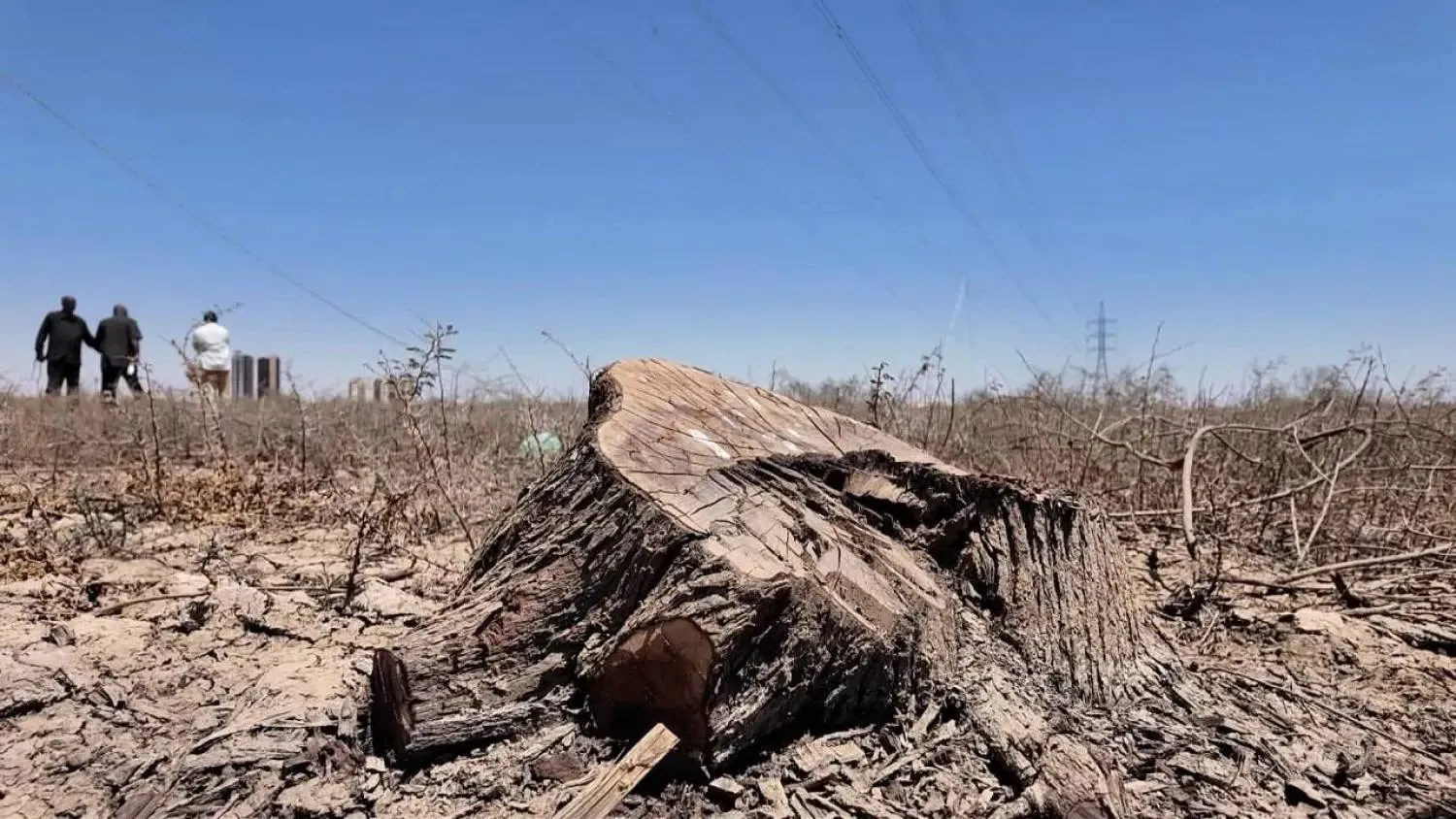

Sudan’s War Fuels Silent Disaster for Forests

Damage to Sudan’s forests caused by the war and indiscriminate tree cutting (Asharq Al-Awsat)
TT

Sudan’s War Fuels Silent Disaster for Forests

Damage to Sudan’s forests caused by the war and indiscriminate tree cutting (Asharq Al-Awsat)

As war tears through Sudan, the environment has been buried beneath the smoke of battle, mass displacement and hunger. Yet it is one of the sectors suffering the broadest and deepest losses.

Experts say what is unfolding in Sudan’s forests is no longer routine environmental degradation. It is a silent disaster threatening the country’s natural resources and climate balance, as the state’s ability to monitor and protect them weakens and living pressures grow.

The collapse of basic services, fuel shortages and soaring living costs have forced thousands of Sudanese families back to firewood and charcoal as alternative energy sources.

The result has been a surge in tree felling and the depletion of forest belts. Internal displacement has added to the pressure, with large numbers of people moving to safer areas and setting up temporary shelters in wooded zones, amid an almost total absence of environmental oversight and law enforcement.

A bitter reality

On the outskirts of Khartoum state, among acacia trees near the confluence of the two Niles, Aisha Abdullah collected firewood and described the choices now facing families.

“We used to rely on cooking gas, but the price of a cylinder has risen to about 90,000 Sudanese pounds, around $22.50, and we can no longer afford it,” she said. “We have no option left but firewood to cook food. We know that cutting trees harms the environment, but how can a family live without food?”

In Gezira state, Salah al-Tayeb said economic hardship has pushed many people toward the forests.

“The price of a sack of charcoal has reached about 105,000 Sudanese pounds, around $26.25, which is beyond the means of most families,” he said. “That is why firewood has become the only available option for many people to meet their daily needs.”

Saadia Abdullah, a tea seller on Nile Street in Omdurman, said the war has upended her work as fuel prices climbed and incomes fell.

“I used to use gas and charcoal in my work normally, but prices have become beyond our capacity,” she said. “Today I rely on firewood so I can prepare tea and continue working under these difficult conditions.”

Accelerating environmental damage

Moussa Suleiman Moussa, director general of the National Forestry Corporation, said forests have become an emergency energy source during the war because of power cuts and shortages of cooking gas.

Official data show about 60% of acacia forests in Gezira state have deteriorated, along with 45% in Sennar state. Other states have been affected to varying degrees.

In remarks to Asharq Al-Awsat, Moussa said Sudan’s forest area is estimated at about 30 million feddans after South Sudan’s secession in 2011, equal to around 12.5% of the country’s area. Plans had aimed to raise that figure to 25% , but the war halted that path and accelerated the depletion.

Bishra Hamed, former head of the Higher Council for Environment and Natural Resources in Khartoum state, said Sudan’s environmental resources are facing a “wide and multifaceted assault” as the effects of war intersect with economic, social and security crises.

He said the weakened role of the state and declining law enforcement have allowed the firewood, charcoal and timber trade to expand. Modern methods are being used to cut trees and move them quickly through networks operating inside and outside the country.

“Between 70% and 80% of the population depends directly on natural resources for their livelihoods, whether through farming, herding or firewood production. This makes environmental degradation a direct threat to economic and social stability in a country already suffering from structural fragility,” he said.

Hamed also warned that unregulated mining inside forests and natural reserves is deepening the crisis by stripping more vegetation and polluting soil and water, creating complex environmental challenges that will be hard to contain in the near term.

Environmental expert Awad Mohammed Siddig said the damage goes beyond temporary resource consumption. It amounts to the rapid dismantling of an entire ecosystem.

He said the loss of vegetation strips soil of its ability to retain moisture and allows desertification to spread in already fragile areas, while habitats disappear and biodiversity declines.

In remarks to Asharq Al-Awsat, Siddig said rural communities are paying the price directly through falling agricultural production, weaker protection from advancing sand and disruption to the water cycle.

Climate and environmental expert Noureldin Ahmed said forests are among Sudan’s most important natural resources because they help moderate the climate, protect soil and provide food and shelter for millions of living organisms.

He said wide areas have become barren after once serving as a natural lung that supplied oxygen and reduced the effects of desertification and climate change. He warned that the continued deterioration of vegetation cover threatens to multiply Sudan’s climate and humanitarian crises.

Mounting economic losses

Forestry expert Talaat Dafallah said the loss of dense vegetation contributes to rising temperatures and weakens the local environment’s ability to absorb carbon emissions.

He said the damage is also draining vital resources such as timber and gum arabic, with annual losses in the forestry sector estimated at about $500 million because of illegal tree cutting.

In remarks to Asharq Al-Awsat, Dafallah said the immediate priority is to reduce household dependence on firewood by providing cooking gas where possible, expanding the use of improved stoves and supporting solar energy in neighborhoods and displacement centers.

The damage has not stopped at the natural environment. It has reached key economic sectors. In Kordofan, one of the world’s most important gum arabic producing regions, production chains have been badly hit, affecting millions of people who depend on the sector as a main source of income.

With the war dragging on and state institutions retreating, Sudan’s environment is facing a real existential challenge. Depletion is accelerating without protection or recovery plans, while environmental, economic and humanitarian losses deepen day by day, raising the prospect of long-term consequences that could affect generations to come.



What Is Behind Claims of RSF Training Camps in Libya?

Military vehicles belonging to the Libyan “National Army” in the south last March. (General Staff)
TT

What Is Behind Claims of RSF Training Camps in Libya?

Military vehicles belonging to the Libyan “National Army” in the south last March. (General Staff)

Talk of ties between Libya's "National Army," led by Field Marshal Khalifa Haftar, and Sudan's Rapid Support Forces (RSF) has resurfaced following fresh allegations that RSF fighters are being trained at camps inside Libya.

The army's General Command rejected the allegations, describing them as "part of a campaign aimed at tarnishing its image."

A senior Libyan military source on Thursday also denied foreign media reports of RSF training camps in Libya, telling Asharq Al-Awsat that the claims were "baseless."

The source, who requested anonymity because of the sensitivity of his position, said the report was “an attempt to cloud the security stability achieved in eastern and southern Libya ... This is false propaganda the General Command has faced for years, especially since the outbreak of the war in Sudan.”

Libyan lawmaker Ali al-Soul, a member of parliament’s National Security Committee, echoed the denial, saying reports of RSF camps on Libyan territory were “nothing more than media lies unsupported by any facts on the ground.”

Al-Soul told Asharq Al-Awsat that “Libya does not interfere in the internal affairs of neighboring countries, and has not and will not fuel any conflicts there.”

“There are no foreign forces from neighboring countries witnessing conflicts, especially Sudan, inside Libyan territory,” adding that Libya acts only through “good offices to calm tensions and protect its national security,” he said.

The Libyan lawmaker said the “National Army” was “doing its duty to protect the country’s sovereignty, borders and resources, fighting smuggling gangs with the available means, and respecting the sovereignty of other states by not backing one side against another.”

Recent reports said southern and eastern Libya host a logistical hub for training RSF fighters, identifying four training camps in areas under the control of the “National Army.”

They include “Camp 17” near Benghazi, where fighters are trained to operate drones and heavy weapons, according to analysis of satellite images and open-source videos.

The reports drew on an investigation by the Dutch organization Lighthouse Reports, in cooperation with Sudan War Monitor and Evident Media, a group specializing in visual investigations.

People close to the “National Army” see the accusations through a different lens, linking them to Libya’s political situation and active international efforts to resolve the crisis, as the country remains divided politically and militarily more than a decade on.

Libyan political analyst Ayoub al-Awjali said the timing of the accusations was “not innocent.”

He told Asharq Al-Awsat they “coincide with the US initiative led by US presidential adviser Massad Boulos on the Libya file,” suggesting they may be part of attempts to “shuffle the political cards and influence the course of ongoing understandings.”

Libya’s political scene is currently focused on an initiative attributed to Boulos that would see Saddam Haftar, deputy commander of the “National Army,” take over the Presidential Council, while the interim Government of National Unity's Prime Minister, Abdulhamid Dbeibah, would remain in a senior role at the head of a unified government.

Al-Awjali did not rule out “efforts by some international parties involved in the Libyan crisis to use such accusations to achieve political gains or reshape the scene in ways that serve their interests, given the advanced steps made by the Boulos initiative.”

He expected “new accusations and attempts” to use various crisis cards in the next phase.

The “National Army” maintains that it has no involvement in Sudan’s conflict, saying its mission is limited to protecting the southern border and preventing threats to Libyan security.

Chief of the General Staff Lieutenant General Khaled Haftar previously made the same point in a televised interview, saying: “The conflict in Sudan is an internal matter in which we do not interfere. Our role is limited to securing Libya’s borders with neighboring countries.”

The parliament-appointed government and Libya’s House of Representatives have also said the same.

Sudan’s representative to the UN Security Council, Al-Harith Idris, had accused Libya’s “National Army” of providing logistical support to the RSF.

In a briefing to the Security Council last month, he said the Subul al-Salam Battalion, based in Kufra, was transferring ammunition and mortar rounds from the warehouses of the 106th Brigade to the RSF.

In December, Reuters reported that an airstrip at Kufra airport in southeastern Libya had been used as a logistical platform to support military operations linked to El Fasher, an allegation the “National Army” denied.


Syrian FM in Beirut to Reassure Lebanon Over Military Intervention Fears

 Syrian Foreign Minister Asaad al-Shibani arrives at the government palace in Beirut. (AP)
Syrian Foreign Minister Asaad al-Shibani arrives at the government palace in Beirut. (AP)
TT

Syrian FM in Beirut to Reassure Lebanon Over Military Intervention Fears

 Syrian Foreign Minister Asaad al-Shibani arrives at the government palace in Beirut. (AP)
Syrian Foreign Minister Asaad al-Shibani arrives at the government palace in Beirut. (AP)

Syrian Foreign Minister Asaad al-Shibani sought on Thursday to allay Lebanese fears of possible Syrian military intervention, assuring that Damascus had “no intention of taking any military step.”

The assurance came during his visit to Beirut, whose meetings extended beyond Lebanese officials, including his first meeting with Parliament Speaker Nabih Berri, to a broad spectrum of political forces. During the visit, Shibani also expressed Damascus's openness to meeting Hezbollah “if the interest requires it.”

The broad meetings in Beirut conveyed a message of Syrian openness toward Lebanon's political forces. They were the first of their kind between a senior Syrian official and representatives of Lebanese parties, underscoring Damascus' desire to open a new chapter with all Lebanese, across the political spectrum.

The most striking stop was Shibani’s first meeting with Berri, one of Hezbollah’s most prominent allies inside Lebanon.

Afterward, Shibani described the meeting as excellent. He also said a future meeting with Hezbollah was possible “if the interest requires it,” while stressing that no such meeting was scheduled during his current visit to Beirut.

Military intervention confusion

Shibani arrived in Lebanon on Thursday morning on his second visit to the neighboring country. He began his meetings with Lebanese President Joseph Aoun, during which the Syrian delegation sought to “clarify the confusion” surrounding talk of a Syrian military intervention in Lebanon.

The delegation said “Syria has no intention of taking such a step,” stressing that Damascus wanted to deal with Lebanon “from state to state.”

It said Syria stood by the Lebanese state in its decisions and choices, and wanted to develop bilateral and economic ties while contributing to Lebanon’s security and stability, which it said would also benefit Syria.

Shibani said the visit aimed to strengthen and steadily develop relations between the two countries, praising existing coordination.

He said Syria’s current authorities were working to close the chapter on the mutual interference that had marked relations in the past, and wanted to expand cooperation at all levels while engaging with all Lebanese parties.

Shibani called for continued and stronger coordination between Lebanon and Syria, and for a shared vision for solutions in the region and in both countries.

He pointed to efforts to build a Lebanese-Syrian economic partnership with Gulf states open to the idea, and said coordination through the committee formed by the two countries was important to advance work on the economy, energy and other fields.

Shibani also invited Aoun to visit Damascus and hold a summit with Syrian President Ahmed al-Sharaa.

Aoun

The Lebanese presidency said Aoun “affirmed Lebanon’s commitment to brotherly relations with Syria based on cooperation, coordination and non-interference in the internal affairs of both countries,” and to developing those ties across all fields.

Aoun said such relations were especially important after a previous period of mutual interference that created tension and caution.

He said that the chapter should end through state-to-state relations, respect for each country’s particularity and good neighborly ties, because what affects Syria, positively or negatively, also affects Lebanon, and vice versa.

Aoun welcomed security coordination between the two countries, “particularly in controlling the border and preventing all forms of smuggling, including weapons, drugs and people, in both directions, in the interest of both Lebanon and Syria.”

He also welcomed the formation of a higher committee to safeguard their shared interests.

Aoun said Lebanon was following events in Syria, especially in the south. He said he always calls, in regional and international meetings and contacts, for Israel to withdraw from Lebanon and Syria so the region can enjoy stability and security.

He said he was keen on Syria’s stability, just as Syria was keen on Lebanon’s stability.

Economic cooperation

Shibani also met Prime Minister Nawaf Salam. At a joint news conference, the two sides announced the formation of a joint higher committee that Shibani said would serve as “a platform for all relevant ministries to develop economic, investment and trade partnerships, as well as security understandings, and expand cooperation between the two countries.”

Salam said the two sides also discussed electricity interconnection between Lebanon and Syria, transport, the exchange of goods and easier movement across their border, which stretches for more than 300 km.

He said he had discussed those issues with Sharaa during his last visit to Damascus in May.

Dar al-Fatwa

Shibani visited Lebanon’s Grand Mufti, Sheikh Abdul Latif Derian. Dar al-Fatwa said the meeting covered Islamic and national affairs, strengthening ties between the two countries, and the importance of consultation, communication, cooperation and coordination between the Lebanese and Syrian states.

Derian praised “the efforts and endeavors of Syrian President Ahmed al-Sharaa and his keenness on Lebanon’s sovereignty, unity, Arab identity and the extension of its authority over all Lebanese territory.”

Derian placed great importance on the Syrian foreign minister’s visit to Lebanon at a difficult time for the country.

“Lebanon will remain in solidarity and cooperation with Syria and with all brotherly Arab states, away from axes and conflicts that threaten the security of Lebanon and the Arab region,” he said.

Shibani also visited Maronite Patriarch Bechara al-Rai.

Jumblatt

Former Progressive Socialist Party leader Walid Jumblatt received Shibani.

“Between a balanced and objective relationship with Syria, and an agreement that could lead to worse than the May 17 Agreement, I prefer a balanced relationship with Syria,” Jumblatt said after the meeting.

“A good relationship between Lebanon and Syria is a historical destiny,” he added.


Sources Reveal to Asharq Al-Awsat How Hamas Identified Suspects in the Assassinations of Haddad and Ouda

 Palestinians inspect the site of a destroyed building as smoke billows following an Israeli airstrike in the Al Rimal neighborhood of Gaza City, Gaza Strip, 15 May 2026 EPA/MOHAMMED SABER
Palestinians inspect the site of a destroyed building as smoke billows following an Israeli airstrike in the Al Rimal neighborhood of Gaza City, Gaza Strip, 15 May 2026 EPA/MOHAMMED SABER
TT

Sources Reveal to Asharq Al-Awsat How Hamas Identified Suspects in the Assassinations of Haddad and Ouda

 Palestinians inspect the site of a destroyed building as smoke billows following an Israeli airstrike in the Al Rimal neighborhood of Gaza City, Gaza Strip, 15 May 2026 EPA/MOHAMMED SABER
Palestinians inspect the site of a destroyed building as smoke billows following an Israeli airstrike in the Al Rimal neighborhood of Gaza City, Gaza Strip, 15 May 2026 EPA/MOHAMMED SABER

The announcement by security bodies affiliated with Hamas in Gaza that they had executed a Palestinian convicted of "collaborating" in the killing of the late Izz al-Din Haddad, former commander of the Izz al-Din al-Qassam Brigades, the movement's armed wing, drew attention inside and outside Gaza. The announcement came nearly two months after Israel killed Haddad and his successor, Mohammed Ouda, in separate strikes less than two weeks apart.

Hamas sources told Asharq Al-Awsat some details of how suspects in the killings of Haddad and Ouda were identified, revealing that the movement's security services are preparing to announce another execution involving a second individual accused of providing information that helped facilitate Ouda's assassination.

Although a ceasefire was supposed to have taken effect in Gaza last October, Israel has continued to kill members and senior figures of Hamas and the Qassam Brigades.

A statement issued Wednesday evening by the so-called "Resistance Security" in Gaza said it had executed an individual identified only by the initials "M.M." after completing what it described as all "revolutionary procedures." The statement said the man had been convicted of collaborating with Israeli intelligence and providing information that led to several attacks resulting in the deaths of Palestinians, including leaders of armed factions, most recently Haddad.

Two Hamas sources, one with field knowledge and the other from the movement's security apparatus, separately described to Asharq Al-Awsat how the suspect was apprehended.

Went to the Hospital to Confirm Victims' Identities

The field source said the suspect was arrested immediately after Haddad's assassination on May 15, 2026, at the scene of the attack after being observed communicating with an Israeli intelligence officer.

The security source, however, said the suspect was arrested the following day after he was spotted at the attack site. The source said he was also seen at Al-Shifa Hospital on the day of the strike to verify the identities of those killed and wounded. He allegedly returned to the hospital the next day, searching the buildings for resistance members who had been injured in earlier airstrikes.

Both sources claimed the suspect confessed immediately after his arrest to collaborating with Israeli intelligence, which they said had recruited him to monitor several locations linked to the Haddad family. They said he admitted moving between those locations and being present at the scene after Haddad, his wife and his daughter were targeted while traveling in a vehicle on Al-Wahda Street east of Gaza City.

According to the security source, the 47-year-old suspect also confessed to providing information that contributed to the killings of around 30 fighters from the Qassam Brigades and other armed factions, most of them from the Sheikh Radwan Battalion. The source added that surveillance equipment and devices used to track entry and exit routes were found in his possession when he was arrested at Al-Shifa Hospital.

Smoke billows from a residential building that was hit by an Israeli strike the previous day in the Rimal neighbourhood of Gaza City on May 16, 2026.(Photo by Omar AL-QATTAA / AFP)

Intensive Surveillance of Mohammed Ouda's Wife

The two sources said Hamas is continuing efforts to track down and arrest individuals it describes as collaborators.

The security source said another suspect was arrested two days after the killing of Mohammed Ouda, who had assumed command of the Qassam Brigades' General Staff following Haddad's death before being killed by Israel on May 26.

The source said the detainee in the Ouda case was not a Hamas member and would also be executed after all "revolutionary procedures" had been completed.

According to sources in Gaza, the term "revolutionary procedures" refers to informing the suspect's family, the families of those allegedly killed as a result of information he provided, and the armed factions of the investigation's findings.

The Hamas security source said the suspect in Ouda's assassination admitted collaborating with Israeli intelligence and contributing to the killing of several prominent field operatives, in addition to his alleged role in Ouda's assassination. According to the source, the suspect's Shin Bet handler provided him with information related to the Haddad family's identity and whereabouts and specifically instructed him to monitor Ouda's wife.

The field source added that on the day Ouda was killed, his wife was under close surveillance by the alleged collaborator as she prepared the evening meal for the Day of Arafah fast. She reportedly left the family's newly rented apartment to prepare the meal while Ouda was on his way to join them. He later arrived and ate with his family before the apartment was struck, after the detained suspect allegedly confirmed to his handlers that they were all inside.

The source said Hamas security personnel had become suspicious of several individuals in the vicinity of the apartment targeted in the strike on Ouda and monitored the suspect for some time before arresting him.

According to the two sources, modern communication devices were seized from both suspects accused in the assassinations of Haddad and Ouda.

During the war and after the ceasefire, Hamas security services have executed several people convicted of collaborating with Israel in connection with a series of assassinations targeting senior leaders, including the late Qassam Brigades commander Mohammed Deif. According to the sources, some of those executed were Hamas members, although most were not affiliated with the movement.