
Syrian FM in Beirut to Reassure Lebanon Over Military Intervention Fears

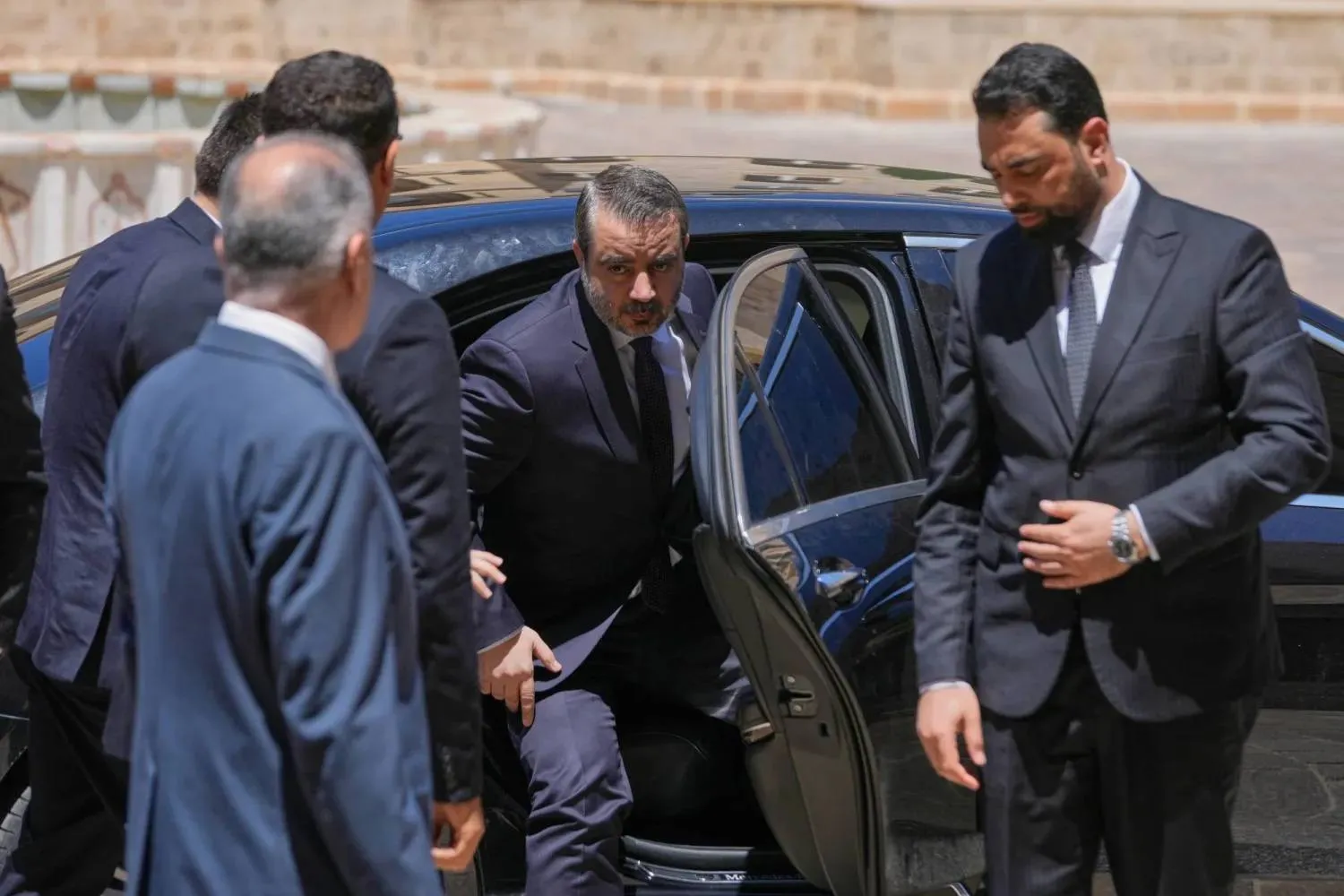
 Syrian Foreign Minister Asaad al-Shibani arrives at the government palace in Beirut. (AP)
Syrian Foreign Minister Asaad al-Shibani arrives at the government palace in Beirut. (AP)
TT

Syrian FM in Beirut to Reassure Lebanon Over Military Intervention Fears

 Syrian Foreign Minister Asaad al-Shibani arrives at the government palace in Beirut. (AP)
Syrian Foreign Minister Asaad al-Shibani arrives at the government palace in Beirut. (AP)

Syrian Foreign Minister Asaad al-Shibani sought on Thursday to allay Lebanese fears of possible Syrian military intervention, assuring that Damascus had “no intention of taking any military step.”

The assurance came during his visit to Beirut, whose meetings extended beyond Lebanese officials, including his first meeting with Parliament Speaker Nabih Berri, to a broad spectrum of political forces. During the visit, Shibani also expressed Damascus's openness to meeting Hezbollah “if the interest requires it.”

The broad meetings in Beirut conveyed a message of Syrian openness toward Lebanon's political forces. They were the first of their kind between a senior Syrian official and representatives of Lebanese parties, underscoring Damascus' desire to open a new chapter with all Lebanese, across the political spectrum.

The most striking stop was Shibani’s first meeting with Berri, one of Hezbollah’s most prominent allies inside Lebanon.

Afterward, Shibani described the meeting as excellent. He also said a future meeting with Hezbollah was possible “if the interest requires it,” while stressing that no such meeting was scheduled during his current visit to Beirut.

Military intervention confusion

Shibani arrived in Lebanon on Thursday morning on his second visit to the neighboring country. He began his meetings with Lebanese President Joseph Aoun, during which the Syrian delegation sought to “clarify the confusion” surrounding talk of a Syrian military intervention in Lebanon.

The delegation said “Syria has no intention of taking such a step,” stressing that Damascus wanted to deal with Lebanon “from state to state.”

It said Syria stood by the Lebanese state in its decisions and choices, and wanted to develop bilateral and economic ties while contributing to Lebanon’s security and stability, which it said would also benefit Syria.

Shibani said the visit aimed to strengthen and steadily develop relations between the two countries, praising existing coordination.

He said Syria’s current authorities were working to close the chapter on the mutual interference that had marked relations in the past, and wanted to expand cooperation at all levels while engaging with all Lebanese parties.

Shibani called for continued and stronger coordination between Lebanon and Syria, and for a shared vision for solutions in the region and in both countries.

He pointed to efforts to build a Lebanese-Syrian economic partnership with Gulf states open to the idea, and said coordination through the committee formed by the two countries was important to advance work on the economy, energy and other fields.

Shibani also invited Aoun to visit Damascus and hold a summit with Syrian President Ahmed al-Sharaa.

Aoun

The Lebanese presidency said Aoun “affirmed Lebanon’s commitment to brotherly relations with Syria based on cooperation, coordination and non-interference in the internal affairs of both countries,” and to developing those ties across all fields.

Aoun said such relations were especially important after a previous period of mutual interference that created tension and caution.

He said that the chapter should end through state-to-state relations, respect for each country’s particularity and good neighborly ties, because what affects Syria, positively or negatively, also affects Lebanon, and vice versa.

Aoun welcomed security coordination between the two countries, “particularly in controlling the border and preventing all forms of smuggling, including weapons, drugs and people, in both directions, in the interest of both Lebanon and Syria.”

He also welcomed the formation of a higher committee to safeguard their shared interests.

Aoun said Lebanon was following events in Syria, especially in the south. He said he always calls, in regional and international meetings and contacts, for Israel to withdraw from Lebanon and Syria so the region can enjoy stability and security.

He said he was keen on Syria’s stability, just as Syria was keen on Lebanon’s stability.

Economic cooperation

Shibani also met Prime Minister Nawaf Salam. At a joint news conference, the two sides announced the formation of a joint higher committee that Shibani said would serve as “a platform for all relevant ministries to develop economic, investment and trade partnerships, as well as security understandings, and expand cooperation between the two countries.”

Salam said the two sides also discussed electricity interconnection between Lebanon and Syria, transport, the exchange of goods and easier movement across their border, which stretches for more than 300 km.

He said he had discussed those issues with Sharaa during his last visit to Damascus in May.

Dar al-Fatwa

Shibani visited Lebanon’s Grand Mufti, Sheikh Abdul Latif Derian. Dar al-Fatwa said the meeting covered Islamic and national affairs, strengthening ties between the two countries, and the importance of consultation, communication, cooperation and coordination between the Lebanese and Syrian states.

Derian praised “the efforts and endeavors of Syrian President Ahmed al-Sharaa and his keenness on Lebanon’s sovereignty, unity, Arab identity and the extension of its authority over all Lebanese territory.”

Derian placed great importance on the Syrian foreign minister’s visit to Lebanon at a difficult time for the country.

“Lebanon will remain in solidarity and cooperation with Syria and with all brotherly Arab states, away from axes and conflicts that threaten the security of Lebanon and the Arab region,” he said.

Shibani also visited Maronite Patriarch Bechara al-Rai.

Jumblatt

Former Progressive Socialist Party leader Walid Jumblatt received Shibani.

“Between a balanced and objective relationship with Syria, and an agreement that could lead to worse than the May 17 Agreement, I prefer a balanced relationship with Syria,” Jumblatt said after the meeting.

“A good relationship between Lebanon and Syria is a historical destiny,” he added.


Sources Confirm to Asharq Al-Awsat that Senior Hamas Commander Killed in Gaza

Izz al-Din ​Al-Beik, the head of Hamas armed wing in the northern Gaza Strip
TT

Sources Confirm to Asharq Al-Awsat that Senior Hamas Commander Killed in Gaza

Izz al-Din ​Al-Beik, the head of Hamas armed wing in the northern Gaza Strip

Four Hamas sources in the Gaza Strip confirmed on Tuesday that Israel assassinated the commander of the Al-Qassam Brigades' Northern Brigade, Izz al-Din al-Beik, in an airstrike in the Al-Nasr neighborhood, northwest of Gaza City.

The sources said in separate statements to Asharq Al-Awsat that al-Beik, known by the nom de guerre of "Ashmawi," was killed on the spot after being targeted in a strike that hit a residential apartment with three missiles.

Israeli Prime Minister Benjamin Netanyahu and Defense Minister Israel Katz announced the operation, confirming al-Beik's assassination.

The attack occurred at 3:30 AM, as witnessed by the Asharq Al-Awsat reporter, who noted that fire consumed the apartment and continued burning for more than half an hour until Civil Defense crews managed to extinguish it.

The attack took place adjacent to another residential building subjected to a similar daytime attack about two months ago. During that strike, Adham Nassan, commander of operations in the Gaza Brigade of the Al-Qassam Brigades and one of those who played a prominent role in the October 7, 2023 attack, was assassinated.

Previous Assassination Attempt

Al-Beik had previously survived an assassination attempt end of May, just days after the killing of Izz al-Din al-Haddad and Muhammad Awad, who successively led the Al-Qassam Brigades in the Gaza Strip, succeeding Muhammad al-Sinwar.

Imad Islim, deputy commander of the Gaza Brigade and commander of the Zeitoun Battalion, was killed in that raid. Sources told Asharq Al-Awsat at the time that a meeting was set to take place between Islim and al-Beik, along with the new commander of the Gaza Brigade, Muhannad Rajab, but the latter two had not arrived at the location when the raid was executed.

This operation came about two weeks after the assassination of the commander of the Khan Younis Brigade in Al-Qassam, Muhammad al-Yazouri, and the commander of the Rafah Brigade, Nael Abu Obeid.

Who is al-Beik

Izz al-Din al-Beik, 48, a resident of the Faluja area in Jabalia camp - one of Hamas's most prominent strongholds - had been a top activist in the movement for many years.

With the outbreak of the Second Al-Aqsa Intifada, he began working with the Al-Qassam Brigades and was heavily active in operations confronting Israeli incursions into the camp and the town of Beit Lahia. He was among the first to use "Al-Yassin" anti-armor shells to counter a major Israeli military operation targeting Jabalia camp in 2004.

According to Hamas sources speaking to Asharq Al-Awsat, al-Beik led the first special forces unit in Al-Qassam in Jabalia camp, currently known as "Elite" (Nukhba). For many years, he led the "Imad Aql" (Western) Battalion in the Jabalia camp area before leaving it to become the head of the intelligence apparatus for the Northern Brigade.

Following the assassination of Ahmad al-Ghandour in November 2023, he became the commander of the Northern Brigade.

Sources say that during his time as head of intelligence for the Northern Brigade, he was described as the "spoiled boy" of Muhammad Awad, who was then head of the intelligence corner for the entire Gaza Strip. The two shared a special relationship and were both residents of Jabalia camp.

The sources clarify that he led the operation that foiled what was called the "Generals' Plan" during the recent war, which aimed to displace the residents of the northern Gaza Strip, and he stood ground alongside his fighters in face-to-face battles against the Israeli army.

One Hamas source who knew him well described him as a skilled sniper who also took responsibility for operations management in the Northern Brigade for a certain period.

Both before and during the war, al-Beik survived several assassination attempts. One occurred inside Jabalia camp during which his bodyguard was killed.


Syria Tightens Public Spending Amid Rising Regional Tension

Syrian Finance Minister Mohammed Yisr Barnieh participates in the launch of an electronic link between the Popular Credit Bank and Al-Haram Transfer Company (minister’s account)
TT

Syria Tightens Public Spending Amid Rising Regional Tension

Syrian Finance Minister Mohammed Yisr Barnieh participates in the launch of an electronic link between the Popular Credit Bank and Al-Haram Transfer Company (minister’s account)

The General Secretariat of the Syrian Presidency has approved a series of measures to control and rationalize public spending, aimed at safeguarding the state budget.

Syrian Finance Minister Mohammed Yisr Barnieh said Monday that the measures would not affect salaries, wages or essential expenditures, particularly in the health, education, water, energy, security, public safety and operational maintenance sectors.

As Syrians fear a harsh winter that could revive memories of the difficulties they faced during the war and shortages of basic necessities, the Syrian government is increasingly concerned about continued regional escalation and rising energy production and fuel costs.

Sources close to the government told Asharq Al-Awsat that there was concern over continued escalation in the region, particularly the wars in Iran and Yemen, and its impact on Arab Gulf states, which have become Syria’s new financial lifeline.

They said the escalation was casting a dark and direct shadow over the country’s political and economic landscape and threatening recovery efforts, amid the possibility of declining support and investment.

Barnieh explained in a Facebook post Monday that the measures include limiting nonessential expenditures and reprioritizing spending and investment projects, while postponing projects that can be deferred according to their necessity, readiness and financial, economic and social impact.

The financial measures are aimed at improving the efficiency of public spending by directing available resources toward projects with a direct impact, strengthening the budget’s ability to withstand current pressures and preserving fiscal sustainability, according to the minister.

The launch of the public spending rationalization plan coincides with preparations for the 2027 budget, amid challenges related to containing the current year’s fiscal deficit.

Public spending during the first half of this year reached about $3.7 billion, compared with total public revenue of around $2.7 billion, according to the state budget’s fiscal performance report issued last August, which estimated the fiscal deficit at approximately $1 billion.

Compared with the first half of 2025, public revenue rose by about 111%, while public spending increased by around 331%.

The government says the increase in spending was primarily linked to higher salaries and wages, expanded spending on government priorities and higher costs for a number of goods, services and inputs as a result of regional developments and rising import prices.

The government is working to cover the budget deficit through financial instruments such as short-term bonds and efforts to attract foreign investment, as living conditions worsen and the gap between salaries and wages and the cost of basic necessities widens.

The government raised fuel prices on Sept. 13 by between 25% and 40%, covering gasoline, diesel and household gas.

More than 90% of Syrians live below the poverty line, while 65% live in extreme poverty, according to UN figures.

Estimates indicate that a Syrian family of five needs more than $500 a month — nearly 6 million Syrian pounds at prevailing valuations — to meet minimum basic needs. By contrast, salaries in the public and private sectors often do not exceed $100 to $150.


WHO: Houthi Attacks Leave More than 4,000 Victims in Yemen

A displaced Yemeni walks at Al-Firdaws camp in Ras Imran, on the western outskirts of Aden, Yemen, Monday, Sept. 28, 2026. (AP Photo/Abdulnasser Alseddik)
TT

WHO: Houthi Attacks Leave More than 4,000 Victims in Yemen

A displaced Yemeni walks at Al-Firdaws camp in Ras Imran, on the western outskirts of Aden, Yemen, Monday, Sept. 28, 2026. (AP Photo/Abdulnasser Alseddik)

The health and humanitarian situations in Yemen continue to deteriorate as fighting intensifies, with 809 new casualties recorded during the reporting period between September 19 and 26, including 164 deaths, the World Health Organization said on Monday.

The new figures brought the cumulative total since Aug. 6 to 4,481 casualties, including 838 deaths.

In its fifth Situation Report on the Conflict Escalation in Yemen, WHO said deaths represented 20% of newly reported casualties during the reporting period, compared with 24% in the previous period and 17% before that, while casualties continue to rise at roughly 100 per day.

It said Lahj remains the heaviest front where Al-Madharibah wa Ras Al-Arah and the Bab Al-Mandab coast accounted for the largest daily burden on both days for which detailed field reports were available, it said.

The area recorded 47 casualties on Sept. 21, including 18 deaths, and 34 casualties on Sept. 26.

The next highest casualty burdens were reported in Marib and Taiz, according to WHO.

Displaced Yemeni families from Al-Kadha, west of Taiz, gather at the Al-Akdaf camp in Taiz, Yemen, Saturday, Sept. 26, 2026. (AP Photo/Abdulnasser Alseddik)

Displacement Doubled

As the number of victims has risen in Yemen, the Situation Report said displacement has grown by more than half in eight days.

The Executive Unit for IDPs consolidated report of September 24 registered 27,413 displaced families (180,513 people) across ten governorates, up from 17,852 families (122,297 people) on September 15.

It said Marib and Al-Dhale have been added as governorates of arrival while Aden has more than tripled its caseload to 3,741 families.

WHO also noted that displaced families face rising risks of cholera, measles, malaria and dengue, and disrupted maternal, mental health and chronic care.

The UN agency warned that the Rapid Response Mechanism (RRM) registrations reached their highest daily levels of the crisis, with 1,315 households on Sep 21 and 1,470 on Sep 23.

Meanwhile, cholera alerts were registered in two displacement sites in Aden and suspected cholera cases reached 7,784 in a week.

Also, WHO said, around 40% of newly displaced households on the West Coast draw drinking water from unprotected wells or surface water, and nearly one third have no lockable latrine.

Volunteer Naseem Al-Adini, right, provides free meals to displaced people at the Al-Akdaf camp in Taiz, Yemen, Saturday, Sept. 26, 2026. (AP Photo/Abdulnasser Alseddik)

Hospitals Under Pressure

The UN report said the rise in injuries has placed further strain on the healthcare system, with some hospitals temporarily suspending emergency obstetric and neonatal services and referring patients to other facilities able to accommodate them.

Additionally, fewer facilities are reporting in Marib, Taiz, Al-Dhale and Aden, where only about 60% were fully functional before the escalation as verification is under way.

In an effort to strengthen response, the UN agency said it had sent 258 units of the Interagency Emergency Health Kit (IEHK) and the Trauma and Emergency Surgery Kit (TESK) to Yemen, worth more than $184,000.

It also provided additional supplies valued at around $656,000 to 40 health facilities across 10 governorates, alongside securing additional funding for surgical services, trauma care and the response to epidemic diseases.