
Lebanon Limits Security Delegation’s Role to ‘Technical’ Talks with Israel

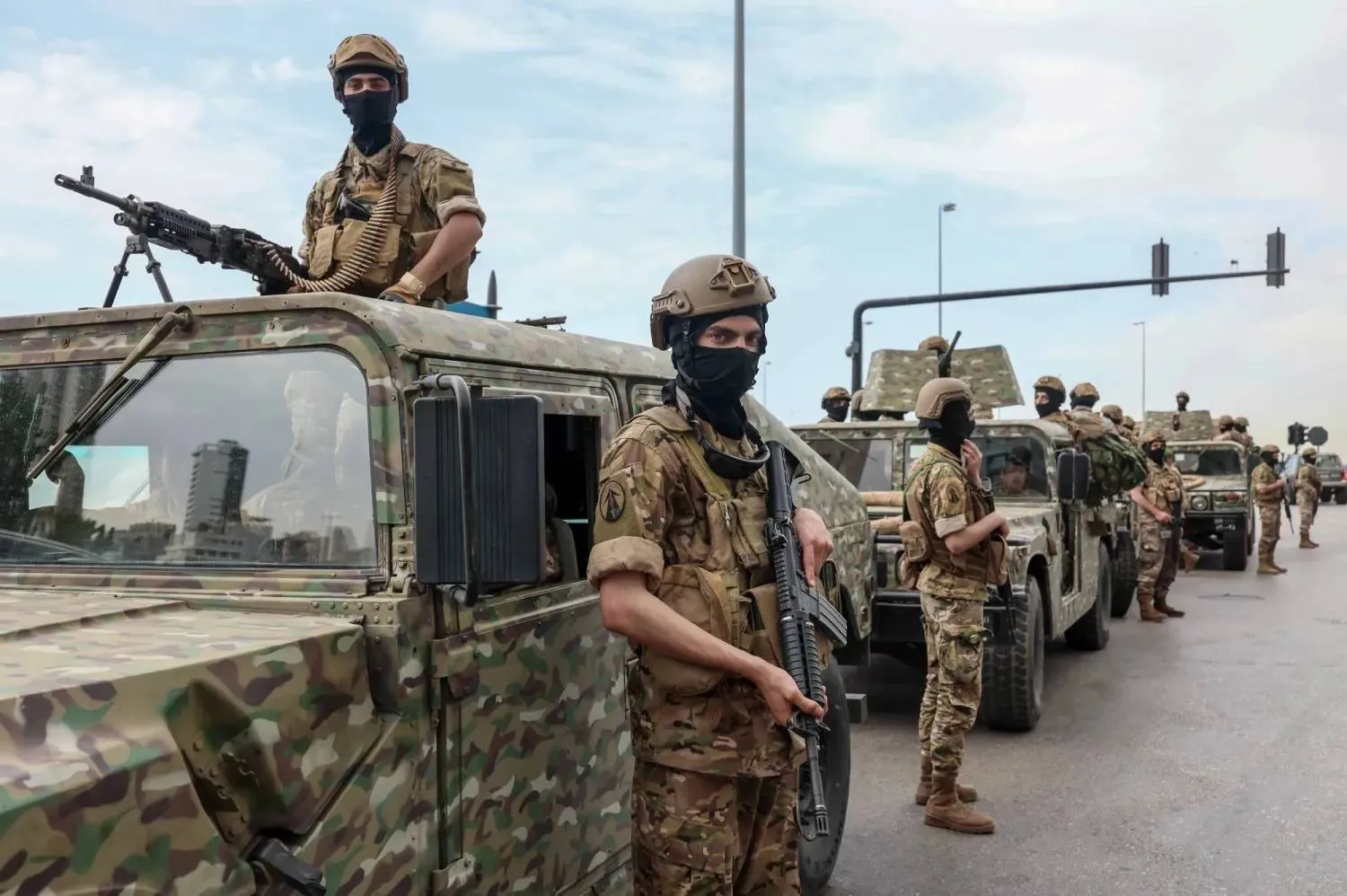
Lebanese Army troops deployed in central Beirut last week. (EPA)
TT

Lebanon Limits Security Delegation’s Role to ‘Technical’ Talks with Israel

Lebanese Army troops deployed in central Beirut last week. (EPA)

Hezbollah threatened on Tuesday to attack any armed force that coordinates with Israel if such a force were ever created. The warning came ahead of a planned security meeting between Lebanese and Israeli military representatives in Washington on May 29, even though Lebanese officials insist that no proposal to establish such a force exists.

According to official Lebanese sources speaking to Asharq Al-Awsat, the upcoming meeting will focus strictly on technical and logistical matters between representatives of the Lebanese and Israeli armies under US sponsorship and mediation.

Still, MP Hassan Fadlallah, a member of the party’s parliamentary bloc, issued a sharp warning against what he described as “American-Israeli talk” of creating a proxy armed force similar to the “Free Lebanon Army” established in 1978 and the “South Lebanon Army” formed in 1984, both of which collaborated with Israel.

Fadlallah said Hezbollah would confront any such force “as we confront the enemy.” At the same time, he praised the relationship between Hezbollah and the Lebanese Army, describing it as “excellent.”

Lebanese sources dismissed the MP’s remarks as reactions to “speculative media reports about the upcoming talks”.

Speaking to Asharq Al-Awsat, the sources said the idea of creating a pro-Israel Lebanese force “has never been discussed” in negotiations in Washington and has not been raised by any international envoy visiting Lebanon.

They added that the Lebanese Army categorically rejects any proposal to establish an independent force, an idea that had also circulated in local media reports.

Trilateral committee and expanded UN monitoring

The May 29 meeting is expected to focus on two proposals. The first involves establishing a trilateral committee made up of representatives from the Lebanese Army, the Israeli military, and the US Army. It would monitor ceasefire violations, oversee the Israeli withdrawal from Lebanese territory, and coordinate the deployment of the Lebanese Army in those areas.

The talks are also expected to address expanding the role of the United Nations Truce Supervision Organization (UNTSO), the UN’s first-ever peacekeeping mission, founded in May 1948 to monitor ceasefire agreements between Israel and neighboring states, including Lebanon. UNTSO observers are limited to monitoring and reporting duties rather than combat operations.

The sources said one proposal under discussion is to strengthen the observer mission by increasing the number of personnel and expanding its operations.

Unlike the UN Interim Force in Lebanon (UNIFIL), which is expected to fully withdraw from Lebanon later this year, the UNTSO maintains only a small presence in Lebanon. Its observers, numbering only in the dozens, operate within the “Observer Group Lebanon” along the Blue Line to monitor the truce agreement between Lebanon and Israel.

Strictly military and technical files

The sources emphasized that the May 29 meeting will remain strictly technical and military in nature. Diplomatic negotiators, including Lebanon’s chief negotiator Ambassador Simon Karam and Lebanese Ambassador to Washington Nada Hamadeh Mouawad, are not expected to participate directly in the military discussions.

The agenda is likely to center on the ceasefire, Israeli withdrawal, and mechanisms for deploying the Lebanese Army in southern Lebanon.

The sources stressed that the meeting will not address Hezbollah’s weapons or any cooperation regarding its disarmament, saying those matters fall under the authority of the diplomatic negotiating team.

Hezbollah criticizes Lebanese leadership

Despite those assurances, Hezbollah continued to criticize the political and diplomatic approach pursued by Lebanese President Joseph Aoun to resolve the crisis. Relations between the party and Aoun remain strained.

Although Hezbollah appointed MP Fadlallah to coordinate with the presidency, Lebanese sources said he has neither met nor spoken with Aoun. The party has effectively suspended dialogue with the president, even though the presidential palace remains open, said the sources.

During a press conference in parliament, Fadlallah accused the government of breaking its commitment not to enter negotiations before a ceasefire was secured.

He questioned “how anyone can sit at a table with those continuing their crimes while Israel boasts of support from its allies in pursuing a destructive project.”

Fadlallah insisted that Lebanon’s only viable option is continued “resistance combined with indirect diplomacy backed by national unity and strength,” arguing that “no political alternative could compel Israel to halt the war and withdraw from Lebanese territory.”

In contrast, the Lebanese Kataeb Party called for broad national support for the negotiations in Washington, saying the process aims to consolidate the ceasefire, secure an Israeli withdrawal, end hostilities, free detainees, and allow displaced residents to return home.

The party accused Hezbollah of trying to keep Lebanon “a card in Iran’s hands” at the expense of South Lebanon and its residents.

Jordan Says Shot Down Drone in its Airspace

AP file photo shows Jordanian soldiers
TT

Jordan Says Shot Down Drone in its Airspace

AP file photo shows Jordanian soldiers

The Jordanian military announced it had shot down a drone of unknown origin in its airspace on Wednesday. No casualties were reported.

"This morning, the Jordanian Armed Forces engaged with a drone of unknown origin that entered Jordanian airspace and was brought down in Jerash Governorate, without any injuries," the military said of an area located around 50 kilometres (30 miles) north of the capital Amman.


First of Hundreds of Detained Gaza Flotilla Activists Arrive in Israel

 Israeli soldiers are seen on a vessel bearing symbols of the Global Sumud Flotilla, with an Israeli military ship behind it, as seen from Ashdod, southern Israel, May 19, 2026. (Reuters)
Israeli soldiers are seen on a vessel bearing symbols of the Global Sumud Flotilla, with an Israeli military ship behind it, as seen from Ashdod, southern Israel, May 19, 2026. (Reuters)
TT

First of Hundreds of Detained Gaza Flotilla Activists Arrive in Israel

 Israeli soldiers are seen on a vessel bearing symbols of the Global Sumud Flotilla, with an Israeli military ship behind it, as seen from Ashdod, southern Israel, May 19, 2026. (Reuters)
Israeli soldiers are seen on a vessel bearing symbols of the Global Sumud Flotilla, with an Israeli military ship behind it, as seen from Ashdod, southern Israel, May 19, 2026. (Reuters)

Israeli authorities have begun detaining hundreds of activists seized from a Gaza-bound flotilla at the southern port of Ashdod on Wednesday, a rights group said, after Israeli forces intercepted their vessels at sea.

The Global Sumud Flotilla set sail from Turkey last week in the latest attempt by activists to breach Israel's blockade of the Palestinian territory, after Israeli forces intercepted a previous convoy last month.

Israeli authorities said 430 activists aboard the flotilla were en route to Israel, while rights group Adalah said some had already arrived at Ashdod port and were being held there.

"Having set sail toward Gaza to deliver humanitarian aid and challenge the unlawful blockade, these civilian participants were forcefully abducted from international waters and taken into Israeli territory entirely against their will," Adalah said.

"These acts are a direct extension of Israel's policies of collective punishment and starvation of Palestinians in Gaza."

The Israeli foreign ministry dismissed the operation as a publicity stunt serving the Palestinian movement Hamas.

"Another PR flotilla has come to an end. All 430 activists have been transferred to Israeli vessels and are making their way to Israel, where they will be able to meet with their consular representatives," a spokesman from the foreign ministry said late on Tuesday.

"This flotilla has once again proved to be nothing more than a PR stunt at the service of Hamas," the spokesman added.

Prime Minister Benjamin Netanyahu earlier denounced the flotilla as "a malicious scheme designed to break the blockade we have imposed on Hamas terrorists in Gaza".

The United States on Tuesday sanctioned four people associated with the Global Sumud Flotilla and accused them of being "pro-terrorist".

Around 50 ships had departed from southwestern Türkiye on Thursday.

Nine Indonesian citizens who were part of the flotilla "have all been reported arrested by Israel," a spokeswoman for Indonesia's foreign ministry said, citing information dated Wednesday.

Indonesia called on Israel to immediately release all vessels and crew members, adding that "every diplomatic channel and consular measure will continue to be fully utilized".

Indonesian newspaper Republika earlier said two of its journalists were among the nine Indonesians detained.

Türkiye and Spain have condemned the interception.

Organizers said the flotilla also included 15 Irish citizens, including Margaret Connolly, sister of President Catherine Connolly.

Israel controls all entry points into Gaza, which has been under an Israeli blockade since 2007.

During the Gaza war, triggered by Hamas's October 2023 attack on Israel, the territory has suffered severe shortages of food, medicine and other essential supplies, with Israel at times halting aid deliveries entirely.

A previous flotilla attempt was intercepted last month in international waters off Greece, with most activists expelled to Europe.

Two were brought to Israel, detained for several days and then deported.


Authorities Deny Existence of a Second Israeli Base in Iraq

An Iraqi shepherd leads a flock of sheep at sunset in the town of Mishkhab, south of Najaf, Iraq. (AFP)
TT

Authorities Deny Existence of a Second Israeli Base in Iraq

An Iraqi shepherd leads a flock of sheep at sunset in the town of Mishkhab, south of Najaf, Iraq. (AFP)

Iraqi authorities on Tuesday denied reports of a second Israeli military base in western Iraq, while acknowledging that an Israeli force had been stationed between the provinces of Najaf and Karbala for 48 hours in early March.

The controversy erupted after The Wall Street Journal reported earlier this month that Israel had established a makeshift secret military site in the desert between Najaf and Karbala to support its war against Iran that erupted on February 28.

The report fueled criticism over Baghdad’s ability to safeguard national sovereignty and prevent foreign military incursions.

The New York Times had previously reported that Israel had spent more than a year preparing clandestine sites in the Anbar province in western Iraq for aerial support operations, refueling, and medical treatment during the war with Iran.

At a press conference Tuesday, Iraqi Interior Ministry media director Miqdad Miri rejected claims that any foreign military camp exists in Iraq.

“The ministry denies the existence of any camp belonging to another country in Iraq,” he said. “What occurred was an airborne deployment lasting 48 hours during the war against Iran” in early March.

He added that the Joint Operations Command had resolved the issue and possessed “photos and documents confirming that the deserts of Najaf and Anbar are free of any military bases.”

Miri further stated that Iraq had strengthened security along its border with Syria by completing a 380-kilometer concrete wall and carrying out 12 anti-smuggling operations in coordination with Syria, Kuwait, and Saudi Arabia.

The media reports about the Israeli bases have embarrassed Iraqi authorities, leading to conflicting official statements that alternated between denying and acknowledging the sites before ultimately conceding that Israeli forces had briefly operated on Iraqi territory.

Officials continue to minimize the significance of the incident by stressing the short duration of the deployment.

Sources familiar with the matter had previously told Asharq Al-Awsat that “a foreign force remained stationed inside Iraqi territory for nearly a full week before it was discovered by chance.”

Iraqi security agencies are facing mounting public criticism for failing to prevent foreign military activity on Iraqi soil. Authorities have also been criticized for failing to stop attacks carried out by Iran-backed armed factions inside Iraq and against Gulf states.