


Beirut Plan to Organize the Displaced Ends in Waterfront Camp

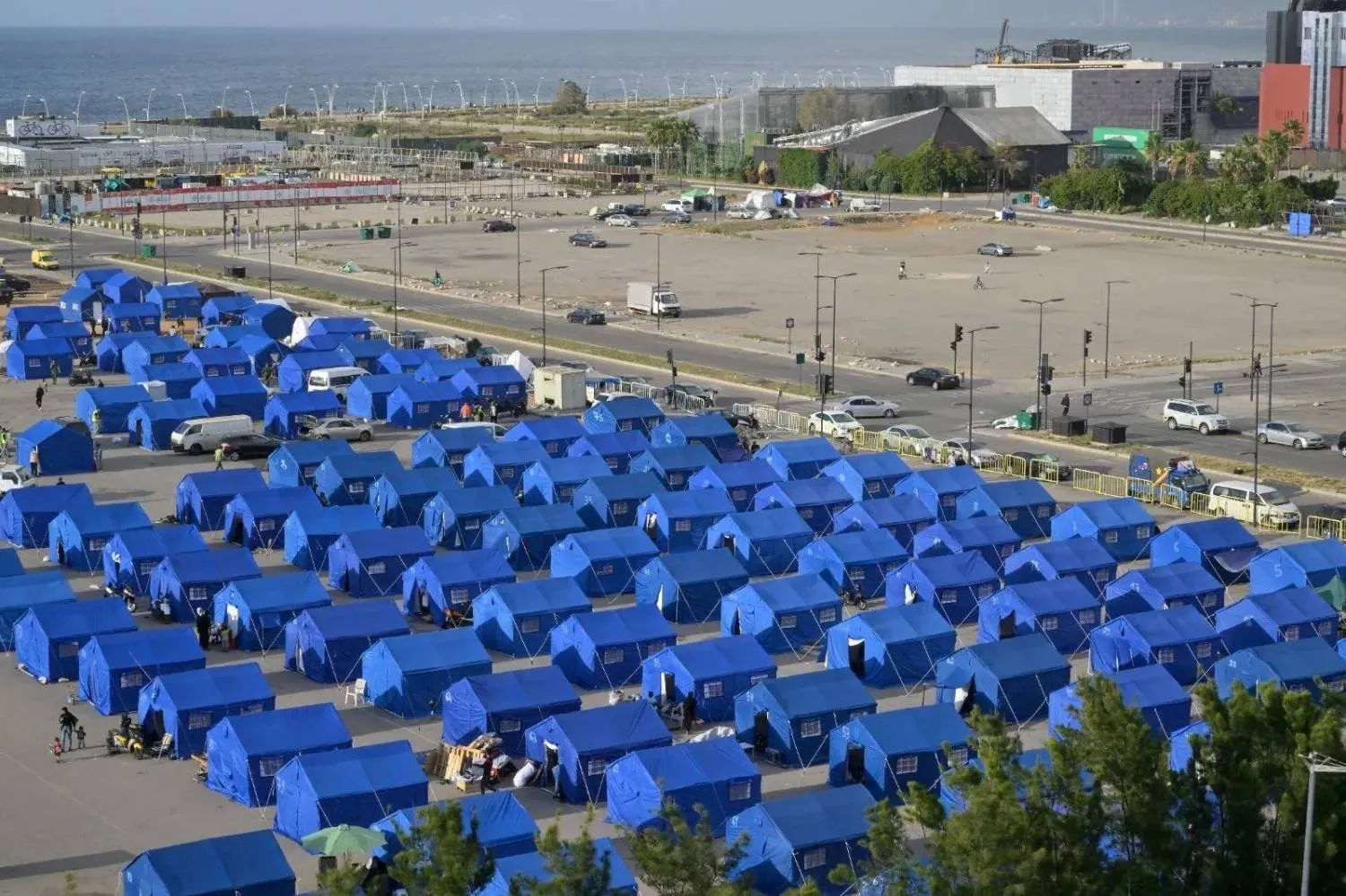
A camp housing displaced people from southern Lebanon and Beirut’s southern suburbs on the Lebanese capital’s waterfront (Asharq Al-Awsat)
TT

Beirut Plan to Organize the Displaced Ends in Waterfront Camp

A camp housing displaced people from southern Lebanon and Beirut’s southern suburbs on the Lebanese capital’s waterfront (Asharq Al-Awsat)

The insistence of about 500 displaced Lebanese to stay along Beirut’s waterfront has raised questions about why they chose to remain in that area despite the lack of basic living conditions.

The displaced say they are staying for security reasons, fearing they could be targeted if they move to larger gatherings, such as the Sports City, and because they want to remain in Beirut rather than in distant areas in the north or the Bekaa.

But Beirut figures and lawmakers say the issue has security dimensions that go beyond the humanitarian aspect, arguing that their continued presence on the waterfront is taking place by a decision from Hezbollah.

The prime minister’s office said, “No infrastructure will be allowed to be built at the newly designated site, nor any additional facilities that could turn this temporary presence into a permanent reality.”

Over the past two days, the displaced were moved only a few meters from privately owned land, where they had been living in inhumane conditions inside random and disorganized tents, to adjacent land owned by the Beirut municipality.

Their presence was organized there, and proper tents were provided, along with security and organizational measures at the new site. But the gathering still lacks bathrooms and basic services.

The official decision to move the tents only a few meters, rather than ending the gathering and distributing the displaced to more suitable shelters, surprised many, especially as it effectively kept the same concentration of people on Beirut’s waterfront, with only limited organizational changes.

Prime minister’s office

The central operations room at the prime minister’s office said in a statement that, “as part of efforts to prevent random gatherings, fixed structures that had been set up on Beirut’s waterfront were removed, especially those made of wood, asbestos and concrete, in a way that prevents any expansion at this site.”

It said the new site, which belongs to the Beirut municipality, accounts for no more than 15% of the area where the tents had previously been set up.

It added that “this measure does not aim to establish a camp or an official shelter, nor to impose a new fait accompli, as some are trying to suggest, but rather to protect public order and security in the capital, and to remove encroachments on private property.”

It stressed that “no infrastructure will be allowed to be built at the newly designated site, nor any additional facilities that could turn this temporary presence into a permanent reality.”

Interior Ministry clarification

Interior Ministry sources said the displaced had been asked to move to Sports City but had refused.

“Because the tents had spread randomly, and under the directives of the prime minister, Beirut Governor Judge Marwan Abboud was tasked with finding a temporary solution to organize the situation. It was decided to confine the tents to land belonging to the Beirut municipality as a temporary measure,” the sources told Asharq Al Awsat.

They said the measure aimed to establish a minimum level of organization, while “the best solution remains for the displaced to move to shelters, in the hope that this crisis ends as soon as possible so they can return to their homes.”

A decision by Hezbollah?

MP Waddah Sadek said the authorities had faced three options, either leave the gathering in the state of chaos it was in on private land, move the displaced within the same area to state owned land in a way that ends the encroachment on private property and allows their presence to be better organized, or remove the tents and gathering by force, which would have led to a security incident given the displaced people’s refusal to leave.

“The officials concerned chose the second option because they considered it the best at this stage,” Sadek told Asharq Al Awsat.

Sadek said, “What is happening is taking place by a clear decision from Hezbollah, because the displaced have no interest in staying in the condition they are in when better alternatives and options exist.”

He warned of “gatherings under the title of displacement at every entrance to Beirut, which reinforces fears over the scenario Hezbollah is preparing.”

Security fears?

One of the displaced people at Beirut’s waterfront said in a television interview that their insistence on staying where they are was “purely” for security reasons.

“We fear being gathered in one large center, such as the Sports City, and then Israel targeting us,” he said.

Although the Social Affairs Ministry had provided buses for weeks to transport them to other areas, where suitable shelters had been prepared, they refused to leave and insisted on staying in the capital.

Deporting Syrians

Beirut municipal council member Mohammad Ballouza said the municipal council had no role in the file and that no council session had been held to take any decision on the matter.

“The decision to move the displaced from private land to land belonging to the Beirut municipality was taken under the directives of Prime Minister Nawaf Salam, under the supervision of the interior minister, and implemented by the Beirut governor. Instead of having tents spread across private property, they were gathered on land owned by the Beirut municipality,” he told Asharq Al Awsat.

Ballouza said, “The displaced do not want to leave the area, so they were only provided with tents. Syrians were deported to Syria or moved to other points.”

He said shelters in Beirut had reached full capacity and that the capital had exceeded its ability to absorb more people. “The Sports City in Beirut can accommodate only about 200 people,” he said.

Fear that the temporary becomes permanent

MP Ghassan Hasbani, a member of the Strong Republic bloc, visited the Grand Serail with MP Fouad Makhzoumi, where they discussed with Prime Minister Nawaf Salam the presence of the displaced on Beirut’s waterfront.

After the meeting, Hasbani stressed the need to move the displaced to other equipped shelters, saying Beirut’s waterfront is not prepared or able to accommodate this population, whether on private or municipal properties.

He also voiced concern that “the temporary could become permanent, especially through public property that must be protected.”


Israel Ignores Lebanon’s Ceasefire Request as US Imposes New Sanctions

Children inside a tent at a camp for displaced people set up along Beirut’s seafront (Reuters) 
TT

Israel Ignores Lebanon’s Ceasefire Request as US Imposes New Sanctions

Children inside a tent at a camp for displaced people set up along Beirut’s seafront (Reuters) 

Washington moved ahead of the Lebanese-Israeli security negotiations scheduled for May 29 by imposing sanctions on two officers from the Lebanese Army and General Security, marking the first time US measures have targeted Lebanese security officials alongside figures affiliated with or accused of cooperating with Hezbollah.

The sanctions, announced Thursday, targeted nine individuals, including Mohammad Fneish, head of Hezbollah’s Executive Council; Iranian Ambassador to Beirut Mohammad Reza Sheibani; and three Hezbollah lawmakers: Hassan Fadlallah, Ibrahim al-Moussawi, and Hussein Hajj Hassan. Also sanctioned were Ahmad Baalbaki and Ali Safawi, both considered close to Parliament Speaker Nabih Berri.

In a notable development, the measures also targeted Colonel Samer Hamadeh, head of Army Intelligence in Beirut’s southern suburbs, and Brigadier General Khattar Nassereddine, head of the Analysis Department at General Security.

Meanwhile, Lebanese ministerial sources told Asharq Al-Awsat that Beirut is awaiting an Israeli response, through the United States, to its request that Washington pressure Israel to comply with the ceasefire agreement. According to the sources, Tel Aviv has neither responded nor adhered to the terms of the deal. “Lebanon is still waiting for a response that the United States will convey from Israel,” the sources said.

Last week, Lebanon held its first direct negotiation session with Israel in Washington, while the ceasefire agreement was extended for an additional six weeks. The extension, however, appears limited to Beirut and its southern suburbs, excluding southern Lebanon, where exchanges of fire between Hezbollah and the Israeli military continue.

A Lebanese military delegation is due to participate on May 29 in security talks with Israeli army representatives at the US Department of Defense headquarters.

The Lebanese sources said Beirut had finalized the composition of its military delegation, which will consist of four officers, though the Army Command has yet to issue the official order naming them.

Responding to media speculation over the delegation’s makeup, the Lebanese Army Command said in a statement that discussion of the “sectarian distribution” of the officers “has no connection whatsoever to the principles of the military institution.”

The command stressed that the delegation, regardless of its composition, “remains committed to national constants,” adding that the officers assigned to the mission represent the nation and remain bound by the army’s doctrine and national duty.

Since the truce was announced on April 17 - and its 45-day extension took effect Monday - Israel has continued carrying out strikes it says target Hezbollah operatives and infrastructure, while also conducting demolition operations in border areas occupied by its forces.

The Israeli military has also continued issuing near-daily evacuation warnings for villages and towns, with the affected areas often extending far beyond the border region and including communities hosting displaced residents from elsewhere in the country.

French Warning

French President Emmanuel Macron’s special envoy to Lebanon, Jean-Yves Le Drian, warned Thursday that Lebanon is “in a dangerous situation.”

In an interview with BFM TV and RMC Radio, Le Drian said Lebanon faces “a dangerous situation regarding its unity and territorial integrity,” citing divisions among Lebanese factions over Hezbollah and Israel.

“Lebanon’s territorial integrity is under threat,” he stated, adding that Israel occupies part of Lebanese territory while Hezbollah operates in another “in service of Iranian interests — the interests of a foreign power.”

Despite that, Le Drian welcomed the continuation of the truce, saying it opens “a 45-day horizon for continuing discussions.”

He also praised Lebanese leaders engaged in the process as “high-level” and “courageous,” referring to their request for direct negotiations with Israel aimed at freeing Lebanon “from this stranglehold” and restoring the Lebanese state’s ability “to function and exist.”

Le Drian further described US involvement in the negotiations as “a positive thing,” even though, he noted, Israel has rejected French participation in the talks despite Lebanon’s request for it.


Australian Women Linked to ISIS Leave Syrian Camp

Members of Australian families believed to be linked to the ISIS militants wait to leave Roj camp near Derik, Syria April 24, 2026. REUTERS/Orhan Qereman/File Photo
TT

Australian Women Linked to ISIS Leave Syrian Camp

Members of Australian families believed to be linked to the ISIS militants wait to leave Roj camp near Derik, Syria April 24, 2026. REUTERS/Orhan Qereman/File Photo

A second group of Australian women and children linked to the ISIS extremist group have departed a refugee camp in northeast Syria and may be returning to Australia, the Australian Broadcasting Corporation reported on Friday.

The broadcaster said a bus carrying the group left the Al-Roj camp on Thursday afternoon under escort by a convoy of Syrian government officials. The group is expected to reach Damascus, though it remains unclear when they might travel ‌to Australia, the report ‌said.

Home Affairs Minister Tony Burke said ‌Australia's ⁠security and intelligence agencies ⁠had been preparing for the return of women linked to ISIS for more than a decade, reported Reuters.

"This is not a coherent group, there is a spectrum in terms of the actions of the individuals while they have been away from Australia," Burke said by email.

He did not ⁠provide details about the group's travel ‌to Australia.

The Australian government has previously ‌ruled out providing direct assistance for the return of Australian ‌families linked to ISIS but has acknowledged "very serious limits" ‌to preventing citizens from re-entering the country. Earlier this month, four women and nine children linked to ISIS returned to Australia after spending seven years in detention camps. Upon arrival, Kawsar Ahmad, 54, ‌and her daughter Zeinab Ahmad, 31, were charged with slavery offences, while 32-year-old Janai Safar ⁠faced terror-related ⁠charges.

The return of the women drew criticism, with opponents accusing Australia's center-left government of failing to prevent their repatriation.

Between 2012 and 2016, some Australian women travelled to Syria to join their husbands who were allegedly members of ISIS. Following the collapse of the “caliphate” in 2019, many were detained in camps, while others returned home. In January, the United States began moving detained ISIS members out of Syria after the collapse of the Kurdish-led Syrian Democratic Forces, which had been guarding several detention facilities housing ISIS fighters and affiliated civilians, including foreigners.


Lebanese Accuse Israel of Wiping their Towns Off the Map

(COMBO) This combination of handout satellite images taken by Planet Labs PBC shows views of the village of Yarun in southern Lebanon close to the border with Israel on (top L to R followed by bottom L to R) October 5, 2024; January 10, 2025; January 30, 2025; and on May 2, 2026. (Photo by 2026 Planet Labs PBC / AFP)
TT

Lebanese Accuse Israel of Wiping their Towns Off the Map

(COMBO) This combination of handout satellite images taken by Planet Labs PBC shows views of the village of Yarun in southern Lebanon close to the border with Israel on (top L to R followed by bottom L to R) October 5, 2024; January 10, 2025; January 30, 2025; and on May 2, 2026. (Photo by 2026 Planet Labs PBC / AFP)

Lebanese mother-of-two Hala Farah is collecting photos and videos to preserve the memory of her hometown which, like many others along the southern border, has been completely destroyed by Israeli forces.

Testimony from residents and officials, as well as satellite images and photographs taken by AFP journalists on both sides of the border, show widespread destruction in dozens of Lebanese towns and villages since the start of the Israel-Hezbollah war on March 2.

Responding to Hezbollah's attacks, Israel carried out massive airstrikes and launched a ground invasion in the south, which borders Israel and where the Iran-backed movement holds sway.

While a ceasefire began on April 17, the destruction, demolitions and bulldozing in southern areas have only intensified, affecting homes, infrastructure, schools, places of worship and farmland.

Israel's army, which sometimes issued evacuation warnings ahead of strikes, has repeatedly said its attacks target Hezbollah sites and operatives -- not civilians.

But Farah, 33, said everything in her hometown Yarun, less than a kilometer (mile) from Israel, has been destroyed.

"All that's left are memories and some pictures that we and the neighbors are trying to collect... so that we can tell our children what Yarun was like," she told AFP.

"I had hoped my daughters would grow up in the family home," she said, wearing a pin showing her village.

Yarun has found itself on the front line before: satellite images seen by AFP show it had been mostly destroyed by early 2025 following the previous Israel-Hezbollah war, with its Saint George church left with only three walls standing.

Other medium-resolution images, taken earlier this month and reviewed by AFP, show that what had previously been spared is now gone.

- Reduced to rubble -

Unable to return to the south, some displaced families are sharing the cost of purchasing satellite images -- at $140 -- to catch a glimpse of their hometowns.

Some post images of their homes on social media, taken before and after their destruction.

Among them is an anti-Hezbollah activist whose grandfather's three-storey home in the city of Nabatieh was wrecked in an Israeli strike.

A veteran writer meanwhile mourned his book collection in the border town of Bint Jbeil.

"Israel is trying to remove all the essential elements of life necessary for return," said Farah, who learned through satellite imagery that her house in Yarun, a town where both Christians and Muslims lived, was now rubble.

Her voice broke as she scrolled through dozens of photos and videos on her phone.

"What happened during the truce confirms that Israel's goal is the urbicide of the south, including Yarun," she said.

Environment Minister Tamara Zein last month also accused Israel of committing an "urbicide" in the area, using a term which means the deliberate destruction of urban areas.

Israel occupied south Lebanon until the year 2000, and Hezbollah has insisted it must retain its arsenal, despite a Lebanese government push to reclaim the monopoly of force.

While the majority of the south is Shia, Farah said Israel's demolitions in Yarun have included "the church hall, a convent and the Saint George school".

Around six kilometers (four miles) north of Yarun, satellite images from early April showed no sign of major damage in Bint Jbeil, an ancient hilltop town that had become a Hezbollah bastion.

A month later, the town appeared to have been razed almost entirely, including the stadium where slain Hezbollah chief Hassan Nasrallah delivered his "liberation" speech in 2000 to mark the withdrawal of Israeli forces.

- 'Destroy the land' -

At Lebanon's government-linked National Council for Scientific Research (CNRS) in Beirut, research director Chadi Abdallah showed AFP journalists before and after images of Bint Jbeil.

"Most buildings in Bint Jbeil are destroyed," he said, with most demolitions and detonations occurring since the truce.

"The Israelis are not conducting military or clearing operations; they are entering to destroy the land, the people, and the infrastructure," he said.

The agriculture ministry estimated this month that Israeli attacks have damaged more than 560 square kilometers of farmland.

"They are trying to erase the memory of the people in this region and to erase its history," said Abdallah.

According to the CNRS, Israeli attacks since 2023 have destroyed more than 290,000 housing units, 61,000 of them since the start of the latest war.

Among them, some 12,000 units were completely or partially destroyed since the truce began.

Lebanese officials say Israeli attacks have killed more than 3,000 people since Hezbollah drew Lebanon into the Middle East war in support of Iran after Israeli strikes killed Iran’s supreme leader.

"Lebanon is witnessing such destruction for the first time in its history," said researcher Hanaa Jaber, who has roots in Bint Jbeil.

More than a million people displaced from the south face an "uprooting... with terrible repercussions," she said.

- 'Life support' -

Others, like Imad Bazzi from Bint Jbeil, spoke to AFP about the loss of their life's work.

"There is a total annihilation of... Bint Jbeil, from residential buildings and water and electricity institutions to the hospital, and even schools and gas stations," said Bazzi, 60, a municipal councilor and owner of an engineering firm that was destroyed.

"What is happening today is a blatant change of geography. It is systematic destruction."

Israel, whose soldiers are operating inside a self-declared "yellow line" that runs around 10 kilometers north of the border, says it is protecting its communities from Hezbollah attacks.

Lebanon and Israel began their first direct talks in decades last month in Washington, and Farah, the woman from Yarun, hopes for a positive outcome.

"We hope this will be the last war, because our villages in the south... are currently on life support," she said.

"We hope the Israelis will withdraw from every inch of our land and let us... create new memories for our children, erasing the echoes of the strikes that still ring in their ears."
