


Lebanon Caught between US, Iran in Reclaiming its Independent Decision-making

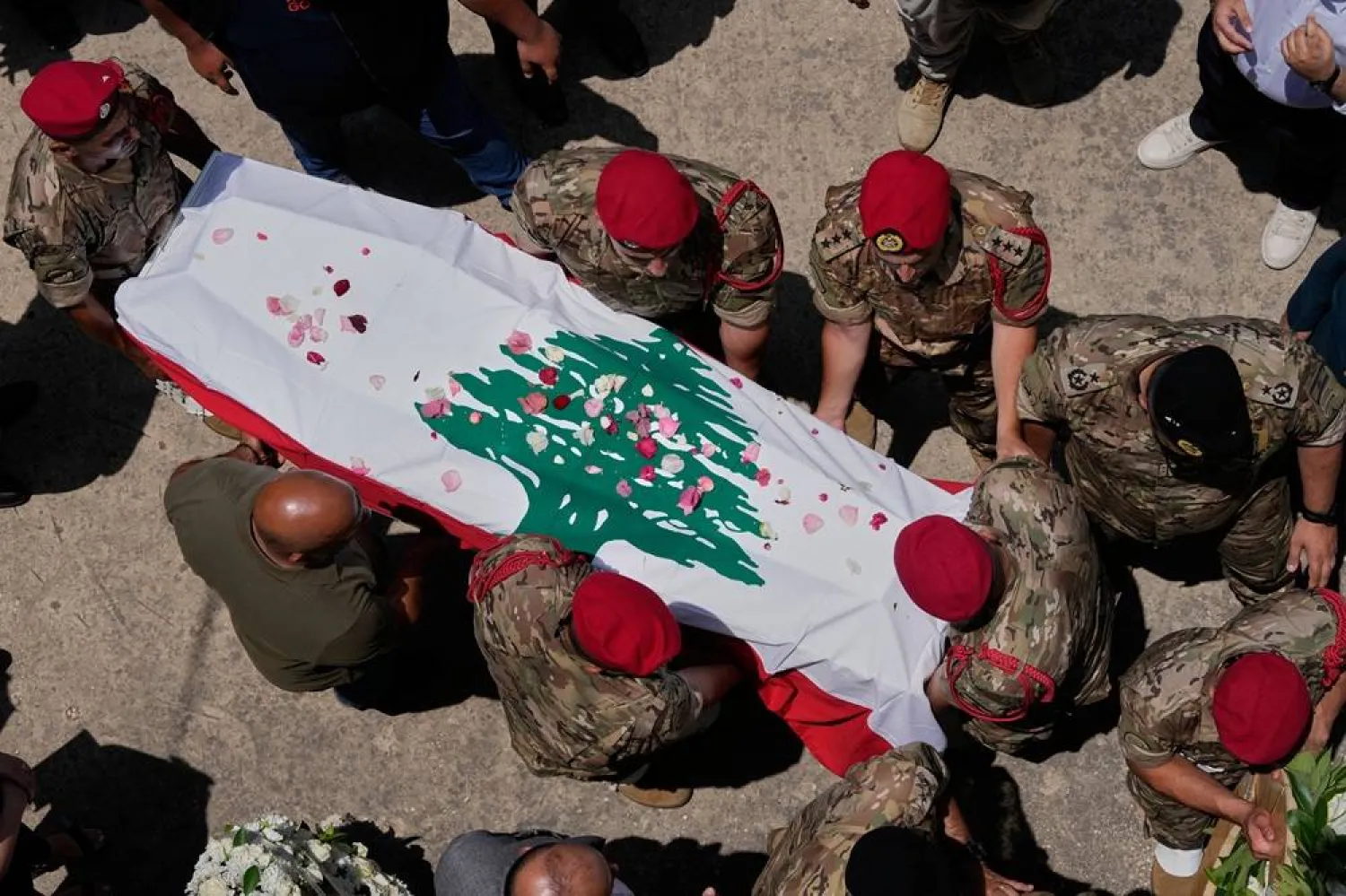
 Lebanese army soldiers carry the coffin of captain Elie Khoury, who was killed on Saturday in an Israeli airstrike, during his funeral procession in Kfar Jarra, southern Lebanon, Monday, June 8, 2026. (AP)
Lebanese army soldiers carry the coffin of captain Elie Khoury, who was killed on Saturday in an Israeli airstrike, during his funeral procession in Kfar Jarra, southern Lebanon, Monday, June 8, 2026. (AP)
TT

Lebanon Caught between US, Iran in Reclaiming its Independent Decision-making

 Lebanese army soldiers carry the coffin of captain Elie Khoury, who was killed on Saturday in an Israeli airstrike, during his funeral procession in Kfar Jarra, southern Lebanon, Monday, June 8, 2026. (AP)
Lebanese army soldiers carry the coffin of captain Elie Khoury, who was killed on Saturday in an Israeli airstrike, during his funeral procession in Kfar Jarra, southern Lebanon, Monday, June 8, 2026. (AP)

Iran’s attack on Israel in retaliation to Israeli strikes on Sunday on Beirut’s southern suburbs, a Hezbollah stronghold, carried several messages.

It was seen as an attempt to reinforce its claim over Lebanon as a bargaining chip in its confrontation with the United States and Israel that it can use in the ongoing negotiations in Pakistan.

It remains to be seen if Iran has succeeded in seizing the initiative in this file and tie Lebanon’s stability to its own negotiations with the US, or if the attack deepened the Lebanese state’s drive to separate the Lebanese file from the Islamabad talks and further pursue the US-sponsored negotiations with Israel.

Lebanese President Joseph Aoun openly slammed Iran last week for using Lebanon as a “bargaining chip” in its negotiations with the US and demanded that it cease interfering in its internal affairs. Hezbollah, which is backed by Iran, has been adamant that Lebanon be included in the Pakistan negotiations, putting it at odds with the Lebanese state.

Head of the Saydet El Jabal Gathering, former MP Fares Souaid noted that since 1969, Lebanon has witnessed several conflicts between foreign powers over usurping the country’s independent decision-making and holding negotiations on its behalf with or without consulting it.

The Palestinian Liberation Organization tried to do so decades ago, then it was followed by the Syrian regime, under Hafez al-Assad, that imposed hegemony over Lebanon for several years and now, the country finds itself in the Iranian sphere of influence, he told Asharq Al-Awsat.

“The Lebanese state, represented by President Joseph Aoun and Prime Minister Nawaf Salam, has now succeeded in reclaiming the initiative for the first time since 1969,” Souaid added.

This has been achieved with evident US support after Washington realized the importance of separating the Lebanese file from Iran and preventing Tehran from negotiating in its name, he went on to say.

“Iran has been trying to claim that the Lebanese negotiations with Israel are a farce and that Lebanon will be unable to achieve its demands, or impose an Israeli withdrawal without it. Iran has been claiming that it alone will be able to achieve this [for Lebanon], but it will fail,” stressed Souaid.
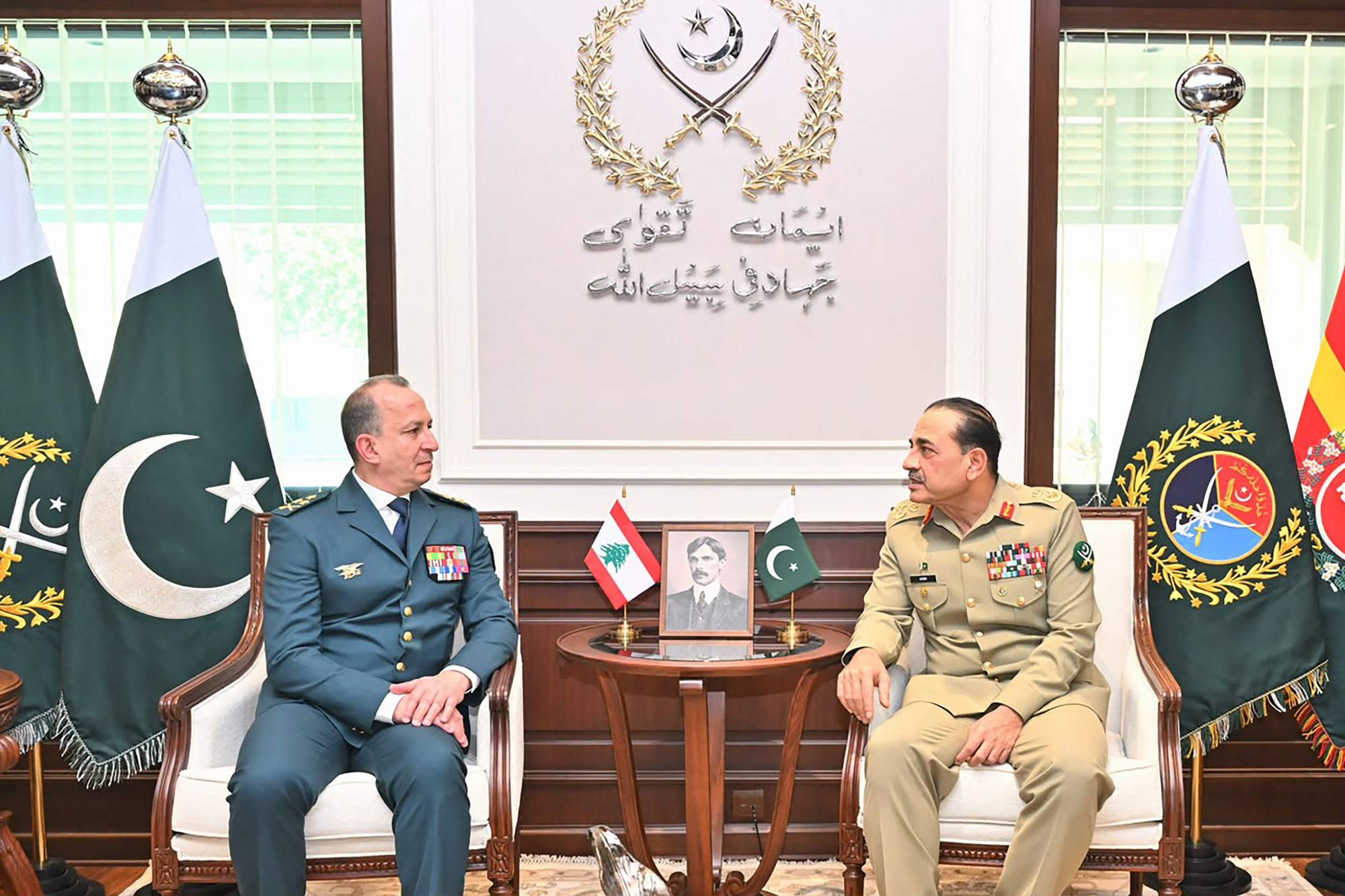
This handout photograph taken and released on June 9, 2026 by Pakistan's Inter-Services Public Relations (ISPR) shows Pakistan's Army Chief and Field Marshal Asim Munir (R) speaking with General Rodolphe Haykal, Commander-in-Chief of the Lebanese Armed Forces during their meeting in Rawalpindi. (Handout / Pakistan's Inter-Services Public Relations (ISPR) / AFP)

The Iranian embassy in Beirut posted on its social media an image of two clasped hands, with one covered with the Lebanese flag and the other the Iranian one, and the statement “always with you” in Lebanese dialect.

The post sparked hundreds of comments in support and criticism from users about Iranian and Lebanese interests.

Souaid noted the “sharp division in Lebanon between one camp that wants the country to be a mere bargaining chip for Iran, and another that wants to consolidate the authority of the Lebanese state and its independent decision-making.”

“The state is committed to its independent decision-making, while Iran is trying to usurp it through sparking a war in Lebanon and exploit the Israeli strike on Beirut’s southern suburbs as if to say that it alone holds the keys to the solution,” he added.

“Iran will not succeed in reclaiming Lebanon’s decision-making or again impose its authority over the country,” he stressed.

Army commander in Pakistan

Amid the developments, Lebanese army commander Rodolphe Haykal was in Islamabad at the invitation of his Pakistani counterpart Asim Munir .

The military has not revealed details about the visit.

An informed source confirmed to Asharq Al-Awsat that he was visiting at his counterpart’s invitation and that the trip was coordinated with President Aoun.

Pakistan has expressed its readiness to offer assistance to the Lebanese army in terms of its deployment in the South after the Israeli withdrawal, it said, noting that Islamabad enjoys the trust of the Americans, Iranians and the Israelis given its role in the mediation efforts between the US and Iran.

UN Says Sudan Resources Fuel Civil War

FILE PHOTO: A displaced Sudanese mother of five, including her child, prepares food at a camp shelter amid the ongoing conflict between the RSF and the Sudanese army, in Tawila, North Darfur, Sudan, July 30, 2025. REUTERS/Mohamed Jamal/File Photo
TT

UN Says Sudan Resources Fuel Civil War

FILE PHOTO: A displaced Sudanese mother of five, including her child, prepares food at a camp shelter amid the ongoing conflict between the RSF and the Sudanese army, in Tawila, North Darfur, Sudan, July 30, 2025. REUTERS/Mohamed Jamal/File Photo

Sudan's rival factions are profiting from control over the country's resources and the "war economy" was sustaining the conflict, the United Nations said Wednesday.

To fund the growing cost of military operations, the two sides rely on exploiting territory, trade routes, and commodities, contributing to a conflict that has become "increasingly self-perpetuating", said the UN human rights office OHCHR.

The war between Sudan's regular army and the Rapid Support Forces (RSF), that erupted in April 2023, has killed 200,000 people by some estimates and displaced upwards of 11 million.

Several areas of Sudan have been plunged into hunger and famine.

OHCHR called on the two sides, and corporations involved in collecting and selling Sudanese commodities, to ensure compliance with international law.

"Sudan's vast wealth of natural resources should benefit its people," said UN rights chief Volker Turk.

"Distressingly, what we are seeing today is anything but that. In fact, this wealth is only serving to undermine human rights and drive conflict, bringing pain and suffering on an enormous scale.

"This war economy must be disrupted, and the international community must pay much closer attention to the commodities and trade routes that help keep it alive."

OHCHR issued a report focusing on the trade in gum arabic -- a key ingredient in products ranging from soft drinks, to cosmetics and pharmaceuticals.

Sudan accounted for 70-80 percent of global crude gum arabic exports before the war.

Although modest in export value compared with other commodities, it is an important income source for millions of Sudanese, and remains one of the country's most internationally relied-upon exports.

The report found that many who depend on the gum arabic trade have faced looting, extortion, arbitrary detention and threats -- particularly at the hands of the parties to the conflict and their allies.

In May 2025, for instance, the Gum Arabic Exchange and its warehouses, plus part of the local market in El-Nuhud in West Kordofan state, were reportedly looted by the RSF when stocks were full and ready for export.

This severely disrupted local trade and livelihoods, the report said.

OHCHR said that Sudan's gum arabic trade had been reshaped by the fragmentation of the country since the war started.

Gum arabic from areas controlled by the armed forces goes towards Port Sudan for export, while significant quantities from RSF-controlled areas have been redirected to neighboring countries via cross-border smuggling routes.

The report said this may then be treated and traded as locally-produced, making its origin hard to verify.

According to AFP, Turk, the UN high commissioner for human rights, urged countries and companies linked to trade in Sudanese commodities, including gum arabic, to ensure their business was not fueling the conflict or damaging human rights.

He urged countries to strengthen accountability, traceability and regulatory oversight and respect human rights.

"Companies cannot continue business as usual when sourcing from conflict-affected value chains," Turk said.


Israel Kills Four People in Gaza, Including a Child, Medics Say

Smoke rises following an Israeli airstrike in southern Gaza City, 12 July 2026. (EPA)
TT

Israel Kills Four People in Gaza, Including a Child, Medics Say

Smoke rises following an Israeli airstrike in southern Gaza City, 12 July 2026. (EPA)

An Israeli airstrike killed a man, his wife and their six-year-old daughter in the Gaza Strip on Wednesday, Palestinian health officials said as talks to advance the US-brokered Gaza ceasefire deal faltered.

The strike on an apartment building in Deir Al-Balah in central Gaza killed Omar Abu Qassem, his wife, Asma, and their daughter, Habeeba, medics said. Their son survived, but was injured, medics said.

The Israeli military said the strike targeted a Hamas fighter.

In Sheikh Radwan neighborhood in Gaza City, an Israeli airstrike killed one person, medics said.

The Israeli military didn't immediately comment on this incident.

The deaths add to a toll of more than 1,100 Palestinians, mostly civilians, killed by Israeli attacks since an October ceasefire between ‌Israel and Hamas ‌to end the war took effect, according to health officials in the ‌enclave. ⁠Hamas doesn't usually disclose ⁠information about its fatalities.

The truce halted major fighting, but has failed to stop near-daily Israeli strikes. Four Israeli soldiers have been killed by fighters in Gaza over the same period.

CEASEFIRE FALTERS

The latest violence comes as Hamas leaders wrapped up another round of truce talks in Cairo on Tuesday.

The discussions — mediated by Egypt, Türkiye and Qatar — were aimed at implementing the second phase of US President Donald Trump's Gaza peace plan.

The talks included the disarmament of Hamas and the Israeli military's withdrawal from the strip, according to sources ⁠close to the talks, who said there had been little progress amid deep distrust ‌between the two sides.

The second phase also includes allowing ‌a US-backed Palestinian technocratic committee to assume power from Hamas, the deployment of an international security force, and the ‌start of the reconstruction of Gaza, which has been devastated by the war.

Five countries — Indonesia, Morocco, Kazakhstan, ‌Kosovo and Albania — have committed to providing troops to the US-backed International Stabilization Force. However, none have yet been deployed as negotiations between Trump's Board of Peace and Hamas have stalled for months.

Speaking at an aid donor meeting in Brussels on Monday, Nickolay Mladenov, the Board of Peace envoy for Gaza, said he would be visiting Morocco on ‌Tuesday to "sign Morocco's contribution to the International Stabilization Force, and soon we hope to see them on the ground undertaking their tasks."

Mladenov said the ⁠October ceasefire was holding ⁠but "imperfectly" with violations continuing, adding that Hamas has yet to agree to what he called a "roadmap" for negotiations.

Hamas official Basem Naim accused Mladenov of supporting Israel’s position in negotiations, and failing to hold the country accountable for violating the ceasefire and not upholding the terms of the first phase of the Trump plan.

The plan called for Israel to withdraw its troops to a demarcated "yellow" line, but Israel has been slowly moving its troops forward and now effectively occupies more than 60% of the strip.

Hamas has repeatedly said that it cannot advance to the second phase of the peace plan until the terms of the first phase are fulfilled.

Nearly all of Gaza's 2 million people, most of whom have been displaced several times, now live on a tiny strip of land along the coast, mainly in makeshift tents or damaged buildings, under Hamas control.

Hamas-led fighters killed 1,200 people during their cross-border attack into Israel on October 7, 2023, according to Israeli tallies. The Gazan health ministry said Israel’s subsequent offensive on the strip killed more than 73,000 Palestinians.


Yemeni Information Minister to Asharq Al-Awsat: We Prevented Sanaa Airport from Becoming an Iranian Platform

Graphic content / TOPSHOT - This screen grab taken from a video footage made available via AFPTV on July 13, 2026 shows smoke rising from the airport in Sanaa
TT

Yemeni Information Minister to Asharq Al-Awsat: We Prevented Sanaa Airport from Becoming an Iranian Platform

Graphic content / TOPSHOT - This screen grab taken from a video footage made available via AFPTV on July 13, 2026 shows smoke rising from the airport in Sanaa

Yemeni Minister of Information Moammar Al-Eryani said on Wednesday that the state will not tolerate any new violations, and will take all political, diplomatic, legal, and military measures guaranteed by the constitution and international law to prevent any attempt to undermine Yemen’s sovereignty or impose faits accomplis by force.

Al-Eryani made his remarks to Asharq Al-Awsat following the Yemeni Ministry of Defense’s announcement on Monday that it had targeted the runway of Sanaa International Airport to prevent an Iranian aircraft from landing outside legal and sovereign procedures.

Al-Eryani said the Yemeni government’s position had been clear since the beginning of the crisis. He noted that the government had exhausted all political, diplomatic, and legal avenues and had put forward initiatives aimed at maintaining civilian flights through Yemenia Airways in a manner that safeguarded citizens’ interests while respecting Yemen’s sovereignty.

Al-Eryani stated that “the terrorist Houthi militia, with direct support from the Iranian regime, has rejected these initiatives and insisted on imposing a fait accompli outside the institutions of the state.”

He told Asharq Al-Awsat that the Chairman of the Presidential Leadership Council (PLC), the Supreme Defense Council, the Cabinet, and the Ministry of Defense had all stressed that protecting Yemen’s sovereignty, airspace, and ports of entry is a constitutional duty that cannot be compromised.

The minister reassured the Yemeni people, saying that the armed forces and security agencies are currently at the highest level of preparedness, in implementation of directives issued by the PLC Chairman, the National Defense Council, and Cabinet decisions.

He stressed that they are fully capable of carrying out their constitutional duty to protect Yemen’s sovereignty and defend its airspace and land, sea, and air borders.

Crisis Management Room

Asked about Yemen’s options should the Houthis choose to escalate, Al-Eryani highlighted the role of a crisis management room through which state institutions are working in full coordination.

He revealed that developments are being monitored around the clock and that necessary measures are being taken based on military, security, and political assessments.

According to him, this ensures the protection of citizens and national interests and demonstrates that the state has the ability to deal decisively and responsibly with any developments.

He also placed full responsibility for any escalation and its consequences on “the Houthi militia and the Iranian regime, which chose to reject all peaceful initiatives and continue violating international law and undermining peace opportunities.”

Houthi Rejection of Government Initiatives

Regarding the Iranian plane’s eventual landing at Hodeidah Airport, Al-Eryani stressed that the government’s success in this crisis should not be measured by where the aircraft landed, but rather by preventing Iran and the Houthis from achieving their objective of establishing Sanaa Airport as a permanent platform for Iranian flights outside state authority.

He explained that the government handled the crisis from the outset with responsibility, exhausting all political, diplomatic, and legal means. It also proposed practical solutions to spare Yemen and the region further escalation, including operating civilian flights through Yemenia Airways and facilitating the transport of the Houthi delegation via the national carrier. However, he said, the militia rejected all such initiatives.

“When the militia insisted on imposing a fait accompli, the state implemented what it had previously announced and prevented the Iranian aircraft from landing at Sanaa Airport, demonstrating that its warnings ... were an expression of a sovereign position stemming from the state’s responsibility to protect its airspace and ports,” Al-Eryani explained.

He reiterated that preventing the aircraft from landing at Sanaa Airport was the most significant turning point in the crisis, because it thwarted attempts to establish the airport as a platform for regular Iranian flights and confirmed that the Yemeni government would not grant the Houthis sovereign powers they do not possess.

Allowing the Plane to Land in Hodeidah

Al-Eryani noted that “the decision to allow the aircraft to land at Hodeidah Airport was taken from a position of strength, after the state had demonstrated its readiness and ability to impose its will.”

He stressed that this did not alter Yemen’s legal and sovereign position, which rejects the operation of any Iranian flights outside official frameworks.

He argued that the crisis had established a new equation: Any future Iranian air movement toward Yemeni territory would not be viewed as a civilian flight but rather as an attempt to violate Yemeni sovereignty and impose a new reality.

He stressed that the Yemeni state would deal with any similar attempt in line with the constitution and international law so as to protect Yemen’s sovereignty and prevent its territory and airports from being used to serve Iran’s regional project.

On Monday, Al-Eryani announced that the Houthis had detained an International Committee of the Red Cross aircraft at Sanaa Airport, preventing it from departing, and had held the pilot and co-pilot hostage.

In his remarks to Asharq Al-Awsat, he described this as “not an isolated incident, but part of a systematic pattern by the militia of violating international law and international humanitarian law.”

“The militia has previously abducted dozens of UN employees and staff members of international agencies and humanitarian organizations from their workplaces and homes, detaining them arbitrarily. It has also targeted humanitarian institutions, confiscated their property, and used humanitarian workers as leverage for political blackmail, in blatant violation of all international norms and conventions.”

Seizure of National Airline Aircraft

Al-Eryani further revealed that the Houthis’ record includes “the seizure of four Yemenia Airways aircraft and the disruption of the national carrier’s operations, causing severe harm to citizens and to the civil aviation sector.”

He expressed surprise that some international organizations continue to operate flights to Sanaa Airport despite the absence of security and legal guarantees and despite the militia’s ongoing detention of aircraft, individuals, and threats to civil aviation safety.

The minister said this requires a serious review by the United Nations and international organizations of how they deal with such violations. He called for a firmer stance to ensure the protection of their personnel and aircraft and to prevent the militia from using humanitarian work as a cover for imposing a fait accompli or extorting the international community.
