

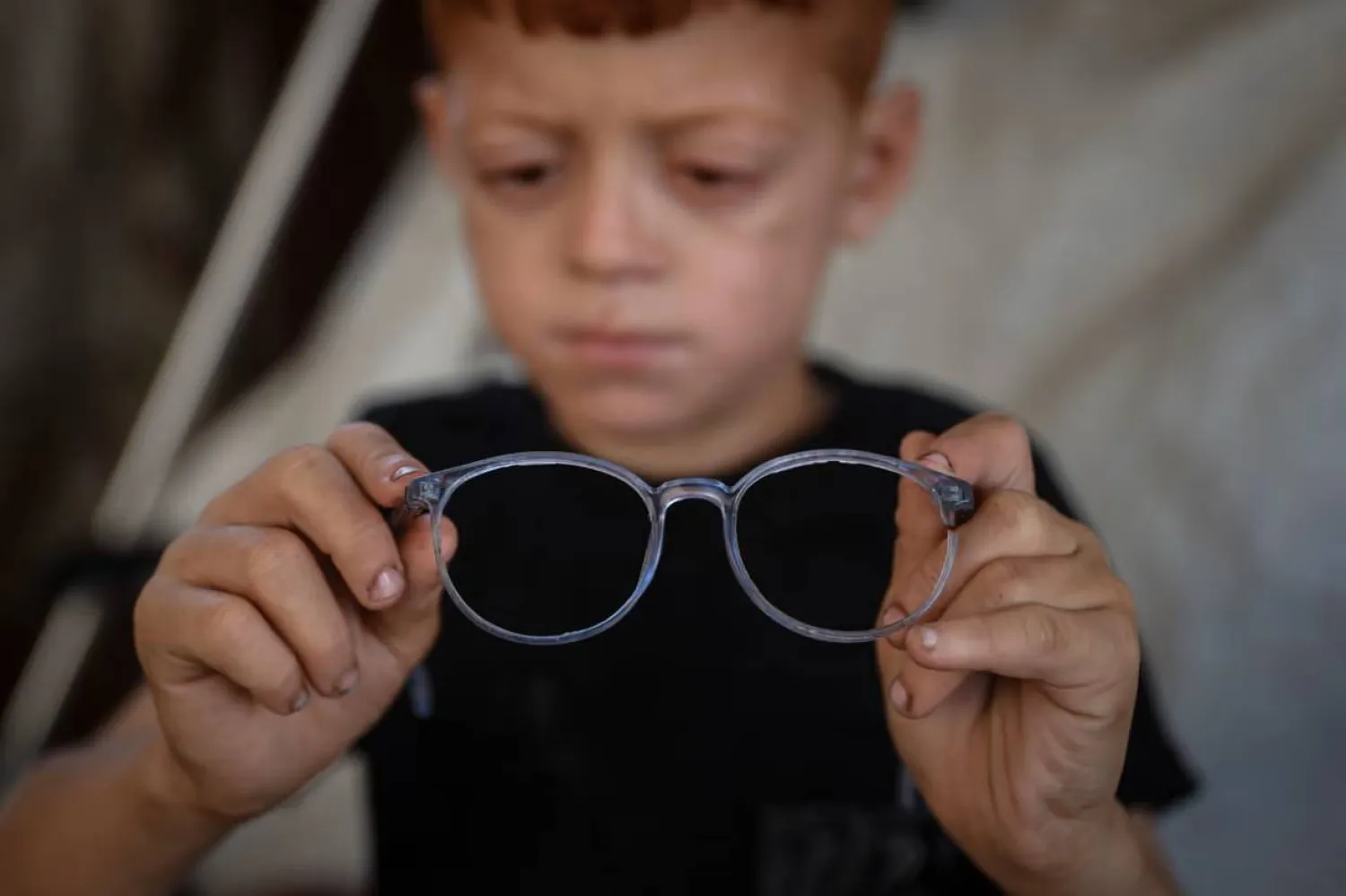

Video of Visually Impaired Palestinian Boy Draws Global Attention

Ayoub holding his damaged glasses on 2 June. Photograph: Anadolu/Getty Images
TT

Video of Visually Impaired Palestinian Boy Draws Global Attention

Ayoub holding his damaged glasses on 2 June. Photograph: Anadolu/Getty Images

A video of a seven-year-old Palestinian boy in Gaza who suffers from a severe visual impairment crying over his shattered glasses has drawn widespread attention across social and international media, Britain’s the Guardian reported on Thursday.

The footage of Ayoub Junaid has shone a light on the plight of the many visually impaired children in Gaza who, because of Israel’s blockade and the devastation caused by the war, have been unable to access eye examinations, corrective lenses or specialist ophthalmic surgery.

After the clip was viewed by tens of millions of people, Ayoub received a new pair of glasses. This good news, however, does not solve the underlying problem, as he urgently needs surgery.

Ayoub’s mother, Eman Junaid, 30, displaced in the Gaza City port area, tells the Guardian her son’s problem began when he was two.

“Ayoub suffers from very severe nearsightedness after having a fever illness,” she says. A doctor told Junaid that Ayoub’s vision would gradually improve as he got older, but the opposite happened – the prescription he required increased and the lenses he now needs are not available in Gaza.

“We were preparing to travel for treatment, but the war started and everything stopped,” she adds.

Ayoub rarely leaves his tent, Junaid says. When he wants to play with his siblings or other children, he clings tightly to his glasses and moves with extreme caution. He does not run, jump or move freely. The doctors warned the family not to let him engage in strenuous activities because any fall or blow could cause further damage to his retinas.

Ayoub used to ask his mother why he was different from other children. He often asks her: “Why don’t the other children wear glasses like me? Why can’t I move like them? Why can’t I go to school like them?”

“At the end of April, while walking with a family member along a road strewn with rubble, he fell and struck his face on the ground, breaking the glasses,” his mother says. “He burst into tears, rolled on the ground and desperately tried to piece them back together. For Ayoub, those glasses were everything. Even with them, he cannot see clearly and often has to hold objects just inches from his face. But without them, he can barely move around at all.”

His family says the time Ayoub spent without glasses was particularly distressing. For three or four days, he rarely left a corner of the tent and was unable to move around without assistance. When he tried to walk on his own, he would crouch close to the ground, bringing his eyes near the floor in an effort to make out his surroundings.

Relatives said they repeatedly tried to repair his glasses, but the damaged lenses could not be fixed.

“The video I shared was filmed after we reached the tent,” his mother says. “In the street, he was crying even more and saying he wanted to fix his glasses because he could not see without them. After the video spread, donors helped us and we were able to get a new pair of glasses, but it is still not the correct prescription he needs.”

According to his family, Ayoub’s emotional state has shown signs of improvement. In recent days, he has appeared more willing to interact with visitors and those offering support. While the change remains modest, his family say it has brought them a sense of relief and hope.

Health officials in Gaza say the war has devastated eye care services, leaving thousands of visually impaired patients without treatment amid severe shortages of medical equipment and surgical supplies.

Hospitals are lacking key items including surgical microscopes and phaco machines. Officials say more than 2,800 patients are currently waiting for cataract surgery alone, while the total backlog for eye procedures, including corneal transplants, glaucoma operations and reconstructive surgery, exceeds 4,000 cases.

In addition to this, Israeli bombardment around medical facilities has forced the temporary shutdown of Gaza City’s Government Eye Hospital, the only public eye care center in the territory.

“The current situation clearly shows a shortage in all medical consumables and surgical tools,” says Dr. Hussam Dawoud, a senior consultant in ophthalmology and eye surgery and the director of the hospital. “Currently, we are providing services at around 60% of what we used to offer before the war. The main reason is that Israel is preventing the entry of medical equipment and surgical instruments.”

Doctors have also reported a sharp rise in severe corneal infections, which they attribute to overcrowded living conditions, poor sanitation and limited access to medication, with some patients suffering permanent vision loss.


Hamas Delegation in Cairo for Gaza Ceasefire Talks

15 August 2026, Palestinian Territories, Gaza: Tents sheltering displaced Palestinians crowd the beach, as the coastline has become a refuge for thousands displaced from different parts of the Gaza Strip by the war. (dpa)
TT

Hamas Delegation in Cairo for Gaza Ceasefire Talks

15 August 2026, Palestinian Territories, Gaza: Tents sheltering displaced Palestinians crowd the beach, as the coastline has become a refuge for thousands displaced from different parts of the Gaza Strip by the war. (dpa)

A Hamas delegation, chaired by the group’s leader Khalil al-Hayya, is in Cairo Sunday for Gaza ceasefire-related talks with Egyptian officials, the group said.

The talks come as mediators push for the implementation of a roadmap to move forward with US President Donald Trump’s peace plan, which calls for the disarmament of Hamas and other Palestinian groups in Gaza, the withdrawal of Israeli forces from the area as well as handing over power to Palestinian technocrats.

Israel’s Prime Minister Benjamin Netanyahu has rejected Trump’s latest plan to advance the stalled ceasefire in Gaza, saying Israel will not withdraw from any of the roughly 60% of the territory it controls until Hamas has been completely disarmed — something the group controlling the other 40% has long resisted.

It wasn’t immediately clear whether al-Hayya would meet with Trump’s son-in-law and negotiator Jared Kushner, the Board of Peace’s high representative Nickolay Mladenov, or executive board member and former British Prime Minister Tony Blair, who are scheduled to travel to Israel and Egypt this week.


Israel Vows to Go After Hezbollah as It Names Another Killed

15 August 2026, Lebanon, Nabatieh district: An Israeli warplane carried out an airstrike on a house in a tourist area of Ansar, southern Lebanon, before dawn, completely destroying the building and causing extensive damage to surrounding properties. (dpa)
TT

Israel Vows to Go After Hezbollah as It Names Another Killed

15 August 2026, Lebanon, Nabatieh district: An Israeli warplane carried out an airstrike on a house in a tourist area of Ansar, southern Lebanon, before dawn, completely destroying the building and causing extensive damage to surrounding properties. (dpa)

Israel vowed Sunday it would hit Hezbollah again if threatened, as it identified what it described as a commander killed in strikes a day earlier that also left several children dead. 

Israeli strikes on Saturday killed 11 people in southern Lebanon, according to authorities, in the deadliest attacks since a deal was reached in June aimed at ending hostilities. 

Israel said the strikes were a response to Hezbollah setting off explosive drones inside a so-called "security zone" in southern Lebanon, seriously injuring three Israeli troops including an officer. 

"No score will be left unsettled in any arena. We'll defend our soldiers and our civilians with full power," Defense Minister Israel Katz wrote on X. 

The Israeli military identified one of those killed on Saturday as Abu Hassan Alaa, saying he was a senior commander of Hezbollah's Badr unit who had been involved in firing drones at Israeli troops. 

Israel earlier said that the strike killed a commander in Hezbollah's elite Radwan Force, Ali Samir Al-Haj Hassan. 

The Israeli military acknowledged that Hassan's family was present but defended the strike by saying they were not the target. 

Lebanese President Joseph Aoun said a whole family had been killed in the strike in the village of Ansar, with Lebanon's health ministry reporting that three children and two women died. 

Imran Riza, the UN humanitarian coordinator for Lebanon, condemned the strike. 

"Children and civilians continue to pay an unacceptable price. International humanitarian law is clear: civilians must be protected at all times," he said. 

Prime Minister Benjamin Netanyahu's office accused Hezbollah of deliberately placing civilians in harm's way. 

Hezbollah denied the account, saying that "another entire family has been wiped out following orders issued by Netanyahu". 

"Netanyahu, who is the subject of proceedings before the International Criminal Court over war crimes and crimes against humanity committed in Gaza, is once again presiding over the killing of Lebanese civilians," Hezbollah said in a statement. 

Hezbollah pulled Lebanon into the regional war in March by firing rockets at Israel in support of Iran, after US-Israeli strikes there sparked war in late February. 

Lebanon and Israel signed a US-brokered deal in which Lebanon's army will gradually take over security in southern areas occupied by Israel, but Hezbollah has refused to disarm. 


US Top Middle East Commander Visits Deployed Aircraft Carrier

This US Navy handout photograph released on August 4, 2026, by US Central Command Public Affairs shows an F/A-18E Super Hornet launching from the flight deck of Nimitz-class aircraft carrier USS Abraham Lincoln on July 31, 2026. (AFP / US Navy / Navcent Public Affairs)
TT

US Top Middle East Commander Visits Deployed Aircraft Carrier

This US Navy handout photograph released on August 4, 2026, by US Central Command Public Affairs shows an F/A-18E Super Hornet launching from the flight deck of Nimitz-class aircraft carrier USS Abraham Lincoln on July 31, 2026. (AFP / US Navy / Navcent Public Affairs)

Adm. Brad Cooper, the top US military commander in the Middle East, visited the USS Lincoln in the Arabian Sea during a 10-day tour in the region that concluded on Saturday, US Central Command said.

The Lincoln arrived in the Middle East in January and has been supporting the US war against Iran, including the blockade on Iranian ports. Its deployment has included a record-setting uninterrupted time at sea of more than 240 days.

Extended deployments of carriers, which can have more than 5,000 sailors and Marines on board, have raised concerns about the impact not only on the ships but on service members.

“History will record this deployment as one of the most operationally intense and consequential of the modern era,” Cooper said of the Lincoln strike group in a statement released Saturday.