
Arab Push Seeks Lebanon Ceasefire Arrangements

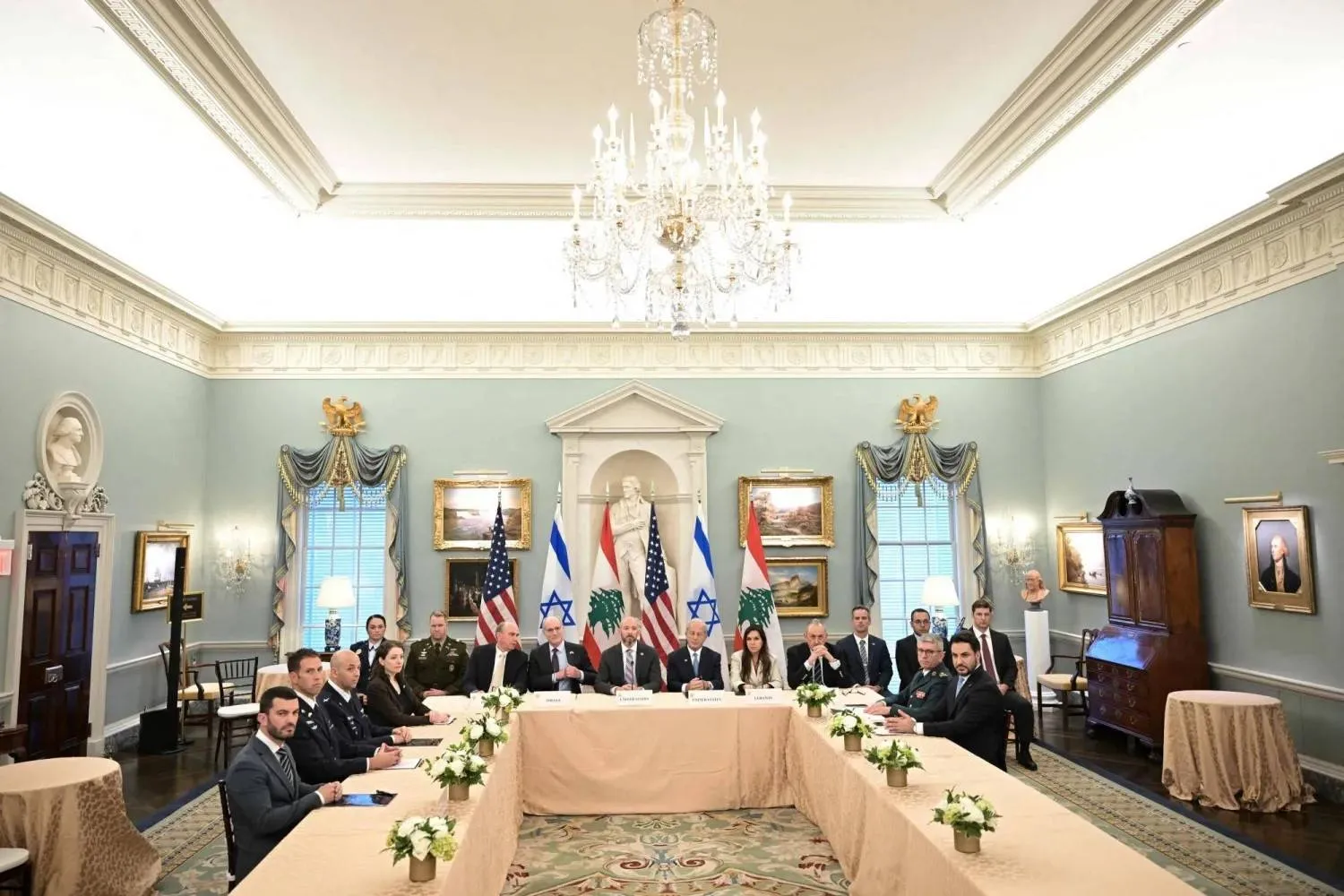
From a session of bilateral negotiations between Lebanon and Israel, held under US sponsorship at the US State Department. (AFP)
TT

Arab Push Seeks Lebanon Ceasefire Arrangements

From a session of bilateral negotiations between Lebanon and Israel, held under US sponsorship at the US State Department. (AFP)

An Arab diplomatic push is moving alongside talks involving Pakistan to increase pressure for a ceasefire agreement in Lebanon, after the country was pulled into a wider contest between Iran and the United States on one side, and Israel and Hezbollah on the other, Lebanese sources told Asharq Al-Awsat.

The phased effort would begin with enforcing a ceasefire, followed by a plan to carry out subsequent steps, the sources said.

Details of the Iranian-US understanding have yet to be announced, including whether Lebanon is included and under what formula.

But Israeli leaks offered no sign of calm on the Lebanese front.

Israel’s Channel 14 quoted an Israeli source as saying “the situation in Lebanon will remain as it is,” adding that Israel would “retain freedom of action against any threat inside Lebanese territory.”

The source said: “Iran’s attempts to link the arenas have failed.”

Lebanese sources, however, do not see the two files as separate in practice, even as Lebanon pursues an independent track through bilateral negotiations with Israel in Washington and prepares for a new round of talks.

Any US-Iranian understanding “will inevitably reflect on the Lebanese file, and we hope it will,” the sources said. The two sides concerned, they added, “can impose arrangements” through pressure from Washington on Tel Aviv and from Tehran on Hezbollah.

Supporting the Arab push

As the outcome of the Iranian-US talks takes shape, another factor has entered the Lebanese scene: an Arab effort to prepare the ground for any shift in those negotiations.

Lebanese sources following international contacts said a friendly Arab push on Lebanon’s behalf had gained momentum over the past two days and was working to shape a position that could support the negotiations.

Such a position, the sources said, “would pave the way for a tripartite meeting” between President Joseph Aoun, Parliament Speaker Nabih Berri and Prime Minister Nawaf Salam “to assess the situation and proceed with a plan that begins with implementing a ceasefire and carrying out the post-ceasefire phase.”

The effort is moving on several tracks, the sources said. It begins with enforcing a ceasefire, then moves to further steps: withdrawals by both sides, with the Israeli army pulling out of occupied territory and Hezbollah withdrawing its fighters; deployment of the Lebanese army; and the handover of Hezbollah’s weapons.

The process would be backed by international guarantees to prevent renewed fighting, allowing residents to return and restore stability in the south.

A helpful domestic development also emerged over the past week, with renewed contact between Aoun and Berri. The speaker is handling internal talks with Hezbollah.

Israel’s “intransigence” and Hezbollah’s insistence

Despite the regional and international moves, Lebanon is pressing ahead with its Washington negotiating track with Israel in pursuit of a ceasefire, a goal on which the Lebanese president has insisted.

Sessions are scheduled for June 22, 23 and 24, Lebanese ministerial sources told Asharq Al-Awsat. The first meeting will be military-diplomatic, the second day will be limited to military talks, and the third will be devoted to diplomacy.

So far, however, all initiatives have collided with Israeli “intransigence” and Hezbollah’s insistence on continuing the fight.

Israel has not provided answers to Lebanese demands in previous sessions, the sources said. At the latest session, Lebanon’s ambassador threatened to leave before US Secretary of State Marco Rubio intervened, the Lebanese presidency said last week.

The Israeli side “is intransigent and has not offered anything that would move the negotiations forward,” the sources said, citing its insistence on linking any step, including a ceasefire or a model zone, to Hezbollah’s prior disarmament.

Hezbollah, for its part, has told mediators it will not give answers before a full and comprehensive ceasefire across Lebanese territory. It has also halted contact with Aoun.

Caught between those positions, Lebanon has received US support for shielding Beirut and its southern suburbs from bombardment, but not enough pressure to secure a ceasefire in the south, the sources said.

The Israeli side “has enough freedom of movement in the south to continue bombardment and fighting,” they added, describing a reality in which some areas, namely the south, appear designated for combat while others remain spared.

The model zone

The previous negotiating session proposed a “pilot zone” for a model weapons-free area from which both sides would withdraw.

But the proposal never got a real chance to succeed before a practical implementation plan became clear. Hezbollah and Israel both rejected it, according to the sources.

The plan also carries risks for the Lebanese army if implemented without a ceasefire. It would leave troops unable to move safely between combat zones and amid incoming fire, placing soldiers directly in danger.

Awaiting Hezbollah’s answers

Against this deadlock, Lebanon is watching the Iranian-US talks and their possible impact at home.

Sources following the domestic push said, “Hezbollah’s margin for maneuver is narrowing,” and that the group must now provide answers on whether it will withdraw from the proposed model zones and whether it will hand over its weapons under any initiative.

It remains unclear whether, if Hezbollah agrees, it would provide such guarantees to the Lebanese state or to the Iranian negotiator.

“If it rejects both points, it must also provide an alternative to stop the war,” the sources said.

Hezbollah’s parliamentary bloc, Loyalty to the Resistance, on Friday condemned “the latest round of direct negotiations” and renewed its rejection “in full and in detail of all the unjust outcomes of the meeting, which imposed unilateral obligations on Lebanon.”

The bloc said it rejected “the conditions and dictates put forward by the enemy and adopted by the Lebanese negotiating delegation, despite the commitments containing no reference to what the enemy should commit to in terms of halting hostile operations, withdrawing from our land, the return of the displaced and reconstruction, which constitute national priorities and constants that the political authority should not overlook.”



Israel Defense Minister Vows to Keep Troops in Syria During Visit

25 June 2024, Jerusalem: Israeli Defense Minister Israel Katz is pictured in Jerusalem. (dpa)
TT

Israel Defense Minister Vows to Keep Troops in Syria During Visit

25 June 2024, Jerusalem: Israeli Defense Minister Israel Katz is pictured in Jerusalem. (dpa)

Israeli Defense Minister Israel Katz made a rare visit to troops in southern Syria on Tuesday, reiterating a pledge to keep forces in the area as long as there were "threats" to his country's security.

Damascus slammed Katz's "illegal entry" into the country, which came a week after Israel bombed the disused Abu al-Duhur base in northwestern Syria, claiming it wanted to prevent Turkish troops deploying to the facility. Ankara has denied any visit to the site.

In southern Syria, Israeli forces have been stationed in a "security zone" since the fall of longtime ruler Bashar al-Assad in December 2024.

They occupy what was previously a buffer zone patrolled by the United Nations that had separated Israeli and Syrian forces in the Israeli-occupied Golan since 1974.

"There is daily activity here to thwart threats, to eliminate remnants of the old regime, to prevent dangerous consolidation of the new regime," Katz said according to a video statement from his office.

"The message is clear to the president of Syria as well: when you wake up in the morning in your palace in Damascus, look up at Mount Hermon and see the Israeli army -- you know we are here to protect our communities and our border," he added.

"As long as there are threats, the army will remain here to guarantee our security -- this is what we have done and this is what we intend to continue doing in the future," Katz said.

Syria's foreign ministry said Katz's visit was a "flagrant violation of the country's sovereignty and territorial integrity".

It went on to urge the international community to take "the necessary measures to force the occupying authorities to halt these repeated violations".

Israel has carried out hundreds of strikes in Syria since the fall of Assad and made repeated incursions into Syrian territory.

Officials have also repeatedly vowed to keep troops in the security zone, where Israel is seeking a broader demilitarized area.

Israeli army chief Lieutenant General Eyal Zamir visited troops in the security zone last week, saying the military would not allow threats to "establish themselves" on the border.

During his visit on Tuesday, Katz addressed the strike on the Abu al-Duhur air base, saying Israel had "acted against a Turkish attempt to entrench itself in Syria, at the risk of Israel's security interests".


Kurdish-Led SDF Says It Has Dissolved After Merging with Syrian Army

 Syrian President Ahmad al-Sharaa, right, meets with the commander of the Kurdish-led Syrian Democratic Forces, Mazloum Abdi, center left, at the presidential palace in Damascus, Syria, Tuesday, Aug. 25, 2026. (AP)
Syrian President Ahmad al-Sharaa, right, meets with the commander of the Kurdish-led Syrian Democratic Forces, Mazloum Abdi, center left, at the presidential palace in Damascus, Syria, Tuesday, Aug. 25, 2026. (AP)
TT

Kurdish-Led SDF Says It Has Dissolved After Merging with Syrian Army

 Syrian President Ahmad al-Sharaa, right, meets with the commander of the Kurdish-led Syrian Democratic Forces, Mazloum Abdi, center left, at the presidential palace in Damascus, Syria, Tuesday, Aug. 25, 2026. (AP)
Syrian President Ahmad al-Sharaa, right, meets with the commander of the Kurdish-led Syrian Democratic Forces, Mazloum Abdi, center left, at the presidential palace in Damascus, Syria, Tuesday, Aug. 25, 2026. (AP)

The commander of the Kurdish-led Syrian Democratic Forces on Tuesday announced the official dissolution of the group, which once controlled a de facto autonomous zone in Syria's northeast.

Speaking during a news conference at the presidential palace in Damascus, Mazloum Abdi said the SDF has completed a merger with the Syrian army and would cease to operate as an independent force. The Kurdish-led force lost most of its territory in northeast Syria to a government offensive in January and then signed the deal to merge with the army.

The SDF was once the main partner of the United States in Syria as it battled the ISIS group. But after the ouster of former Syrian President Bashar al-Assad in December 2024, Washington formed close ties with the new government in Damascus led by interim Syrian President Ahmad al-Sharaa.

The SDF “carried a heavy responsibility during one of the most difficult periods in Syria’s history,” Abdi said.

“Today, circumstances have changed, and the country has entered a new phase, one of peace and participation in building a new Syria,” he said, announcing the “end of the SDF’s mission” and “its dissolution as an independent military force.”

Under the 50-year rule of the Assad dynasty in Syria, Kurds were marginalized, with many denied citizenship.

Shortly after the uprising against the Assad government began in 2011, the Kurds filled the vacuum created by the withdrawal of government forces from wide areas of Syria’s northeast. The SDF at one point controlled about 25% of Syria.

The Kurds were initially circumspect about the new post-Assad government and unwilling to give up their de facto autonomy. Some of the opposition groups that took part in the offensive that ousted Assad were Turkish-backed forces that had clashed with the SDF in the past.

Türkiye considered the SDF to be a terrorist organization because of its ties to the Kurdistan Workers’ Party, or PKK, a separatist group that staged a decades-long insurgency in Türkiye. A peace process is now underway.

Kurds questioned whether the new authorities would give them true representation in the new government, while al-Sharaa tried to woo them.

During ceasefire negotiations with the SDF in January, he issued a decree strengthening Kurdish rights. It made Kurdish an official language along with Arabic, and adopted Nowruz as a national holiday. It also restored the citizenship of tens of thousands of Kurds in northeastern Hasakeh province after they were stripped of it during the 1962 census.

Abdi said that al-Sharaa had promised that Kurds would have the right to education in their own language, an important issue for the country’s Kurdish population.

Questions remain, including the fate of the SDF's all-female fighting units.

But the success of the integration agreement with the SDF is a major boost to al-Sharaa's government, which has struggled to unify the country as it begins to recover from a nearly 14-year civil war. Most of the country is now under the control of the central government in Damascus.

The exception is southern Syria's Sweida province, which is now controlled by Druze factions that are hostile to Damascus after clashes last year. The Druze factions have received support from Israel, which is also occupying a strip of land in southern Syria near the border with the Israeli-annexed Golan Heights.


Iraq’s Ruling Coalition Discusses Arrests of Armed Faction Members

Iran’s Supreme National Security Council Secretary Mohsen Rezaei receives Iraq’s top judge Faiq Zidan in Tehran on Tuesday (Mehr)
TT

Iraq’s Ruling Coalition Discusses Arrests of Armed Faction Members

Iran’s Supreme National Security Council Secretary Mohsen Rezaei receives Iraq’s top judge Faiq Zidan in Tehran on Tuesday (Mehr)

Mohsen Rezaei, secretary of Iran’s Supreme National Security Council, said on Tuesday that regional countries would shape their own future and that the United States would have no place in the region.

Rezaei made the remarks in Tehran during talks with Faiq Zidan, head of Iraq’s Supreme Judicial Council.

He said Iran wanted a strong and independent Iraq and called for a resolution to the status of Iranian opposition groups based along the two countries’ border, an apparent reference to Iranian Kurdish parties in Iraq’s Kurdistan region.

His comments came days after Iranian parliament Speaker Mohammad Baqer Ghalibaf visited Baghdad, as Iraqi Prime Minister Ali Faleh al-Zaidi’s government faces growing pressure to press ahead with its plan to bring all weapons under state control.

During Ghalibaf’s visit, Iraqi National Security Adviser Qasim al-Aboudi said the government was moving forward with the plan.

He said the constitution did not allow armed groups to threaten the security of other countries and reaffirmed Baghdad’s commitment to its security agreement with Tehran.

The circumstances surrounding the visit suggested that armed factions were a central focus of the talks, even if the issue did not formally appear on every publicly announced agenda.

Iraqi reports said Ghalibaf conveyed Tehran’s position on government measures targeting the factions’ weapons as Baghdad’s deadline for completing the process approached.

Separately, leaders of the Coordination Framework discussed the arrests of Popular Mobilization Forces (PMF) members and commanders at a meeting in Baghdad attended by Mohsen Qomi, a representative of Iran’s supreme leader.

Local media said the leaders objected to how the arrests were carried out. They argued that those wanted by the authorities could have been summoned through formal judicial procedures instead of military force.

Underscoring the sensitivity of the issue, PMF later said what it called a “misunderstanding” over the arrests of several members had been resolved. It said they had been handed over to PMF security services to pursue their cases in court.

The developments come as al-Zaidi’s government seeks to enforce a state monopoly on weapons, bringing it into direct confrontation with armed factions that wield extensive political and security influence.

The weapons issue poses a sensitive test for al-Zaidi, who is also under US pressure to dismantle armed groups operating outside state control.

Baghdad ‘appreciates Tehran’s support’

In Tehran, Rezaei and Zidan focused their talks on security and judicial ties.

Zidan said Iraq appreciated Iran’s support and stressed the need for regional cooperation and security along the shared border.

He arrived in Tehran on Tuesday at the head of a senior judicial delegation following an official invitation. The delegation included the heads of the Judicial Supervision Commission and the Public Prosecution Service, as well as the director-general of the Judicial Protection Department.

Zidan was received by the Iranian judiciary’s deputy chief for international affairs and Nasser Seraj, secretary of the judiciary’s Human Rights Council.

During the visit, Zidan also met Iranian judiciary chief Gholam-Hossein Mohseni-Ejei to discuss closer judicial and legal cooperation.

Ejei said more than 131 Iranian convicts had been transferred from Iraqi prisons over the past year. He called for better prisoner-transfer and exchange mechanisms and measures to ease the difficulties facing their families.

He also said Iranian and Iraqi security were interconnected and urged closer coordination against activities threatening their shared border.

Zidan praised relations between the two countries and said the Iraqi government and people stood with Iran against what he described as “US and Israeli aggression.” He also recalled Iran’s support for Iraq during its war against ISIS.

Zidan also discussed several issues of common interest with Ghalibaf, according to Iraq’s state news agency.