

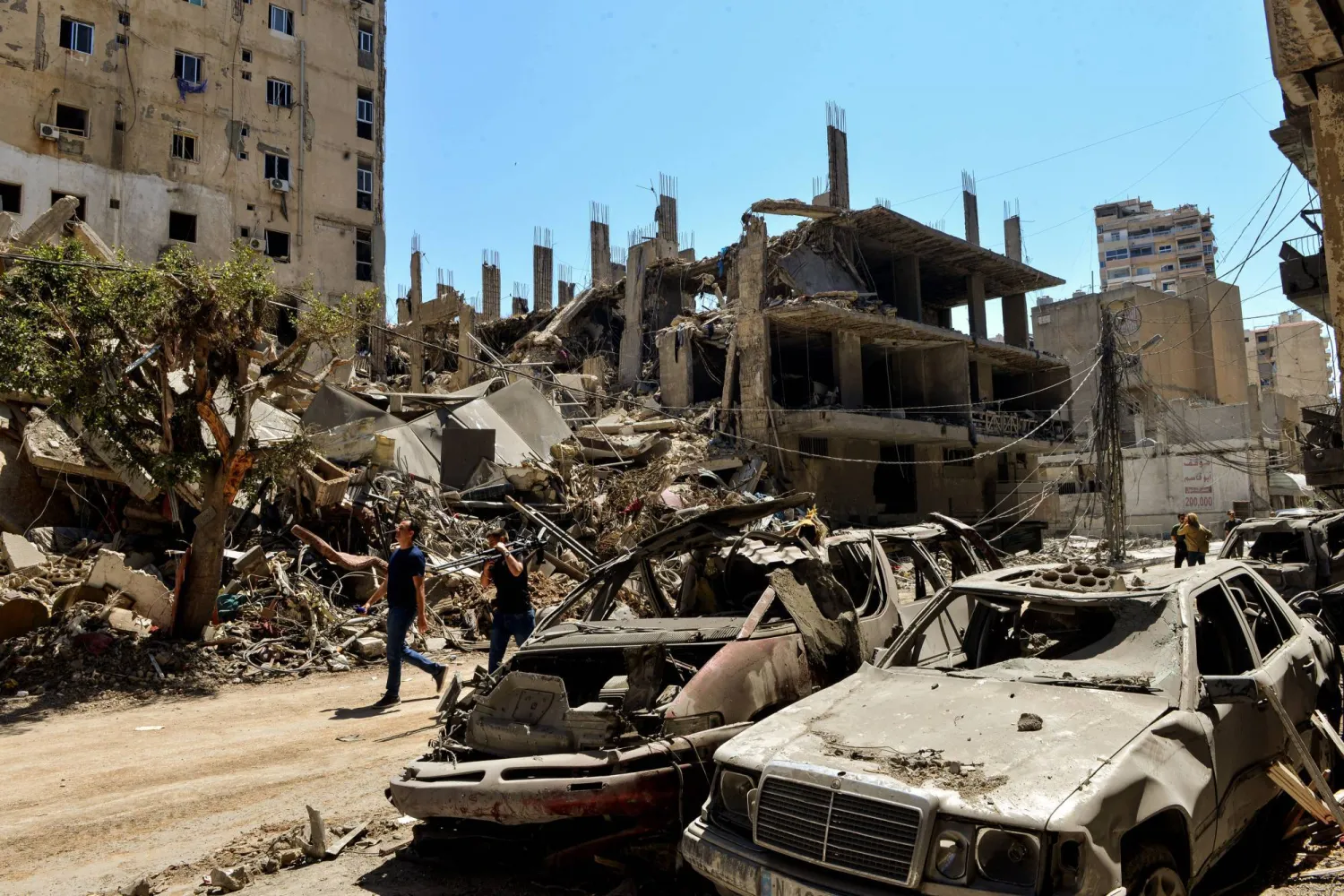

Israel Pushes Beyond ‘Yellow Line’ in Lebanon to Target Hezbollah and Bolster Negotiating Leverage

Residents walk amid buildings destroyed by Israeli bombardment in the city of Tyre, Lebanon (dpa). 
TT

Israel Pushes Beyond ‘Yellow Line’ in Lebanon to Target Hezbollah and Bolster Negotiating Leverage

Residents walk amid buildings destroyed by Israeli bombardment in the city of Tyre, Lebanon (dpa). 

Israel’s latest advance beyond the self-declared “Yellow Line” in southern Lebanon has raised questions about whether the expansion is driven solely by military objectives or also reflects broader political calculations, particularly as it coincides with reports of a US-Iran agreement that would include a comprehensive ceasefire in Lebanon.

On Saturday, Israeli forces made fresh gains along both the western and eastern fronts beyond the Yellow Line. Troops advanced toward the outskirts of Majdal Zoun following four days of artillery and air strikes, while forces also pushed into Kfartebnit, reaching the approaches to the strategically important Ali al-Taher Heights, which overlook the city of Nabatieh and much of the surrounding region.

The “Yellow Line” is the term adopted by the Israeli military in spring 2026 for a belt of territory inside southern Lebanon that it considers a military buffer zone, similar to the model previously employed in Gaza. The zone extends roughly 4 to 10 kilometers into Lebanese territory and encompasses about 55 border towns and villages.

Retired Brig. Gen. Mounir Shehadeh said military operations beyond the Yellow Line are concentrated in Kfartebnit, Zawtar al-Sharqiya, Yahmar al-Shaqif, Arnoun, and the Beaufort Castle area.

Speaking to Asharq Al-Awsat, Shehadeh argued that Israel is “racing against time” because it believes any US-Iran agreement could force an end to hostilities. As a result, he said, Israel is seeking to advance as far as possible before negotiations begin, allowing it to bargain from a position of strength.

He noted a distinction between villages entered by Israeli troops and those brought under operational control. Some communities have been incorporated into what Israel describes as a security zone, where residents are barred from returning and where Israeli forces maintain control through surveillance and firepower, even without a permanent troop presence.

According to Shehadeh, Israeli-controlled areas now extend between 5 and 10 kilometers inside Lebanese territory and include villages whose residents have been prohibited from returning.

Israel’s stated goal, Shehadeh underlined, is to push Hezbollah forces farther from its northern border, prevent future cross-border attacks on Galilee communities, destroy military infrastructure and weapons stockpiles, and establish a buffer zone to protect border settlements.

Its unstated objectives, however, may be broader. These include creating a new security belt resembling the zone Israel occupied between 1982 and 2000, turning border villages into sparsely populated areas that would make it difficult for Hezbollah to reestablish itself, and securing strategic high ground and transportation corridors. Such gains could provide Israel with significant leverage in future negotiations involving Lebanon and the postwar regional order.

For his part, Dr. Riad Kahwaji, defense and security analyst, said Israel is advancing along three separate axes, primarily to eliminate Hezbollah infrastructure, some of it located beyond the Yellow Line.

The eastern axis runs from Beaufort Castle through Kfartebnit and the Ali al-Taher Heights, placing Israeli forces in a position overlooking Nabatieh and potentially opening the way toward the Iqlim al-Tuffah region, where Hezbollah is believed to maintain tunnel networks.

The central axis stretches north of Bint Jbeil and Tebnine toward Ghandouriyeh in an effort to encircle Wadi al-Hujayr, long regarded as a key defensive zone and another suspected tunnel hub.

The western axis centers on Majdal Zoun and extends toward Qlayleh, potentially bringing Israeli forces closer to the approaches of the coastal city of Tyre.


4 People Killed in Israeli Strike in South Lebanon’s Nabatieh

This picture taken from a position in the Upper Galilee in northern Israel shows an Israeli army tank being positioned along the Israel-Lebanon border, on July 1, 2026. (Photo by Jack GUEZ / AFP)
TT

4 People Killed in Israeli Strike in South Lebanon’s Nabatieh

This picture taken from a position in the Upper Galilee in northern Israel shows an Israeli army tank being positioned along the Israel-Lebanon border, on July 1, 2026. (Photo by Jack GUEZ / AFP)

Four people were killed when an Israeli drone ⁠targeted a vehicle ⁠in ⁠Nabatieh in southern Lebanon, according to Lebanon's state news agency.

Hezbollah drew Lebanon into the Middle East war on March 2 with rocket fire at Israel to avenge the killing of Iran's supreme leader in US-Israeli strikes days earlier.

Israel responded with heavy airstrikes and a ground invasion of southern Lebanon, where its troops still occupy swathes of territory near the border.

At the end of June, Lebanon and Israel agreed to a US-backed framework aiming to pave the way for a permanent end to hostilities.


Hamas to Dissolve Gaza Governing Body, Say Officials

Palestinians walk along a road in Gaza City on July 3, 2026. (AFP)
TT

Hamas to Dissolve Gaza Governing Body, Say Officials

Palestinians walk along a road in Gaza City on July 3, 2026. (AFP)

Hamas is preparing to dissolve the body that has governed the Gaza Strip for nearly two decades, officials from the group said Monday, clearing the way for a Palestinian technocratic committee to implement civilian rule.

The move marks a significant political shift by the Hamas group, which has run Gaza since its fighters seized control from rival Palestinian movement Fatah in 2007.

Since a ceasefire took effect in Gaza last October between Hamas and Israel, the group has repeatedly said it is prepared to step aside from day-to-day governance, but the thorny issue of its disarmament remains unresolved.

"The movement has decided to dissolve the Gaza government committee and to appoint a nationally accepted figure to oversee the committee's work until the National Committee for the Administration of Gaza formally assumes its responsibilities," a Hamas official told AFP, speaking on condition of anonymity as he was not authorized to talk publicly on the matter.

Hamas's media office in Gaza said it would hold "an important press conference" later on Monday, without providing details.

A second Hamas official said the group had already informed other Palestinian factions of the move at a recent meeting in Cairo.

"The factions welcomed Hamas's decision, describing it as a serious step towards enabling the National Committee to take up its governing role," the official said.

The dissolution of the Hamas body paves the way for the National Committee for the Administration of Gaza (NCAG), headed by Palestinian official Ali Shaath, to assume administrative responsibilities.

The NCAG was established by the Board of Peace, which was in turn set up by US President Donald Trump when he brokered the ceasefire between Hamas and Israel last October.

But it has remained based outside Gaza for months, reportedly due to Israeli objections to its entry into the war-devastated territory.

Hamas and other Palestinian factions have held several rounds of talks in Cairo with mediators to narrow differences, particularly over the second phase of the Gaza ceasefire.

The first phase involved the release of the last Israeli hostages held by Hamas in exchange for Palestinians detained by Israel.

The transition to the second phase, which was to involve Hamas's disarmament and a gradual withdrawal of Israeli forces from Gaza, has been stalled for months.

Israeli forces have actually expanded their presence in the territory in recent months, taking control of nearly 70 percent.

Meanwhile, Hamas is demanding the establishment of a Palestinian administration before it will consider handing over any part of its arsenal.

The question of Gaza's post-war governance remains one of the main sticking points in negotiations on implementing phase two.

Israel rejects any return of Hamas to power, but also rejects a direct takeover by the Ramallah-based Palestinian Authority at this stage.


UN Rights Council Orders 'Urgent Inquiry' in Sudan's El-Obeid

A Sudanese girl reacts while carrying a plastic canister in al-Rahmaniyah camp for displaced people, near the city of El-Obeid in the southern Kordofan region, on June 25, 2026. (Photo by AFP)
TT

UN Rights Council Orders 'Urgent Inquiry' in Sudan's El-Obeid

A Sudanese girl reacts while carrying a plastic canister in al-Rahmaniyah camp for displaced people, near the city of El-Obeid in the southern Kordofan region, on June 25, 2026. (Photo by AFP)

The UN rights council on Monday ordered an "urgent inquiry" into violations and abuses in the Sudanese city of El-Obeid, warning of the looming risk of "large-scale atrocities". 

A strategic hub in the southern Kordofan region, El-Obeid has been encircled for months by the Rapid Support Forces, the paramilitary group that has been fighting Sudan's army since April 2023. 

In a resolution adopted by consensus, the 47-member council voiced "deep concern about the imminent risk of large-scale atrocities by the (RSF)... faced by hundreds of thousands of civilians, including children and internally displaced persons in and around El-Obeid". 

The resolution, which passed after the council held an urgent debate on the situation on Friday, also condemned "reports of dozens of drone strikes on El-Obeid in the last two weeks, including on hospitals and health facilities". 

It also decried "widespread use of rape and other forms of sexual and gender-based violence", and voiced "alarm at reports of the use of starvation as a method of warfare". 

Presenting the resolution on behalf of a number of countries, Britain's human rights ambassador in Geneva Eleanor Sanders told the council that it was "not enough to express shock and concern". 

"We must take concrete action to support accountability for these crimes." 

- 'Red alert' - 

El-Obeid, the capital of North Kordofan state, sits on a key route linking RSF-held areas in the western Darfur region to army-controlled regions in the east. 

A city of half a million people that hosts nearly 100,000 refugees displaced by the civil war, El-Obeid has, in recent weeks, faced its most intense RSF attacks yet. 

The UN has voiced fears that there could be a repeat in El-Obeid of atrocities committed during the RSF's October 2025 assault on the Sudanese city of El-Fasher. 

The UN's independent fact-finding mission on Sudan concluded earlier this year that the siege and capture of El-Fasher bore "the hallmarks of genocide". 

During Friday's debate, UN rights chief Volker Turk told the council that "the signs from El-Obeid are clear and unmistakable: another human rights catastrophe is unfolding in Sudan". 

Monday's text called on the existing fact-finding mission to conduct "an urgent inquiry into any violations and abuses of international... law and related to international crimes, allegedly committed in and around El-Obeid". 

The investigators, it said, should provide an update to the rights council and the General Assembly in New York during their next sessions, both in September.
