
Lebanon Says 47 Killed in Strikes, Israel Reports Deaths of 4 Soldiers

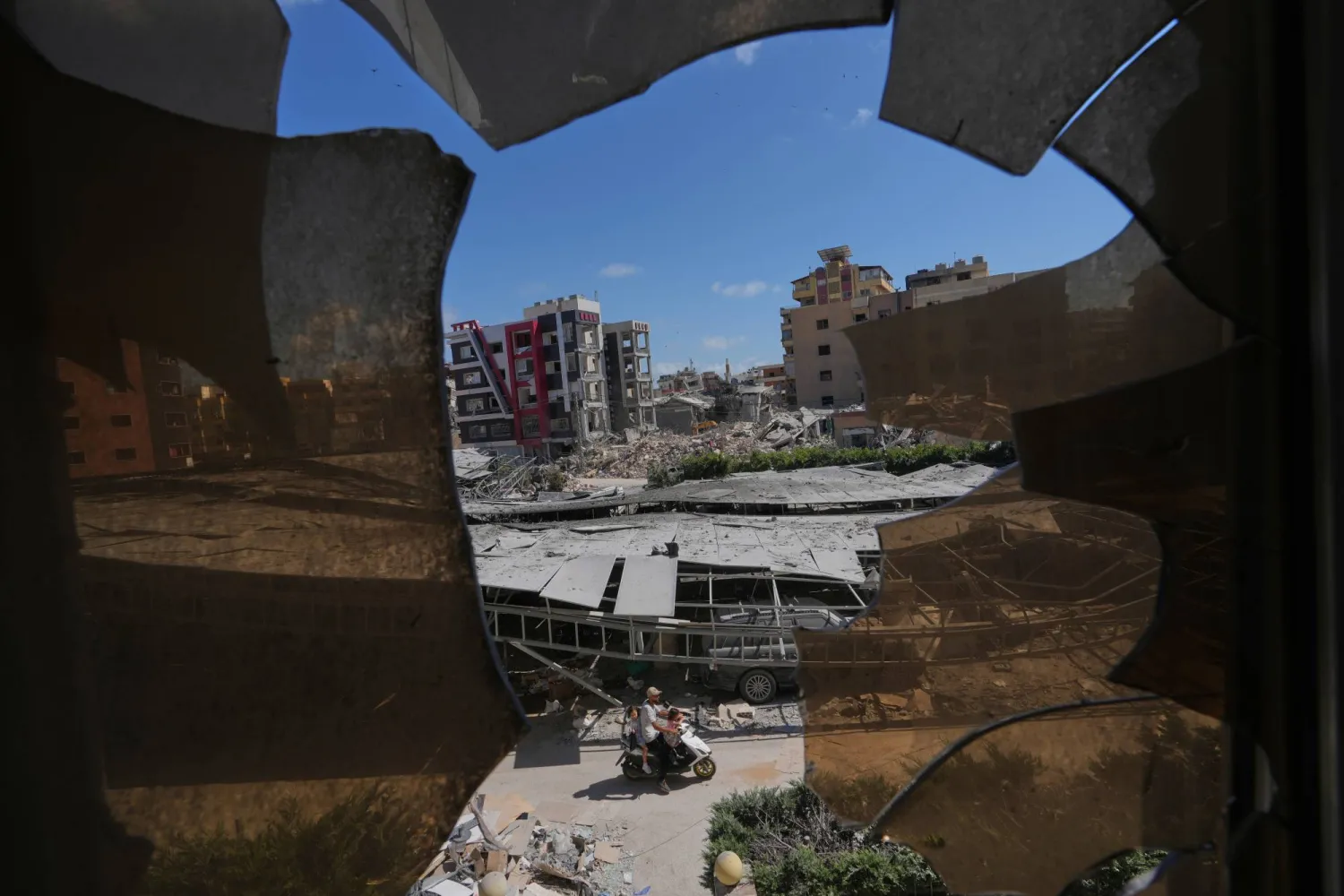
Buildings damaged by Israeli strikes are seen through shattered glass from the Jabal Amel Hospital in the southern port city of Tyre, Lebanon, Thursday, June 18, 2026. (AP Photo/Hassan Ammar)
TT

Lebanon Says 47 Killed in Strikes, Israel Reports Deaths of 4 Soldiers

Buildings damaged by Israeli strikes are seen through shattered glass from the Jabal Amel Hospital in the southern port city of Tyre, Lebanon, Thursday, June 18, 2026. (AP Photo/Hassan Ammar)

Fighting flared anew in Lebanon on Friday, with authorities reporting 47 killed in Israeli airstrikes and Israel announcing the deaths of four of its soldiers. 

The violence is the worst since the sealing of a US-Iran deal to halt the wider Middle East war, which was supposed to also pause fighting between Israel and Hezbollah in Lebanon. 

Lebanon's official National News Agency also reported a fresh Israeli strike on the area of Jezzine in the south, soon after a US official said on Friday that Israel and Hezbollah had agreed a ceasefire. 

An NNA journalist had also reported drones flying over the Tyre area, while an AFP correspondent heard continuous artillery shelling in the southern town of Nabatieh. 

The US official told AFP on condition of anonymity that the truce was brokered by US and Qatari mediators, following talks with Israel and Iran. 

A Gulf diplomat later confirmed the ceasefire was brokered by Qatar, the US and Iran. 

Israeli Prime Minister Benjamin Netanyahu's office did not respond to an AFP request to confirm the ceasefire. 

Israeli military spokesman Brigadier General Effie Defrin said: "Everything related to agreements belongs to the political echelon... We will continue to operate according to the directives". 

An earlier truce meant to have taken effect in April did little to stop attacks from either side. 

- 'Dangerous escalation' - 

Lebanon's health ministry said Israeli airstrikes and bombardments killed at least 47 people -- including seven women and two children -- and wounded 97 others in Lebanon on Friday. 

Video from AFPTV showed hundreds of cars packing roads in the city of Sidon as people attempted to flee southern areas. 

Israel's military reported "more than 150 military strikes in Lebanon since midnight". 

It said earlier it had "struck more than 80 command centres, terrorists, launch positions and additional terrorist infrastructure sites in the area of Nabatieh and additional areas in southern Lebanon". 

"Dozens of Hezbollah terrorists operating in the command centres were eliminated." 

Iran-backed Hezbollah, meanwhile, said it was attacking Israeli forces around Nabatieh. 

Israeli strikes also targeted the Baalbek region in the east of Lebanon, which had been largely spared since the start of the conflict in March. 

Lebanese President Joseph Aoun said Israel's latest attacks "constitute a dangerous escalation". 

Earlier, the Israeli military said Lieutenant Colonel Dor Gedalia Ben Simhon had "fallen in combat" along with three other soldiers. 

Israeli military correspondents reported the four were killed when a tank was hit by "a suspected drone or anti-tank missile". 

The military also reported that a reserve officer was severely wounded by a drone attack, with four other soldiers lightly injured. 

- 'Mothers must weep' - 

The deaths of the soldiers drew a furious reaction in Israel. 

Far-right National Security Minister Itamar Ben-Gvir said "Lebanon must burn... For every tear shed by an Israeli mother, 1,000 Lebanese mothers must weep". 

In response, Iranian Foreign Minister Abbas Araghchi accused Israel of wanting "permanent war". 

US officials including President Donald Trump have expressed frustration at Israel's campaign in Lebanon. 

But Netanyahu said Friday that Israeli troops will stay in south Lebanon "as long as necessary". 

Hassan Tarhini, 57, forced to flee the Nabatieh area, told AFP that "we have no problem being displaced once, twice or even 10 times, so long as we return with our heads held high". 

Hezbollah drew Lebanon into the Middle East war in early March by attacking Israel to avenge the killing of Iran's supreme leader in US-Israeli strikes. 

Israel responded with a massive campaign of airstrikes and a ground invasion. 


Plans for Post-War Gaza Face Challenges on the Ground

11 July 2026, Palestinian Territories, Nuseirat: A vehicle damaged in an Israeli strike is seen at the scene in the Nuseirat refugee camp in the central Gaza Strip, where a Palestinian was killed and others were wounded. (dpa)
TT

Plans for Post-War Gaza Face Challenges on the Ground

11 July 2026, Palestinian Territories, Nuseirat: A vehicle damaged in an Israeli strike is seen at the scene in the Nuseirat refugee camp in the central Gaza Strip, where a Palestinian was killed and others were wounded. (dpa)

In spite of the ongoing risk of renewed fighting in Gaza, stakeholders have spent months preparing for the post-war phase.

Plans for governance, security and humanitarian relief have begun to take shape, but remain largely theoretical in the absence of a political agreement, credible security guarantees and sustained funding.

Below are some of the key challenges facing local and international players as they seek to rebuild the devastated territory home to more than two million Palestinians.

- Security concerns -

Security remains the cornerstone of every post-war scenario under discussion.

Israel insists Hamas must disarm before any progress can be made, while the Palestinian movement refuses to surrender its weapons before Israeli troops withdraw and a Palestinian governing authority is established.

However, an official from the Board of Peace established by US President Donald Trump to help prepare for post-war Gaza told AFP that Hamas's disarmament was no longer being treated as a precondition for advancing plans on the ground.

"The entire planning is around worst case scenario," he said, referring to a planned pilot "humanitarian zone" in Rafah, in the south.

"We get nothing in the negotiation, but we move forward anyhow."

Among the proposals is an International Stabilization Force (ISF) tasked with helping maintain order in Gaza.

According to the same source, four countries -- Morocco, Kosovo, Albania and Kazakhstan -- are "really engaged" in the initiative.

A logistical base on the Israeli side of the Kerem Shalom crossing is "close to complete" and would be able to host an initial rotation of around 500 troops before any deployment into Gaza, the official said.

Preparations are also continuing for a Palestinian police force, with around 20,000 applications already received, the official added.

But several diplomats and security sources interviewed by AFP described a process that remains deadlocked.

According to one diplomatic source, training has yet to begin and Israel has rejected the current list of recruits following its vetting process, arguing in particular that a proposed force of 5,000 police officers would be too large for Gaza.

Despite a ceasefire in place since October 2025, daily violence grips the territory as Israeli strikes continue targeting what the military says are violations of the truce by fighters from Hamas and other Palestinian groups.

- Little reconstruction -

The humanitarian needs of Gaza remain overwhelming.

The United Nations estimates reconstruction will take years and require tens of billions of dollars, as construction materials and debris-clearing equipment remain in critically short supply.

Despite substantial donor pledges, much of the expected funding has yet to be disbursed, according to the Board of Peace.

"We're working with an amount that for now meets our needs," the board official said, adding that if several humanitarian zones have to be established then "we obviously need more funding".

The board is currently planning a pilot humanitarian zone in Rafah which would accommodate tens of thousands of vetted Palestinians, the official said earlier this week.

- No governing institutions -

Hamas announced recently it intends to hand over administrative responsibilities to the National Committee for the Administration of Gaza (NCAG), a body set up by the Board of Peace comprising Palestinian technocrats tasked with overseeing day-to-day governance during a transitional period.

But the NCAG has still not even managed to enter Gaza, with several Palestinian and diplomatic sources saying Israel has barred the committee from entering.

For Israel, dismantling Hamas's administrative apparatus falls short of its longstanding demand that the group disarm.

The future role of the Palestinian Authority (PA) also remains unresolved.

Based in Ramallah in the occupied West Bank -- a separate Palestinian territory from the Gaza Strip -- the PA remains the international community's officially recognized Palestinian interlocutor.

The NCAG is intended as a temporary body implementing basic services across the strip, with European officials expecting it to work in coordination with the PA.

Several observers, however, warn that the result could be an administration responsible for delivering public services but lacking authority over security forces or border crossings -- leaving it dependent on its international backers while remaining vulnerable to Hamas should the group retain all or part of its military arsenal.


US Delegation in Lebanon to Discuss Israel ‘Pilot Zone’ Withdrawal, Says Official

A vehicle that was reportedly damaged by an Israeli strike is pictured in the southern Lebanese village of Kfar Rumman on July 10, 2026. (AFP)
TT

US Delegation in Lebanon to Discuss Israel ‘Pilot Zone’ Withdrawal, Says Official

A vehicle that was reportedly damaged by an Israeli strike is pictured in the southern Lebanese village of Kfar Rumman on July 10, 2026. (AFP)

A US military delegation met with Lebanon's army in Beirut to discuss the implementation of Israel's withdrawal from a "pilot zone" in occupied territory, a Lebanese military official told AFP on Saturday.

Under a framework agreement reached on June 26, Israel will gradually withdraw from areas of southern Lebanon where it has deployed troops to fight the Iran-backed Hezbollah party.

As part of the agreement, the long-disempowered Lebanese military will take full control of two small areas dubbed pilot zones.

"The American military delegation arrived and began meetings with the Lebanese army command to discuss the mechanisms for implementing the first pilot zone from which the Israelis will withdraw, allowing the Lebanese army to deploy," the official said, requesting anonymity.

"This is the main objective the American military delegation is bringing to Lebanon... it is the translation and implementation of the framework agreement."

US Ambassador Michel Issa told President Joseph Aoun on Thursday that the American delegation was coming to "determine the mechanism" for the deal's implementation.

In Washington, a US official had said on condition of anonymity that "the first pilot zone will launch in a matter of days, and further pilot zones are being mapped out and planned".

US Central Command will coordinate on the zones with both countries, he said.

The agreement -- rejected by Hezbollah -- does not set a timetable for Israel's withdrawal, and Israeli officials have also vowed that their forces will remain in a "security zone" 10 kilometers (six miles) deep as long as Hezbollah remains armed.

The war, which began in early March when Hezbollah entered the wider Middle East conflict on the side of its backer Iran, displaced more than a million people in Lebanon, according to the UN's humanitarian agency OCHA.

On Saturday, the agency said more than 732,000 people had now returned home, up from 640,000 a week before.

That leaves more than 430,000 still displaced, it added.

Israel has pursued intermittent strikes despite a truce in its war with Hezbollah, with Lebanon's state-run National News Agency reporting several in the south on Saturday.

The latest talks between Lebanon and Israel, which have no formal relations but have met for five rounds of negotiations since the start of the war, will take place in Rome next Wednesday and Thursday.

Lebanon conditions its participation on Israel withdrawing from two pilot zones.

The talks precede Aoun's expected visit to Washington later this month at the invitation of his American counterpart Donald Trump.


Iraqis Protest Over Power Cuts in Sweltering Summer Heat

Demonstrators gather as they take part in a protest over unemployment, corruption and poor public services, in Baghdad, Iraq October 2, 2019. (Reuters)
TT

Iraqis Protest Over Power Cuts in Sweltering Summer Heat

Demonstrators gather as they take part in a protest over unemployment, corruption and poor public services, in Baghdad, Iraq October 2, 2019. (Reuters)

Hundreds of residents of an eastern Iraqi city protested on Saturday against power cuts during extreme summer heat, an AFP correspondent said.

Temperatures in the city of Kut have peaked at 44C, with residents organizing protests to urge authorities to boost electricity supply.

Decades of war have left Iraq's infrastructure in a pitiful state, with power failures worsening blistering summers.

On Friday night, hundreds of protesters took to the streets with dozens hurling stones at security forces, who responded by firing tear gas and detaining more than 30 people, according to an AFP correspondent.

The clashes lasted until early morning.

Two local health officials told AFP on condition of anonymity that more than 50 police officers were injured.

It is unclear how many protesters were wounded, with one source estimating the number at around 30.

Protesters have likely avoided reporting themselves to hospital for fear of arrest, a health official said.

Demonstrations against power cuts are frequent in Iraq, especially during the scorching summer months, when temperatures often reach 50C.

In the oil-rich country, many households have just a few hours of state electricity per day, and those who can afford it use private generators to keep fridges and air conditioners running.

Iraq is the second-largest oil producer in the OPEC cartel, but despite its immense oil and gas reserves, it remains dependent on imports to meet its electricity needs.