


Lebanese, Int’l Contacts Contain South Lebanon Security Deterioration

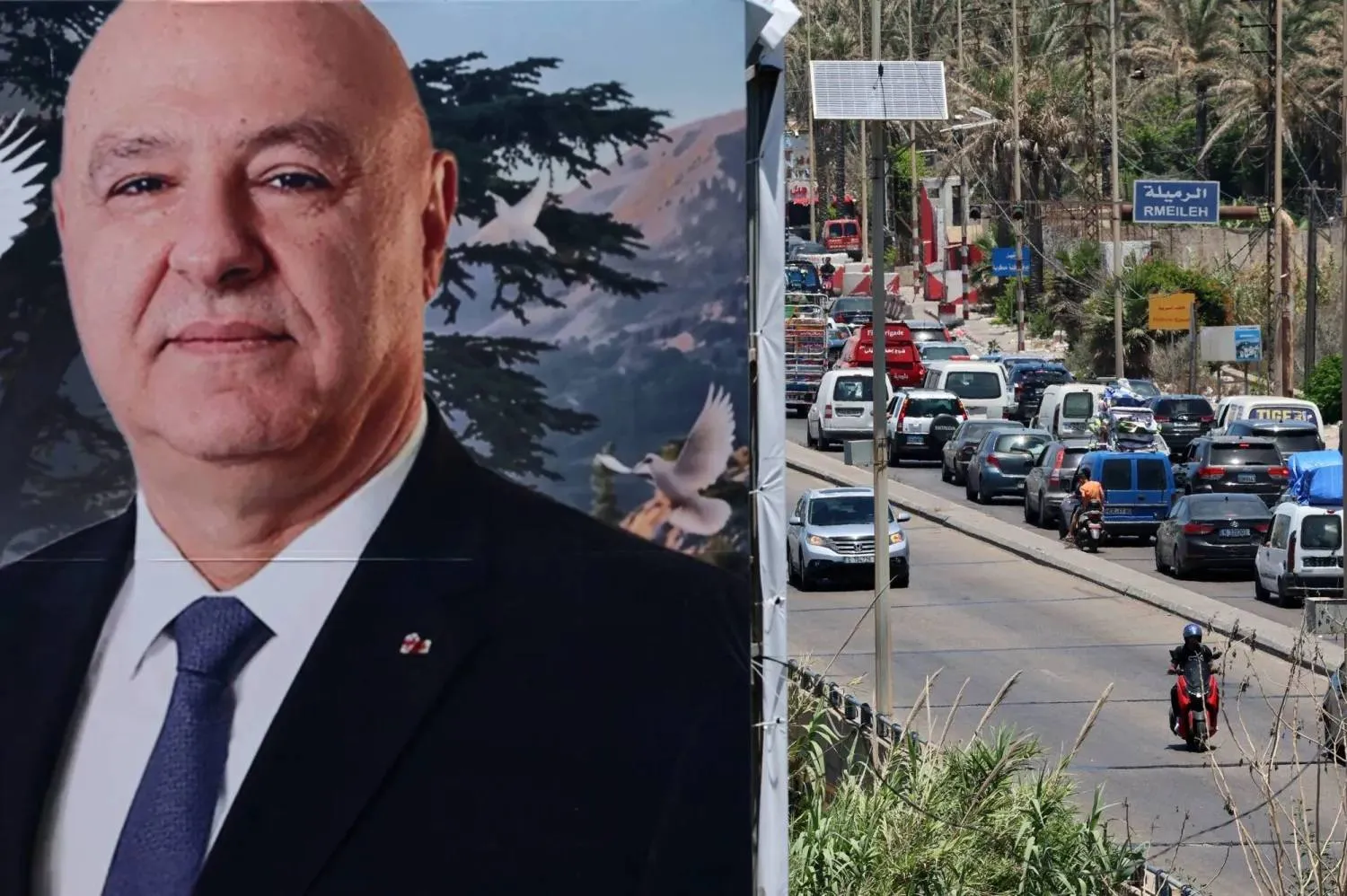
A giant portrait of Lebanese President Joseph Aoun hangs at the northern entrance to Sidon, as cars carrying displaced people from southern Lebanon head toward Beirut. (EPA)
TT

Lebanese, Int’l Contacts Contain South Lebanon Security Deterioration

A giant portrait of Lebanese President Joseph Aoun hangs at the northern entrance to Sidon, as cars carrying displaced people from southern Lebanon head toward Beirut. (EPA)

Lebanese and regional contacts contained a sharp deterioration in Lebanon’s security situation after a major military escalation between Israel and Hezbollah, and threats by Tel Aviv to escalate further.

Lebanese sources said Israel was seeking to undermine the ceasefire agreement, pressure Lebanese negotiators ahead of a fifth round of talks with Lebanon in Washington, and secure gains on the ground.

Reuters quoted a US official as saying Israel and Hezbollah had agreed to a ceasefire starting at 4 p.m. local time, after a major escalation that killed 47 Lebanese, including children and civilians, and four Israeli soldiers in clashes with Hezbollah in southern Lebanon. The Israeli air force carried out more than 150 strikes in southern and eastern Lebanon.

“Hezbollah and Israel agreed to a ceasefire,” the US official said, adding that US and Qatari negotiators reached the agreement with help from Iran.

“We understand that after the exchange of fire earlier today, Israel and Hezbollah are now in a ceasefire,” the official said.

Israel and Hezbollah both said they were ready to respect the ceasefire and respond to violations.

Lebanese and international contacts

The security deterioration triggered a flurry of regional, international and local contacts.

Official sources told Asharq Al-Awsat that Lebanese President Joseph Aoun “began a series of international contacts in the morning with influential countries to lower the escalation, prevent further deterioration and ensure commitment to the ceasefire.”

The contacts focused mainly on the United States and Qatar.

Aoun also condemned “the continuing Israeli escalation.”

“What we are witnessing today in the south and the Bekaa, with the expansion of Israeli attacks and further killing and destruction, is a dangerous and condemnable escalation, especially as it has affected dozens of innocent people, including women and children,” Aoun said.

He said the escalation “effectively targets all ongoing efforts to consolidate the ceasefire and end the war, especially after the latest developments between the US and Iran.”

“But this will not prevent work to achieve a comprehensive ceasefire as quickly as possible. This is what I instructed the Lebanese negotiating delegation to pursue in the next round in Washington,” he said.

“There can be no leniency on this issue because a comprehensive ceasefire is the entry point for discussing other issues, most importantly the Israeli withdrawal, the deployment of the army and the return of prisoners.”

On the international level, Hezbollah parliamentary bloc member MP Hassan Fadlallah said Iran had informed the group that negotiations with the United States could not continue without the implementation of a comprehensive ceasefire.

Fadlallah urged the Lebanese government to reject any direct negotiations with Israel while Israeli attacks on Lebanon continue. He said Washington was responsible for ensuring Israel stops its attacks and implements the terms of the agreement.

Geographic expansion and pressure on Lebanon

The sudden deterioration appeared to signal an Israeli attempt to bypass the agreement that took effect last Monday.

Sources in the Shi’ite duo told Asharq Al-Awsat that Israel was “pressuring to strike the agreement directly and target it.” They said Tel Aviv was also trying to pressure the Lebanese negotiator before the fifth round of direct negotiations with Israel opens in Washington next Tuesday. The talks are due to run for three days.

The sources said Israel was trying to “seize additional cards with which to pressure Lebanon.”

They cited “an Israeli desire for geographic expansion after its failure to achieve a major expansion during 110 days of war.” The area where Israel made significant advances in the first weeks of the war, they said, was the same area Hezbollah evacuated and where it committed to restricting weapons to the Lebanese state.

But attempts to expand beyond that area “met fierce resistance that slowed the push,” the sources said.

The source said a fourth reason was “an internal crisis linked to the rising far-right mood in Israel,” adding that “military failure is driving it to target civilians in Lebanon.”

Ceasefire before any arrangements

Lebanese observers say Israel’s failure to abide by the ceasefire agreement is not driven only by Prime Minister Benjamin Netanyahu’s sense of being “sidelined” after the agreement was signed.

They say Israel is also trying to reach an agreement with the Lebanese state in exchange for withdrawal from occupied territory, and to begin disarming Hezbollah in exchange for halting the escalation.

Hezbollah rejects this. The group is relying on US-Iranian understandings and continues to criticize the Lebanese state’s negotiating track.

Still, Lebanese authorities are proceeding with the sessions scheduled to begin Tuesday.

Lebanese ministerial sources told Asharq Al-Awsat that the instructions to the negotiating delegation are clear: demand a full and comprehensive ceasefire before discussing any other arrangements.

The sources said Beirut “is holding to its demands.”

Singling out Lebanon

Hezbollah, however, rejects the direct negotiating track.

Sources following Hezbollah’s escalation against the track said the group “believes there is an overlap of interests between Tel Aviv and the state within the framework of the track on which the state is relying to achieve withdrawal and a ceasefire.”

The sources said Hezbollah believes the direct negotiating track rests on the view that Israel is uncomfortable with US performance in the agreement with Iran, while Lebanon is uncomfortable with Iran’s performance.

They said Hezbollah had “sensed that Lebanon was being singled out” through the US statement issued after the first negotiating session. This, they said, was reinforced in the declaration of intent paper in the fourth round, which appeared to show bias toward Israel in the negotiations.

Hezbollah MP Hussein Hajj Hassan said: “The authorities agreed to a joint statement with the Americans and Israelis containing language to the effect that Hezbollah is a common enemy of Israel, America and Lebanon. This was stated by US Secretary of State Marco Rubio, while the Lebanese delegation did not utter a word. No Lebanese official in power objected to this language. Therefore, what is required from them is a position clarifying whether they agree with this language or not.”

He called on Lebanese officials “to bridge the gap they created with the resistance and its public, and to bridge the gap they created with the Islamic Republic of Iran, for Lebanon’s interest and not for Iran’s interest.”



Iraq’s ‘Oil Network’ Arrests Reach Another Official

Iraqi security personnel patrol a street in Baghdad on June 28. (AFP)
TT

Iraq’s ‘Oil Network’ Arrests Reach Another Official

Iraqi security personnel patrol a street in Baghdad on June 28. (AFP)

An Iraqi security force on Thursday arrested Hussein Talib, director general of the state-run Oil Products Distribution Company, on suspicion of involvement in corruption cases, hours before he was scheduled to take the constitutional oath as a replacement member of parliament, a security source said.

Talib’s detention came as investigations into corruption linked to the oil sector widened. The Central Anti-Corruption Criminal Court announced Thursday that an additional 14 billion Iraqi dinars, or about $10.7 million, had been seized in the case of detained Oil Ministry Undersecretary Adnan al-Jumaili.

Talib, who heads the Oil Ministry-affiliated company, had been named to replace lawmaker Ammar Mousa as a Baghdad representative for the National State Forces Alliance. His arrest prevented him from taking the oath, the source said.

The National Wisdom Movement, led by Ammar al-Hakim and of which Talib is a member, said it supported measures taken by the government, judiciary and Integrity Commission to combat corruption.

Movement spokesman Hossam al-Hassani said it backed legal action aimed at protecting public funds, adding that an official’s compliance with investigative procedures demonstrated respect for constitutional and legal institutions.

He stressed that “the accused is innocent until proven guilty by a final court ruling,” adding that any legal responsibility, if established, was personal and should not extend to any political, social or institutional entity. He urged against prejudging or politically exploiting the case.

Iraqi security forces last week arrested politicians, lawmakers and senior government officials named in al-Jumaili’s confessions. Security and legal sources described the arrests as the beginning of a broader anti-corruption campaign ordered by Prime Minister Ali al-Zaidi.

Al-Zaidi, who took office in May, has pledged to root out corruption, one of Iraq’s most persistent challenges despite repeated accountability promises by successive governments.

An investigating judge said continued inquiries into the waste of public funds in projects led authorities to discover money hidden in a stormwater drainage pit. Investigations were continuing to identify all members of the network.

Parliament also voted Thursday to dismiss National Investment Commission Chairman Haider Makkiya and refer the relevant files to the Integrity Commission after he failed to attend a questioning session.

Al-Zaidi said his government would fight corruption “without exceptions or red lines,” pursue those involved and recover stolen funds.

Local media also reported that Foreign Minister Fuad Hussein discussed in Kuwait efforts to freeze and recover money allegedly deposited in Kuwaiti banks by corruption suspects, as well as cooperation to identify shell companies and return assets to Iraq.


Syrian Authorities Say Captured ISIS-linked Cell Behind Blasts

Syrian security personnel inspect a burned vehicle near the Four Seasons Hotel after two explosions rocked the area earlier in Damascus, Syria, Tuesday, July 7, 2026. (AP Photo/Omar Albam)
TT

Syrian Authorities Say Captured ISIS-linked Cell Behind Blasts

Syrian security personnel inspect a burned vehicle near the Four Seasons Hotel after two explosions rocked the area earlier in Damascus, Syria, Tuesday, July 7, 2026. (AP Photo/Omar Albam)

Syrian officials said late Thursday the country had captured an ISIS-linked cell responsible for two bomb blasts during French President Emmanuel Macron's visit to Damascus earlier this week.

In a joint press conference with his Syrian counterpart, Macron said we must "not let ourselves be destabilized" by such attacks, and the two leaders vowed to boost ties with new ambassadors to be installed in each country.

Syria's Interior Minister Anas Khattab said that "the cell responsible for the terrorist bombings that targeted Damascus two days ago is now in our custody".

"Once the investigations are completed, we will reveal to the public the identities of the cell's members, their roles, and all of their affiliations and connections," he wrote on X.

Ahmad Dalati, head of interior security for the Damascus region, said on Syrian state television that preliminary investigations indicated "the cell was affiliated with the ISIS group".

The interior ministry said in a statement that the cell had been captured following a series of raids "carried out at the same time against the suspects' different locations across Damascus and its countryside".

The statement said the raids occurred in four neighborhoods.

Two blasts hit central Damascus on Tuesday, killing one person and wounding dozens during the French president's first visit to Syria.

The explosives had been planted near the Four Seasons Hotel, where Macron had spent the night, with Syria's interior ministry saying one was placed in a garbage container and the other in a vehicle near the hotel in the heart of the capital.


Hamas Shifts Its Center of Gravity to Türkiye, Seeks Rapprochement with Syria

Turkish Foreign Minister Hakan Fidan meets a Hamas delegation led by Khalil al-Hayya in Istanbul. (Hamas)
TT

Hamas Shifts Its Center of Gravity to Türkiye, Seeks Rapprochement with Syria

Turkish Foreign Minister Hakan Fidan meets a Hamas delegation led by Khalil al-Hayya in Istanbul. (Hamas)

Hamas has shifted much of its organizational center of gravity toward Türkiye in recent months, according to meetings, activities and public positions by the group, after years in which it kept its operations there at a distance and reduced its presence.

The shift has coincided with statements of condemnation and solidarity after bombings in Syria, whose new government Hamas is seeking to approach.

The clearest sign of Hamas’s growing reliance on Ankara came in May, when the group chose Türkiye as the venue for internal elections to select the head of its political bureau. The vote ended without a decisive result.

Three Hamas sources abroad told Asharq Al-Awsat that the group had recently resumed holding its meetings in Türkiye, after using the Qatari capital Doha in recent years for meetings and internal elections.

In recent years, Turkish security agencies have announced the dismantling of “espionage networks working for Israel’s Mossad”. Turkish media reports, citing investigations, said some of the networks’ activities involved tracking Hamas members and activity in Türkiye, along with other missions.

Israel had repeatedly demanded that Türkiye deport senior Hamas figures, including prisoners freed in a 2011 exchange deal for Israeli soldier Gilad Shalit.

The most prominent among them was Saleh al-Arouri, deputy head of Hamas’s political bureau, who was in Türkiye from 2011 to 2015. He moved almost permanently to Beirut’s southern suburbs in 2017 and remained there until Israel assassinated him in January 2024.

The three sources said in separate accounts that the recent election for head of the political bureau, which ended without a decision, was held in Istanbul with leaders from the political bureau and the Shura Council present. They said the process would also resume there soon if the voting inside the Palestinian territories is completed after its recent renewal.

A dispute with Qatar?

The sources said the vast majority of Hamas leaders have recently been based in Türkiye and have stayed there for extended periods, including leaders whose families live in Qatar.

They said all meetings now being held, whether on ceasefire discussions, internal affairs or other files, are taking place in Türkiye.

Israel targeted a meeting of Hamas leaders in Doha last September. Hamas said its senior officials survived, but five of its members were killed, along with a member of Qatar’s security forces.

Asked by Asharq Al-Awsat whether the transfer of most meetings to Türkiye reflected security concerns or a dispute with Qatar, one senior source said: “This does not amount to a dispute with Qatar; rather, it came to ease the burden on Qatar in the face of US pressure, driven by Israel, demanding the expulsion of the movement’s leaders.”

A second source said: “The Hamas leadership still maintains a solid and strong relationship with Qatari officials, who continue to welcome the movement’s leadership.”

The third source said Türkiye was now a safer destination after the Israeli attack on Hamas leaders in Doha. “Israel, at least, cannot attack targets in Türkiye from the air, although it can carry out assassinations by other means. But its options are also limited,” the source said.

The source said the security situation in Qatar, amid continuing tension and strikes between Iran and the United States, could create a gap that Israel might exploit to carry out its plan to assassinate the group’s leaders, “as it did last time.”

Although Israel pledged to US President Donald Trump’s administration not to repeat the attack, the source said, “it cannot be trusted and may do it again.”

Moves toward Syria

The activity in Türkiye has notably coincided with two Hamas statements issued about a week apart, condemning two bombings in Damascus. The first took place near the Palace of Justice, while the second coincided with French President Emmanuel Macron’s visit to Syria.

Syria and Türkiye have had strong ties since the overthrow of ousted President Bashar al-Assad. Hamas’s condemnations came as Islamic Jihad, which is closely linked to Iran, remained silent.

In its statement condemning the first blast, Hamas said that “targeting innocent civilians and terrorizing peaceful people is a crime condemned by all standards, and serves only projects of chaos and the destabilization of security and stability.”

It offered condolences to “the families of the victims, and to the Syrian Arab Republic, its leadership, government and people.”

Hamas also declared its “full solidarity with sisterly Syria in confronting this crime” and said it was confident in “the ability of Syria, its leadership and people, to overcome this ordeal and preserve its security and stability.”

The second statement used almost the same language. Hamas said that “targeting Syria’s security and stability represents a blatant assault that serves suspicious agendas aimed at undermining the region’s security and stirring chaos in it.”

The senior Hamas source said “openness to the new Syrian government, or to other Arab, Islamic and international countries, is natural, since the movement is a national liberation movement seeking normal relations with everyone based on mutual respect, in line with the interests of each party, and in a way that guarantees everyone’s safety and non-interference in the affairs of others.”

Asked whether any further step was expected in the rapprochement, the source said: “So far, there is no plan for any official visit by a delegation from the movement, but such an option appears likely after the internal situation of the new government improves and it rearranges its domestic and foreign priorities.”

According to a source from one of the Palestinian factions that had been active in Syria before suspending its activities there, Hamas has what he described as “good relations with the Syrian government”.

The source said Hamas had mediated in cases involving Palestinians from several factions who were detained over their previous activities before being released and moving to other countries. Others, he said, were forced to leave voluntarily for several countries.

The Hamas sources declined to confirm or deny the information.