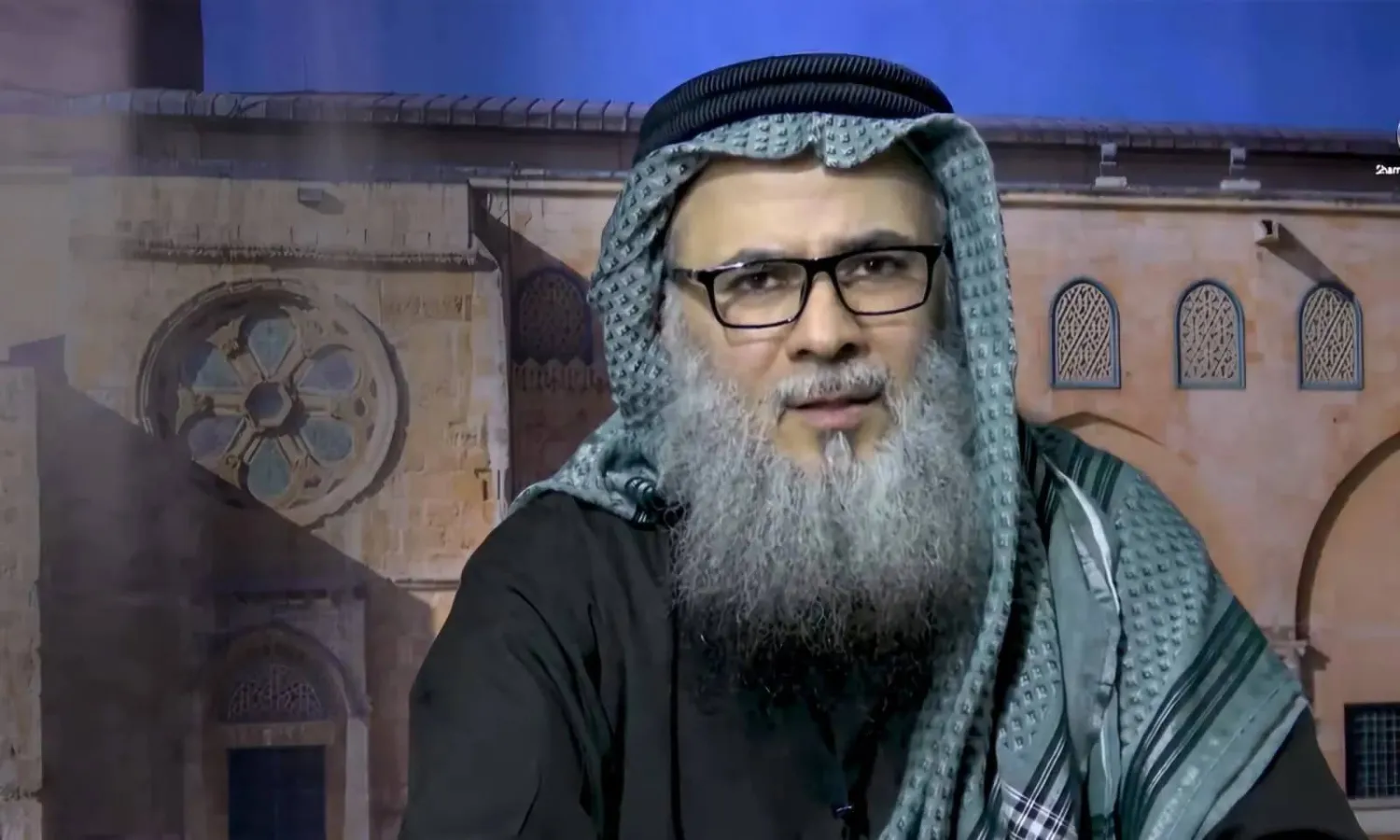

The issue of extremist groups in Syria has returned to the spotlight following reports that Sami Al-Uraydi, one of the most prominent religious ideologues associated with Al-Qaeda’s network in Syria, was killed in a strike by the US-led international coalition overnight Friday into Saturday.
Syrian state television reported that a drone struck a motorcycle near Mashhad Rouhin in the northern Idlib province, killing an unidentified individual, without providing further details.
Local sources in Idlib said four explosions were heard in quick succession.
Sources told Asharq Al-Awsat that the target was later identified as Al-Uraydi, also known as Abu Mahmoud Al-Shami, a senior figure in the now-defunct Hurras Al-Din group.
According to the sources, the man had been living in hiding in recent months to evade arrest.
The sources said he and other leaders of Al-Qaeda-linked factions remained targets of coalition operations. They noted intensified drone activity over the Idlib countryside in recent days. Coalition aircraft routinely patrol the region, including areas along the Turkish border.
While neither coalition forces nor the Syrian government have officially confirmed the target’s identity, several local media outlets reported that Al-Uraydi was killed.
A Jordanian national, Sami Mahmoud Mohammad Al-Uraydi was born in Amman in 1973 and held a doctorate in Islamic law. He authored numerous works on hadith and Islamic doctrine and became known in Salafi circles as a close associate of Abu Mohammad Al-Maqdisi, one of the movement’s leading ideologues.
After the outbreak of the Syrian uprising against President Bashar Al-Assad in 2011, Al-Uraydi moved to Syria, where he served as chief religious authority of Jabhat Al-Nusra, Al-Qaeda’s Syrian affiliate, from 2014 to 2016. He emerged as one of the group’s most influential religious theorists and spokesmen on ideological and organizational matters.
When Jabhat Al-Nusra severed ties with Al-Qaeda in 2016 and rebranded itself as Jabhat Fatah Al-Sham, Al-Uraydi opposed the move. The resulting disputes led to his detention in 2017 alongside several other senior figures.
After his release, he helped establish Hurras Al-Din in 2018 under the leadership of Farouq Al-Suri, serving as the group’s chief religious official and a member of its Shura Council.
Al-Uraydi continued to criticize the policies of Jabhat Fatah Al-Sham, which later evolved into Hayat Tahrir Al-Sham.
In 2022, the European Union designated Hurras Al-Din a terrorist organization and imposed sanctions on both Al-Suri and Al-Uraydi.
The US State Department designated Al-Uraydi a Specially Designated Global Terrorist in 2023. Washington had previously placed him on its terrorism list in 2019 and offered a reward of up to $5 million for information leading to his identification or location.
Although Hurras Al-Din formally dissolved itself in 2025 under mounting pressure, its leaders remained targets of coalition operations. Al-Uraydi reportedly continued to live in hiding under the protection of allied factions.
The presence of such groups remains one of Syria’s most complex security challenges. Although Damascus has joined the international coalition against terrorism, several organizations, including ISIS and remnants of dissolved extremist factions, continue to oppose the Syrian government.