


Aoun Hails Gulf Support, Says Lebanon Remains Committed to Strongest Ties with GCC States

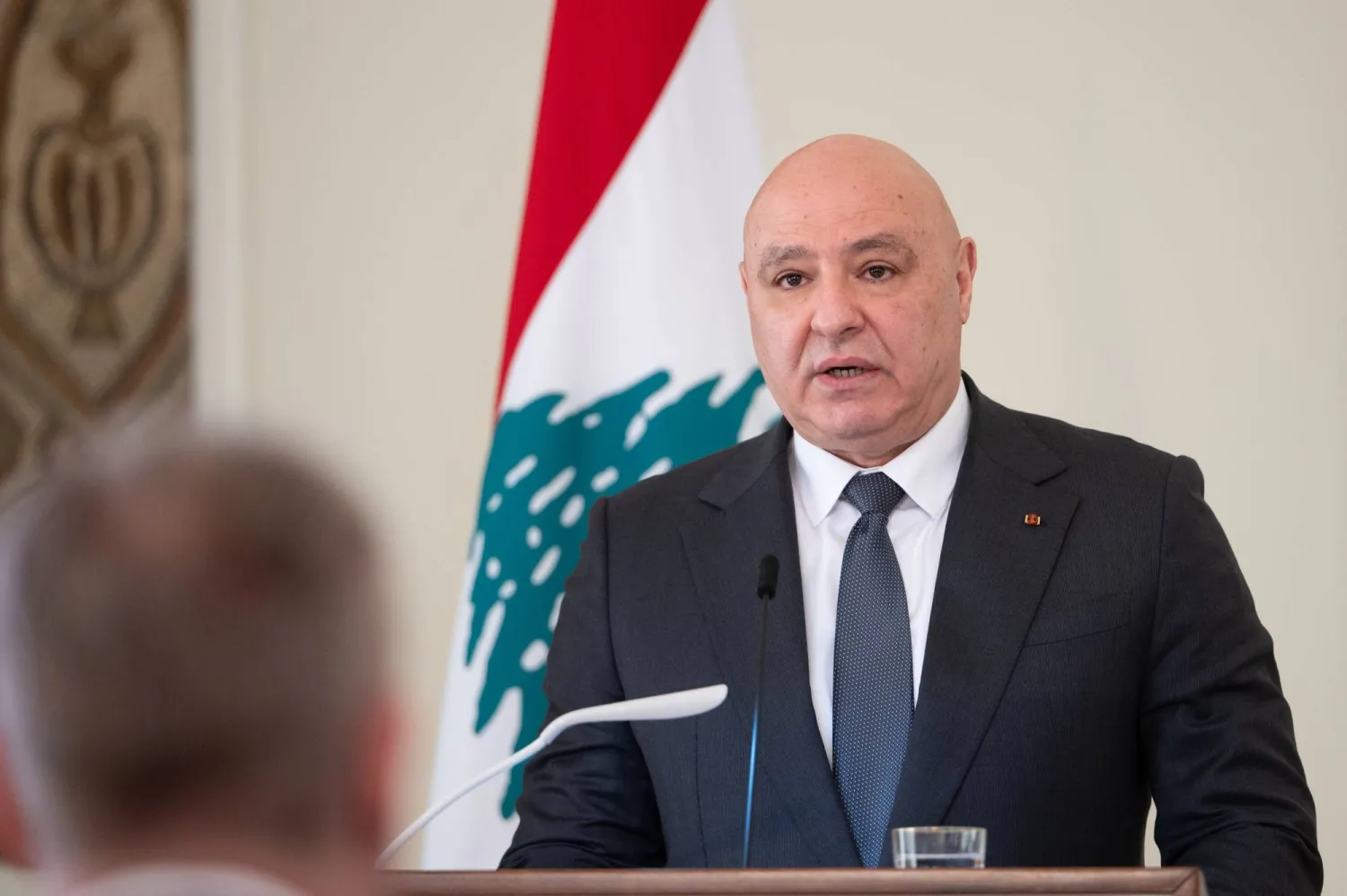
FILED - 16 February 2026, Lebanon, Beirut: FILE PHOTO - Lebanese President Joseph Aoun speaks during a press conference. Photo: Markus Lenhardt/dpa
TT

Aoun Hails Gulf Support, Says Lebanon Remains Committed to Strongest Ties with GCC States

FILED - 16 February 2026, Lebanon, Beirut: FILE PHOTO - Lebanese President Joseph Aoun speaks during a press conference. Photo: Markus Lenhardt/dpa

Lebanese President Joseph Aoun welcomed the statement issued by the General Secretariat of the Gulf Cooperation Council expressing support for Lebanon and its people as they confront current challenges, describing it as a reflection of the deep historical and fraternal ties between Lebanon and the GCC member states.

Aoun praised the GCC's reaffirmation of the importance of preserving Lebanon's security, stability, and territorial integrity, as well as its commitment to supporting the country's reform agenda and strengthening state institutions in line with the Lebanese people's aspirations for a strong, capable, and just state.

In a statement, Aoun also expressed his appreciation for the GCC's call for the Lebanese state to exercise sovereignty over its entire territory and for all weapons to remain exclusively in the hands of the country's legitimate institutions, in accordance with the Lebanese Constitution, relevant international resolutions, foremost among them UN Security Council Resolution 1701, and the decisions adopted by the Lebanese government in this regard.

The Lebanese president further expressed his deep gratitude for the Gulf states' readiness to continue providing humanitarian and development support to Lebanon, saying such assistance would help ease the country's economic burdens and improve the living conditions of the Lebanese people.

Aoun reaffirmed that Lebanon remains committed to maintaining the strongest relations with its Arab partners, particularly the Gulf Cooperation Council states, and to further expanding cooperation across all fields in a manner that serves shared interests and reinforces regional stability.

Also, Aoun welcomed on Friday France and Italy's efforts to set up a multinational coalition to succeed the UN peacekeeping force in his country, whose mandate expires at the end of the year.

In his statement, he called the initiative "a sincere expression of the international commitment to supporting Lebanon's sovereignty and stability".

On Thursday, French President Emmanual Macron said that France and Italty "want to launch a coalition for the post-UNIFIL arrangement, obviously in coordination with the European Union and the United Nations, to strengthen Lebanon's sovereignty and that of its armed forces" and prevent its territory from being "a foothold for regional escalation".


Houthi Leader Escalates War Rhetoric Despite Worsening Hardship for Yemenis

Supporters of the Iranian-backed Houthi movement gather at a mass rally, denouncing what they perceive to be derogatory comments by the US president  Donald Trump, held in capital Sanaa on June 16, 2026. (Photo by Mohammed HUWAIS / AFP)
Supporters of the Iranian-backed Houthi movement gather at a mass rally, denouncing what they perceive to be derogatory comments by the US president Donald Trump, held in capital Sanaa on June 16, 2026. (Photo by Mohammed HUWAIS / AFP)
TT

Houthi Leader Escalates War Rhetoric Despite Worsening Hardship for Yemenis

Supporters of the Iranian-backed Houthi movement gather at a mass rally, denouncing what they perceive to be derogatory comments by the US president  Donald Trump, held in capital Sanaa on June 16, 2026. (Photo by Mohammed HUWAIS / AFP)
Supporters of the Iranian-backed Houthi movement gather at a mass rally, denouncing what they perceive to be derogatory comments by the US president Donald Trump, held in capital Sanaa on June 16, 2026. (Photo by Mohammed HUWAIS / AFP)

As economic and humanitarian crises deepen across areas under Houthi control, the group's leader, Abdul Malik al-Houthi, used his latest televised address on Thursday to escalate his political and military rhetoric at both the domestic and regional levels.

He threatened confrontation with Israel and the United States, warned of attacks in Somalia, and signaled readiness to intervene alongside Iran in any future regional conflict.

Al-Houthi's remarks coincided with an intensified campaign of internal mobilization and mass recruitment, reflecting the group's continued commitment to escalation despite the deteriorating living conditions of millions of Yemenis.

His speech carried multiple messages, beginning with renewed assertions of what the group describes as its unwavering position toward the United States and Israel, and a pledge to continue coordinating with the so-called "Axis of Resistance."

He also reaffirmed the group's readiness to participate in any future round of escalation, particularly if linked to the Gaza Strip or any other regional front.

Members of Yemen's security forces stand guard as crown of people listen to a speech by Houthi leader Abdul-Malik al-Houthi in Sanaa on June 25, 2026. (Photo by Mohammed HUWAIS / AFP)

The Houthi leader also congratulated Iran on what he described as its "victory" in its recent confrontation with Israel, arguing that the outcome represented a triumph for the entire "Axis of Resistance," in another affirmation of the group's continued alignment with the Tehran-led alliance.

Al-Houthi's speech extended beyond the conflict in Gaza and the confrontation with Israel to the Horn of Africa. He warned of what he described as Israeli efforts to establish a presence in Somaliland, claiming the move was intended to secure control over the Gulf of Aden, the Bab al-Mandab Strait, and the Red Sea.

He threatened that his group would target any potential Israeli presence in the area "by all available means," while calling on Red Sea littoral states to adopt a unified position to prevent such a development, further expanding the group's military rhetoric beyond Yemen's borders.

Vehicles pass under a billboard showing Houthi leader Abdul Malik al-Houthi, in Sanaa, Yemen, Tuesday, June 9, 2026. (AP Photo/Osamah Abdulrahman)

Internal Political and Military Mobilization

Alongside the political escalation, the Houthis have intensified mobilization efforts in recent days ahead of Ashura, organizing large-scale events in the Houthi-held capital, Sanaa, and other areas under their control.

Local sources said Houthi supervisors carried out field campaigns in neighborhoods, government institutions, and educational facilities, compelling residents, employees, and students to attend the events. Attendance lists were reportedly compiled and submitted to the organizing authorities.

Residents in Sanaa said many participants attended under direct pressure for fear of questioning or harassment, while the group relied on loudspeakers and extensive propaganda campaigns to maximize turnout.

One resident of Maeen district said neighborhood leaders had received explicit instructions to mobilize as many residents as possible. Government employees also reported being ordered to attend despite having gone unpaid for years.

Residents say the focus on sectarian events and mass mobilization comes at a time when families are struggling daily to secure food, medicine, and other basic necessities amid rising prices and declining purchasing power.

Al-Houthi also called for preserving what he described as the "home front" and urged the continuation of public mobilization programs and military training courses, while praising tribal initiatives and popular activities organized by the group across areas under its control.

Observers say these calls reflect the group's continued investment in military and ideological mobilization through religious occasions with a sectarian character, which have, over the years, become tools for expanding political and military influence and recruiting additional fighters.

They also argue that the latest speech is consistent with the group's approach since the outbreak of the war in Gaza, using regional developments to reinforce its domestic narrative and keep its support base in a constant state of mobilization.

Millions of Yemenis in Houthi-controlled areas face severe hunger (EPA)

Food Emergency

The Houthi escalation comes as international warnings continue over Yemen's worsening humanitarian situation. UN and international reports maintain that the country remains one of the world's worst humanitarian crises, with millions of people in urgent need of food and humanitarian assistance.

In its latest report, the Famine Early Warning Systems Network forecast that severe food insecurity across Houthi-controlled areas will persist through the end of the third quarter of this year.

The governorates of Hodeidah, Hajjah, and parts of Taiz are expected to remain at emergency food insecurity levels, while the rest of the group's territory will continue to face crisis-level conditions.

The report attributed the continuing crisis to a deteriorating business environment, restrictions on economic activity, limited income-generating opportunities, and the ongoing impact of the war, all of which have contributed to expanding poverty and increasing humanitarian needs.


Israel Army Says Killed Seven Hezbollah Operatives in South Lebanon

A photograph taken from the southern Lebanese region of Marjayoun shows smoke rising following an Israeli airstrike on the village of Choukine on June 19, 2026.  (Photo by AFP) /
A photograph taken from the southern Lebanese region of Marjayoun shows smoke rising following an Israeli airstrike on the village of Choukine on June 19, 2026. (Photo by AFP) /
TT

Israel Army Says Killed Seven Hezbollah Operatives in South Lebanon

A photograph taken from the southern Lebanese region of Marjayoun shows smoke rising following an Israeli airstrike on the village of Choukine on June 19, 2026.  (Photo by AFP) /
A photograph taken from the southern Lebanese region of Marjayoun shows smoke rising following an Israeli airstrike on the village of Choukine on June 19, 2026. (Photo by AFP) /

The Israeli military said it killed seven Hezbollah militants who had operated near its so-called "security zone" in southern Lebanon on Friday.

The latest attack comes amid a fragile ceasefire between Israel and Iran-backed Hezbollah in an offshoot of the Middle East war that the United States and Iran are negotiating to bring to a definitive end.

While the fighting has diminished significantly in recent days, it has not stopped completely, AFP reported.

The military said in a statement it had "struck and eliminated seven Hezbollah terrorists who transferred weapons near the Security Zone in southern Lebanon," adding that it would "continue to operate to remove threats."

Hezbollah drew Lebanon into the regional war on March 2 with rocket fire at Israel to avenge the killing of Iran's supreme leader in US-Israeli strikes.

Israel responded with airstrikes and an invasion that Lebanon says have killed more than 4,200 people.

Under US pressure, Lebanese officials began direct talks in April with Israel in Washington, and a truce was announced on April 17 but failed to stop the fighting.

A new ceasefire was declared this month as Tehran insists that its deal with the US to end the Middle East war must include Lebanon.

The fifth round of talks between Israel and Lebanon were slated to end on Thursday, but the US State Department said they would go on for another day.


A Moroccan Court Sentences 29 Prominent People in Major Drug Trafficking and Corruption Case

File photo of a police officer standing near a Moroccan national flag near the main stadium during preparations for the FIFA Club World Cup in Agadir, December 10, 2013. REUTERS/Amr Abdallah Dalsh
TT

A Moroccan Court Sentences 29 Prominent People in Major Drug Trafficking and Corruption Case

File photo of a police officer standing near a Moroccan national flag near the main stadium during preparations for the FIFA Club World Cup in Agadir, December 10, 2013. REUTERS/Amr Abdallah Dalsh

A Moroccan court handed prison sentences to 29 people, including prominent politicians and sports and business figures, in an international drug trafficking and corruption scandal that has rocked the country.

The court also ordered the defendants to pay hundreds of millions of dollars in fines late Thursday after a trial that lasted more than two years.

The case began when an imprisoned drug kingpin dubbed “Sahara’s Pablo Escobar," in reference to the notorious Colombian trafficker, alleged that some of his business associates, including senior Moroccan politicians, were involved in drug trafficking and seized his assets while he was in prison. Those accused have denied the allegations, according to The AP news.

The revelations led to multiple arrests and a lengthy trial that involved 30 defendants, 18 witnesses and two civil parties. The case reignited debate over corruption in Moroccan political circles. It also prompted King Mohammed VI, Morocco’s highest authority and a figure officially above politics who rarely speaks publicly, to call for the adoption of a legally binding code of ethics to “moralize” life in parliament.

Abdennebi Bioui, a construction tycoon and former lawmaker with the co-governing Authenticity and Modernity Party, or PAM, who headed a Regional Council, was sentenced to 12 years in prison and fined $15,989.

Said Naciri, a former PAM lawmaker and former president of Wydad AC, one of Morocco’s most prominent soccer clubs, was sentenced to 10 years in prison.

Belkacem Mir, a former PAM lawmaker and former president of a soccer club, was also sentenced to 10 years.

Other defendants received prison sentences of up to nine years and fines of up to $26,649. One was acquitted. Charges included drug and gold trafficking, corruption, forgery and violations of exchange control regulations. Attorneys can appeal the ruling.

The court ordered the seizure of assets belonging to several defendants, including Bioui, Naciri and Mir, capped at $1 million. It also ordered hundreds of millions of dollars in financial penalties to be paid to customs authorities, with the bulk to be paid jointly by the three men.

Prosecutors had called for the conviction of all the defendants and the seizure of assets, according to local media.

As the judge read out the sentences, shouts of protest rang out from the defendants’ box. “I am innocent. I haven’t done anything,” some yelled. Within moments, the tension inside the packed courtroom No. 8 boiled over into scenes of panic and grief. Relatives screamed, some collapsed to the floor, and others wept as police officers pushed through the crowd to restore order.

Police documents presented in court show that Hadj Ahmed Ben Brahim, a jailed Malian drug lord, accused his partners of involvement in an international gold trafficking network. He also accused them of seizing his assets, including a luxury villa, high-end apartments and dozens of cars.

The Paris-based magazine Jeune Afrique has reported that Ben Brahim teamed up with Moroccan politicians to transport cannabis resin to Libya, Egypt and Mauritania.

Morocco is one of the world’s largest producers and exporters of hashish. Although the North African nation has legalized cannabis cultivation for medical and industrial purposes, drug trafficking remains deeply entrenched. Its proximity to Europe has helped traffickers move narcotics across the Mediterranean.

The court ordered Bioui, Naciri and Mir to jointly pay Hadj Ahmed Ben Brahim $106,599.
