

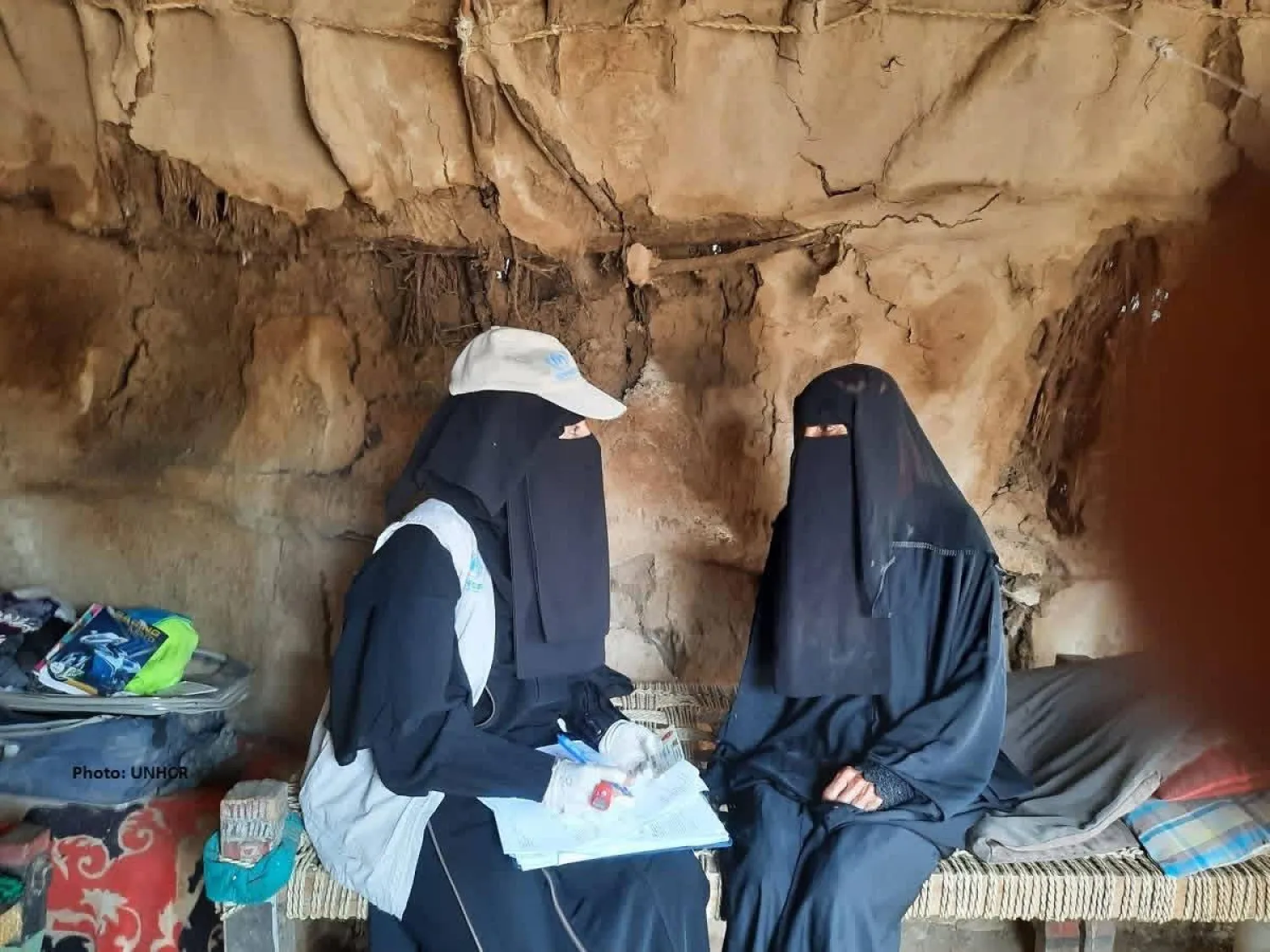

UN: Yemen Bears World’s Highest Burden of Populations Trapped in Famine

The food security outlook for Yemen through the end of 2026 remains highly alarming (local media)
TT

UN: Yemen Bears World’s Highest Burden of Populations Trapped in Famine

The food security outlook for Yemen through the end of 2026 remains highly alarming (local media)

The food security outlook for Yemen through the end of 2026 remains highly alarming, with 53% of the population projected to face crisis or worse levels of acute food insecurity (IPC Phase3+), a UN agency warned this week.

In its Yemen Market and Trade Bulletin, the Food and Agriculture Organization (FAO) said Yemen currently bears the world’s highest burden of populations trapped in the severe acute food insecurity classification (IPC Phase 4), a global early-warning indicator that the country is on the verge of famine, requiring urgent humanitarian intervention to prevent mass starvation.

Also, FAO said the presence of isolated pockets of extreme food insecurity conditions are already emerging.

“Yemen's structural food system collapse is driven by a critical convergence of localized instability, severe funding shortfalls (only above 14% funded as of June), and regional geopolitical shocks,” the FAO report warned.

It said although the intense conflict is likely to ease, regional disruptions and its lingering impacts are expected to continue for some time to come.

FAO affirmed that protracted trade disruptions through the Strait of Hormuz and volatile fuel costs will continue to exert upward pressure on domestic transport, food, and agricultural inputs.

“Without immediate, multi-year funding and the full restoration of humanitarian access, a slide into extreme food insecurity situation remains a risk,” the UN agency said.

Economic Fragility

FAO said that in May 2026, the Yemeni rial in government-controlled areas held stable month-on-month at 1,553 riyal per US dollar representing a notable 63% year-on-year strengthening.

It said while this stability temporarily buffers local markets and lowers imported food costs, the fiscal situation remains highly fragile due to critically depleted foreign reserves and high exposure to global market shocks.

The UN agency also found that the Minimum Food Basket (MFB) rose 2% month-on-month, though it remains 27% lower year-on-year and 9% below the three-year average.

However, household food access is still severely constrained by weak purchasing power, irregular salaries, scarce income opportunities, and the lingering effects of inflation.

Fuel costs surged 11 to 15% month-on-month in May, tracking 10–21% above three-year averages despite remaining 5–11% lower year-on-year.

FAO said this sharp uptick is renewing severe financial pressure across transport, food distribution, milling, agricultural inputs, water trucking, electricity generation, and overall household expenses.

In return, labor trends were mixed in May. “Agricultural wages rose 3% month-on-month and remained 19% above the three-year average, while non-agricultural casual wages dipped 2% month-on-month and stayed 11% below May 2025 levels,” the agency’s report found.

“This indicates strong seasonal support for farm labor but persistent weakness in broader income opportunities,” it added.

And while staple food prices remained broadly stable in May, FAO said rising fuel, transport, shipping, and global commodity costs threaten to renew upward pressure.

Decrease of Wheat Imports

FAO said wheat and flour imports fell 28% month-on-month but remained 22% higher year-on-year.

It noted that while fuel imports more than doubled from April, they were still 68% below May 2025 levels and 63% below the three-year average, signaling a partial recovery rather than supply normalization.

Meanwhile, Terms of Trade (ToT) improved for agricultural laborers and livestock owners but weakened for casual laborers.

The report said month-on-month, agricultural labor-to-cereal ToT rose by about 2%, goat-to-cereal by 6%, and sheep-to-cereal by 9%, while off-farm labor-to-cereal ToT fell by about 3%.

Although all indicators remain above May 2025 and three-year averages, the positive welfare impact is limited for households lacking regular work, stable income, market access, or livestock assets.

The UN agency also showed that driven by pre-Eid demand and higher transport costs, livestock prices increased by 7–10% month-on-month in May.

“While prices remained 10–13% below May 2025 levels, they tracking 17–19% above the three-year average, keeping meat expensive for consumers but improving sale returns for livestock-owning households,” it said.

The report concluded that the presence of a dual exchange rate regime in Yemen, governed separately by Houthi-held areas and those under the government-controlled areas, led to a noticeable disparity in food prices.

It said although prices in government-controlled areas might appear to be 'twice as high as in Houthi-held areas' in local currency, the prices when converted to US dollars are nearly equivalent, and at times slightly higher in Houthi-held areas.



Ghalibaf Urges Baghdad to Break Economic Dependence on Washington

 Iranian Parliament Speaker Mohammad Baqer Ghalibaf (R) attends a ceremony marking 40 days since the burial of Supreme Leader Ali Khamenei in Karbala, central Iraq, Aug. 20, 2026. (AFP)
Iranian Parliament Speaker Mohammad Baqer Ghalibaf (R) attends a ceremony marking 40 days since the burial of Supreme Leader Ali Khamenei in Karbala, central Iraq, Aug. 20, 2026. (AFP)
TT

Ghalibaf Urges Baghdad to Break Economic Dependence on Washington

 Iranian Parliament Speaker Mohammad Baqer Ghalibaf (R) attends a ceremony marking 40 days since the burial of Supreme Leader Ali Khamenei in Karbala, central Iraq, Aug. 20, 2026. (AFP)
Iranian Parliament Speaker Mohammad Baqer Ghalibaf (R) attends a ceremony marking 40 days since the burial of Supreme Leader Ali Khamenei in Karbala, central Iraq, Aug. 20, 2026. (AFP)

Iranian Parliament Speaker Mohammad Ghalibaf on Friday urged Baghdad to reduce its reliance on the dollar and draw up what he called a “precise roadmap” for economic cooperation between the two countries.

Ghalibaf made the remarks during a visit to the southwestern Iraqi city of Najaf, as the region awaits what has been described as an unprecedented package of US sanctions on Iran and its trading partners.

Iran must plan to overcome what Ghalibaf called “unjust sanctions,” after US Treasury Secretary Scott Bessent announced what he described as the toughest sanctions ever imposed on Iran, according to Reuters.

Earlier, at a consultative meeting with business figures at the Iranian embassy in Baghdad, Ghalibaf called for a “precise roadmap” for economic ties with Iraq that would include moving away from the US dollar.

He said the two countries should end their reliance on the US currency and use local currencies in trade.

“The era of US dominance over the world has ended, but we have not made proper use of the opportunities available to us, and we are still conducting trade through outdated methods,” Ghalibaf said.

Iraq relies entirely on the dollar for its oil exports, which generate more than 90% of national revenues. The proceeds are deposited in US dollars into an account held in the name of the Central Bank of Iraq at the Federal Reserve Bank of New York.

‘Difficult and trying circumstances’

In stark contrast, Iraqi Prime Minister Ali al-Zaidi sought to reassure public-sector employees and pensioners that monthly salaries and government payments were fully secured, even as he warned that Iraq was facing “difficult and trying circumstances” due to regional developments and disruptions to oil exports through the Strait of Hormuz.

Speaking at the Baghdad Dialogue conference, organized by the Iraqi Institute for Dialogue, al-Zaidi said Iraq faced major economic challenges and described the closure of the Strait of Hormuz as a key obstacle.

The strait, he said, “was not closed even during the harshest days of the blockade.”

Al-Zaidi said the government had found alternative routes for oil exports and activated border crossings to bolster trade, adding that the state had “more than one solution” to preserve economic stability and contain the fallout from the crisis.

He said Iraq was working to expand oil exports through Türkiye’s Ceyhan port, while efforts continued to develop export routes through Banias and Aqaba.

“We are working to increase Iraq’s export quota through OPEC, and we aim to reach 8 million to 10 million barrels per day within six years,” al-Zaidi said.

“Iraq fought ISIS on behalf of the region and the world, and it is only fair that it receive a crude oil export quota commensurate with the size of its population and its oil reserves.”

On the political front, al-Zaidi said political forces were in full agreement that the government should press ahead with its anti-corruption campaign.

He described “the battle against the looting of public funds” as a matter of honor for him.

The government launched an operation dubbed “Dawn Crackdown” on June 28 to combat the looting of public funds. The operation has targeted political officials, lawmakers, and businesspeople.


State Return to South Lebanon Extends Beyond Security to Services, Recovery

Lebanese Prime Minister Nawaf Salam during a visit to the Lebanese army in southern Lebanon, Aug. 21, 2026. (National News Agency)
TT

State Return to South Lebanon Extends Beyond Security to Services, Recovery

Lebanese Prime Minister Nawaf Salam during a visit to the Lebanese army in southern Lebanon, Aug. 21, 2026. (National News Agency)

Lebanon’s push to reassert the state’s presence in the south is moving beyond security deployments to a harder test: restoring schools, services, and livelihoods in communities battered by war.

Recovery programs are beginning to take shape, but a wide funding gap threatens efforts to keep residents in their towns and revive areas where infrastructure, agriculture, and education have sustained extensive damage.

A framework for return, but funding lags

In 2026, the government launched the “National Framework for Return, Early Recovery and Restoration of Basic Services,” covering the return of residents, social protection, the restoration of services and livelihoods, and preparations for reconstruction.

No consolidated budget has been announced yet.

One of its main financing tools is the Lebanon Emergency Assistance Project (LEAP), implemented by the Council for Development and Reconstruction.

The project was designed to scale up to $1 billion. So far, only $250 million has been secured, leaving a $750 million funding gap.

Of the available financing, $50 million is earmarked for immediate response measures, including debris removal, securing buildings, and reopening roads. Another $175 million is allocated to restoring water, energy, transport, health, and education services, while $15 million is set aside for studies and designs, and $10 million for project management.

Under the full framework, $455 million is allocated for reconstruction, most of it still unfunded.

In a parallel effort, the government launched a program in May worth about 32 million euros for southern Lebanon and the Bekaa, running through 2029.

The European Union is providing 24.8 million euros, Denmark 5.35 million euros, and the French Development Agency 2 million euros. The program targets local authorities, small businesses, and the agricultural sector, while seeking to create jobs.

Lebanese ministerial sources told Asharq Al-Awsat that “the new response framework provides a basis for attracting funding, but it is still not fully financed.”

They said the Ministry of Social Affairs was “continuing to work intensively to secure additional funding to help respond to the needs of affected groups.”

A safety net for more than one million people

Social protection is a central part of efforts to keep residents in their communities and support their return.

The sources said one of the main response measures was cash assistance provided by the Ministry of Social Affairs, covering about 230,000 families through the ministry’s shock-responsive social safety net.

Based on the average household size, more than 1 million people receive support.

The assistance is particularly significant in areas where returning home still depends on families' ability to repair their homes, restore access to services, and find work.

That makes social support part of the effort to re-establish communities, rather than simply an emergency measure.

Agriculture: getting farmers back to their land

The Ministry of Agriculture has divided its response plan into five tracks: emergency support for farmers; protection of food supply chains and markets; protection of livestock production and assets; continuity of programs and services; and coordination and needs assessment.

Measures include monitoring food supply chains, accelerating imports of plant products, extending import deadlines for some essential goods, and monitoring markets and prices in coordination with the Ministry of Economy.

The plan also provides emergency assistance to farmers in high-risk areas and steps up operations at ports, border crossings, quarantine centers, and laboratories to speed the entry of goods.

The report does not set an overall budget for the agricultural response.

Instead, it says the ministry is working with partners and donors to identify priorities, assess possible interventions, and secure resources.

Resources reported by the ministry’s network of agricultural partners that are being mobilized include $1,650,150 in cash assistance targeting 4,840 farmers.

In-kind assistance is expected to reach 1,850 farmers and includes solar-powered irrigation pump kits, agricultural inputs, animal feed, treatment support, and infrastructure.

The ministry has also launched a platform with the food security sector to identify and track available resources.

Schools face a September test

Education is emerging as one of the clearest tests of whether state institutions can resume normal operations in the South and Nabatieh governorates.

Sources at the Ministry of Education and Higher Education told Asharq Al-Awsat that the ministry aims to start the 2026-2027 academic year with in-person classes at schools that meet safety and readiness requirements, starting Sept. 15.

Schools in the affected areas of the South and Nabatieh will temporarily rely on remote learning until technical and operational assessments are completed.

The scale of the challenge is substantial.

Of 267 schools in the two governorates, 198 have been damaged. Eighty-nine sustained very minor damage, 64 moderate damage, and 15 severe damage. Another 30 were completely destroyed.

The ministry is using a “school cluster” model for planning, grouping schools and alternative learning spaces within the same geographical area.

Each cluster will have a file detailing student and teacher numbers, building conditions, capacity, and the locations of displaced students.

Students whose schools cannot reopen will remain enrolled in their original schools while temporarily attending a host school or alternative learning space.

Schools being used as shelters will operate under conditions designed to ensure the safe separation of their educational and shelter functions.

The ministry is also building an operational database to track schools and students and setting up a hotline.

Each school will receive an official operational decision specifying how classes will resume.

The ministry has also expanded its use of “Teaching Hubs,” or teaching and learning centers, aimed at restoring teachers’ roles in affected areas while providing students with places to receive support and continue their education.

The sources said the objective went beyond repairing damaged buildings.

“The goal is not limited to rehabilitating damaged school buildings, but also includes preserving the school as an existing institution even if its building has been destroyed, by maintaining its administration, teachers, and students,” they said.

That, they added, would ensure that each school retains its identity and educational role until it can be rehabilitated or rebuilt.


New US Sanctions Tighten Grip on Hezbollah, Test Lebanon

17 April 2026, Lebanon, Jiyyeh: A displaced Lebanese woman flashes the victory sign and displays Hezbollah and Iranian flags as they drive along the highway linking Beirut to southern Lebanon in the Jiyyeh area. (dpa)
TT

New US Sanctions Tighten Grip on Hezbollah, Test Lebanon

17 April 2026, Lebanon, Jiyyeh: A displaced Lebanese woman flashes the victory sign and displays Hezbollah and Iranian flags as they drive along the highway linking Beirut to southern Lebanon in the Jiyyeh area. (dpa)

New US sanctions on Hezbollah go beyond targeting money-transfer networks, signaling a broader shift in Washington’s approach to the group and its relationship with the Lebanese state.

By relisting Hezbollah on its sanctions list and targeting a network accused of moving millions of dollars to the group, Washington is stepping up pressure on Hezbollah while putting Lebanese institutions to a sensitive test: whether they can tighten oversight of money flows and transfers and meet their obligations without worsening the country’s internal crisis.

The US Treasury Department’s Office of Foreign Assets Control (OFAC) announced sanctions on 10 people “that are part of a network responsible for transferring cash to Hezbollah.”

“The network utilizes couriers travelling on commercial airline flights between Lebanon, Türkiye, the UAE, and Iran to move up to hundreds of millions of dollars between jurisdictions, providing an avenue outside the formal financial system for Hezbollah to obtain foreign currency and evade sanctions,” it said.

OFAC also re-designated Hezbollah “for service to the Iranian regime under the command of Iran’s Revolutionary Guard Corps-Quds Force (IRGC-QF).”

Lebanese institutions under scrutiny

The US move is unlikely to stop with the targeted individuals and entities. It puts Lebanese banks, financial institutions, and regulatory bodies under closer US scrutiny, testing their ability to detect financial activity that could be linked to Hezbollah, its institutions, or its networks.

An official Lebanese source told Asharq Al-Awsat that the sanctions “pose challenges for the Lebanese state and its security, judicial and financial institutions.”

The source said the “tough US measures require tighter oversight of any assets linked to Hezbollah and its institutions, because any delay in doing so could leave the state facing consequences it can ill afford.”

OFAC said that “Hezbollah and its allies exploit financing schemes including oil smuggling, illicit shipping, commodities sales, and bulk cash smuggling to generate and move funds across the region.”

The US Treasury linked the targeted network to Behnam Shahriyari, a former Quds Force finance official, saying it was “one example of the methods used to funnel support to terrorist proxy groups throughout the region.”

Beyond Lebanese framework

But the strongest message in the sanctions, according to one Lebanese political reading, is directed at Lebanon itself.

Sami Nader, director of the Levant Institute for Strategic Affairs, said the latest measures differ from previous sanctions because Washington is “dealing with Hezbollah under a new classification that places it outside the traditional Lebanese framework and presents it as an Iranian faction and part of the broader US confrontation with Iran.”

Nader told Asharq Al-Awsat that the shift “will have repercussions inside Lebanon and for the authorities and official institutions, particularly in light of the political and even financial relationship linking the group to some Lebanese factions.”

Under the new US approach, he said, Hezbollah “is no longer viewed as a representative of the Shiite community, but as an Iranian faction occupying Lebanon.”

He said the implications could extend well beyond financial sanctions.

“Any party dealing with Hezbollah could be viewed by the United States as being involved in dealings with Iran’s Revolutionary Guards,” Nader said, adding that this could trigger “political and legal repercussions that go beyond direct financial sanctions.”

The effects of the new approach also extend into the political and diplomatic sphere, particularly Lebanese-Israeli negotiations.

Nader said tougher sanctions “could give Washington greater room to manage negotiations with Israel, allowing it to pressure Hezbollah” and “keeping the issue of ending Hezbollah’s influence part of the broader US confrontation with Iran.”

Europe’s response in focus

Attention is also turning to Europe and whether it will follow Washington’s lead.

Nader pointed to what he called “the recent hardening of the French and British positions toward Iran.”

“If the US approach extends to Europe, Lebanon could find itself entering a more complicated phase,” he said.

In that case, compliance with international sanctions would become “not merely a political choice, but an additional test of the state’s ability to protect its financial system and institutions from the repercussions of a regional and international conflict that extends beyond its borders,” he explained.

Hezbollah rejects US designation

Hezbollah rejected the US position, saying the claim that it is under the control of the Quds Force was merely a pretext for relisting it under sanctions.

The party described the move as “part of the continued policies of US administrations to target the resistance, its community, its support base and to besiege them and exert political, financial and security pressure on them.”

Hezbollah said Washington “continues to deal with Lebanon from a position of tutelage.”

It accused the US of choosing, instead of pressuring Israel to withdraw from southern Lebanon and halt its attacks, to “besiege the Lebanese and work to strip Lebanon of all sources of strength.”

On its relationship with Iran, Hezbollah said: “Our close and brotherly relationship with Iran is one we cherish and take pride in.”

But it stressed that it “does not await anyone’s certification of its Lebanese identity or patriotism.”

The party said sanctions and designations “will not deter us from adhering to the option of resistance and to the right of Lebanon and the Lebanese people to defend their land, sovereignty, and resources.”