Israeli Forces Kill Palestinian Teen in West Bank

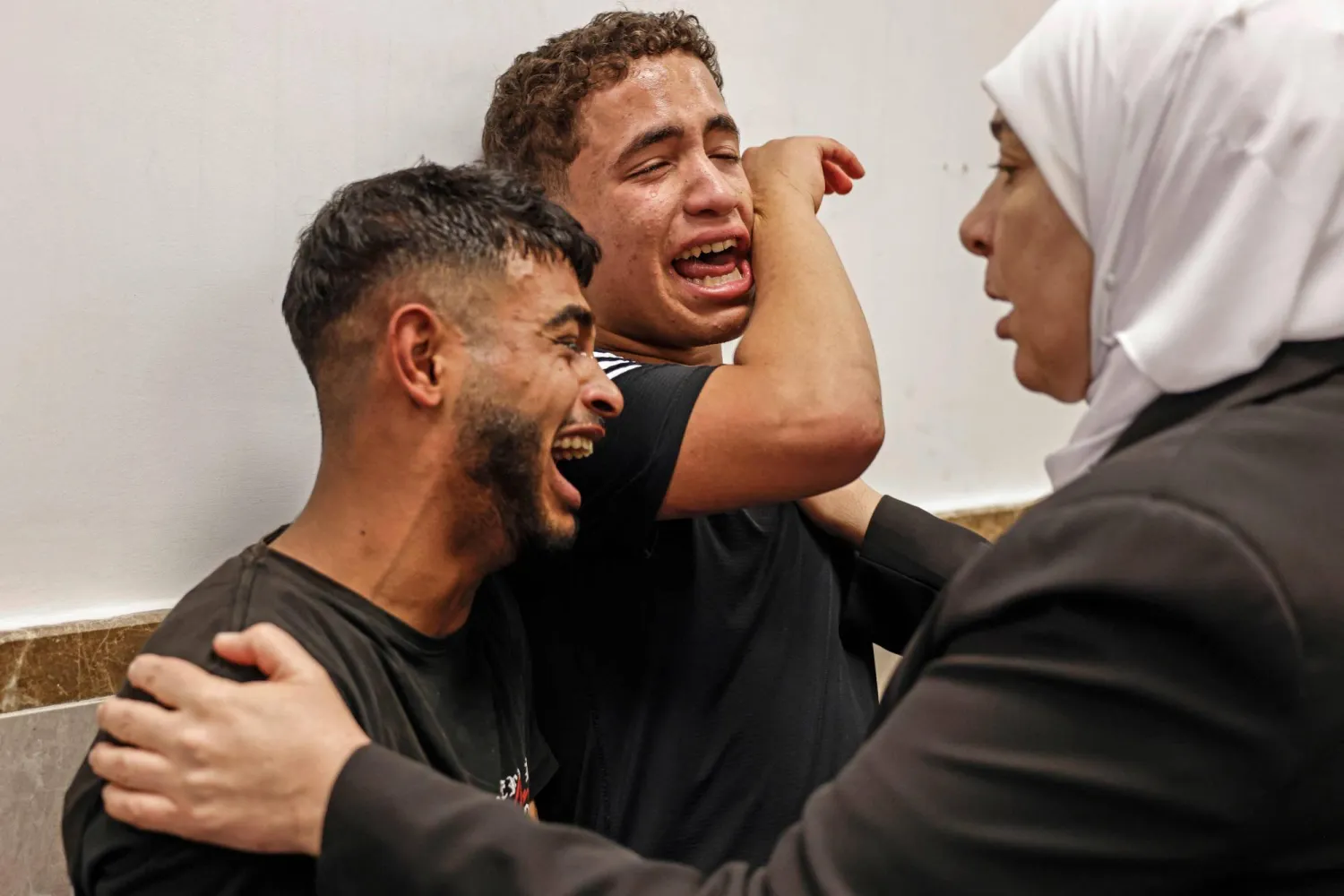
Relatives mourn the death of Amir Ahmad Jawad Jaber, a Palestinian teenager who was killed during an Israeli raid, at a hospital in Ramallah, in the Israeli-occupied West Bank on June 29, 2026. (AFP)
TT

Israeli Forces Kill Palestinian Teen in West Bank

Relatives mourn the death of Amir Ahmad Jawad Jaber, a Palestinian teenager who was killed during an Israeli raid, at a hospital in Ramallah, in the Israeli-occupied West Bank on June 29, 2026. (AFP)

Israeli forces fatally shot a 15-year-old Palestinian teenager during a raid in the occupied West Bank on Monday, the Palestinian health ministry said, as violence surges in the Israeli-occupied territory.

"The child Amir Ahmad Jawad Jaber, 15 years old, was martyred after being shot in the head and once in the chest by occupation soldiers during their raid in the Umm al-Sharayit neighborhood in Al-Bireh" near the West Bank city of Ramallah, the ministry said.

There was no immediate response from the Israeli military when asked by AFP about the incident.

The Palestinian Red Crescent had earlier said its teams were transporting to hospital and trying to resuscitate a 15-year-old who was shot in the head with live ammunition during a raid in the Umm al-Sharayit area.

Dozens of mourners gathered at the Palestine Medical Complex as grieving relatives wept over the teenager's body.

"Today, we witnessed a clear-cut execution in broad daylight," Laila Ghannam, governor of Ramallah and Al-Bireh, told AFP.

"This is a disgrace to all institutions who claim to uphold democracy and human rights.

"When it comes to our cause, they see nothing. They allow this occupation to escalate its campaign of terror every single day -- not only across Palestine, but throughout the entire region."

Since the start of the Gaza war in October 2023, violence has escalated in the West Bank, which Israel has occupied since 1967.

Israeli soldiers or settlers have killed at least 1,085 Palestinians in the West Bank since October 2023, including both gunmen and civilians, according to an AFP tally based on Palestinian health ministry data, which says 71 people were killed in 2026.

Official Israeli figures show that at least 46 Israelis, both soldiers and civilians, have been killed in Palestinian attacks or during Israeli military operations in the West Bank since the start of the Gaza war.


What Does the End of MINURSO Mean for the Future of Western Sahara?

A United Nations Security Council meeting titled "Maintenance of international peace and security" at UN headquarters in New York City, US, October 29, 2026. REUTERS/Jeenah Moon
TT

What Does the End of MINURSO Mean for the Future of Western Sahara?

A United Nations Security Council meeting titled "Maintenance of international peace and security" at UN headquarters in New York City, US, October 29, 2026. REUTERS/Jeenah Moon

Russia has plunged the Western Sahara dispute into an unprecedented geopolitical impasse after vetoing an amended US-drafted resolution at the United Nations Security Council that sought to fundamentally reshape the longstanding regional conflict.

Although the US draft secured the support of 11 council members, Russia's unexpected veto blocked its adoption.

Washington responded swiftly, using its own veto to block a rival Russian draft resolution that proposed a conventional technical extension of the UN mission's mandate without altering its underlying structure.

The diplomatic confrontation between the two powers prompted Morocco's King Mohammed VI to announce, in an urgent statement issued by the Royal Cabinet, the closure of the chapter on the United Nations Mission for the Referendum in Western Sahara (MINURSO) after 35 years of operations.

The king also called for the issue to be removed entirely and permanently from the Security Council's agenda, describing the existing framework as outdated and ineffective on the ground.

Competing legal frameworks and the legacy of Resolution 2797

At the heart of the dispute between Washington and Moscow are competing legal and institutional frameworks that each side has sought to establish, a confrontation that began taking shape with the adoption of Security Council Resolution 2797 on Oct. 31, 2025.

That resolution marked a significant shift by endorsing Morocco's autonomy proposal as the basis for negotiations.

The latest US draft sought to build on Resolution 2797 by establishing expanded autonomy as the exclusive and definitive framework for resolving the dispute, removing references to a referendum from the UN framework and reducing the mission's military component ahead of its eventual administrative dissolution.

Russia, by contrast, sought to halt that process, which Washington had pursued under the framework established by Resolution 2797.

Moscow's permanent representative to the United Nations objected to what he described as an attempt to override existing balances, while Russia introduced an alternative resolution proposing to extend MINURSO's mandate until Oct. 31, 2027.

The Russian proposal would have retained the mission's name and traditional responsibilities, leaving room for broader interpretations of the political process that could accommodate all parties, including Algeria and the Polisario Front.

What does the shift mean for the parties and their allies?

The change in the international approach to Western Sahara is reshaping the calculations of regional and international powers involved in the dispute.

For Morocco's international allies, the Security Council deadlock presents a new reality.

Major European capitals, including Paris and Madrid, now face pressure to translate their political support for Morocco's autonomy initiative into direct bilateral and economic partnerships with Rabat, rather than relying primarily on diplomatic negotiations and votes at the United Nations.

Moroccan diplomacy has increasingly favored that approach as an alternative to the UN-led framework.

Meanwhile, countries supporting the traditional UN approach, including African governments aligned with Algeria, face a different set of challenges.

Although Russia's veto succeeded in blocking the US attempt to rewrite the legal framework governing the dispute, it also shifted greater responsibility for maintaining stability to regional actors.

Regional alliances may therefore have to reconsider their strategies in dealing with a Morocco seeking to exercise full sovereignty over the territory without UN monitoring, and a Polisario Front searching for alternative diplomatic channels to compensate for the loss of the Security Council framework.

What next for regional stability after the institutional vacuum?

The region is entering a new phase in the management of the Western Sahara dispute following the expiration of MINURSO's mandate without renewal.

The absence of a renewed mandate threatens to end the mission's longstanding role as an international third-party observer monitoring the lines of contact and ceasefire arrangements.

Without that UN framework, the parties could face fewer institutional and diplomatic constraints, leaving developments on the ground increasingly dependent on their respective positions on sovereignty and territorial control.

Morocco views the mission's absence as an opportunity to end what it considers a temporary arrangement and proceed with the administration and development of the territory it claims as its own, without the restrictions associated with UN monitoring and reporting.

The Algeria-backed Polisario Front, meanwhile, faces the prospect of losing a central UN platform through which it has pursued its demand for a referendum on self-determination.

The institutional shift could move the dispute away from the Security Council's negotiating chambers and toward developments on the ground and direct bilateral diplomacy.

The future of stability and sovereignty in North Africa would then depend increasingly on the measures taken by the parties themselves and the regional and international alliances supporting them.


Lebanese Concern Over 'Third War' Despite Hezbollah Assurances

Lebanese President Joseph Aoun inspects military units deployed in Zawtar al-Gharbiya, southern Lebanon (File photo: Lebanese Presidency)
TT

Lebanese Concern Over 'Third War' Despite Hezbollah Assurances

Lebanese President Joseph Aoun inspects military units deployed in Zawtar al-Gharbiya, southern Lebanon (File photo: Lebanese Presidency)

Lebanese President Joseph Aoun is standing firm on negotiations as the "only path" out of the country's crisis after two wars between Hezbollah and Israel.

But the threat of a third war continues to loom large, despite fresh assurances from Hezbollah that it would stay out of any new confrontation involving Iran, the United States and Israel.

Aoun has heard such promises before. He received similar assurances ahead of the second war last March, only for Hezbollah to reverse course following the assassination of Iranian Supreme Leader Ali Khamenei.

Mindful of a Lebanese proverb warning against repeating a failed experience, Aoun is taking the latest assurances with caution. He is equally wary of a tentative dialogue recently opened with Hezbollah.

The president fears a third war could devastate southern Lebanon, particularly the Shiite community, following warnings delivered to him and other Lebanese officials.

The latest came in a telephone call with US Secretary of State Marco Rubio, who warned that Hezbollah's entry into any new conflict "would have devastating consequences."

Elections deepen negotiating deadlock

Two elections have cast a long shadow over Lebanon's negotiations with Israel: one in the United States, the sole official sponsor of the talks, and another in Israel.

Concessions from Israel were difficult to secure even under a strong government. Now, inconclusive election results in Israel threaten to prolong the negotiating deadlock.

Washington has yet to set a date for another round of political or military talks, awaiting a clearer picture of Israel's political landscape.

But Beirut does not see the impasse as proof that negotiations have failed.

Aoun continues to confront critics of his approach with a simple question: What is the alternative?

He insists negotiations remain the only way to protect Lebanon and offer its people a measure of hope after the devastating crisis they have endured.

The latest round of military-level talks in the United States underscored the deadlock.

Israeli representatives declined to respond to several Lebanese proposals, saying they needed to consult their political leadership. The talks ended without clear results.

Yet a Lebanese official source told Asharq Al-Awsat that the outcome should not be viewed as a failure.

The US side, the source said, was impressed by the Lebanese military delegation's presentation of the army's achievements, contradicting the Israeli side's initial portrayal of its performance. Israeli representatives eventually acknowledged those achievements.

The source said US General Joseph Clearfield explicitly praised the Lebanese army's presentation.

In the small village of Zawtar al-Gharbiya alone, the army carried out more than 1,200 operations to remove ammunition, weapons and military infrastructure after Israeli forces withdrew, the source said.

The village was among the "pilot zones" designated under an arrangement that was never completed because of Israel's failure to cooperate.

Dispute over who verifies disarmament

A dispute over who should verify that the pilot zones are free of weapons remains a key obstacle to resuming negotiations.

Two proposals are on the table, and neither has won agreement.

Israel wants a non-governmental organization (NGO) to carry out the verification, an option Lebanon rejects.

Lebanon instead wants the task assigned to the UN Truce Supervision Organization, whose observers have been stationed in the country since 1949. Israel opposes that proposal.

Aoun defends the army

Aoun has also moved to defend the Lebanese army against mounting criticism, praising its performance and warning against campaigns targeting an institution he considers a guarantee of national security.

Such attacks do little to strengthen domestic stability, he has told visitors, but they will not derail the army's national mission.

The president maintains that the military has "no independent position or agenda of its own" and acts strictly on instructions from the political leadership.

That includes its refusal to open direct channels with the Israeli military.

Aoun said he personally ordered the army not to establish such contact because "it is still far too early" to discuss it.

"Under the current circumstances, direct communication is impossible while the Israeli army occupies our territory and attacks it every day," he said.

Hezbollah explosives stir controversy

A Lebanese official source has played down the uproar over explosives seized by Lebanese security forces in an operation involving Hezbollah members, describing the controversy as excessive.

The case "has followed its legal course. If further steps are required once the investigations are completed, we will take them," the source said.

The remarks appeared to allude to the possibility of referring the case to Lebanon's Judicial Council.

The source stressed that the seizure was hardly unprecedented.

The Lebanese army had carried out two similar operations earlier in the week, followed by a fourth. Previous seizures had also taken place across the country, including in the Bekaa Valley, southern Lebanon and Beirut, without provoking comparable controversy.

Such operations will continue in line with the Lebanese state's commitment to ensuring that weapons remain exclusively under state control, the source said.

The source also rejected reports that Washington had pressured Beirut over the seized explosives.

During his call with Aoun, Rubio merely asked whether reports that the explosives would be returned to Hezbollah were true, the source said.

He raised no other details and requested no additional action.


Trump's Board of Peace Asks Italy to Provide Support for Gaza Security Force

Children help fill drinking water containers at a distribution point in the Nuseirat refugee camp in the central Gaza Strip on Saturday (dpa)
TT

Trump's Board of Peace Asks Italy to Provide Support for Gaza Security Force

Children help fill drinking water containers at a distribution point in the Nuseirat refugee camp in the central Gaza Strip on Saturday (dpa)

US President Donald Trump’s Board of Peace formally asked Italy to provide advisers from the police, firefighters and the carabinieri corps to help build a new security force for the Gaza Strip, according to letters seen by Bloomberg News.

The letters, sent last month to Premier Giorgia Meloni’s government, asked Rome to commit to the initiative, name a point of contact and nominate a senior officer from the carabinieri — a military police force overseen by the Ministry of Defense — to serve as the board’s deputy police program manager.

While the carabinieri have provided training to Palestinian police for years and served in European Union peace missions in the border city of Rafah in the Strip’s south, Italy’s role in Trump’s project has been tenuous.

Meloni earlier this year declined to sign the Board of Peace charter, citing constitutional constraints.

The US asked Italy to join the board’s stabilization force as a founding member, Bloomberg News reported in January, but the country has limited itself to offering police training.

Nine months after its official launch, the board has yet to deliver on the ground, with no stabilization force or Palestinian administration inside Gaza, and no reconstruction underway.

Last month, it earmarked $2.45 billion for the reconstruction of the strip, a fraction of the $71 billion the board says is needed over a decade to rebuild the war-torn territory.

A peace deal brokered in 2025 between Israel and Hamas, which the US categorizes as a terrorist organization, requires that the Palestinian group disarm, although it has yet to do so.

People familiar with the Italian government’s thinking said Rome was considering appointing a senior officer to serve as the deputy police program manager, but that questions surrounding security have complicated any decision and that no final determination has been made.

Adding to the complexities was a spat earlier this year between Trump and Meloni that temporarily strained relations between Rome and Washington, some of the people said.

Meloni is also campaigning to be re-elected as premier in next year’s general election.

The Italian government declined to comment when contacted by Bloomberg and the US State Department referred questions to the Board of Peace.

One of the board’s officials said it was in “active discussions” with several governments over how they could contribute to the reconstruction of Gaza, where at least 77,000 have died since Israel launched a counteroffensive against Hamas’s Oct. 7, 2023 attack that killed at least 1,100.

Italy has “contributed in a very positive way for several years on capacity building around police forces, and we have had very positive interactions with Italian authorities on potential support for the technocratic National Committee for the Administration of Gaza,” the official said.