


Lawyer Warns Detained Palestinian Doctor Hussam Abu Safiya Is in Critical Condition

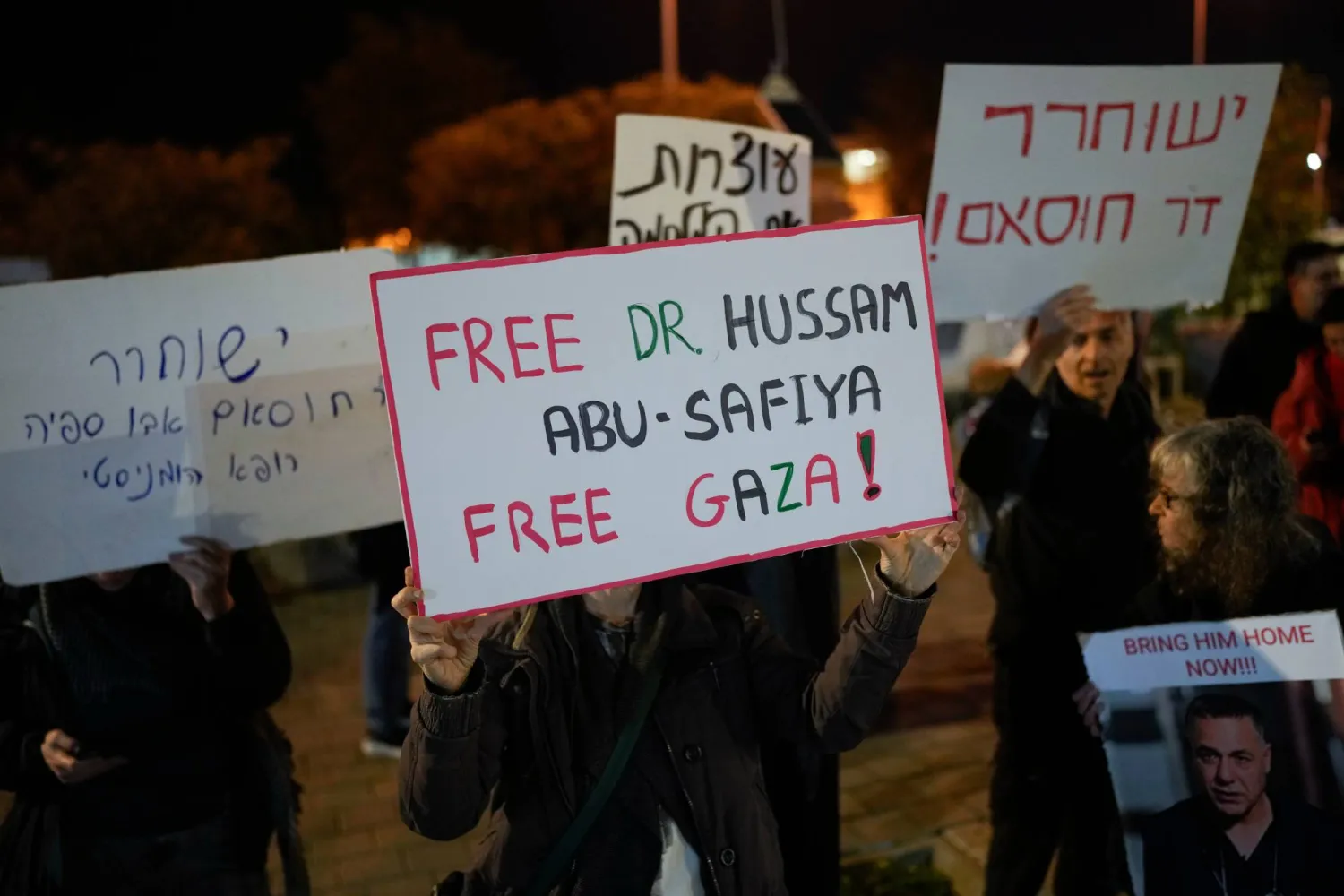
A woman holds a sign that reads "Free Dr. Hussam Abu Safiya, Free Gaza" during a protest in front of the Shin Bet offices, calling for his release, in Tel Aviv, Israel, on Jan. 1, 2025. (AP)
TT

Lawyer Warns Detained Palestinian Doctor Hussam Abu Safiya Is in Critical Condition

A woman holds a sign that reads "Free Dr. Hussam Abu Safiya, Free Gaza" during a protest in front of the Shin Bet offices, calling for his release, in Tel Aviv, Israel, on Jan. 1, 2025. (AP)

The lawyer for a prominent Palestinian doctor who was seized by Israeli forces 18 months ago said his client has been abused in captivity and is in critical condition, according to the human rights group representing him.

Hussam Abu Safiya who served as director of the Kamal Adwan Hospital in northern Gaza, became the face of health workers struggling to treat patients throughout the Israel-Hamas war.

He led the facility through an 85-day siege by the Israeli military, releasing videos in which he pleaded for help before he was arrested in December 2024. He has not been charged.

The Israeli military said Abu Safiya, 53, was being investigated on suspicion of cooperating with or working for Hamas. Staff and international aid groups that worked with him deny the claims.

Physicians for Human Rights Israel and Abu Safiya’s lawyer, Nasser Odeh, said Abu Safiya appeared extremely weak and struggled to sit upright during a visit on July 2. Odeh said he had recent head injuries around his eyes, ears and neck and experienced difficulty breathing.

Odeh and Physicians for Human Rights Israel said they have petitioned to have Abu Safiya transferred to another facility.

Abu Safiya faced physical and psychological abuse and was kept in solitary confinement for extended periods, Odeh said following an appearance before Israel’s Supreme Court last month challenging his continued detainment without charge.

Abu Safiya appeared briefly by video during that hearing, looking pale and gaunt and with lash-like marks on both arms.

Israel’s Prison Service called the allegations “false and entirely without factual basis.” The prison service declined to discuss the case directly, citing privacy concerns, but said all prisoners and detainees are held in accordance with the law and receive medical care based on Ministry of Health guidelines.

“The Israel Prison Service rejects allegations of abuse, torture, starvation, or denial of medical treatment,” the prison service said.

Israel has faced severe criticism over its treatment of Palestinian prisoners and detainees since the start of its war with Hamas in October 2023. Human rights organizations and the United Nations have alleged systematic patterns of abuse.

The number of Palestinians in Israeli detention surged after the start of the war and thousands remain in detention. The Associated Press has previously reported on the dire conditions in prisons.

The war between Israel and Hamas began Oct. 7, 2023, after the Gaza-based group led an attack on southern Israel, killing around 1,200 people and taking 251 people hostage.

Since then, more than 73,000 Palestinians have been killed in the Israeli offensive in Gaza, according to the territory’s Health Ministry, which doesn’t distinguish between civilians and combatants.



‘Between the Lines’: Lebanon’s Constitution Under the Microscope at 100

The presidential palace in Lebanon (National News Agency)
TT

‘Between the Lines’: Lebanon’s Constitution Under the Microscope at 100

The presidential palace in Lebanon (National News Agency)

Lebanon’s Culture Ministry is putting the constitution under the microscope on its centenary, urging citizens, especially young people, to examine their rights and the gap between the text and a century of political practice.

The aim is to help Lebanese people read between the lines to understand “their constitutional rights and the political system it established,” Culture Minister Ghassan Salame told Asharq Al-Awsat.

It also seeks to “open a debate about the gap between what the constitution stipulates and what has been implemented over a hundred years, exploring the relationship between the constitutional text and political practice in the country,” he said.

The centenary events begin with an exhibition titled “Between the Lines of the Constitution,” as Lebanon debates its political system and how its institutions function.

Drafting of the 1926 constitution began under the French mandate. Its draft then underwent extensive debate and consultation involving Lebanese figures.

Contrary to an easy assumption, it did not copy the French constitution. France had a parliamentary system; Lebanon’s was parliamentary in name, presidential in practice.

From the 1926 constitution to the Taif Agreement

The exhibition opens on Oct. 8 and runs through the end of the year. Tracing the constitution’s history, Salame stressed that its origins under the French mandate did not make it a replica of France’s constitution.

“After independence, the constitution underwent various amendments, some aimed at removing the vestiges of the mandate. The most significant came in 1990, following the adoption of the Document of National Accord, the Taif Agreement,” he said.

The Taif Agreement’s importance, Salame said, lies in having “incorporated its proposed amendments into the constitution itself.”

“If someone wants to take a major step that would contravene the constitution, that requires a special vote,” he said. “This respects the constitution. Implicitly, the political authorities acknowledge that there is a book they must respect, rather than doing whatever they please.”

Constitutional breaches and political exceptions

Salame also pointed to cases he considers constitutional breaches, urging Lebanese people to learn about them and debate them as part of their understanding of the constitution.

He cited exceptional amendments that allowed a president to be elected outside the timeframe or conditions set by the constitutional text.

He warned against treating breaches lightly or turning exceptions into routine political practice. Departures from the text should not become the rule through repetition or appeals to political necessity, he said.

Salame also cited political understandings reached outside the constitutional text. Among them was the “troika,” an arrangement among the president, parliament speaker and prime minister in the 1990s that concentrated key decisions in their hands.

Another was the 2008 Doha Agreement, which left no constitutional imprint comparable to that of the Taif Agreement.

“A political understanding does not, in itself, acquire constitutional status unless it is translated into a constitutional text,” he said.

Reading the constitution closely

The exhibition began with a basic question, Salame said: How well do Lebanese people know their constitution?

“That is why, for the first time, we have brought original documents held in France, including the document signed by the French high commissioner, and other documents that Lebanese people will be able to see for the first time,” he said.

The exhibition will go beyond historical documents. It will offer a detailed reading of the constitution in accessible language — an approach reflected in its title, “Between the Lines of the Constitution.”

“We want to make the constitution part of Lebanese citizens’ political culture,” Salame said.

Constitutional conventions and interpreting the text

“No country relies solely on the text. There are constitutional conventions,” Salame said.

But he stressed the distinction between constitutional conventions and political practice.

Repeating a practice does not automatically make it a constitutional rule.

“I want Lebanese people to think: Was this justified? Was it legitimate? These questions must be asked,” he said.

Constitutional rights and freedoms

“The constitution not only organizes the political system. It also sets out fundamental rights,” Salame said.

He highlighted freedom of belief and expression, saying their survival through Lebanon’s crises and wars is a central part of its constitutional experience.

“It is no small matter that, after 50 years of all the calamities that have struck Lebanon, everyone can still speak freely, and freedom of opinion and belief remains a constitutionally acquired right that we refuse to relinquish. That is something great,” he said.

Documents from the republic’s founding

Some original documents were borrowed from France and elsewhere, Salame said. They will be returned to their owners or the institutions that hold them after the exhibition closes. The National Library will retain facsimile copies.

The Culture Ministry is targeting young people, particularly school students, seeking to turn the centenary from a historical commemoration into an opportunity to understand Lebanon’s constitutional system.

Salame said the exhibition would remain open through the end of the year, with efforts underway to add afternoon hours for school and student visits.


Israel Targets Top Hamas Leader in Deadly Gaza Strike on Anniversary

Palestinians inspect the rubble of a residential apartment following an Israeli air strike in the west of Gaza City on 03 October 2026. (EPA)
TT

Israel Targets Top Hamas Leader in Deadly Gaza Strike on Anniversary

Palestinians inspect the rubble of a residential apartment following an Israeli air strike in the west of Gaza City on 03 October 2026. (EPA)

Israel said on Saturday that it attempted to kill Hamas's top leader in the Gaza Strip in an airstrike on an apartment that local officials said killed five people, four of them women.

The pre-dawn strike came on the anniversary according to the Jewish calendar of the October 7, 2023 attack, the deadliest-ever day for Israel which retaliated with a devastating offensive in Gaza.

The Israeli military said it aimed to kill Ali al-Amoudi, describing him as the "right-hand man" of slain Hamas chief Yahya Sinwar and saying he was involved in planning the October 7 attack.

Israel said it was reviewing whether it killed or injured him.

It said it targeted him after learning that he was inside an apartment building, saying it showed that Hamas was using civilians as human shields.

"Today, al-Amoudi is the most senior Hamas figure in the Gaza Strip and is directly involved in Hamas's terror activities and in rebuilding the organization for war. The terrorist was struck in order to remove the threat," a military statement said.

"Steps were taken to mitigate harm to civilians, including the use of precise munitions," the military said, adding it "regrets any harm caused to uninvolved individuals".

Israel killed Sinwar in Gaza in October 2024, in what many Israelis saw as a major symbolic victory, although Israel has vowed to keep destroying Hamas even since a US-brokered ceasefire was declared a year ago.

Amoudi is considered Hamas's top person in the Gaza Strip. The movement's leader Khalil al-Haya lives in Qatar and has tried to maneuver diplomatically to Hamas's advantage.

Haya agreed in July to a US plan for Hamas to give up its weapons, in what President Donald Trump hailed as a breakthrough but Israeli Prime Minister Benjamin Netanyahu dismissed as insincere.

An official at Gaza City's Al-Shifa hospital told AFP it received at dawn the bodies of five people and a number of injured following an airstrike in the Rimal neighborhood.

It said the dead were two women and their daughters, as well as a man.

Mahmoud Bassal, the spokesman for the civil defense agency which operates as a rescue force under Hamas authority, said two missiles directly hit the apartment, causing a fire and damaging the building.

Mourners gathered later on Saturday at the small Greek Orthodox church of Saint Porphyrius in Gaza City for the funeral of the two women, identified as 56-year-old Maysaa Abu Daoud and her 36-year-old daughter Mary Al-Najjar.

Ihab Ayad, a relative of the women, said that they had been "minding their own business" at home when Israel carried out the strike.

"We didn't hurl stones or fire rockets. If any child among us carries a stone, they call him a terrorist, a murderer. But they possess the most powerful arsenal and destroy everything," he said.

The Hamas-led October 7 attack killed 1,221 people, according to an AFP tally based on official Israeli figures.

The massive Israeli offensive in response has left most of Gaza in ruins and killed more than 74,200 people, according to Gaza's health ministry, which is under Hamas authority and whose figures are considered reliable by the United Nations.

Israeli forces have killed more than 1,440 people since the announcement of the ceasefire a year ago, according to Gaza's health ministry.

The Israeli military has identified five deaths in its ranks over the same period, as well as the death of one civilian contractor.


Yemen’s Armed Forces Say It Is Conducting Strikes Against Houthis in Sanaa

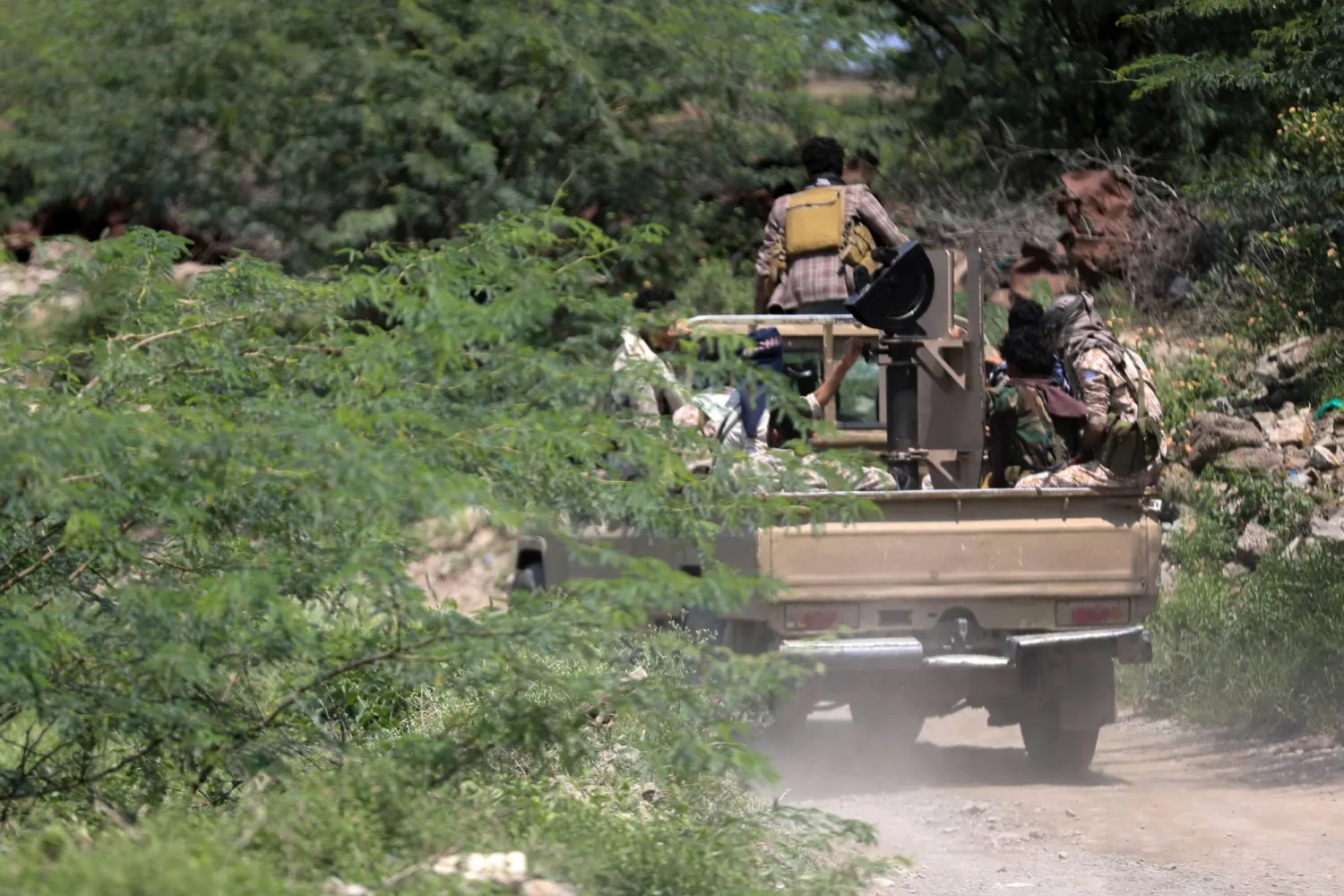
Yemen government soldiers ride in a pick-up truck near the Jabal Han front, west of the city of Taiz on October 3, 2026. (AFP)
TT

Yemen’s Armed Forces Say It Is Conducting Strikes Against Houthis in Sanaa

Yemen government soldiers ride in a pick-up truck near the Jabal Han front, west of the city of Taiz on October 3, 2026. (AFP)

Yemen's armed forces said early on Sunday it was conducting strikes against the Iran-aligned Houthis in the capital Sanaa and the group's stronghold Saada. 

A spokesperson for Yemen's armed forces, which ‌are aligned with ‌the legitimate government, ‌said ⁠forces were targeting "vital targets", without providing further details. 

The ‌conflict between the Iran-backed Houthis and forces aligned ‌with the government mostly ‌stopped after a 2022 truce, but fighting has broken out again in a spillover from the wider war between Iran ‌and the United States. 

Hostilities resumed this year after the ⁠Houthis ⁠escalated attacked in Yemen, making major territorial gains along the Red Sea coast. 

Earlier, government forces broke a new wave of Houthi attacks targeting the western front of the city of Taiz and forced the attackers to retreat.

This coincided with a broad escalation in air and artillery targeting operations that struck the group's positions, reinforcements, and supply lines across various fronts in the governorate.

The Iran-backed Houthi group has been exerting pressure for more than two weeks in an effort to encircle the city of Taiz from the south by seizing control of its countryside and isolating it from the liberated Yemeni regions toward Lahij and Aden.

It has also been trying to consolidate its gains in the West Coast and Bab al-Mandab regions by taking control of the highlands.

Armed Forces spokesperson Colonel Majid Al-Nuzaili said that the forces carried out 71 precise operations against Houthi gatherings, mobilizations, and reinforcements in the areas of Al-Aqrud, Samea, Al-Ahkoum, Al-Akboosh, Jabal Rasen, Jabal Jardad, Bani Omar, Bani Bakari, Al-Kaawish, and Al-Athawir.

He added that the operations resulted in the destruction of a number of hostile transport and support vehicles and the neutralization of militia elements, repelling their advance.