


Lebanon’s President: Israeli Attacks Undermine Efforts to End the War

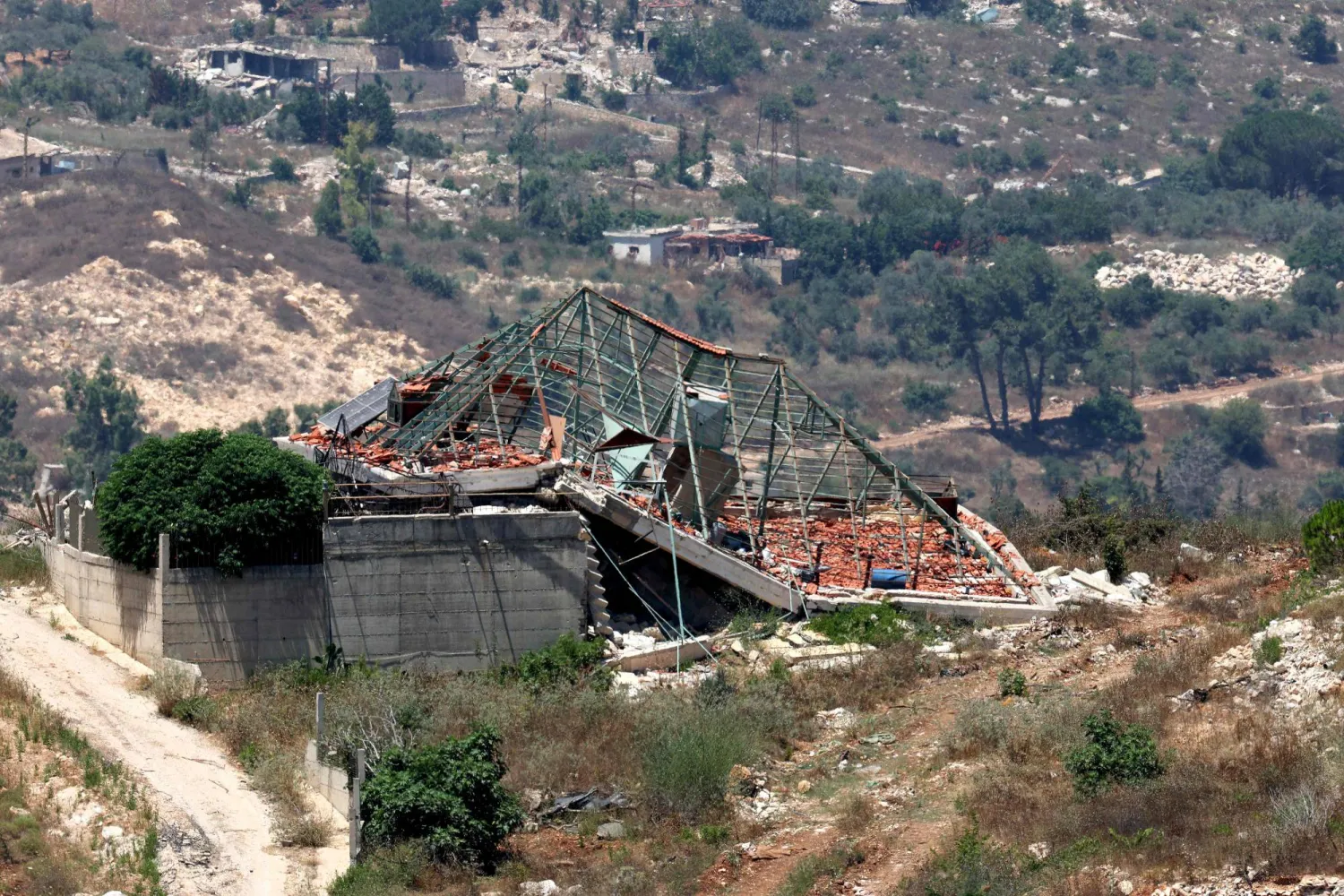
This picture taken from a position in the Upper Galilee in northern Israel shows destroyed buildings in a Lebanese village along the Israel-Lebanon border, on July 1, 2026. (Photo by Jack GUEZ / AFP)
TT

Lebanon’s President: Israeli Attacks Undermine Efforts to End the War

This picture taken from a position in the Upper Galilee in northern Israel shows destroyed buildings in a Lebanese village along the Israel-Lebanon border, on July 1, 2026. (Photo by Jack GUEZ / AFP)

Lebanese President Joseph Aoun said Israel’s continued attacks in southern Lebanon are undermining efforts to end the war and restore stability on both sides of the border, while stressing that the authority to negotiate rests exclusively with the Lebanese state.

Prime Minister Nawaf Salam likewise reaffirmed the need to consolidate the ceasefire and secure a full Israeli withdrawal from Lebanese territory as soon as possible.

Sixth round of talks next week?

Ministerial sources said the Lebanese presidency has not been officially notified of a new date for Lebanese-Israeli negotiations. They also denied reports that Aoun’s visit to the United States had been scheduled for July 21, telling Asharq Al-Awsat that the trip is expected to take place before the end of the month but that no official date has been communicated.

Their comments came after an Italian Foreign Ministry spokesperson announced Tuesday that the sixth round of Lebanon-Israel negotiations would be held in Rome on July 15-16. Diplomatic efforts continue on several fronts to overcome obstacles delaying the start of Israel’s withdrawal from the designated pilot zones.

Israeli Foreign Minister Gideon Saar said during a joint press conference in Jerusalem with German Foreign Minister Johann Wadephul: “Less than two weeks ago, Israel, Lebanon, and the United States reached a historic framework agreement, and these talks are scheduled to continue next week in Rome.”

Italian Foreign Minister Antonio Tajani welcomed the upcoming round, saying on X that Rome’s selection reflects Italy’s diplomatic role and commitment to promoting dialogue and regional stability.

Aoun calls for pressure on Israel

Aoun renewed his appeal to the US and other friendly countries to pressure Israel to respect the ceasefire. He also expressed sorrow over Monday’s Israeli strike on a vehicle in Nabatieh that killed four people, including the principal of a public school in the town of Nabatieh al-Fawqa.

He stressed that his decision to enter negotiations was driven by the goal of achieving stability, ending the war, and removing the occupation. While acknowledging that implementing the framework agreement would be a lengthy and difficult process, Aoun said Lebanon hopes to begin seeing parts of the agreement implemented soon.

“We have succeeded in curbing Israeli attacks and reducing their intensity, even if we have not yet achieved a complete end to the war,” he stated, adding that Lebanon had secured an Israeli acknowledgment that it has no territorial ambitions in Lebanon.

“No one will negotiate on Lebanon’s behalf”

Aoun accused some domestic opponents of deliberately misrepresenting the framework agreement and rejecting it regardless of official explanations affirming that Lebanon has not compromised its sovereignty or territorial rights.

“I will not, under any circumstances, accept anyone negotiating on Lebanon’s behalf,” he said. “Lebanon’s sovereignty requires an independent political decision. Our fundamental problem is with Israel, and we must resolve it ourselves.”

He added that one Lebanese faction, whose choices differ from those of the majority of Lebanese, remains under Iranian influence, seeks to act as an alternative to the state, and negotiates in its name.

Separately, Foreign Minister Youssef Raji said the government remains committed to placing all weapons under state authority.

He described the framework agreement with Israel as “the beginning of the beginning,” saying its greatest significance lies in establishing an independent Lebanese negotiating track separate from Iran’s, while accusing Tehran of continuing to interfere in Lebanon’s internal affairs.

Politically, the Kataeb Party backed swift implementation of the framework agreement, calling for all arms to be placed under state control to facilitate Israel’s withdrawal, the return of displaced residents, and reconstruction.

By contrast, Walid Jumblatt, former leader of the Progressive Socialist Party, criticized the agreement, calling it a unilateral arrangement imposed by Israel on Lebanese negotiators with limited legal and diplomatic expertise.

He argued that, unlike international treaties, the framework agreement has no explicit commitment to Israeli withdrawal.

Israel Army Chief Vows in Syria to Deter Threats to Border

Eyal Zamir and Israeli troops during a visit to an Israeli-occupied security zone in southern Syria. (Israeli army)
TT

Israel Army Chief Vows in Syria to Deter Threats to Border

Eyal Zamir and Israeli troops during a visit to an Israeli-occupied security zone in southern Syria. (Israeli army)

Israel's army chief said Wednesday during a visit to an Israeli-occupied security zone in southern Syria that the military would not allow threats to "establish themselves" on the border.

"We are monitoring the changes on the Syrian front. We will not allow hostile forces to establish themselves on our borders, and we will know how to use our operational capabilities precisely where and when needed," Lieutenant General Eyal Zamir told troops.

Israeli forces have been stationed in a security zone in southern Syria since the fall of the Assad regime in December 2024, occupying what was previously a buffer zone patrolled by the United Nations that had separated Israeli and Syrian forces in the Israeli-occupied Golan since 1974.

The top general said the army cannot afford to let down its guard on any of Israel's active war fronts, including Syria.

"We are still in a multi-front war, alert and operating in all arenas -- escalation can develop in any one of them, and we must remain in constant readiness."

Zamir's visit came one day after Israel bombed the Abu al-Duhur air base in Idlib province in northwestern Syria, accusing Damascus of violating an agreement by accepting Turkish troops on it.

"Israel repeatedly warned Syria that such a deployment would pose a threat to Israel's security. Syria chose to ignore these warnings," said a statement by the Office of Prime Minister Benjamin Netanyahu, which stopped short of acknowledging Israeli responsibility.

Türkiye, which has had tense relations with Israel in recent years, rejected the allegations, while the US ambassador to Türkiye Tom Barrack condemned the strikes, saying they constituted an "unnecessary escalation."

Syria's foreign ministry condemned "in the strongest terms the Israeli airstrikes" targeting the base, calling them "an unjustified act of aggression" and urging action by the UN Security Council.

The attacks come as Syria "has exercised restraint and worked to consolidate stability and avoid escalation", it added.

Despite tensions between the neighbors, Israel and Syria's new authorities have held several rounds of direct talks and have agreed to establish an intelligence-sharing mechanism.

But last week Israeli Defense Minister Israel Katz said that his country planned to keep troops in Syria.

Israel captured most of the Golan from Syria in the 1967 Arab-Israeli War and later annexed the areas under its control, in a move not recognized by the international community except for the United States and Colombia.


Germany, France Condemn Far-Right Israeli Minister’s ‘Inhumane’ Gaza Remarks

10 November 2022, Israel, Jerusalem: Israeli Minister of National Security Itamar Ben-Gvir speaks during a memorial ceremony for late Rabbi Meir Kahane. (dpa)
TT

Germany, France Condemn Far-Right Israeli Minister’s ‘Inhumane’ Gaza Remarks

10 November 2022, Israel, Jerusalem: Israeli Minister of National Security Itamar Ben-Gvir speaks during a memorial ceremony for late Rabbi Meir Kahane. (dpa)

Germany and France on Wednesday condemned remarks by Israel's far-right national security minister, who declared that Israel should kill "30 or 40" people every night in the Palestinian territory of Gaza.

German Chancellor Friedrich Merz "strongly condemns the inhumane appeals made by Minister (Itamar) Ben-Gvir, which violate international law," German government spokesman Sebastian Hille said. "They are unacceptable."

French Foreign Minister Jean-Noel Barrot also slammed the remarks, calling them "intolerable and inhumane" in an interview with the La Montagne regional newspaper.

Israel launched a military campaign on Hamas-ruled Gaza after the October 7, 2023 attack by the Palestinian group Hamas against Israel.

Ben-Gvir, who is already facing calls from several European countries for bloc-wide sanctions, made the call for mass killings during a podcast with a former Gaza hostage who had been held by Hamas.

"I think targeted eliminations should be carried out in Gaza every night. Take out 30 or 40," he said.

"Not only those who endanger you right now. These are people who shouldn't be alive," Ben-Gvir said. "I'm paying them a compliment by calling them humans."

Lars Klingbeil, German vice chancellor and finance minister, said in a TV interview Tuesday that Ben-Gvir's comments "must have consequences", adding that sanctions were being discussed at the European level.

Several European countries have called for EU-wide sanctions against the far-right minister, but the proposal has failed to win the required unanimity.

Calls to blacklist Ben-Gvir grew after he published a video in May of himself mocking bound activists seized by Israeli soldiers on a Gaza-bound aid flotilla.

France in response banned Ben-Gvir from entering the country and called for the EU to impose bloc-wide sanctions.

But EU sanctions have to be signed off by all 27 member states and staunch supporters of Israel refused to go along with the push.

- 'No further steps' -

Germany also condemned Israeli plans for settlement expansion in the so-called E1 area of the occupied West Bank, saying it jeopardizes the prospect for a two-state solution.

"Our message is clear: there must be no further steps toward annexation in the West Bank," said Hille.

"No formal ones, but also no political, structural, or other measures whose impact is increasingly and obviously leading toward annexation. They run counter to a two-state solution."

France's Barrot did not rule out further sanctions on Israeli settlers in the West Bank, who have increasingly been harassing and assaulting Palestinian residents in recent months, often with the aim to take their property.

"We imposed European sanctions against these settlers for the third time on May 28," he said.

"Further sanctions could be imposed and all options are on the table," Barrot added.

Israel has occupied the West Bank since 1967 and since then settlement expansion has been a policy under successive Israeli governments.

But it has accelerated significantly under the current coalition government of Prime Minister Benjamin Netanyahu.

Excluding east Jerusalem, more than 500,000 Israelis now live in the West Bank in settlements that are illegal under international law, among some three million Palestinians.


Lebanon Says Received French Invitation to Meeting on Army Support

13 August 2026, Lebanon, Zawatar al-Gahrbiyeh: Lebanese army soldiers secure the premises of "Our Lady of the Annunciation" Monastery in Zawatar al-Gahrbiyeh. (dpa)
TT

Lebanon Says Received French Invitation to Meeting on Army Support

13 August 2026, Lebanon, Zawatar al-Gahrbiyeh: Lebanese army soldiers secure the premises of "Our Lady of the Annunciation" Monastery in Zawatar al-Gahrbiyeh. (dpa)

Lebanon said Wednesday it had received an invitation from France for a meeting to prepare for an international conference on support for the Lebanese army, an event postponed by the Middle East war.

The conference in Paris was supposed to take place in March but was delayed after the Hezbollah group drew Lebanon into the regional war by attacking Israel in support of its backer Iran.

Lebanon said in a statement Wednesday that President Joseph Aoun had "received from the French charge d'affaires in Lebanon, Bruno Da Silva, a letter from French President Emmanuel Macron that included an invitation for Lebanon to participate in a preparatory meeting to be held in Paris on September 17".

Aoun thanked Macron for the invitation, praising "the constant interest he shows towards Lebanon and its national institutions, foremost among them the army and the Internal Security Forces".

He said the invitation highlighted the importance of "supporting the Lebanese army with the aim of enabling it to possess the capabilities and resources necessary to carry out its responsibilities effectively".

The army "requires international support and a collective effort to meet its operational needs, logistical equipment, training and capacity building", the statement by the Lebanese presidency added.

Army chiefs from several countries, as well as representatives from governmental and international organizations, along with experts, are expected to attend the meeting, according to the presidency.

France did not announce anything on Wednesday related to the conference.

In February, French Foreign Minister Jean-Noel Barrot visited Lebanon to prepare for the event.

Beirut received pledges of international support for its troops after Lebanon's government committed to disarming Hezbollah last year and tasked the army with the process.

Hezbollah has been weakened by over a year of hostilities with Israel, which a November 2024 ceasefire sought to end, although the fighting has not been completely halted.

Lebanon and Israel have since entered US-sponsored direct talks in an effort to end hostilities. In June they signed a framework agreement that calls for the disarmament of Hezbollah, a gradual withdrawal of Israeli forces from south Lebanon and the deployment of the Lebanese army to the region, starting in "pilot zones".

But the Lebanese military faces major challenges amid a shortage of equipment, personnel, and technical capabilities necessary to carry out its mission.
