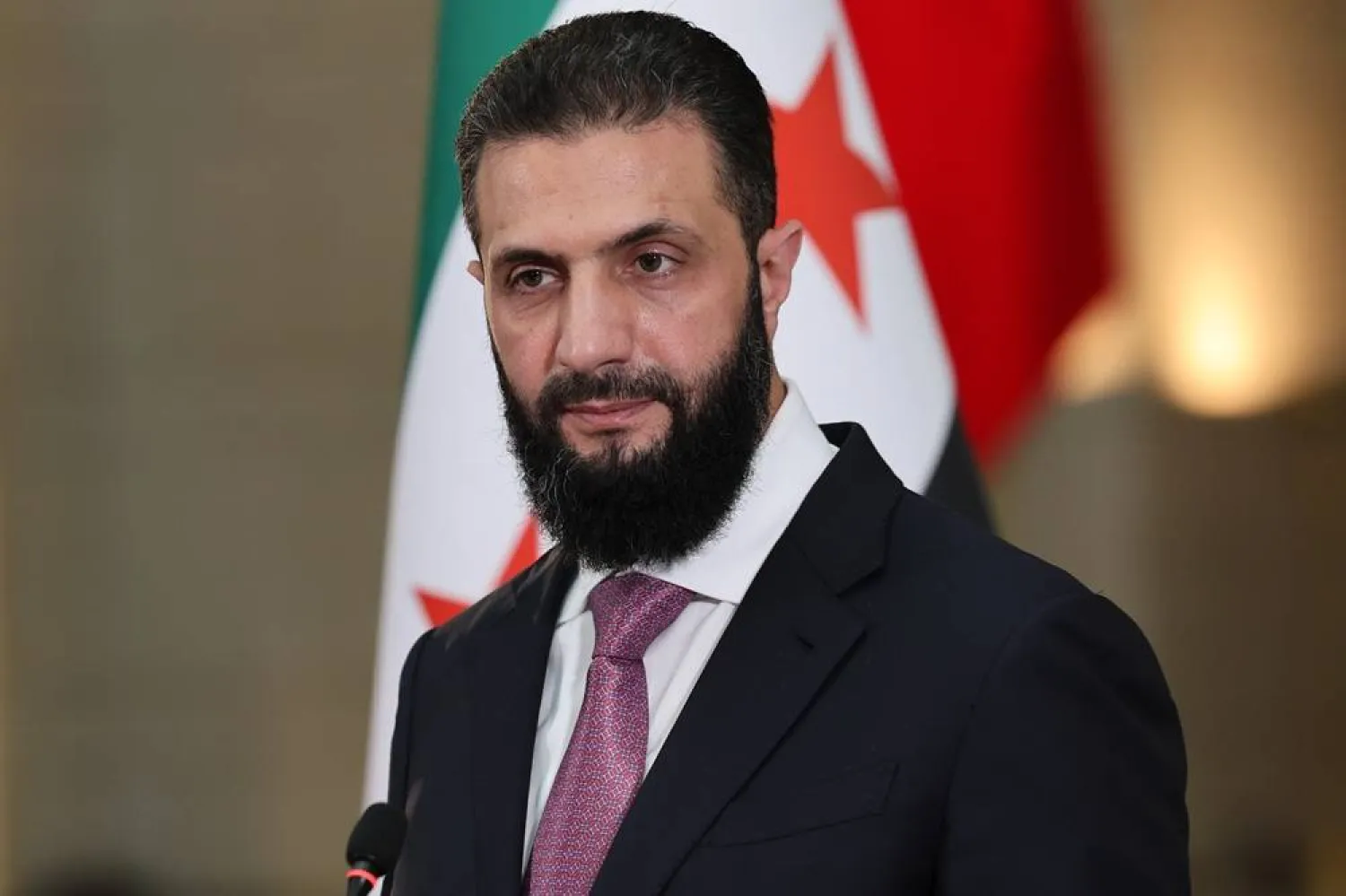
Syrian President Arrives in Ankara for Talks with Trump

Syrian President Ahmed al-Sharaa during a joint press conference with the French president at the Presidential Palace in Damascus, Syria 07 July 2026. (EPA)
TT

Syrian President Arrives in Ankara for Talks with Trump

Syrian President Ahmed al-Sharaa during a joint press conference with the French president at the Presidential Palace in Damascus, Syria 07 July 2026. (EPA)

Syria's President Ahmed al-Sharaa arrived in Ankara on Wednesday, where he was due to meet US President Donald Trump on the sidelines of the NATO summit.

The summit of the military alliance, which closes on Wednesday, has brought together 36 heads of state, as well as several representatives from Gulf countries.

Al-Sharaa was invited by Türkiye's President Recep Tayyip Erdogan.

Trump, who has flaunted his closeness to Erdogan, described his Syrian counterpart, who came to power after toppling president Bashar al-Assad in December 2024, as "tough".

"Because of the president (Erdogan), we have a very good relationship with Syria's new leader," the US leader told reporters on Tuesday.

"He's done an amazing job in a year and a half, he's pulled the whole country together. And I have a very, very good relationship with him.

"Somebody said, well, he's pretty tough... I approved him along with the president (Erdogan) We were the two that really wanted him. And he's done a great job, he's pulled it together. Not an easy job."

Thirteen years of war have devastated Syria, which needs international support to rebuild and still faces numerous threats.

On Tuesday, 18 people were wounded in two bomb attacks in Damascus, near a hotel where visiting French President Emmanuel Macron was staying.

Sharaa visited Washington in November last year seeking financial support for Syria.

But last month he refused calls from Trump to intervene militarily in neighboring Lebanon against the Iran-backed Hezbollah group, which is in open conflict with Israel.

"We are looking for economic channels between Lebanon and Syria, not military ones," he said in an interview last month.


West Bank's Violent Settlers Part of a New Generation Fueled by Ideology

TOPSHOT - Mahmoud al-Toubasi, a 60-year-old Palestinian who was displaced from his home months earlier following an attack by Israeli settlers, stands from a distance looking at his house in the Palestinian village of Jalud, south of Nablus in the Israeli-occupied West Bank, on September 29, 2026. (Photo by Zain JAAFAR / AFP)
TT

West Bank's Violent Settlers Part of a New Generation Fueled by Ideology

TOPSHOT - Mahmoud al-Toubasi, a 60-year-old Palestinian who was displaced from his home months earlier following an attack by Israeli settlers, stands from a distance looking at his house in the Palestinian village of Jalud, south of Nablus in the Israeli-occupied West Bank, on September 29, 2026. (Photo by Zain JAAFAR / AFP)

A mass attack by Israeli settlers on a Palestinian village in the occupied West Bank has placed new focus on the emergence of a generation of radicals in the territory.

A loosely connected movement of hardline Israeli settlers, most of them young and including school dropouts from outside the West Bank, known as the "Hilltop Youth", is behind the surging violence against Palestinians.

Inspired by religious-nationalist ideology, the movement seeks to expand the Jewish presence in the Palestinian territory by setting up unauthorized outposts -- usually makeshift tents or mobile homes -- on hilltops outside established Israeli settlements.

While groups of Israelis living off-grid in the West Bank have existed since the 1990s, the new generation has a clear agenda to take over Palestinian lands through violent means, said Dvir Warshavsky of Children of Abraham, a group of observant Jewish activists supporting Palestinian rights.

Early on Tuesday, more than 100 Israeli settlers attacked the village of Jalud, wounding three members of Israeli security forces, as the army accompanied a Palestinian family seeking to return to their home after being displaced by settler attacks.

The ramp-up in violence, including attacks on mosques and churches, had already prompted countries including Britain and the Netherlands to impose sanctions on settlement products, infuriating Israel.

A post published in a WhatsApp channel affiliated with the movement and seen by AFP recently claimed that over the past 12 months, the Hilltop Youth had carried out 635 attacks in 158 different Palestinian villages, and that 409 Palestinians were wounded and 436 cars were burned during the attacks. The figures could not be independently verified.

The perpetrators of such violence are rarely prosecuted by Israeli authorities.

Israeli Prime Minister Benjamin Netanyahu, addressing the UN General Assembly last week, dismissed settler attacks as the work of a "handful of juvenile delinquents, about 150 in number" and accused the rest of the world of ignoring violence by Palestinians.

Israel has occupied the West Bank since 1967. More than 500,000 settlers live in the territory which is home to some three million Palestinians.

About 140 settlements are recognized by the Israeli government while being illegal under international law, but farms and outposts that are also illegal under Israeli law now number around 400, according to the Peace Now watchdog.

- 'Minimum people on maximum land' -

Israeli rights experts who have tracked the Hilltop Youth for years said the movement gathered pace after Israel dismantled 21 settlements in the Gaza Strip and four in the West Bank as part of its unilateral "disengagement" in 2005.

The failure of the settler movement's old guard to prevent thousands of Israelis from losing their homes in the forced evacuations, combined with resentment toward the central government, ushered in a new phase.

More ideological settlers emerged, challenging "the traditional strategy of the settler movement, whose logic was to build more and more settlements with more and more people," Warshavsky said.

The "new generation" focused on building small illegal outposts and agricultural projects without permits from Israeli authorities -- a strategy known as "minimum people on maximum land".

Grazing flocks of sheep and goats has allowed the hilltop youth to significantly expand control over rural areas which are under Israeli military authority.

With the rise of politicians representing the ideological settlers, such as Finance Minister Bezalel Smotrich, the communities have received growing legitimization and financial support -- some of it channeled toward illegal farms and outposts, according to experts.

While the government cannot make direct transfers because of their illegal status, "they fund all the rest", said Hagit Ofran of the Peace Now watchdog, meaning roads, ranger cars, security cameras, solar panels and drones -- along with protection from the Israeli army.

Some funding also comes from private donations and crowdfunding, she added.

- Protected by the army -

Some settler leaders have sought to distance themselves from the movement. At the end of last year, the leaders of three Israeli local councils in the West Bank issued a joint statement urging law enforcement to adopt a "zero tolerance" policy towards the Hilltop Youth, saying they "do not represent" the broader settler movement.

Since Hamas's October 7, 2023 attack on Israel and the outbreak of war in Gaza and on other fronts, regular soldiers have been diverted away from the West Bank, with troops patrolling around the settlements now often reservists who are themselves settlers.

Such troops are much less likely than regular soldiers to dismantle illegal outposts, experts say.

"The army is not really fighting against them. They don't want to deal with them," Ofran said.


The US Military Says Its Withdrawal of Troops from Iraq is Complete

A car moves past a sign depicting Iraqi flags and images of Iraqi security forces on Sovereignty Day, marking the withdrawal of US-led coalition forces from Iraq, thereby ending more than two decades of military presence there, in Baghdad, Iraq, September 30, 2026. REUTERS/Ahmed Saad
TT

The US Military Says Its Withdrawal of Troops from Iraq is Complete

A car moves past a sign depicting Iraqi flags and images of Iraqi security forces on Sovereignty Day, marking the withdrawal of US-led coalition forces from Iraq, thereby ending more than two decades of military presence there, in Baghdad, Iraq, September 30, 2026. REUTERS/Ahmed Saad

The US military announced on Wednesday that it has completed the withdrawal of all American troops from Iraq, ending a 12-year mission to fight the ISIS group. The last US troops left an air base in northern Iraq under a deal between Baghdad and Washington.

The withdrawal, agreed on two years ago, comes against the backdrop of the ongoing war between the United States and Iran that has also sometimes spilled over into Iraq, with Iran-backed militias firing on US troops and the US striking the groups' strongholds.

Baghdad touted the end of the US mission as a sign of the country's increasing strength and sovereignty.

The withdrawal was also celebrated by Iran-backed groups but raised concerns among some other Iraqis, particularly in the Kurdish region. Meanwhile, questions loom around the future of the Iraqi militias, which the Baghdad government has sought — with little success so far — to disarm.

Pentagon spokesperson Sean Parnell said in a statement that US troops and equipment had completed an “orderly departure” from the air base in Irbil, in northern Iraq's semi-autonomous Kurdish region.

“This milestone reflects the success of a 12-year campaign that defeated ISIS as an organized military threat in Iraq and across the region,” he said. “It also marks a transition from a wartime coalition mission to an Iraqi-led security effort supported by a more normal bilateral security relationship.”

Iraqi Prime Minister Ali al-Zaidi presided over the handover ceremony and described the US withdrawal as the beginning of a “new phase, one defined by Iraq’s sovereignty, the strength of its institutions, the readiness of its forces, the unity of its decision-making, and balanced partnerships with its friends.”

He said Iraqi security forces will continue the fight against ISIS and the government will ensure that non-state groups no longer hold weapons.

US troops invaded Iraq in 2003 to topple Saddam Hussein. They departed in 2011, but three years later, Iraqi authorities invited a smaller US-led mission to fight the ISIS group, which had rampaged across Iraq, seizing large swaths of territory.

With the extremist group reduced to scattered sleeper cells, Washington and Baghdad agreed in 2024 to wind the mission down.

US troops pulled out of bases in most areas of Iraq last year but maintained a small presence of hundreds of troops in the semiautonomous northern Kurdish region. Bases there have regularly come under attack since the US and Israel launched their war against Iran on Feb. 28.

The Iraqi government initially linked the Sept. 30 deadline for US withdrawal to the disarmament of non-state armed groups by that date.

While a handful of less-influential militias have agreed to turn over their weapons, powerful groups close to Iran rejected the prospect or set conditions for disarming that the government would be unlikely to meet.

Al-Zaidi has since walked back the deadline. He told The New York Times earlier this month that the deadline for militia disarmament has been pushed to June 2027.

The effects of the US withdrawal may not be immediately visible, particularly since the US military presence had already been scaled down. But officials in Iraq's Kurdish region have expressed anxiety about the departure and particularly about the removal of US air defense systems.

The Kurdish regional government's Peshmerga Ministry said the Kurdish region had faced more than 1,000 drone and ballistic-missile attacks during the recent US-Iran conflict.

“The departure of the United States from the Kurdistan Region under these complex regional circumstances, without the provision of a defense system, is a matter of concern,” the statement said.

Iran-allied groups in Iraq, meanwhile, have celebrated the US withdrawal.

“The expulsion of the occupation forces, defeated, from the land of Iraq is the beginning of full sovereignty,” Abu Mujahid al-Assaf, a security official with the powerful Kataib Hezbollah militia, said in a statement.

He added a warning to al-Zaidi and his government not to carry out American plans, threatening that “any government that does not work for the benefit of the people will be overthrown by all means.”


Lebanon Urges US Pressure on Israel, Seeks Army Support and Commits to Reforms

President Joseph Aoun welcoming US Congress members Darin LaHood and Josh Gottheimer (Lebanese Presidency)
TT

Lebanon Urges US Pressure on Israel, Seeks Army Support and Commits to Reforms

President Joseph Aoun welcoming US Congress members Darin LaHood and Josh Gottheimer (Lebanese Presidency)

Lebanon’s top leaders urged Washington to pressure Israel to implement agreements and halt its operations in South Lebanon, while stressing the need for continued support for the Lebanese Army and pledging to press ahead with economic, financial and political reforms.

The messages emerged from President Joseph Aoun’s and Parliament Speaker Nabih Berri’s meetings with US Reps. Darin LaHood and Josh Gottheimer, as well as Prime Minister Nawaf Salam’s talks in Washington.

Aoun told the US lawmakers that Lebanon was placing considerable importance on Washington pressuring Israel to implement the “framework agreement” reached through Lebanese-US-Israeli negotiations in Washington.

Lebanon remains fully committed to the agreement, while Israel continues to disregard its provisions, Aoun stressed, according to a Lebanese presidency statement.

He stressed the need to halt demolition, bulldozing and destruction activities in the southern villages occupied by Israel, arguing that implementing the agreement required accelerating the return of Lebanese prisoners, resolving disputed points along the Blue Line and a gradual Israeli withdrawal from Lebanese territory alongside Lebanese Army deployment up to the internationally recognized southern border.

Aoun warned that continued delays would prolong tensions in the south and hinder the state’s ability to extend its authority throughout its southern territory, remove armed manifestations and return displaced residents to their villages and towns.

He also underscored the need to provide the Lebanese Army with the resources required to carry out its wide-ranging duties, from combating terrorism and smuggling and securing borders to protecting institutions and maintaining civil peace.

On domestic affairs, Aoun reaffirmed the government’s commitment to financial, economic and judicial reforms, pointing to legislation including amendments to the banking secrecy law, bank restructuring and the media law.

LaHood described the current situation as an opportunity to restore stability to Lebanon and the wider region and affirmed continued US assistance to Lebanon and its army through military aid provided by the administration with congressional approval.

Berri, meanwhile, focused on the continuing Israeli operations in Lebanon, arguing that Israel’s failure to fulfill its obligations under agreements reached to end the war was the main obstacle to their implementation.

He reiterated that the US administration and President Donald Trump had the ability to pressure Israel to halt its war on Lebanon, warning that its continuation would undermine efforts by the state and its institutions to carry out their roles, according to a statement from the parliament speaker’s office.

Berri welcomed assistance to the Lebanese Army but stressed the need to avert a failure to renew the mandate of the UN Interim Force in Lebanon, or UNIFIL, noting that there was still time to prevent such a step.

During a separate meeting with a British military delegation, he emphasized the importance of maintaining a UN umbrella and flag for any force assisting the Lebanese Army after Israel withdraws from occupied Lebanese territory.

Deputy Prime Minister Tarek Mitri also presented Berri with a documented report on crimes committed by Israeli forces in South Lebanon. Berri maintained that Lebanon’s right to pursue Israel over those acts was a “sovereign right” that could not be relinquished.

In Washington, Salam discussed economic and financial relations with US Treasury Secretary Scott Bessent, along with financial and banking reforms, negotiations with the International Monetary Fund and cooperation with the World Bank.

Salam outlined government measures to address the repercussions of Lebanon’s financial crisis and rebuild the banking sector, while seeking US support for reforms and economic recovery. Discussions also covered efforts to curb the cash economy and strengthen transparency, compliance and measures against money laundering and terrorism financing.

Meeting young Lebanese in Washington, Salam linked domestic reform with full state sovereignty, stressing that state-building rested on two inseparable tracks.

“There can be no state with two armies, and no state with two decision-making authorities,” he declared, reaffirming the government’s determination to pursue reforms and extend state authority across all Lebanese territory.

Salam stressed that government success should be measured not only by laws and projects but by its ability to build a country where young people see a future, making the return of Lebanese from abroad “a choice, not a sacrifice.”

He called for a state that respects its citizens and provides a trustworthy judiciary, a productive economy and an effective administration, urging Lebanese abroad to remain engaged through their expertise, investments and connections.

“Judge us by our work; judge us by the results,” Salam concluded.