


Amnesty Urges Investigating Israeli Attacks on Lebanon as ‘War Crimes’

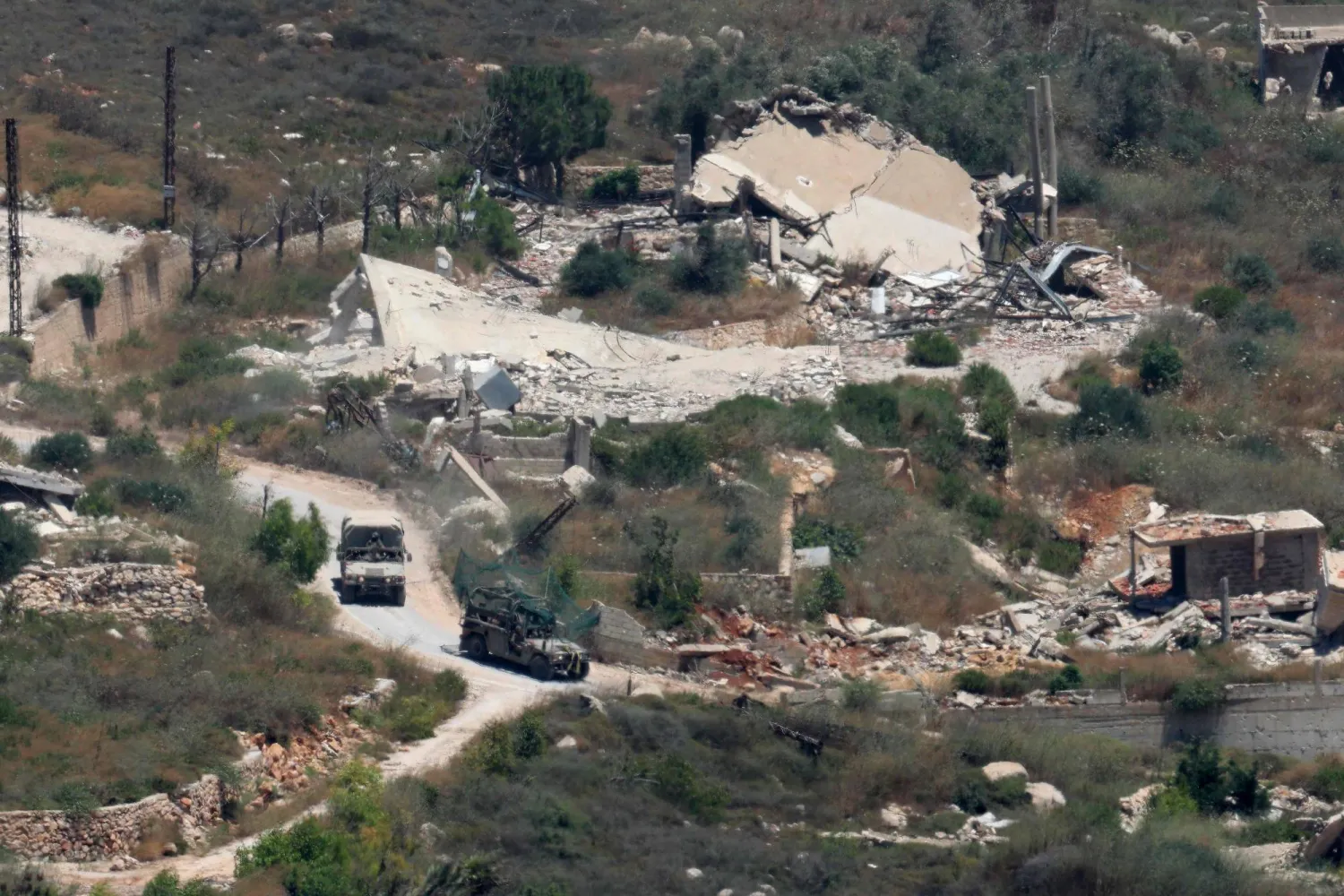
This picture taken from a position in the Upper Galilee in northern Israel shows Israeli military vehicles driving past houses destroyed in Israeli strikes in the southern Lebanese village near the Israel-Lebanon border, on July 1, 2026. (AFP)
TT

Amnesty Urges Investigating Israeli Attacks on Lebanon as ‘War Crimes’

This picture taken from a position in the Upper Galilee in northern Israel shows Israeli military vehicles driving past houses destroyed in Israeli strikes in the southern Lebanese village near the Israel-Lebanon border, on July 1, 2026. (AFP)

Amnesty International on Thursday accused Israel of wiping out families in its strikes on Lebanon during its war with Hezbollah, calling for these attacks to be investigated as war crimes.

Hezbollah drew Lebanon into the Middle East war on March 2 by launching rockets at Israel in support of its backer Iran.

Israel responded with major airstrikes and a ground invasion, killing more than 4,300 people according to Lebanese authorities, including more than 250 children.

Amnesty analyzed three strikes on civilian homes between March 6 and 13, in which 24 civilians were killed, 12 of them children.

The London-based rights group accused Israel of "wiping out families" in those strikes and called for them to be treated as "war crimes".

The group said it reached out to Israeli authorities, who said that some of the attacks "were carried out against Hezbollah military objectives", while others were "referred for examination".

The authorities told Amnesty they were "committed to mitigating harm to civilians during operational activity".

"Despite follow up, the Israeli military did not provide specific information regarding the three attacks... including what the targets may have been," Amnesty added.

Its findings in the investigation were based on interviews with 15 people, including survivors, relatives, paramedics, journalists who visited attack sites and local officials.

"Based on the evidence gathered, in each of these air strikes, Amnesty International has reasonable basis to conclude that Israeli forces violated international humanitarian law, including by failing to distinguish between civilians and military objectives, by carrying out attacks directed against civilians or civilian objects, or by failing to take all feasible precautions to minimize harm to civilians," the report read.

Kristine Beckerle, Amnesty's deputy regional director for the Middle East and North Africa, said that "within the space of just a week -- the Israeli military obliterated entire families, including a dozen children, in Lebanon, demonstrating a callous disregard for civilian lives".

"States must impose an immediate comprehensive arms embargo on Israel and use universal and extraterritorial jurisdiction to investigate and prosecute those responsible," she added.

Israel's Defense Minister Israel Katz said, in a statement on Thursday, that the military's operations in Lebanon were a response to attacks by Hezbollah.

"The terrorist organization Hezbollah has attacked Israel twice on its own initiative," Katz said, without specifying whether he was responding to Amnesty's report.

"Israel responded with force and, over the past two and half years, has crushed most of Hezbollah's capabilities and its leadership," adding that Israeli forces would remain in their self-declared "security zone" inside occupied Lebanese territory "as long as necessary" to protect Israel's northern communities.

Last month, Lebanon and Israel concluded a US-backed framework agreement aiming to pave the way for a permanent end to hostilities.

It was preceded by a memorandum of understanding between Iran and the United States to end the broader Middle East conflict, which included a ceasefire in Lebanon.

Despite this, Israel still carries out intermittent strikes on southern Lebanon, some of them deadly.



Iraq Seizes $20 Mn, Recovers 60 Kg of Gold in ‘Deputy Oil Minister’ Case

Image published by Iraq's Supreme Judicial Council of the seized funds.
TT

Iraq Seizes $20 Mn, Recovers 60 Kg of Gold in ‘Deputy Oil Minister’ Case

Image published by Iraq's Supreme Judicial Council of the seized funds.

Diaa Jaafar, the investigating judge at Iraq’s Central Anti-Corruption Criminal Court, announced on Sunday that authorities had seized $20 million and recovered 60 kilograms of gold in a corruption case involving suspended Deputy Oil Minister for Refining Affairs Adnan al-Jumaili.

In a statement released by Iraq’s Supreme Judicial Council and reported by the German Press Agency (dpa), Jaafar said that, in coordination with the Kurdistan Region, authorities had seized $20.34 million, 200 million Iraqi dinars, and seven vehicles, in addition to recovering 60 kilograms of gold.

The seizures were made as part of the case against Jumaili and other individuals allegedly involved in the corruption scheme.

He said that follow-up and investigative efforts to recover funds obtained through squandering and irregularities in projects carried out by the defendant and others involved in the case led to the seizure of the cash, gold jewelry and vehicles.

The judge said the investigation is ongoing and that authorities are pursuing other suspects before completing the necessary legal procedures against them.


Hamas Delegation in Cairo for Gaza Ceasefire Talks

15 August 2026, Palestinian Territories, Gaza: Tents sheltering displaced Palestinians crowd the beach, as the coastline has become a refuge for thousands displaced from different parts of the Gaza Strip by the war. (dpa)
TT

Hamas Delegation in Cairo for Gaza Ceasefire Talks

15 August 2026, Palestinian Territories, Gaza: Tents sheltering displaced Palestinians crowd the beach, as the coastline has become a refuge for thousands displaced from different parts of the Gaza Strip by the war. (dpa)

A Hamas delegation, chaired by the group’s leader Khalil al-Hayya, is in Cairo Sunday for Gaza ceasefire-related talks with Egyptian officials, the group said.

The talks come as mediators push for the implementation of a roadmap to move forward with US President Donald Trump’s peace plan, which calls for the disarmament of Hamas and other Palestinian groups in Gaza, the withdrawal of Israeli forces from the area as well as handing over power to Palestinian technocrats.

Israel’s Prime Minister Benjamin Netanyahu has rejected Trump’s latest plan to advance the stalled ceasefire in Gaza, saying Israel will not withdraw from any of the roughly 60% of the territory it controls until Hamas has been completely disarmed — something the group controlling the other 40% has long resisted.

It wasn’t immediately clear whether al-Hayya would meet with Trump’s son-in-law and negotiator Jared Kushner, the Board of Peace’s high representative Nickolay Mladenov, or executive board member and former British Prime Minister Tony Blair, who are scheduled to travel to Israel and Egypt this week.


Israel Vows to Go After Hezbollah as It Names Another Killed

15 August 2026, Lebanon, Nabatieh district: An Israeli warplane carried out an airstrike on a house in a tourist area of Ansar, southern Lebanon, before dawn, completely destroying the building and causing extensive damage to surrounding properties. (dpa)
TT

Israel Vows to Go After Hezbollah as It Names Another Killed

15 August 2026, Lebanon, Nabatieh district: An Israeli warplane carried out an airstrike on a house in a tourist area of Ansar, southern Lebanon, before dawn, completely destroying the building and causing extensive damage to surrounding properties. (dpa)

Israel vowed Sunday it would hit Hezbollah again if threatened, as it identified what it described as a commander killed in strikes a day earlier that also left several children dead. 

Israeli strikes on Saturday killed 11 people in southern Lebanon, according to authorities, in the deadliest attacks since a deal was reached in June aimed at ending hostilities. 

Israel said the strikes were a response to Hezbollah setting off explosive drones inside a so-called "security zone" in southern Lebanon, seriously injuring three Israeli troops including an officer. 

"No score will be left unsettled in any arena. We'll defend our soldiers and our civilians with full power," Defense Minister Israel Katz wrote on X. 

The Israeli military identified one of those killed on Saturday as Abu Hassan Alaa, saying he was a senior commander of Hezbollah's Badr unit who had been involved in firing drones at Israeli troops. 

Israel earlier said that the strike killed a commander in Hezbollah's elite Radwan Force, Ali Samir Al-Haj Hassan. 

The Israeli military acknowledged that Hassan's family was present but defended the strike by saying they were not the target. 

Lebanese President Joseph Aoun said a whole family had been killed in the strike in the village of Ansar, with Lebanon's health ministry reporting that three children and two women died. 

Imran Riza, the UN humanitarian coordinator for Lebanon, condemned the strike. 

"Children and civilians continue to pay an unacceptable price. International humanitarian law is clear: civilians must be protected at all times," he said. 

Prime Minister Benjamin Netanyahu's office accused Hezbollah of deliberately placing civilians in harm's way. 

Hezbollah denied the account, saying that "another entire family has been wiped out following orders issued by Netanyahu". 

"Netanyahu, who is the subject of proceedings before the International Criminal Court over war crimes and crimes against humanity committed in Gaza, is once again presiding over the killing of Lebanese civilians," Hezbollah said in a statement. 

Hezbollah pulled Lebanon into the regional war in March by firing rockets at Israel in support of Iran, after US-Israeli strikes there sparked war in late February. 

Lebanon and Israel signed a US-brokered deal in which Lebanon's army will gradually take over security in southern areas occupied by Israel, but Hezbollah has refused to disarm.