

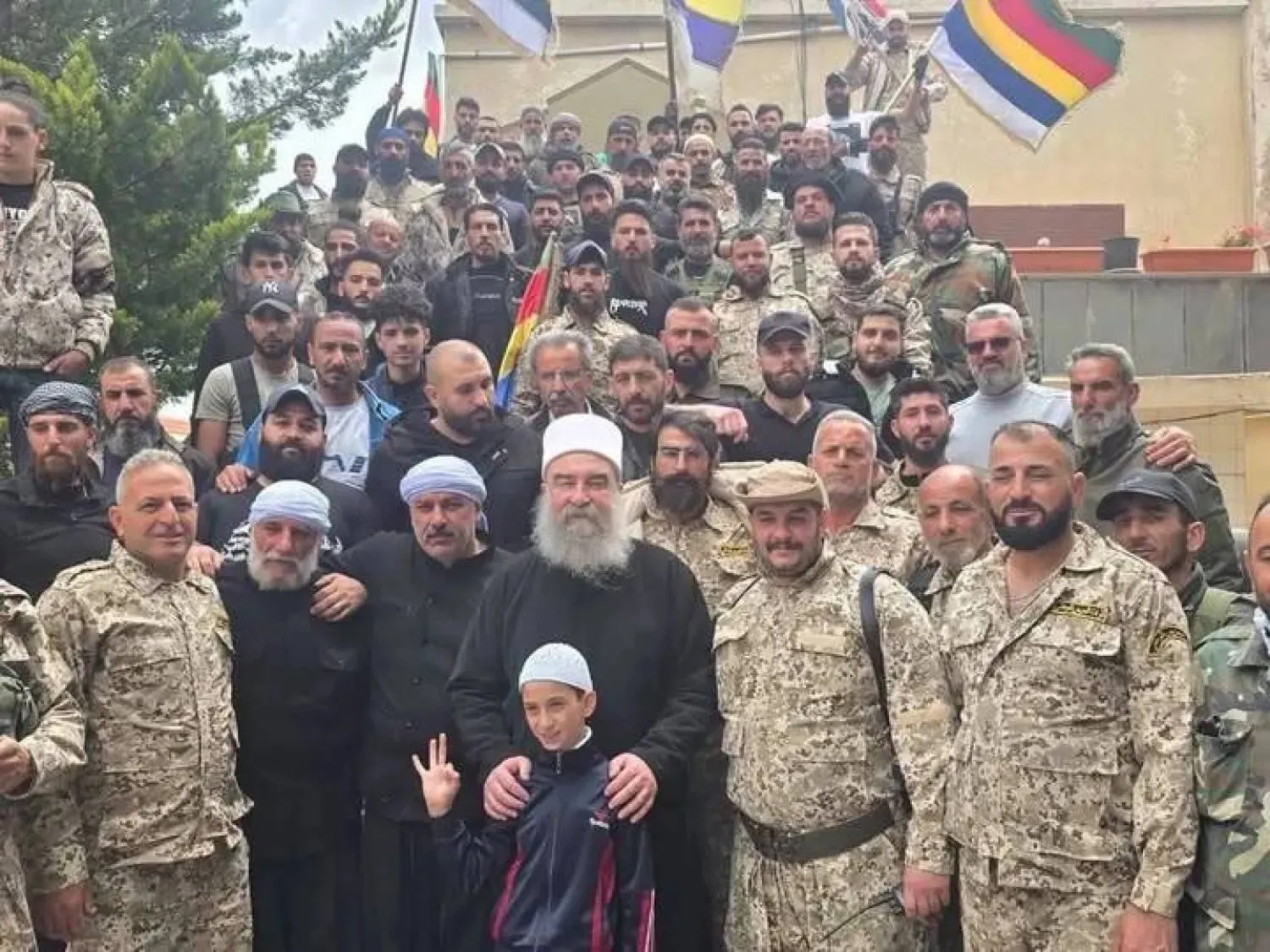

Al-Hijri Renews Call for Sweida’s ‘Independence’ from Syria

Sheikh Hikmat al-Hijri, flanked by supporters from the so-called National Guard. (Suwayda24)
TT

Al-Hijri Renews Call for Sweida’s ‘Independence’ from Syria

Sheikh Hikmat al-Hijri, flanked by supporters from the so-called National Guard. (Suwayda24)

The spiritual leader of Syria’s Druze community, Sheikh Hikmat al-Hijri, renewed calls Monday for what he described as Sweida’s “independence,” saying the southern province could eventually become “an autonomous entity under another state’s protection or join another state.”

His remarks coincided with the first anniversary of the July 2025 clashes in Sweida.

A local source in Sweida opposed to al-Hijri’s policies rejected the proposal, telling Asharq Al-Awsat that residents “have no state but Syria, despite the country’s current hardships.”

The source added that neither Israel nor Jordan supports such a move, noting that Israeli officials have publicly stated they do not back Sweida’s secession and that “the overwhelming majority of residents will not abandon their Syrian identity.”

Areas under al-Hijri’s influence have hosted gatherings in recent days to commemorate last July’s clashes, which killed hundreds of Bedouin residents, Druze faction fighters, civilians, and members of the army and security forces.

The source said the events reflected widespread grief, as most families had suffered deaths, injuries, or displacement, stressing that the commemorations were intended to honor the victims rather than press for secession.

On Sunday, al-Hijri met representatives of the Shahba Operations Room, affiliated with the so-called National Guard, in the town of Qanawat.

In widely circulated video footage, he said the goal was “the independence of Bashan State,” adding that this could take the form of an independent state, a region under another country’s protection, or union with another state, “whichever best serves the interests of the people of the region.”

He also thanked Israel, saying it had stood by Sweida and citing its geographic proximity.

The Sweida Governorate issued a statement marking the anniversary, describing the July events as a tragedy that left lasting scars on the province and on Syrians as a whole.

Maysaa al-Abdallah, a resident of Sweida, told Asharq Al-Awsat that many families remain displaced a year later, with 135 people still missing and civilians still detained at Adra Prison near Damascus.

She also said that, of roughly 14,000 middle- and high-school students eligible to sit for national exams, only a very small number had been able to do so.

While most residents still identify as Syrian and Arab, she argued that “government policies are pushing many to reject that identity.”




Drone Strikes Kill 8 Civilians in Sudan’s North Kordofan

Sudanese army solders take part in a military parade on August 17, 2026, in the city of Gedaref in eastern Sudan during celebrations to mark the 72nd anniversary of the Sudanese Armed Forces. (Photo by AFP)
TT

Drone Strikes Kill 8 Civilians in Sudan’s North Kordofan

Sudanese army solders take part in a military parade on August 17, 2026, in the city of Gedaref in eastern Sudan during celebrations to mark the 72nd anniversary of the Sudanese Armed Forces. (Photo by AFP)

Drone strikes have killed eight civilians and wounded dozens in Sudan's Kordofan region, a rights group said Friday.

Emergency Lawyers, an independent group documenting atrocities in Sudan, said a drone targeted a group of civilians traveling Thursday in the desert town of Sowdari in North Korodofan state. As others rushed to help the victims, a second drone struck, the group said.

The group said in a statement posted on Facebook that targeting civilians and then attacking again while they were being rescued amounts to a violation of international humanitarian law and is a war crime. It called for an independent investigation to determine who was responsible.

Sudan plunged into all-out war in April 2023 as fighting erupted between the Rapid Support Forces and the Sudanese military. The conflict has killed at least 59,000 people killed, according to Armed Conflict Location & Event Data, a conflict monitoring group. Aid groups say the figure is an undercount and the true number could be many times higher.

Drone warfare has become a defining feature in the country's war, with both sides carrying out strikes. Drone strikes are now the leading cause of death in Sudan, according to the United Nations, accounting for 80% of civilian deaths during the first four months of 2026.


Yemen Strengthens Defensive Measures Against Houthi Threat

Part of the latest Yemeni government meeting in the interim capital, Aden (Saba)
TT

Yemen Strengthens Defensive Measures Against Houthi Threat

Part of the latest Yemeni government meeting in the interim capital, Aden (Saba)

The escalating Houthi threat is no longer confined to front lines or direct military attacks. It is increasingly targeting ports, economic infrastructure and maritime routes, as the Yemeni government seeks to reorganize the state's capabilities to confront a threat it sees as extending beyond the domestic conflict to the security of maritime navigation and international trade.

The government measures come amid an escalation along the western coast and the Red Sea. The latest developments in recent hours have included the launch of ballistic missiles toward liberated islands and areas near international shipping lanes, as well as an attempt to deploy a suicide drone. At the same time, the Yemeni navy thwarted an attempt by Houthi boats to approach liberated islands, according to military media.

These developments have placed the Yemeni government before a complex equation. Its institutions are tasked not only with containing military attacks, but also with protecting civilian and commercial infrastructure, securing supply chains and preserving the economy's ability to function in a country already battered by years of war triggered by the Houthis, as well as financial and monetary fragmentation.

The Yemeni cabinet, at its latest meeting in Aden, treated the Houthi escalation as part of a campaign targeting the foundations of the state rather than as a series of isolated military operations. It focused on Houthi attacks against economic infrastructure and civilian and commercial facilities, foremost among them Mokha Port, viewing them as an attempt to disrupt trade, maritime traffic and supplies.

Mokha's significance extends beyond its local importance given its proximity to one of the world's most critical maritime routes. Any threat to the port or surrounding coastal areas therefore affects not only Yemen's economy, but also adds another layer of risk to maritime security in the Red Sea and the Bab al-Mandab Strait.

Expanding the Confrontation

While the Yemeni government seeks to present itself as capable of managing the confrontation through parallel military, security and economic tracks, the cabinet ordered authorities to maintain the highest levels of readiness, strengthen surveillance, early-warning and response systems, and increase coordination among military, security and civilian agencies. The aim is to enable a rapid response to threats while protecting state institutions, facilities and national interests.

The measures, however, have not been limited to security. The cabinet also discussed electricity and gas supplies, supply bottlenecks, market oversight and supply chains, alongside tighter controls over border crossings and revenues and intensified efforts to combat smuggling and the financing of illicit activities.

The package reflects an attempt to link economic security with military security. The government sees the state's ability to withstand the escalation as dependent on preventing disruption to markets and supplies while simultaneously cutting off resources that the Houthis could use to finance their military operations.

It also reflects an official recognition that any prolonged escalation in the Red Sea could compound the pressures on an already fragile economy, particularly if it disrupts ports or affects the movement of goods, food and medicine.

Against this backdrop, the Yemeni cabinet stressed that anti-smuggling measures must not become an obstacle to legitimate trade, seeking to strike a balance between cutting off illicit sources of financing and maintaining the flow of essential supplies to the population.

International Partnership

Alongside the government's moves, Yemen has called for an expanded partnership with the international community, particularly the United States, to address risks that are no longer confined within Yemen's borders.

During a video conference with US Chargé d'Affaires to Yemen Neil Hop, Presidential Leadership Council member Sultan al-Arada stressed that security in the Red Sea and Bab al-Mandab is a shared responsibility. He said protecting freedom of navigation and global trade routes requires greater political and economic pressure on the Houthis, alongside efforts to cut off their sources of financing and weapons supplies.

Through this rhetoric, Yemen's leadership is seeking to shift the discussion from the framework of the Yemeni war to a broader question of international maritime security, arguing that continued instability in Yemen has a direct impact on regional security and the movement of global trade.

According to Yemeni state media, the US side reaffirmed its support for the Presidential Leadership Council and the government, and its readiness to continue supporting state institutions and strengthening their capacity to confront security, economic and humanitarian challenges, with a focus on curbing the Houthis' sources of financing and weapons.


New Israeli Strikes Kill Three in Gaza, Authorities Say

Palestinians inspect the damage following an Israeli airstrike in Gaza City, Gaza Strip, 27 August 2026. (EPA)
TT

New Israeli Strikes Kill Three in Gaza, Authorities Say

Palestinians inspect the damage following an Israeli airstrike in Gaza City, Gaza Strip, 27 August 2026. (EPA)

Israeli strikes killed three people in Gaza on Friday, authorities in the Palestinian territory said, in the latest day of attacks despite international appeals to move ahead on a peace plan.

The civil defense agency, which serves as a rescue service under Hamas, said that the bodies of three people were recovered in pieces after Israeli strikes in the town of Al-Qarara, east of Khan Younis.

Nasser Hospital in Khan Yunis named the three people and said they all belonged to the same family, with two aged 42 and one aged 28.

An Israeli military spokesperson, contacted by AFP, said that the military was looking into it.

Israeli strikes also killed three people on Thursday, according to the civil defense agency. The Israeli military said it had targeted two Hamas members it accused of plotting attacks against Israelis.

Israel has kept striking the Gaza Strip and its forces have made further inroads despite a US-brokered ceasefire announced in October, with Israel insisting it must eliminate threats from Hamas, which led the unprecedented October 7, 2023 attack against Israel.

Nickolay Mladenov, the high representative for Gaza under the Board of Peace established by President Donald Trump to implement the deal, said on Thursday that deadly Israeli strikes made it hard for the people of Gaza to feel the ceasefire, which he said was still holding.

"Every use of force that does not answer an immediate threat, and every incident that the deconfliction mechanism was not asked to resolve, costs this process something very hard to buy back," he told the UN Security Council.

He said that Hamas also has not fulfilled its commitments including on disarmament, although the group promised late last month to do so.

Israel has warned that it will retaliate for the flying of kites in Gaza after a number crossed into Israel, leading some parents to stop their children from kite-flying.

In previous years, kites and balloons laden with explosives have been flown from Gaza. The latest did not contain explosives although at least one reportedly had a political message written on it.

Defense Minister Israel Katz said Thursday that the deadline had passed to stop kite-flying, warning, according to Israeli media: "Any launch constitutes an act of terrorism in itself, and we will treat it as such."