
Trump Rolls Out the White House Welcome Mat for New Iraqi PM

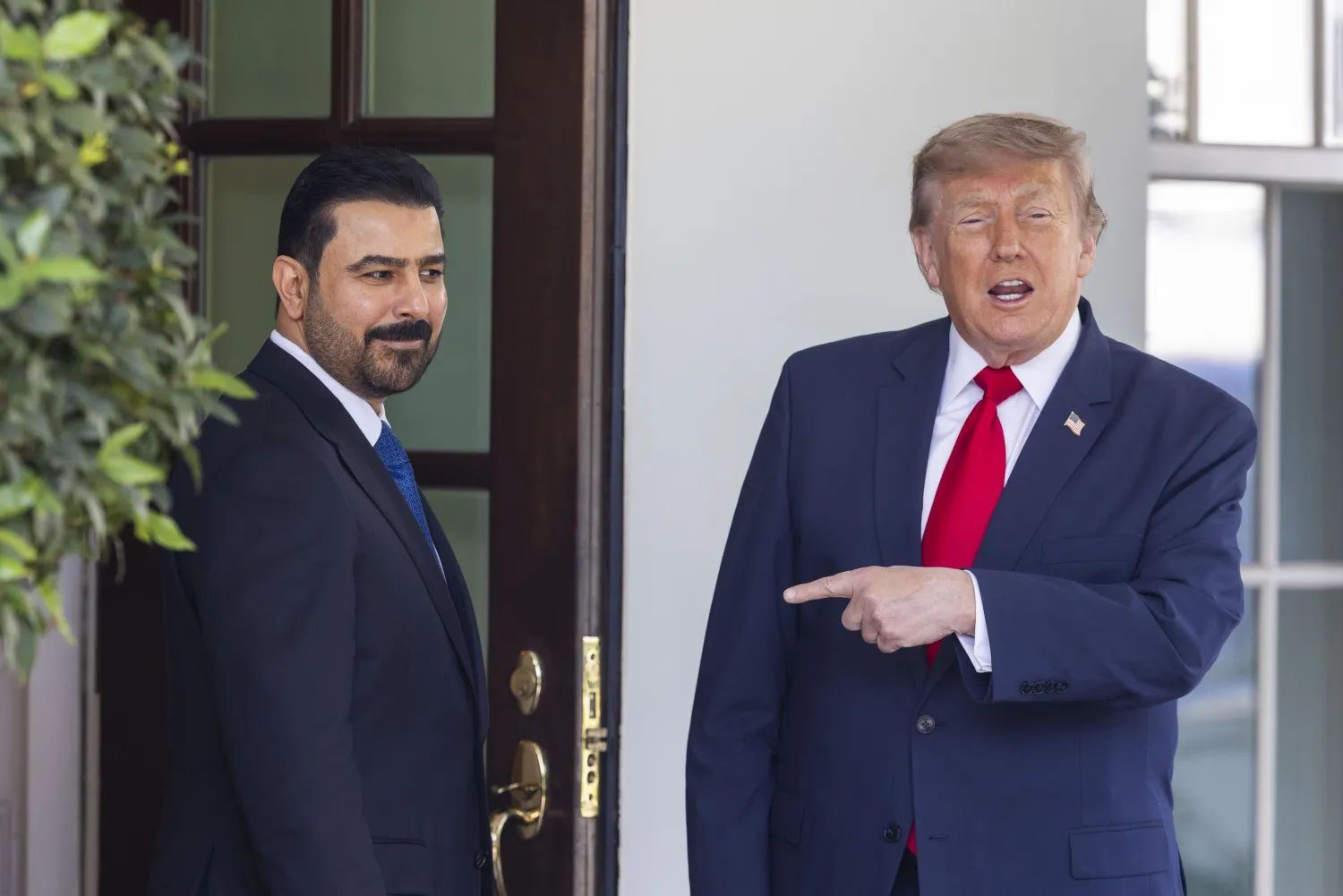
US President Donald Trump (R) greets Iraqi Prime Minister Ali al-Zaidi outside the West Wing of the White House in Washington, DC, USA, 14 July 2026. (EPA)
TT

Trump Rolls Out the White House Welcome Mat for New Iraqi PM

US President Donald Trump (R) greets Iraqi Prime Minister Ali al-Zaidi outside the West Wing of the White House in Washington, DC, USA, 14 July 2026. (EPA)

President Donald Trump welcomed Iraq's new prime minister to the White House on Tuesday after strongly backing the political neophyte in his bid for office. 

Ali al-Zaidi, a businessman with no political background, emerged as a consensus candidate in Iraq after months of deadlock over the premiership following last year’s parliamentary elections.  

When al-Zaidi was formally installed as prime minister-designate in April, Trump said in a social media post that it was the “beginning of a tremendous new chapter between our Nations — Prosperity, Stability, and Success like never seen before.” 

But Trump’s interest and involvement in the next leadership in Iraq began long before that statement. 

Iraq’s dominant parliamentary bloc, the Coordination Framework, a coalition of Shiite parties allied with Iran, initially said it would back former Prime Minister Nouri al-Maliki, whom the Trump administration views as too close to Tehran.  

The Republican president publicly announced his opposition to al-Maliki and threatened to cut off aid to Iraq if he was appointed, adding that “if we are not there to help, Iraq has ZERO chance of Success, Prosperity, or Freedom.” 

The issue of Iran is likely to loom large in the discussions Tuesday. 

Iraq has been under pressure to disarm a network of Iran-backed armed factions operating in the country, some of which launched attacks on US bases and diplomatic facilities after the US and Israel launched their war against Iran in February.  

Officially, the Iraqi government has given non-state armed groups until the end of September to disarm, but some of the most powerful factions have said they have no intention of doing so. 

A Trump administration official said ahead of the Oval Office meeting that the US will make “informed” decisions based on Iraq’s efforts to disarm Iranian-backed factions inside its borders. The official was granted anonymity to discuss the administration’s strategy ahead of al-Zaidi’s visit. 

Victoria Taylor, director of the Iraq Initiative at the Atlantic Council, noted that al-Zaidi has been likened to “Trump of the Middle East” considering his business background and lack of political experience. 

“When you value business success, I think then it’s very appealing to look at an Iraqi prime minister who is likely a billionaire and can be really pointed to as a political outsider,” she said. 

But Taylor added that “the reality is much more complicated,” noting that al-Zaidi was chosen by the current political infrastructure in Iraq and will be “beholden in some way to that system.” 

“I’m not always sure that there’s a full appreciation of the challenge that this prime minister will face in actually trying to really dismantle core parts of the political system,” she said, noting the obstacles that al-Zaidi will face as he tries to disarm the Iran-backed groups or challenge political corruption. 

Renad Mansour, director of the Iraq Initiative at the Chatham House think tank, said he expects that “the US will put significant pressure on al-Zaidi” to move ahead with disarmament during his Washington visit “and Zaidi will respond by saying, ‘But I need support — intelligence support, technical support, armed support.’” 

“There is a scenario in which, if the Iraqi government starts going after these groups, they will also go after the government,” Mansour said. “And this is a scenario that I think that the Iraqi government is apprehensive about.” 

The two governments are also poised to finalize a significant energy deal. 

Two Iraqi officials said an agreement is slated to be signed Friday between Iraq, US companies Chevron and TI Capital, and Qatar’s UCC for construction of an oil pipeline that will connect southern Iraq’s Basra to western Iraq's Haditha and from there to the Ceyhan port in Türkiye and the port of Baniyas on Syria’s coast. The pipeline is projected to carry about 2 million barrels of oil per day. The officials spoke on the condition of anonymity because they were not authorized to comment publicly. 

Al-Zaidi received Trump’s blessing, despite the fact that he was chairman of a bank, Al-Janoob Islamic Bank, that was among the financial institutions banned by Iraq’s central bank in 2024 from dealing in dollars amid pressure from the US to crack down on money laundering and funneling of funds to Iran. 

Since taking office, al-Zaidi has made a public show of cracking down on corruption. His government has conducted raids and arrested dozens of current and former lawmakers and government officials accused of corruption, including some affiliated with former Prime Minister Mohammed Shia al-Sudani. 

The Iraqi premier’s delegation to Washington includes a number of Iraqi businessmen and government officials, and al-Zaidi’s office said in a statement that the aim of the visit is to “strengthen economic and development partnerships, attract investment, and expand the role of US companies in implementing infrastructure projects” and to further develop the oil-rich country’s energy sector. 


Explosions at Aleppo Munitions Army Depot in Northern Syria Injures Four

Smoke billows following an Israeli airstrike on the outskirts of Damascus on December 8, 2024. (Photo by Omar HAJ KADOUR / AFP)
TT

Explosions at Aleppo Munitions Army Depot in Northern Syria Injures Four

Smoke billows following an Israeli airstrike on the outskirts of Damascus on December 8, 2024. (Photo by Omar HAJ KADOUR / AFP)

At least four people were injured following a series of explosions at an Aleppo army site in northern Syria early Monday, state media reported.

The cause of the explosions, which Syrian state media SANA said occurred at an "army site" in the vicinity of the town of Al-Eis, was not immediately known.

One civilian was injured by shrapnel as a result of the explosion at "an ammunition depot", SANA reported later, quoting the Ministry of Emergency and Disaster Management.

Two civilians suffered temporary "breathing difficulties", while another civilian was injured in a traffic accident while attempting to flee the blast area, it added.

Syria's civil defense teams transported the injured and evacuated three families from the blast site and remain on "high alert... due to the continued explosions", reported AFP.

Aleppo civil defense operations chief Faisal Mohammad Ali, quoted by the state-run Al-Ikhbariya channel, said earlier that the explosions had prevented emergency services from reaching the site swiftly.

A resident of Aleppo's Hamdaniyeh neighborhood told AFP they heard a "huge explosion" and when they went up to the roof could see "large flames in the distance".

Aleppo governor Azzam al-Gharib urged residents not to leave their homes for the time being, adding that "hospitals, ambulance and emergency teams are on full alert".

Roads leading to the site of the explosions were closed "to ensure the safety of civilians", Aleppo's Internal Security Command was quoted by SANA as saying.

Several such blasts have previously occurred in Syria, which is emerging from more than a decade of civil war following the toppling of longtime ruler Bashar al-Assad in late 2024.

An explosion of unknown origin killed 11 people at a military site in the eastern province of Deir Ezzor on Friday.

Earlier this month, an explosion at a weapons depot belonging to the Ministry of Defense killed 14 people and injured 11 in Syria's northwest Idlib province.

Five people were killed just over a week earlier in the same area when a vehicle carrying munitions exploded.


Sudan Gold Mine Collapse Kills 10, Injures 21

Workers break rocks at a gold mine near Abu Delelq in Gadarif State, Sudan. (Reuters)
TT

Sudan Gold Mine Collapse Kills 10, Injures 21

Workers break rocks at a gold mine near Abu Delelq in Gadarif State, Sudan. (Reuters)

A gold mine collapsed in northern Sudan killing at least 10 people and injuring 21 others, two survivors told AFP on Sunday after overnight rescue efforts.

Shafts of the Awny mining area near Sudan's border with Egypt collapsed on Saturday.

By Sunday morning "10 bodies had been recovered and 21 injured miners pulled out", said one of the survivors who was working at the mine when it collapsed, requesting anonymity for security reasons.

Another survivor, also requesting anonymity, told AFP the rescue operation was "being carried out by the miners themselves" with little equipment available.

More miners were feared dead under the rubble and survivors said the search for the missing was ongoing.

Many young Sudanese have joined a dangerous gold rush, working in unregulated mines with their hands and rudimentary tools for meagre daily wages.

They face chemical poisoning and regular mine collapses.

Last week at least 82 people were killed and dozens injured in a collapse in the southern Kordofan region.

Artisanal and small-scale mining, which takes place in unofficial zones or decommissioned mines, accounts for the majority of gold extracted in Sudan.

Even before the war pushed nearly 20 million Sudanese into severe hunger, artisanal mining employed more than two million people, according to industry figures.


CIA Chief Meets Egypt's Sisi in Cairo

FILED - 18 October 2023, Egypt, Cairo: President of Egypt Abdel Fattah El-Sisi is pictured in Cairo. Photo: Michael Kappeler/dpa Pool/dpa
TT

CIA Chief Meets Egypt's Sisi in Cairo

FILED - 18 October 2023, Egypt, Cairo: President of Egypt Abdel Fattah El-Sisi is pictured in Cairo. Photo: Michael Kappeler/dpa Pool/dpa

US Central Intelligence Agency Director John Ratcliffe met Egyptian President Abdel Fattah al-Sisi Sunday in a rare visit to Cairo, as the United States warned of rapid escalation in the Middle East war.

Sisi's office said the meeting, attended by Egypt's spy chief Hassan Rashad, discussed the wars in Iran, the Gaza Strip and Sudan, as well as attacks on Gulf countries and threats to maritime security.

Sisi stressed "the paramount importance of settling regional crises through political and diplomatic tracks," according to a presidency statement.

"This military conflict has the potential to escalate rapidly," it warned.

Sisi's office said Ratcliffe on Sunday "lauded Egypt's pivotal role in supporting efforts aimed at reaching peaceful, comprehensive settlements to regional crises".