

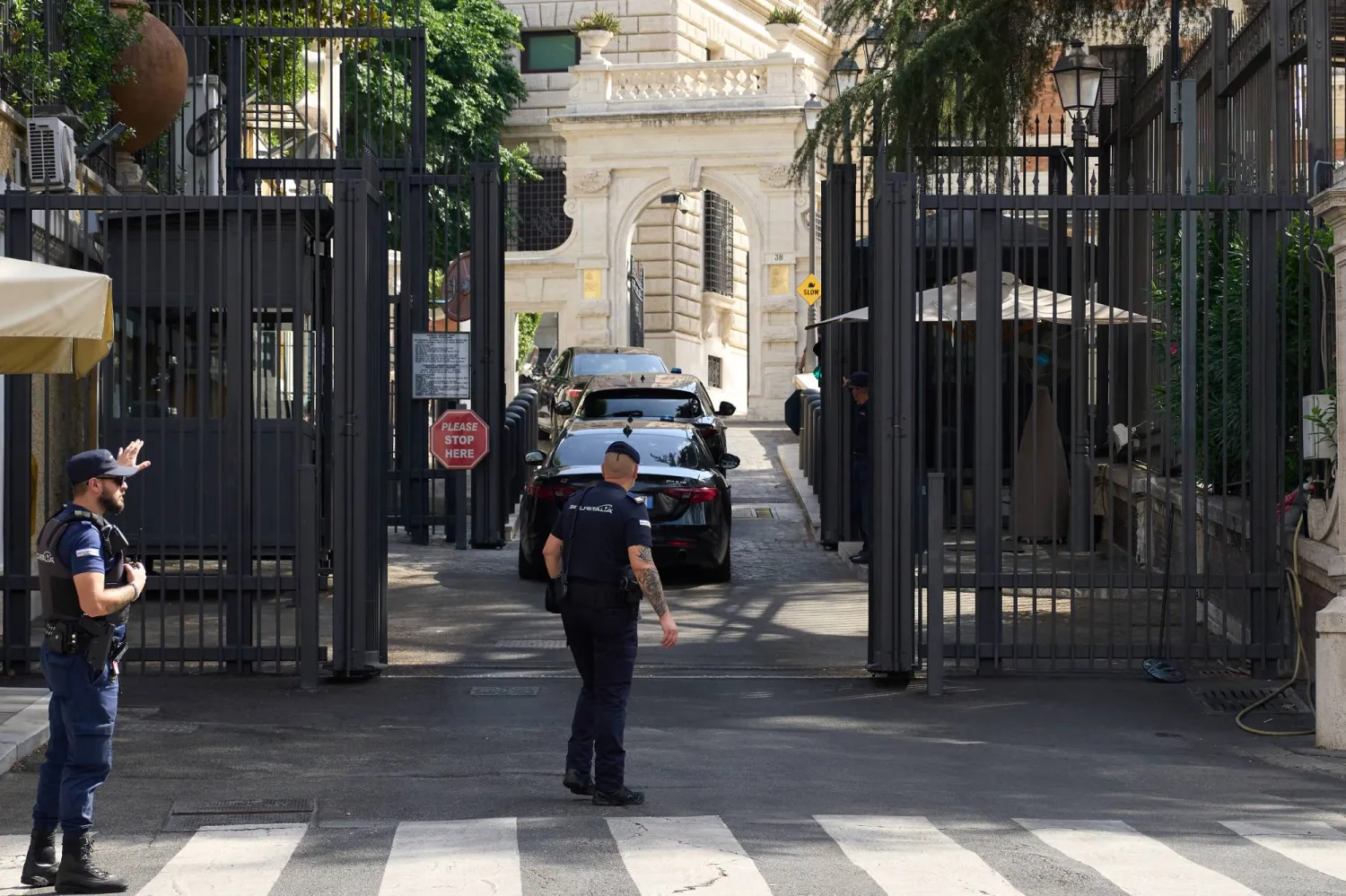

Lebanon, Israel Hold US-Brokered Talks in Rome to Implement Framework Deal

 A motorcade arrives at the United States' Embassy in Rome, Italy, where ambassadors-level talks between Israel and Lebanon are expected to take place, Tuesday, July 14, 2026. (AP)
A motorcade arrives at the United States' Embassy in Rome, Italy, where ambassadors-level talks between Israel and Lebanon are expected to take place, Tuesday, July 14, 2026. (AP)
TT

Lebanon, Israel Hold US-Brokered Talks in Rome to Implement Framework Deal

 A motorcade arrives at the United States' Embassy in Rome, Italy, where ambassadors-level talks between Israel and Lebanon are expected to take place, Tuesday, July 14, 2026. (AP)
A motorcade arrives at the United States' Embassy in Rome, Italy, where ambassadors-level talks between Israel and Lebanon are expected to take place, Tuesday, July 14, 2026. (AP)

Lebanon and Israel resumed talks on Tuesday in the Italian capital, with Beirut hoping for progress towards securing an Israeli withdrawal from south Lebanon under a US-brokered deal, although expectations for swift progress were low.

US-led diplomacy has emerged since Hezbollah and Israel returned to war on March 2 amid the wider regional conflict, moving forward despite strong objections from the Iran-backed group, which believes only Iranian pressure on Washington can secure an end to the war and Israeli withdrawal.

Iran demanded an end to the war in Lebanon as part of its interim deal with Washington signed last month, but the agreement has been shaken over the last week by renewed US-Iranian hostilities in the Gulf.

Israel's military is occupying what it describes as a "buffer zone" about 10 km (6 miles) into Lebanon along the entire length of the ‌Israeli border. Israeli ‌officials say the zone is necessary to protect northern Israeli communities from attacks launched ‌by ⁠Hezbollah.

A meeting in ⁠Washington on June 26 produced an agreement that called for an end to the Lebanon conflict, the disarmament of armed groups - an apparent reference to Hezbollah - as well as the deployment of Lebanese troops to the south and the progressive withdrawal of Israeli forces.

But deadly Israeli strikes have continued and Hezbollah has rejected the agreement as well as efforts to disarm it. Israel, meanwhile, has said its troops would remain in southern Lebanon as long as Hezbollah remained armed.

Lebanese and Israeli officials will meet at the US embassy in Rome on Tuesday and Wednesday to set out how to implement the framework deal, Lebanese officials ⁠told Reuters.

One of the officials said moving the talks to Rome would make ‌it easier for both countries' delegations to consult their governments for guidance as ‌they negotiated.

Italian Foreign Minister Antonio Tajani said on Monday that Italy had offered to host the talks to continue work towards ‌a genuine ceasefire in Lebanon.

"We are also very pleased that Rome can serve as the venue for these meetings. In ‌this way, our capital becomes a capital of peace," Tajani said ahead of a European Union meeting in Brussels on Monday.

PILOT ZONES ON THE TABLE

In comments published by his office on Monday, Lebanese President Joseph Aoun said he hoped the Rome meeting would yield "tangible and practical steps on the ground" to implement the agreement and that it would see Israel begin its troop pull-out so ‌that the Lebanese army could deploy to the south.

One of the Lebanese officials said the country's delegation to Tuesday's talks would seek the gradual and sequential withdrawal of ⁠Israeli troops "one zone after another," ⁠referring to the "pilot zone" project under which Hezbollah would disarm, Israeli forces would withdraw and Lebanese troops would deploy area by area in southern Lebanon.

The June 26 agreement said two zones had been identified as a starting point. A US official said last week that the US military's Central Command (CENTCOM) was coordinating with both Lebanon and Israel to launch the pilot zones.

A US military delegation was in Lebanon at the weekend to discuss the plan in detail with Lebanon's army, sources told Reuters.

Israel's military has forced the local Lebanese population from their homes and carried out controlled explosions of entire villages. It says it is destroying infrastructure, including underground tunnels, used by Hezbollah.

More than 4,000 Lebanese have been killed and more than a million displaced by Israel's campaign in Lebanon since March, according to Lebanon's health ministry. The toll does not say how many combatants may be among the dead and Hezbollah has not disclosed figures on its war dead. Reuters reported on May 3 that several thousand Hezbollah fighters had been killed.

At least 32 Israeli soldiers and four Israeli civilians have been killed by Hezbollah, most of them in southern Lebanon since the latest fighting erupted.



Netanyahu Orders Evacuation of Some West Bank Settler Outposts

FILE PHOTO: Israeli Prime Minister Benjamin Netanyahu, votes in Likud party primary elections ahead of Israel’s general election in October, in Jerusalem, Monday, August. 17, 2026.   Ohad Zwigenberg/Pool via REUTERS/File Photo
FILE PHOTO: Israeli Prime Minister Benjamin Netanyahu, votes in Likud party primary elections ahead of Israel’s general election in October, in Jerusalem, Monday, August. 17, 2026. Ohad Zwigenberg/Pool via REUTERS/File Photo
TT

Netanyahu Orders Evacuation of Some West Bank Settler Outposts

FILE PHOTO: Israeli Prime Minister Benjamin Netanyahu, votes in Likud party primary elections ahead of Israel’s general election in October, in Jerusalem, Monday, August. 17, 2026.   Ohad Zwigenberg/Pool via REUTERS/File Photo
FILE PHOTO: Israeli Prime Minister Benjamin Netanyahu, votes in Likud party primary elections ahead of Israel’s general election in October, in Jerusalem, Monday, August. 17, 2026. Ohad Zwigenberg/Pool via REUTERS/File Photo

Prime Minister Benjamin Netanyahu has ordered the evacuation of some West Bank settlements deemed illegal under Israeli law, Finance Minister Bezalel Smotrich said Sunday.

"To my knowledge, Netanyahu has given the instruction to evacuate" certain settlements, AFP quoted Smotrich as saying.

He added that he did not approve of the measure.

While all Israeli settlements in the West Bank are considered illegal under international law, some established without government approval -- often consisting of just a few prefabricated homes -- are also considered illegal by Israel.

It was not immediately clear when the operation would begin.

UN bodies and most governments deem all Israeli settlements illegal under international law ⁠and consider the West ⁠Bank to be occupied territory under military control. Israel argues the territory is disputed, not occupied.

US Ambassador to Israel Mike Huckabee on Saturday denounced violent settlers as terrorists and called for them to face severe consequences following a meeting with several Palestinian Americans in a West ⁠Bank Palestinian town.

Israeli website Ynet earlier reported the orders targeted around 100 outposts across the occupied territory.


Israeli Strike Kills Two People in Gaza

Palestinians inspect the site of an Israeli air strike on a vehicle, in Gaza City, September 6, 2026. REUTERS/Dawoud Abu Alkas
TT

Israeli Strike Kills Two People in Gaza

Palestinians inspect the site of an Israeli air strike on a vehicle, in Gaza City, September 6, 2026. REUTERS/Dawoud Abu Alkas

An Israeli strike killed at least two Palestinians, including a child, in the Gaza Strip on Sunday, health officials said.

Mohamed Abu Selmia, head of the enclave's largest Al Shifa Hospital, said the Israeli airstrike struck a vehicle in western Gaza City killing two people, including a girl, ⁠and wounding six others, Reuters reported.

An October 2025 US-backed ceasefire halted major fighting in the territory, but it failed to end ⁠strikes by the Israeli military, which it said aimed to thwart attacks by Hamas and other Gaza militants.

Hamas accuses Israel of violating the ceasefire and undermining efforts to implement US President Donald Trump's broader plan to end the Gaza conflict, which also includes Israeli withdrawals ⁠and ⁠Hamas disarmament.

More than 1,300 Palestinians, mostly civilians, have been killed in Gaza since the ceasefire took effect last October, according to the territory's health officials, while the Israeli military says four Israeli soldiers have been killed.


Iraq: Fuel Crisis Exacerbates the Country’s Problems, Citizens’ Burdens

A scene of congestion at a gas station in Baghdad (Iraqi News Agency)
TT

Iraq: Fuel Crisis Exacerbates the Country’s Problems, Citizens’ Burdens

A scene of congestion at a gas station in Baghdad (Iraqi News Agency)

Many Iraqi provinces, including the capital Baghdad, are facing a severe fuel shortage, forcing motorists in some cases to wait for hours to get gasoline. This is placing additional burdens on citizens who are already dealing with deteriorating public services, fewer hours of available electricity, and delays in the payment of pensions and salaries for public-sector employees.

Despite repeated government promises to overcome the fuel crisis, long lines of vehicles can frequently be seen at gas stations across Baghdad, Kirkuk, Babil, Basra, and most provinces of the Kurdistan Region. This is further deepening public distrust in government statements.

According to observers, the current fuel crisis "is one of the consequences of the war and the ongoing state of tension between Washington and Tehran, and its negative repercussions for Iraq since the war began on February 28."

At the same time, successive Iraqi governments face intense public criticism for failing to build enough oil refineries to meet domestic demand in a country that sits on vast oil reserves.

"Deliberate Manipulation"?

While many experts link the fuel crisis to the negative effects of the US-Iran war, particularly following the closure of the Strait of Hormuz and the disruption of most of Iraq's oil exports and foreign imports, sources close to Prime Minister Ali al-Zaidi's government do not rule out "deliberate manipulation" within the Oil Ministry that is worsening the crisis.

They link this alleged manipulation to groups that were recently affected by arrests targeting senior ministry officials on charges of stealing billions of dinars and dollars. Those arrested include former Deputy Oil Minister for Refining Affairs Adnan al-Jumaili, Deputy Oil Minister for Distribution Affairs Ali Maaraj al-Bahadli, Director General of the Oil Products Distribution Company Hussein Talib Abboud, and other figures.

In contrast, the Oil Ministry attributes the current fuel crisis to several factors, including increased demand and higher daily domestic gasoline consumption, technical failures that forced some production units at local refineries to shut down, and delays in the arrival of imported fuel shipments because of security tensions at ports and along regional transportation routes.

Despite the lines of cars at filling stations in more than one province, Oil Minister Basim Mohammed al-Abadi insists that petroleum products are available. During a meeting attended by senior ministry officials, he said that "the temporary shortage of gasoline is being addressed" and that additional gasoline shipments would arrive soon, helping to stabilize supplies and meet citizens' needs.

He added that "gasoline consumption averages around 33 million liters per day and rises to around 38 million liters when citizens become concerned."

He said his ministry "continues to closely monitor supply and distribution flows and is taking the necessary measures to secure petroleum products and strengthen stability in the domestic market."

Regarding the country's current oil exports following the near-total disruption caused by the US-Israeli-Iranian war, Minister al-Abadi said that "crude oil exports were around 250,000 barrels per day when the government took office, while current crude oil production has exceeded 3 million barrels per day."

In a subsequent statement, the Oil Ministry explained that "the congestion at fuel stations is caused by a negative gap between production and consumption." It said the ministry had relied on imported shipments delivered through maritime entry points to make up the shortfall, but regional events and the ongoing conflict have created logistical difficulties for tanker movements, delaying their arrival or docking at Iraqi ports.

No Plans to Export

The Iraqi Oil Ministry on Saturday denied reports circulated by some media outlets and news agencies that it planned to export gasoline, stressing that its immediate priority is to achieve self-sufficiency.

The ministry said in a statement that "the future shift toward exporting certain petroleum products depends on completing expansion work at other refineries," which it is pursuing as part of its strategic plans to transform Iraq from an importer into an exporter.

The statement noted that Iraq currently exports fuel oil and naphtha, in addition to previous shipments of jet fuel and sulfur.