


Israeli Strike on Funeral Kills 7 and Wounds 22 in Gaza, Local Hospital Sayshttps://english.aawsat.com/arab-world/5297157-israeli-strike-funeral-kills-7-and-wounds-22-gaza-local-hospital-says
Israeli Strike on Funeral Kills 7 and Wounds 22 in Gaza, Local Hospital Says
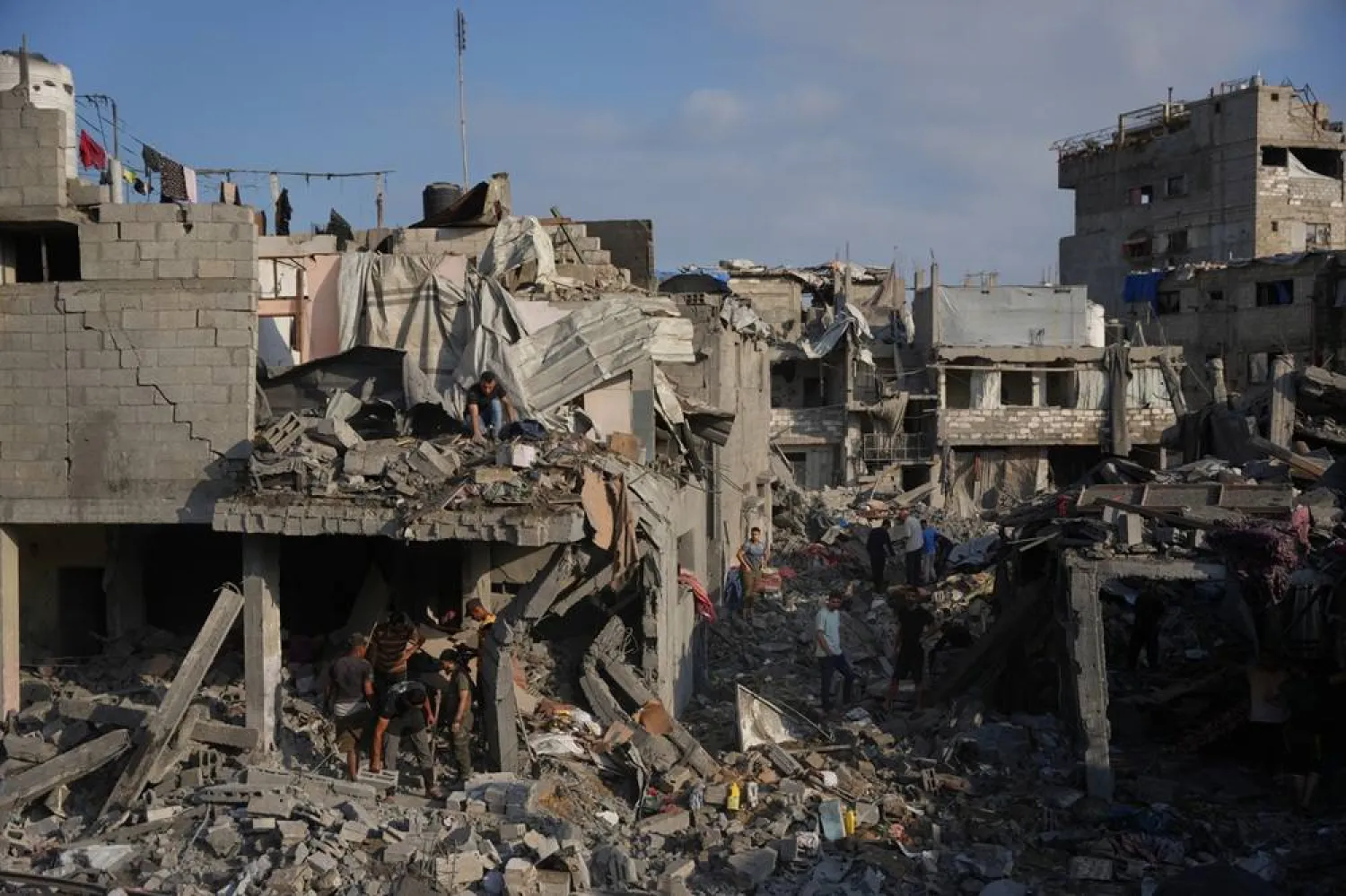
Palestinian residents save their belongings from destroyed buildings following an Israeli airstrike last night, at al-Bureij refugee camp, central Gaza Strip, Thursday, July 16, 2026. (AP)
TT
TT
Israeli Strike on Funeral Kills 7 and Wounds 22 in Gaza, Local Hospital Says
Palestinian residents save their belongings from destroyed buildings following an Israeli airstrike last night, at al-Bureij refugee camp, central Gaza Strip, Thursday, July 16, 2026. (AP)
An Israeli strike on a funeral in the Gaza Strip on Friday killed at least seven people and wounded another 22, according to a local hospital.
There was no immediate comment from the Israeli military.
The Awda Hospital in the Nuseirat refugee camp confirmed the number of casualties, saying people were struck at the funeral for a Palestinian killed in a strike earlier on Friday.
Israel and the Hamas group agreed to a ceasefire deal in October aimed at halting a two-year-long war.
The heaviest fighting has subsided but at least 1,123 people have been killed in Gaza since the ceasefire took effect, according to the territory’s Health Ministry.
The ministry, which has been part of the Hamas-led government, maintains detailed casualty records that are seen as generally reliable by UN agencies and independent experts. It does not give a breakdown of civilians and fighters but says women and children make up most of the dead.
Militants have carried out shooting attacks on troops, and Israel says its strikes are in response to that and other violations. Five Israeli soldiers have been killed since the ceasefire.
The war began after the Hamas-led attack on southern Israel on Oct. 7, 2023, killed around 1,200 people and saw 251 taken hostage. Israel’s retaliatory offensive in Gaza has killed more than 73,264 Palestinians, including those killed since the ceasefire, Gaza’s Health Ministry said.
Komala: A Frequent Target of Iranian Attacks in Iraqi Kurdistanhttps://english.aawsat.com/arab-world/5297175-komala-frequent-target-iranian-attacks-iraqi-kurdistan
Komala: A Frequent Target of Iranian Attacks in Iraqi Kurdistan
A drone is intercepted in the sky over Erbil, Iraq, July 15, 2026, in this screengrab obtained from a social media video. (Dlawer/X/via Reuters)
At least nine people were killed and others wounded on Friday in a missile and drone attack suspected of having been carried out by Iran against an Iranian Kurdish opposition group in the Iraqi Kurdistan Region, a group official said.
The attack targeted positions belonging to the Komala Party of Iranian Kurdistan in the Zargwezela area near Sulaymaniyah, the official said, requesting anonymity for security reasons.
The group said Iran was behind the strike, the official added. Tehran did not immediately claim responsibility.
Iran has previously attacked Iranian Kurdish opposition groups based in the Kurdistan Region.
Abdullah Azarbar, a member of the Politburo of the Komala Party, said the attack began at around 6 a.m. and involved eight large bunker-busting missiles.
Nine members of the group’s Peshmerga forces were killed and three others seriously wounded, he added. Three missiles struck the headquarters where the casualties occurred.
A security source had earlier said a party headquarters in the Surdas subdistrict of Sulaymaniyah province had been hit by missiles. Authorities opened an investigation to determine the circumstances of the attack and identify those responsible, the source said.
The Kurdistan Region Security Agency said seven missiles struck three areas in Sulaymaniyah province early on Friday.
Four landed in Zargwezela, one in Qasardi village and two near Tal Kobani in the Qaradagh area, the agency said. Its teams were still assessing casualties and material damage.
The Kurdistan Region Counter-Terrorism Service had earlier said coalition forces intercepted and destroyed eight explosive-laden drones over Erbil early on Friday. No casualties were reported.
Residents of Sulaymaniyah and Halabja provinces said they heard loud explosions in the early hours of the morning.
The Kurdistan Region Presidency condemned the missile and drone attacks on Sulaymaniyah and Erbil provinces, calling them a “dangerous development and a flagrant violation” of Iraqi sovereignty.
It warned that continued attacks could threaten Iraq’s stability and undermine efforts to strengthen security and peace in the region.
Komala repeatedly targeted
The Komala Party of Iranian Kurdistan is one of Iran’s oldest opposition groups. Founded in the late 1960s as a leftist Kurdish movement, it rose to prominence during the unrest that followed Iran’s 1979 revolution.
The group later entered into armed conflict with the new authorities over Kurdish autonomy and political freedoms.
After years of fighting inside Iran, Komala moved much of its operations and many of its bases to Iraq’s Kurdistan Region, where it established political and military headquarters and camps.
It has since faced repeated Iranian attacks, particularly by Iran’s Revolutionary Guards, which accuses Iranian Kurdish opposition parties of seeking to destabilize the country.
Komala combines political opposition to Tehran with advocacy for Kurdish rights in Iran. Tehran says such groups pose a security threat.
The 2022 “Woman, Life, Freedom” protests renewed attention on Iranian Kurdish opposition parties, although most remained based outside Iran.
Since the war between Iran and the United States began in February, no independent tally has established a final figure for the number of attacks on Komala bases.
Available reports, however, indicate that Iranian Kurdish opposition headquarters in Iraq’s Kurdistan Region were hit by a wave of missile and drone strikes during the conflict.
According to statements by the party and its allies, sites belonging to Iranian Kurdish opposition groups were repeatedly attacked, including bases linked to Komala and other parties in Erbil and Sulaymaniyah provinces.
The Coalition of Political Forces of Iranian Kurdistan also said missile strikes had targeted Peshmerga positions.
Human rights reports and Kurdish sources said bases belonging to Iranian Kurdish opposition parties, including Komala, were among the targets of dozens of missile and drone attacks during the war.
Delay of Lebanon-Israel Technical Meeting Stalls Implementation of Pilot Zones Planhttps://english.aawsat.com/arab-world/5297172-delay-lebanon-israel-technical-meeting-stalls-implementation-pilot-zones-plan
Delay of Lebanon-Israel Technical Meeting Stalls Implementation of Pilot Zones Plan
An Israeli flag hangs from a building in an area occupied by Israeli troops in southern Lebanon, Thursday, July 9, 2026. (AP)
The United States has postponed a virtual meeting between Lebanese, Israeli and US military delegations that had been expected on Friday to discuss the first phase of the “pilot zones” plan.
The delay puts the practical rollout of the framework agreement between Lebanon and Israel on hold, particularly the pilot zone arrangements, and renews questions over an implementation process that still has no clear timetable.
The technical meeting was agreed during the latest round of negotiations in Rome at the start of the week. It was intended to finalize the first phase mechanism: Israeli forces would withdraw from several pilot zones, allowing the Lebanese army to deploy there under the supervision of the monitoring committee. The plan would then expand in later stages.
Sources familiar with the negotiations told Asharq Al-Awsat that Washington requested the postponement, saying more time was needed to complete technical files, operational plans and implementation procedures.
No new date was set.
The sources said the meeting could instead take place during a visit by US Central Command chief Admiral Brad Cooper, who is due in Beirut on July 23. Cooper met President Joseph Aoun and Lebanese army commander General Rodolphe Haykal late last month.
Military sources, however, linked the delay to Israeli actions on the ground in Lebanon.
“Israel is continuing its systematic destruction of border villages in what appears to be an attempt to complete its objectives on the ground before committing to any implementation agreement,” the sources said.
They said Israel, which still refuses to withdraw from Lebanese territory, was trying to limit the pilot zone plan to locations it does not occupy. Washington, meanwhile, is pressing Israel to begin implementing the agreement by withdrawing from areas under its control.
The sources said the disagreement explained Israel’s attempts to buy time and delay the start of actual implementation.
The sixth round of direct Lebanese-Israeli negotiations, held in Rome under US sponsorship, ended with an agreement to finalize the pilot zone structure and begin implementation within days.
The plan forms part of the framework agreement aimed at consolidating the ceasefire and preparing for a gradual Israeli withdrawal in return for the deployment of the Lebanese army. But the agreement sets no binding deadline for a full Israeli withdrawal.
Israel says it will not leave the security zone it seeks to retain, stretching about 10 km from the border, until Hezbollah has been disarmed in those areas.
That condition is widely seen as highly difficult under Lebanon’s current circumstances.
Israeli soldiers walk at the entrance to Beaufort Castle in southern Lebanon, Thursday, July 9, 2026. (AP)
Violations and destruction continue
On the ground, Israeli violations continued across southern Lebanon as the Lebanese army expanded its deployment.
The army deployed in the town of Froun in the Bint Jbeil district and began intensive patrols. Froun is one of six villages being considered for the pilot phase.
Israeli forces continued demolishing homes, most recently in Bint Jbeil.
Israeli drones also struck Mayfadoun and Choukine, carried out three strikes on the Naqoura road and hit Mansouri. Another strike on Naqoura wounded a Syrian worker.
Israeli forces also carried out a large explosion on Friday morning in Hadatha, near the outskirts of Aita al-Jabal, and continued combing operations in several border areas.
Rescue teams recovered the bodies of victims of the strike on Mansouri late on Thursday.
Residents of Haris appealed to the Lebanese army to evacuate civilians trapped during an Israeli combing operation, the state-run National News Agency reported.
This handout photograph released by the Lebanese army press office on July 15, 2026 shows Lebanese army vehicles patrolling in southern Lebanon. (Lebanese Army Press Office / AFP)
Hezbollah steps up criticism, warns of internal instability
Hezbollah, meanwhile, continued to attack the framework agreement and the Lebanese authorities’ handling of the negotiations.
Hezbollah lawmaker Ali Fayyad said the Rome talks had exposed the weakness of Lebanon’s official position.
He accused the authorities of pursuing negotiations despite continuing Israeli military operations and following policies aimed at satisfying the United States and Israel.
Fayyad warned that the approach threatened domestic stability.
“These authorities are determined to take the country to an extremely dangerous place,” he said.
He said the process would neither restore Lebanese territory nor protect sovereignty, but would instead cost the country its internal stability and national unity.
Fayyad said the “resistance [Hezbollah] is ready for all possibilities and options” and remained committed to what he described as its principles of defending Lebanon, liberating occupied territory and securing the return of residents to their villages.
Houthis Link Educational Support to Loyalty and Affiliationhttps://english.aawsat.com/arab-world/5297113-houthis-link-educational-support-loyalty-and-affiliation
Houthis Link Educational Support to Loyalty and Affiliation
School supplies distributed to the children of Houthi fighters killed in combat, excluding other poor families, in Sanaa. (X)
The education system in areas under Houthi control is facing a fresh wave of criticism as the group launched the new academic year during the summer. The Houthis are accused of limiting the distribution of school supplies and cash assistance to their supporters and to the families of fighters killed or missing on the front lines, while also requiring private schools to grant tuition exemptions to the same groups.
The developments come as debate continues over the secondary school examination results announced by the Houthi authorities, with education experts questioning the unusually high pass rates and raising concerns about the impact of these policies on educational equity and the future of education in Yemen.
The controversy unfolds as millions of Yemeni families continue to face worsening economic conditions, leaving many unable to afford even the most basic educational expenses, including tuition fees, school bags, textbooks, and uniforms, amid declining purchasing power and widening poverty caused by the war and the economic crisis.
According to education sources, the Houthi-run so-called Zakat Authority oversaw the distribution of school bags and cash assistance through supervisors affiliated with the group. The sources said the mechanism prioritized the families of Houthi fighters and supporters, while excluding thousands of impoverished families unable to provide basic school supplies for their children.
The distribution process sparked widespread frustration among parents and education advocates, who argued that educational assistance should be allocated according to humanitarian need rather than political considerations or organizational affiliation.
Inequality
"Ibrahim," a parent in the Houthi-held Yemeni capital, Sanaa, told Asharq Al-Awsat that none of his three children received any educational support despite being registered on lists of families in need, while he witnessed school bags and uniforms being distributed to families linked to the group.
He said his family was living under severe financial hardship, yet their needs had been ignored. He argued that if charitable initiatives had supervised the distribution of the aid themselves, some of it would have reached his children.
Other parents in rural areas around Sanaa voiced similar complaints, saying the cost of preparing their children for the new school year had exceeded their financial means, while assistance remained limited to specific groups, deepening their sense of inequality.
Meanwhile, humanitarian sources said Houthi authorities responsible for aid operations and the Zakat Authority had recently confiscated quantities of school bags, notebooks, pens, uniforms, and cash that charitable initiatives had allocated to support poor students at the start of the academic year.
Education sources also said the Houthis had required private schools to waive tuition fees this year for the children of their supporters, as well as the families of fighters killed or captured on the front lines, without providing any compensation to the schools.
The principal of a private school on the outskirts of Sanaa, who requested anonymity, said the administration had no choice but to comply with the directives for fear of punitive measures. She noted that the exemptions did not extend to other students from the poorest families, despite their urgent need for assistance.
Education experts warned that imposing additional financial burdens on private schools without compensation threatens their financial stability and undermines their ability to continue providing educational services under the country's difficult economic conditions.
School supplies allocated by the Houthis for the children of their members. (Facebook)
Secondary School Results Raise Questions
Alongside the controversy over aid distribution, the secondary school examination results announced by the Houthi authorities have prompted widespread debate within education circles after reporting high pass rates and scores exceeding 99 percent for a number of students, despite years of decline in the education sector during the war.
The Education Ministry in the unrecognized Houthi administration announced an overall pass rate of 88.12 percent among more than 210,000 students who sat the examinations. Education specialists said the figure raises questions given the reality facing schools, which continue to suffer from teacher shortages, unpaid salaries, limited resources, and a decline in educational standards.
Education experts believe the conditions facing the education sector make it difficult to explain such a sharp increase in pass rates without releasing data detailing the grading and assessment process in a way that would strengthen confidence in the results and dispel the doubts surrounding them.
Several teachers also expressed surprise at the high scores, saying the level of academic achievement they observed throughout the school year did not correspond with the announced results, particularly in light of repeated student absences and disruptions to the education process.
Cheating Allegations
Yemeni education sources say the high pass rates recorded in Houthi-controlled areas do not reflect an improvement in educational standards. Instead, they attribute the results to widespread cases of organized cheating at some examination centers, along with the circulation of answer keys before and during the exams, which they consider a primary factor behind the higher scores.
Education activists also accused the Houthis of failing around 25,000 male secondary school students this year, claiming the move was part of a policy aimed at pressuring students and encouraging them to join the group's ranks in exchange for better chances of passing. The Houthi authorities have not commented on the allegations.
Several teachers said they had documented irregularities at some examination centers, including weak oversight and allowing certain students to receive assistance while taking the exams. They said such practices undermine the credibility of the examination process and compromise the fairness of student assessment.
In one case, a student from Sanaa said he was surprised to receive a score of 72 percent despite missing most of the school year because he had to work to help support his family. He said he attended only the final examinations, prompting him to question how the results had been calculated.
Meanwhile, a number of high-achieving students expressed dissatisfaction with the announced results, calling for greater transparency in grading procedures and the publication of detailed marks to safeguard students' rights and strengthen confidence in the secondary school certificate.
لم تشترك بعد
انشئ حساباً خاصاً بك لتحصل على أخبار مخصصة لك ولتتمتع بخاصية حفظ المقالات وتتلقى نشراتنا البريدية المتنوعة
