


Thousands of Settlers Perform Banned Religious Rituals Across Al-Aqsa

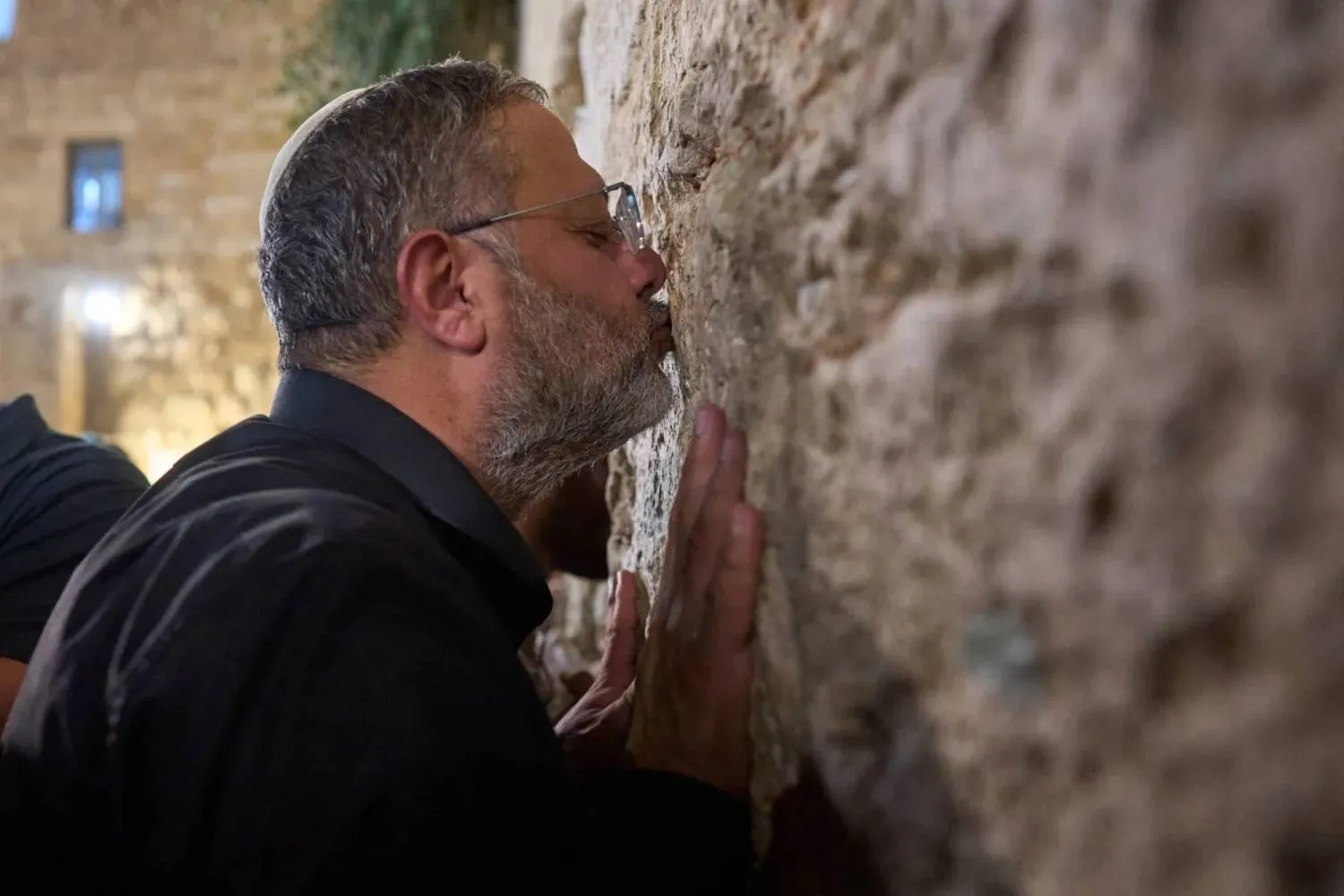
Israeli National Security Minister Itamar Ben-Gvir prays at the Western Wall in Jerusalem’s Old City on July 22, 2026 (AP). 
TT

Thousands of Settlers Perform Banned Religious Rituals Across Al-Aqsa

Israeli National Security Minister Itamar Ben-Gvir prays at the Western Wall in Jerusalem’s Old City on July 22, 2026 (AP). 

Thousands of Jewish settlers entered the courtyards of Al-Aqsa Mosque through the Moroccan Gate on Thursday and performed religious rituals throughout the compound, including in areas that had been barred to them and reserved exclusively for Muslims during Israel’s 59-year occupation.

Under heavy Israeli police protection and led by National Security Minister Itamar Ben-Gvir, they raised Israeli flags and sang Israel’s national anthem, near the main mosque and the Dome of the Rock.

The Islamic Waqf Department in occupied East Jerusalem said unprecedented numbers of settlers, estimated in the thousands, entered Al-Aqsa during the morning and midday. They conducted provocative tours, performed Talmudic rituals, prostrated themselves in prayer, sang, danced and waved Israeli flags, particularly in the compound’s eastern section.

The Waqf said Likud lawmaker Amit Halevi led groups of settlers during the incursions. Israeli police also increased the number permitted in each group to around 150, up from a previous limit of 30, in a move aimed at expanding the incursions.

Israeli forces imposed tight restrictions at Al-Aqsa’s gates and the entrances to Jerusalem’s Old City, turning the area into a military barracks and deploying officers inside the compound. They prevented some Muslim worshippers from entering, searched others, checked their identification and treated them violently.

The Palestinian Jerusalem Governorate described Ben-Gvir’s entry with his followers as a dangerous escalation and a violation of the site’s historical and legal status quo. It warned that the action was part of attempts to impose new realities inside the mosque and called for international intervention, stressing that the entire Al-Aqsa compound is exclusively a Muslim place of worship.

It said only a limited number of Muslim worshippers were able to perform dawn prayers before Israeli forces beat several of them.

The Palestinian Ministry of Religious Endowments also condemned the incursion, warning that the escalation of visits and rituals was intended to impose a temporal and spatial division of the compound.

So-called Temple groups had intensified mobilization ahead of the anniversary of the temples’ destruction, seeking a new record of more than 5,000 settlers in one day, compared with around 4,000 incursions recorded last year.

The groups circulated schedules and routes and urged supporters to participate, renewing calls to build the purported temple in place of Al-Aqsa Mosque. Although the occasion is traditionally a day of mourning, organizers acted with arrogance and violence by denying Palestinian and Muslim rights.

Palestinian groups called on worshippers to gather and maintain a presence at Al-Aqsa. The mosque’s preacher, Sheikh Ekrima Sabri, warned that Israeli authorities were exploiting Jewish religious occasions to expand incursions and alter the status quo under political cover from ministers and Knesset members.

Israel had previously permitted Jews to visit Al-Aqsa in limited numbers without provocation, prayer or visible religious signs. Some Jewish religious circles opposed the visits, regarding them as an affront to Jews and Judaism. Religious Zionists led by Ben-Gvir, however, consider entering Al-Aqsa an inherent religious right and commonly pray for the rebuilding of the Jewish temple they claim once stood where the Dome of the Rock now stands.


Iraq’s Governing Coalition Sidesteps Arms Issue, Warns of Fallout from Iran Sanctions

The State Administration Coalition meets on Saturday. (INA)
TT

Iraq’s Governing Coalition Sidesteps Arms Issue, Warns of Fallout from Iran Sanctions

The State Administration Coalition meets on Saturday. (INA)

Iraq’s State Administration Coalition, which brings together Shiite, Sunni and Kurdish forces, sidestepped the issue of bringing weapons under state control while warning of the potential repercussions for Iraq from US sanctions on Iran.

The State Administration Coalition, the political umbrella formed in 2022, met late Saturday at the request of Prime Minister Ali al-Zaidi.

It called for filling vacant cabinet positions and advancing the oil and gas bill, while stressing the need to shield Iraq from the effects of US sanctions on “some countries,” an apparent reference to Iran, amid difficult financial conditions.

The statement said the country was going through circumstances that “cannot tolerate risk.”

The government remains incomplete, with nine ministerial posts still vacant, notably the defense and interior portfolios, because of disputes within the Sunni and Shiite camps.

The coalition said gatherers agreed to begin talks next week with the blocs entitled to the remaining portfolios, while maintaining coordination among coalition members and supporting state institutions in confronting current challenges.

They also discussed the draft oil and gas law ahead of its referral to parliament, as well as support for the private sector as a partner in development.

Al-Zaidi under pressure

Observers in Baghdad noted that while al-Zaidi is working to implement a government program endorsed by the coalition, political forces now appear chiefly concerned with completing the cabinet without giving sufficient attention to bringing weapons under state control or combating financial and administrative corruption.

An informed source told Asharq Al-Awsat that the omission of the weapons issue reflected the depth of political divisions within the State Administration Coalition, particularly among forces in the Shiite Coordination Framework, which holds a majority in parliament and within the coalition itself.

The source, who is close to Sunni political forces, said Kurdish and Sunni parties support measures taken by al-Zaidi, but their positions run up against the Shiite majority whenever issues are put to a vote inside the coalition.

It added that Coordination Framework forces publicly support the prime minister but are divided over several issues concerning the Shiite bloc itself, including bringing weapons under state control, deputy prime minister posts and the leadership of the Popular Mobilization Forces.

Fayyad dispute

While some Kurdish and Sunni forces have settled on their ministerial nominees through consensus, majority votes or political trade-offs, the main disputes among Shiite factions center on two issues.

The first is the position of Popular Mobilization Forces chief Faleh al-Fayyad, who is also a leading member of the Coordination Framework.

The second concerns deputy prime minister posts, with Asaib Ahl al-Haq, led by Qais al-Khazali, insisting on obtaining the Shiite share of the position.

The group argues that it has the right to the post because it is the second-largest Shiite parliamentary bloc after former Prime Minister Mohammed Shia al-Sudani’s Reconstruction and Development Coalition and Nouri al-Maliki’s State of Law Coalition.

Asaib Ahl al-Haq now openly opposes al-Fayyad remaining as PMF chief. Disputes within the Shiite camp have shifted to whether he should retire because of his age or be compensated with another position. Meanwhile, the PMF leadership would go to another figure, from Asaib Ahl al-Haq or elsewhere, provided that person is not from al-Maliki’s State of Law Coalition, which supports al-Fayyad remaining in the post.


Israeli ‘Gray Line’ Plan Would See Withdrawal from Most Occupied Lebanese Territory

An excavator digs as rescuers search for survivors amidst the rubble following an overnight Israeli airstrike on the village of Kfar Rumman in southern Lebanon on September 7, 2026. (AFP)
TT

Israeli ‘Gray Line’ Plan Would See Withdrawal from Most Occupied Lebanese Territory

An excavator digs as rescuers search for survivors amidst the rubble following an overnight Israeli airstrike on the village of Kfar Rumman in southern Lebanon on September 7, 2026. (AFP)

An Israeli plan has emerged for a withdrawal from most occupied Lebanese territory, with troops remaining two to four kilometers inside Lebanon along what has been dubbed the “gray line,” replacing the currently occupied “yellow line.”

The plan comes after the Israeli military announced it had established operational control over the Ali al-Taher ridge in South Lebanon and begun destroying an underground tunnel complex built by Hezbollah.

Israeli officials are now speaking of “sensitive days” ahead on the northern front that could send the region down one of two sharply different paths: Hezbollah, and possibly Iran, could retaliate and reignite the war, or they could absorb the blow, allowing the Israeli military to withdraw from the ridge and the “yellow line” and establish a new security belt along the “gray line.”

Under that scenario, Israel would retain control of Lebanese territory extending two to four kilometers from the international border.

Israeli military sources cited by public broadcaster Kan 11 said that after establishing “operational control” and clearing tunnels and other underground infrastructure on the Ali al-Taher ridge, the military was preparing to reduce and redeploy its forces, pulling back to a new “security belt” closer to the Israeli-Lebanese border.

‘Gray line’

According to Kan 11, Israeli security officials have held discussions in recent days on establishing a new security zone closer to the border from which the military would protect Israeli border communities.

Under the proposal, Israeli forces would withdraw from the current “yellow line,” which encompasses a broader security zone and in some areas extends north of the Litani River, including Beaufort Castle and the Ali al-Taher ridge. Troops would instead deploy closer to the border.

Israeli military positions would remain inside Lebanese territory and could serve as staging points for operations deeper into Lebanon if Hezbollah activity were detected.

The military is expected to ask the Israeli government to capitalize on the new situation by reaching a political agreement with Beirut that would establish understandings on Hezbollah’s disarmament.

Hezbollah Secretary-General Naim Qassem has said the group would hand its weapons only to the Lebanese state as part of practical steps demonstrating an Israeli withdrawal from Lebanese territory, insisting there could be no disarmament without a withdrawal.

Israel is setting specific conditions, including that the Lebanese Army take control of evacuated areas and commit to preventing Hezbollah from returning to its positions in the south. Israel also wants an agreed mechanism allowing it to monitor the process and intervene militarily to prevent Hezbollah’s return if the Lebanese Army fails to do so.

Kan 11 reported that the plan remains incomplete and has not yet been approved by Israel’s political leadership. Questions remain, particularly over transferring control to the Lebanese Army and negotiations between the two countries, but the plan envisages a substantial reduction in Israeli forces inside Lebanon.


Yemen Army Pursues Houthis Southeast of Hodeidah

Houthi drones downed by government forces. (Saba)
TT

Yemen Army Pursues Houthis Southeast of Hodeidah

Houthi drones downed by government forces. (Saba)

The escalation by the Houthi group on Yemen’s west coast and Taiz entered its fourth day on Sunday, as government forces shifted from containing the attack to pursuing the group’s operatives in southeastern Hodeidah, following the complete liberation of the Hays district.

Meanwhile, battles continued in western Taiz and amid attempts to reclaim positions where the Houthis have made advances.

Field sources said the Yemeni armed forces have captured dozens of Houthis during the fighting. Many are underage. The forces also continued to advance north of Hays towards the al-Garrahi district.

The military is also assessing its positions on the fronts in western Taiz, especially al-Kadha where the Houthi advance is threatening to cut the main supply route between Taiz and al-Mokha cities.

On Saturday, government and joint forces announced the complete liberation of the Hays district. The achievement follows the reclamation of rural areas that had remained under Houthi control for years, despite the initial liberation of the district's center back in 2018. The complete liberation of Hays followed a counteroffensive launched by government forces.

Al-Garrahi

The government advance on al-Garrahi is significant because capturing the district will pave the way for the forces to move on Houthi-held Hodeidah and cut the route connecting the province with Ibb and the Tihamah regions.

The Houthis have been regrouping to counter the government advance from Hays towards southeastern Hodeidah, said the field sources.

In western Taiz, fighting continued on the Jabal Habashi front, particularly in the al-Kadha area where the Houthis managed to achieve a field breakthrough during the offensive, a development that now threatens the main road connecting Taiz city and the coastal city of Mokha.

Government forces are working to reassess the situation in preparation of pursuing the Houthis and reclaiming the positions they captured, while also stabilizing defensive lines and preventing the group from expanding the scope of its advance.

The forces had made advances in the Haifan front in southeastern Taiz on Saturday. The area overlooks Houthi supply routes leading to northwestern Lahj and southern Taiz.

On Sunday, the Houthi fired three ballistic missiles on civilian facilities. No casualties were reported, said local sources.

The militants also continued their sniper attacks in residential areas in western Taiz, wounding a woman and three children in the al-Kadha and Rahba areas.
