


Peace Now Accuses Israeli Government of Weakening PA, Undermining Oslo Accords

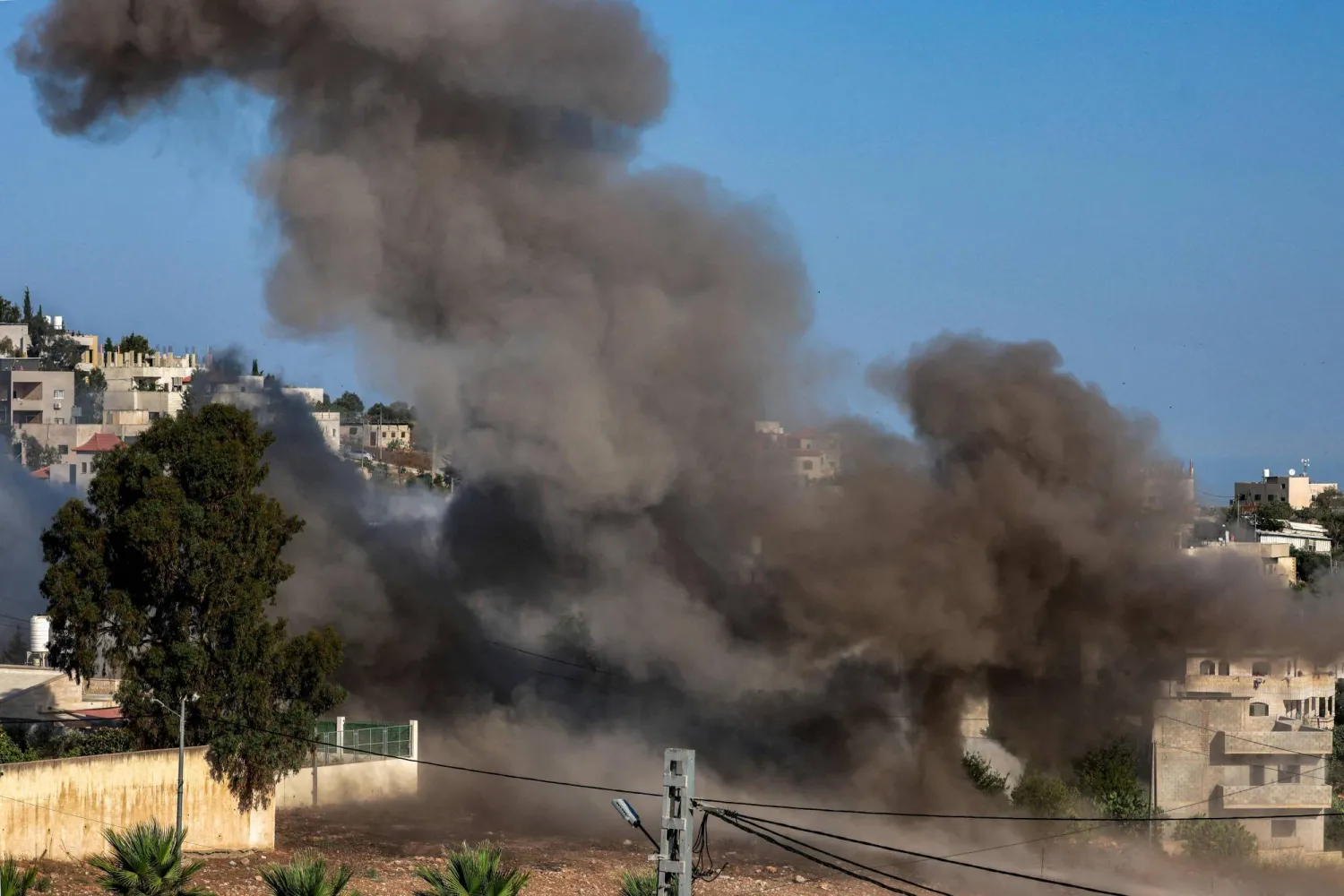
Smoke rises during an Israeli controlled-demolition from the home of Palestinian Farouk Ramadan, who was involved and killed in clashes with Israeli settlers on July 24, killing two, in the Palestinian village of Tell in the occupied West Bank on August 11, 2026. (AFP)
TT

Peace Now Accuses Israeli Government of Weakening PA, Undermining Oslo Accords

Smoke rises during an Israeli controlled-demolition from the home of Palestinian Farouk Ramadan, who was involved and killed in clashes with Israeli settlers on July 24, killing two, in the Palestinian village of Tell in the occupied West Bank on August 11, 2026. (AFP)

The Israeli advocacy group, Peace Now, warned that the policy being implemented by the Israeli government in the West Bank weakens the Palestinian Authority and strains the 33-year-old Oslo framework through settlement expansion and shifted administrative powers.

In a report obtained by Ynet on Tuesday, Peace Now accused Israeli Prime Minister Benjamin Netanyahu’s government of carrying out an organized and consistent campaign to weaken the Palestinian Authority economically, politically, territorially and in terms of security.

It said the Israeli government violated the agreements signed in Oslo by expanding settlements and transferring authority in Areas A and B of the West Bank to the Civil Administration.

The movement then warned that these practices represent an Israeli undeclared annexation of the territories.

“Netanyahu’s government is playing with fire, disregarding its international commitments and endangering Israel’s security - all in order to take control of more territory and land in the West Bank,” Peace Now said.

It added that “the government’s actions in Areas A and B are not isolated incidents but part of an organized policy whose ultimate goal is to collapse the Palestinian Authority and create chaos that would allow it to expand settlements into cities and villages deep inside the West Bank.”

The Oslo Accords split the West Bank into three temporary zones: Area A (about 18% under Palestinian control), Area B (about 22% under joint control), and Area C (about 60% under full Israeli control). The five-year interim plan never shifted to a permanent treaty.

Since the Second Intifada, the Israeli military has routinely conducted operations, raids, and incursions into Area A, fundamentally altering the implementation of the original agreement.

Peace Now said the Israeli military further violated the agreement last year when it used land-requisition orders inside Area A for explicitly civilian settlement purpose, rather than for military purposes.

Also, Peace Now’s report said one of the main tools used to pressure the PA is the withholding of tax revenues collected by Israel on its behalf under the 1994 Paris Protocol.

The revenues amount to about 11 billion shekels (around $3.66 billion) a year and have historically accounted for more than 60% of the Palestinian Authority’s budget, according to Ynet.

Peace Now said only about half of the funds owed to the Palestinian Authority were transferred under the current government between 2022 and 2025. Since June 2025, not a single shekel has been transferred, according to the report.

It also noted the security cabinet measures introduced in February and which authorized the Civil Administration to enforce regulations and oversee environmental protection, water and archaeology in Areas A and B of the West Bank.

The Israeli government claimed the move was aimed at preventing environmental hazards and damage to heritage sites, it said.

Peace Now noted that the environmental and archaeological measures use definitions broad enough to enable Israeli civilian authorities to intervene in Palestinian construction across much of the West Bank.

It then cited Israeli military orders issued in July to requisition Palestinian land inside Area A for a road connecting two settlements.

The movement said it was the first time since the Oslo Accords were signed that military land-requisition orders had been used inside Area A for an explicitly civilian settlement purpose, rather than for military purposes.

Peace Now said it had also documented at least 23 settlement outposts established in Areas B over the past two and a half years.

But even when the military occasionally removes the outposts, they are rebuilt and expanded, including with permanent structures, it said.

The movement noted that the outposts have been accompanied by the construction of roads, the takeover of water sources and the displacement of Palestinian residents.

Settlers have also taken over abandoned Palestinian homes in Areas B and C after residents were forced to leave following repeated settler attacks.

The report mentions a June decision by the Civil Administration, which moved to strip the Palestinian municipality of Hebron of broad planning and construction powers relating to settlements and several holy sites in the heart of the city.

Peace Now stressed that the government has not formally announced the cancellation of the Oslo Accords, nor has it introduced legislation to annex the West Bank or dismantle the Palestinian Authority.

The group argued that the measures combined amount in practice to a process of undeclared annexation.

Israeli Finance Minister Bezalel Smotrich said the report was a “certificate of achievement for the Israeli government.”

He said, “What they call ‘the erosion of Oslo’ we call correcting an injustice resulting from 30 years of neglect,” according to Ynet.

“What they call ‘de facto annexation’ we call establishing Israel’s security belt,” the minister added. “I am proud of the settlement revolution I have led to prevent the establishment of a Palestinian terrorist state in the heart of the country. This is only the beginning.”
UN Identifies 214 Firms Linked to Israeli Settlements

Palestinians protest against Israeli settlements near Nablus in the occupied West Bank (Reuters)
TT

UN Identifies 214 Firms Linked to Israeli Settlements

Palestinians protest against Israeli settlements near Nablus in the occupied West Bank (Reuters)

The United Nations on Friday released a fresh update of its database of companies with activities in Israeli settlements in Palestinian territories, listing 214 firms from 11 countries.

Since last year's update, the UN rights office added an additional 61 companies to the database and had removed five companies.

But major firms like Airbnb, Booking.com, Motorola Solutions and TripAdviser remained on the list.

The report, which was harshly criticized by Israel, served as a "reminder to companies that they have human rights responsibilities", UN rights chief Volker Turk said in a statement.

Firms, he said, "are expected to conduct due diligence to ensure that they do not become involved in human rights violations or abuses".

While most of the companies were based in Israel, others were based in Canada, China, France, Germany, Luxembourg, the Netherlands, Portugal, Spain, Britain and the United States.

There were two Spanish companies removed from the database since last year, along with one each from Canada, Israel and Portugal.

The list was first produced in 2020 after a UN Human Rights Council resolution called for a database of firms that profited from business in illegally occupied Palestinian territory.

The UN rights office was asked to list companies found to be taking part in any of 10 activities, including construction, surveillance, demolitions and destruction of agricultural land in Israeli settlements in the West Bank, including East Jerusalem.

Despite a requirement for the database to be updated annually, it has been revised just twice before, in 2023 and 2025.

The list is not exhaustive.

It only reviews companies about which it received submissions during set timeframes, the last of which closed in June 2024.

In all, it has received submissions about 596 companies, of which it has so far reviewed 381.

Israel, which has been harshly critical of the database from the start, slammed it again Friday as "a distorted mechanism... established solely to persecute the Jewish state".

The country's mission to the UN in Geneva charged that it was "a political tool" used by the rights office "to advance a smear campaign against business enterprises that committed no wrongdoing".

Israel has controlled the West Bank since 1967 in an occupation considered illegal under international law.


Lebanon PM Stresses Need to 'Avert Vacuum' if UN Force Leaves

16 February 2026, Lebanon, Beirut: Lebanese Prime Minister Nawaf Salam is pictured during a meeting at the Prime Minister's office. (dpa)
TT

Lebanon PM Stresses Need to 'Avert Vacuum' if UN Force Leaves

16 February 2026, Lebanon, Beirut: Lebanese Prime Minister Nawaf Salam is pictured during a meeting at the Prime Minister's office. (dpa)

Lebanon's Prime Minister Nawaf Salam insisted at the UN Friday on the need to "avert the vacuum" that would be caused by withdrawing the UN peacekeeping mission deployed in the south of his country without a viable replacement.

"What we wish to stress here and today is the need to avert the vacuum that UNIFIL's withdrawal could create, were it to take place without agreement on a new international force to replace it," he said.


South Lebanon Children Return to School Destroyed by Israel Strike

Displaced children play during an activity organized by the NGO Save the Children at a school turned into a shelter for displaced families in Tyre, southern Lebanon, August 27, 2026. (Reuters)
TT

South Lebanon Children Return to School Destroyed by Israel Strike

Displaced children play during an activity organized by the NGO Save the Children at a school turned into a shelter for displaced families in Tyre, southern Lebanon, August 27, 2026. (Reuters)

In southern Lebanon, eight-year-old Yara Ajami started the academic year this week in a doorless, windowless classroom after her school was destroyed by an Israeli strike.

Well known in the area for its excellence, Ajami's elementary school in Burj Qalaway was struck by Israel in May.

"We are happy to be back (to school), but we were happier before. We used to draw, play, but now there are no desks or chairs," the young girl with braided hair said as she climbed a bare concrete staircase.

Rather than go to their old school building, Ajami and the other students returning to classes after the summer break on Monday were diverted to a nearby structure still under construction that was being built to house preschoolers.

The sun shone through unglazed windows into unfinished classrooms as children followed their lessons, while outside clumps of twisted rebar jutted from the ground like dead bushes where walls used to stand.

The students come from areas heavily hit by Israeli attacks and most were displaced during the war, with some -- like Ajami -- returning to find their homes damaged or destroyed.

- 'Sadness in their eyes' -

"There is sadness in their eyes, each one of them has a story," school principal May Mehdi told AFP from the courtyard.

"But I am happy they are here," she said, showing on her phone what the school, her pride, once looked like.

Mehdi does not have an office in the current building, which does not even have a teacher's lounge.

Around 250 students are registered in the 24-classroom school, which used to have at least 600 school-goers before the start of the latest war in March, when Hezbollah attacked Israel in support of Tehran, following US-Israeli attacks on Iran.

Israel responded with major airstrikes and a ground invasion that killed more than 4,300 people, including 261 children according to Lebanese authorities.

More than a million people were displaced, but more than 800,000 returned since June, when a US-Iran memorandum of understanding and a Lebanon-Israel framework agreement significantly reduced the violence.

In some schools in the south that have been converted into shelters, displaced people and students now share the space, with floors reserved for each group.

The Israeli army has repeatedly accused Hezbollah of using civilian buildings, including schools, to launch attacks or hide weapons.

Rights groups, however, have accused Israel of possible war crimes in its war with Hezbollah.

Lebanese authorities accuse Israel of systematically destroying villages in the south, including homes, schools, places of worship and water and electricity infrastructure.

- 'Destruction, insecurity, displacement' -

Many of Burj Qalaway's children were unable to start the school year, being still displaced or fearing to return to the town, less than a kilometre (mile) away from Israeli troops occupying a swathe of the south.

On Thursday, an Israeli strike hit Qantara, a nearby village.

Earlier this month, UNICEF said that nearly 100,000 students in Lebanon were unable to return to their schools for the academic year due to "damage, destruction, insecurity, or displacement".

The UNICEF report also stated that 436 schools were damaged by the war, while 37 were completely destroyed.

The Burj Qalaway school previously boasted a laboratory, a computer room, and an interactive room.

Government-funded prefabricated units are being installed on the school premises where rubble has not yet been cleared.

- 'Make my father proud' -

Teacher Hoda Najdi gave her class while emphasizing to her students the importance of continuing their education and achieving good results despite the difficult circumstances.

"My home was destroyed and so was my school... (but) the students give us the strength and will to continue," the 42-year-old told AFP.

Student Mohammed Mozannar, who was displaced from one place to another in Beirut during the war, said he was "very happy to be back to make up for" the lost year.

"I had no books, no phone and no internet" to follow lessons online, he said.

"I now want to make my father proud."

But the return to school also brought back painful memories for some, like 14-year-old Rawan Fakih.

"I remembered the activities we used to do, I remembered how stressful exams were... and I remembered my friend who was killed" by an Israeli strike, she said.
