Lebanon: Israeli Airstrikes, Demolitions Hit Southern Villages
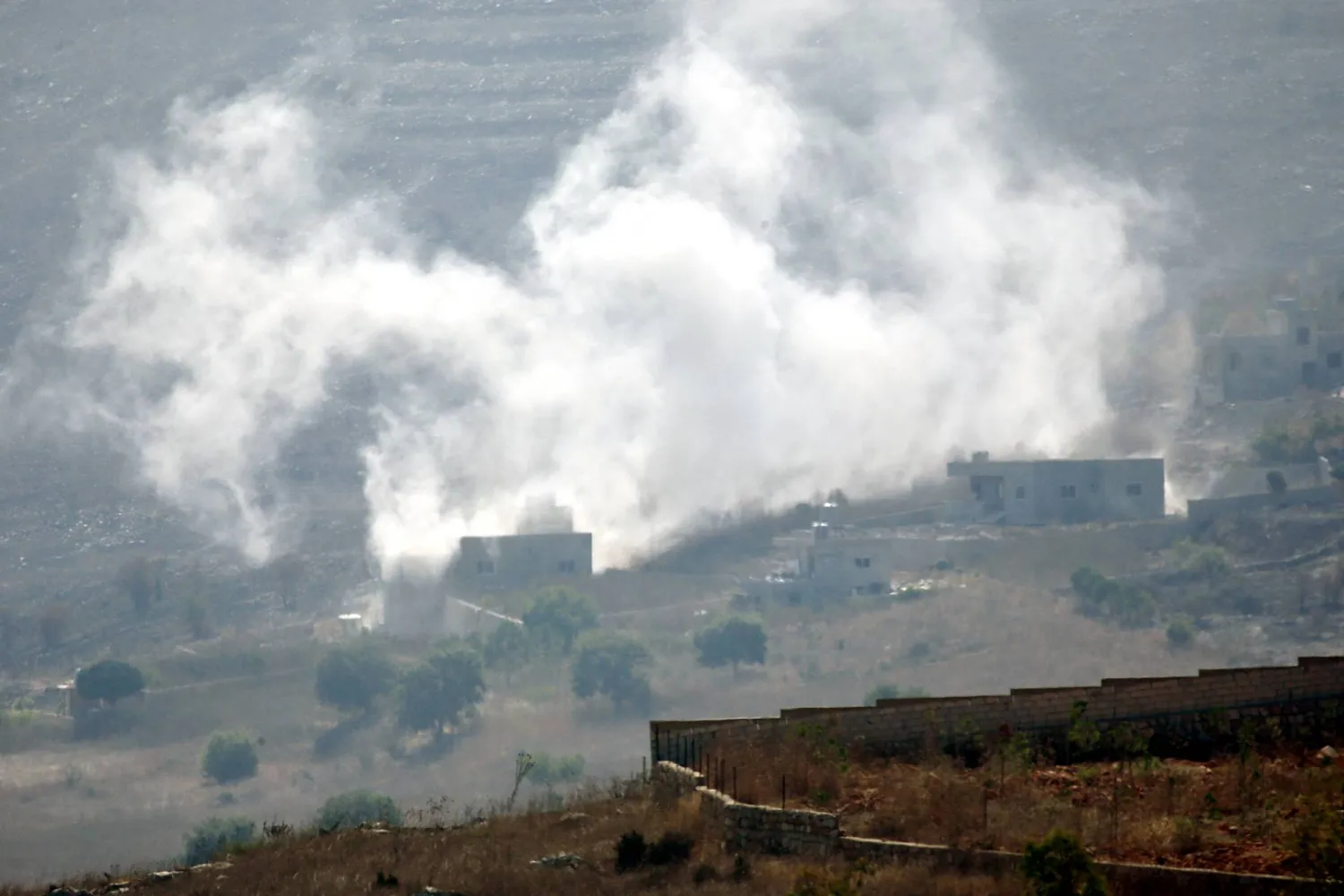
Smoke rises after Israeli tanks shelled targets in the municipality of Mais al-Jabal, as seen from Chaqra village, in southern Lebanon, 21 August 2026. EPA/STRINGER
Lebanon: Israeli Airstrikes, Demolitions Hit Southern Villages
Smoke rises after Israeli tanks shelled targets in the municipality of Mais al-Jabal, as seen from Chaqra village, in southern Lebanon, 21 August 2026. EPA/STRINGER
Israeli warplanes carried out a series of strikes on Saturday near the area of Kfar Rumman in southern Lebanon and also struck the vicinity of Ali al-Taher hills.
At dawn, Israeli shelling targeted the town of Mansouri, the outskirts of Buyut al-Siyad and the outskirts of Majdal Zoun in southern Lebanon.
Overnight, Israeli forces carried out extensive demolitions in the villages and towns of Mansouri, Majdal Zoun and Buyut al-Siyad. Reports said not a single house remained undamaged.
Similar Israeli demolitions were reported in Hadatha, Beit Yahoun and Aita al-Jabal, along with machine-gun fire directed toward nearby valleys. Israeli drones also continued to fly over villages and towns in the western and central sectors.
Khaddam: Despite My Warning, Hariri Stayed in Lebanon for Electoral Reasons, He Was Killed 6 Days Laterhttps://english.aawsat.com/arab-world/5309807-khaddam-despite-my-warning-hariri-stayed-lebanon-electoral-reasons-he-was-killed
Khaddam: Despite My Warning, Hariri Stayed in Lebanon for Electoral Reasons, He Was Killed 6 Days Later
Abdul Halim Khaddam and Rafik al-Hariri meet in June 2001. (AFP)
Former Syrian Vice President Abdul Halim Khaddam reveals new details in his memoirs about a February 2005 meeting with late Lebanese former Prime Minister Rafik al-Hariri at his Beirut residence six days before his assassination.
The memoirs, edited and introduced by Ibrahim Hamidi, are due to be published in early September by Raff Publishing, a subsidiary of the Saudi Research and Media Group (SRMG).
Khaddam recalled that he and Hariri met over a lunch, where the Syrian official, concerned over the former PM’s life, urged him to leave Lebanon “immediately.”
They met on February 8, 2005. Hariri was killed six days later.
The memoirs are due to be published in early September by Raff Publishing, a subsidiary of the Saudi Research and Media Group (SRMG).
In January 2005, during a Baath party meeting at the Syrian presidential palace, then President Bashar al-Assad told the command members: "There is an American-French conspiracy against Syria, and Rafik al-Hariri is involved in it."
Khaddam said that he and the other members were surprised by this dangerous talk, and that two days later, he sent a verbal message to Hariri through former Lebanese Defense Minister Mohsen Dalloul, warning him that dangers were growing and he must leave Lebanon immediately.
On February 8, 2005, Khaddam traveled to Beirut for a medical appointment and accepted a lunch invitation from Hariri. The former PM was anxious and inquired about the message conveyed by Dalloul. Khaddam explained the situation and advised him to leave Lebanon immediately.
Hariri responded, "I have elections... how can I leave the people?"
Khaddam replied: "Your life is more important than the people, and your family is more important than the elections."
Khaddam and other officials take part in Hariri’s funeral on February 6, 2005. (AFP)
The memoirs note two striking details from that lunch. The first was Hariri’s inquiry about the role of Maher al-Assad, Bashar’s brother. He revealed that Aouni Al-Kaaki, owner of Al-Sharq newspaper had informed him that Maher was keen on forming ties with him – Hariri - and was ready to resolve the existing disputes between him and Bashar because he is viewed as "a loyal friend to Syria."
Khaddam replied: "You must be careful and leave Lebanon."
The second detail was Hariri’s revelation about his security detail: "I used to have 50 security personnel, but they withdrew them and left only six."
Six days later, on February 14, while Khaddam was attending a Baath meeting in Damascus, he saw the breaking news flash on a television in a colleague's office about a massive explosion in Beirut. It was subsequently reported that the explosion had targeted Hariri's convoy, killing him along with his security guards and several citizens.
Khaddam with Jumblatt at the Beirut hospital where Hamadeh was being treated after the attempt on his life in October 2004. (AFP)
Khaddam recounted that he informed the presidency of his intention to travel to Beirut to offer his condolences. The reply, which came through the president's chief of staff, said "If you wish to go, go in your personal capacity."
He did indeed attend with his wife and two sons, while the Syrian regime decided to boycott the funeral and the wake.
Syrian official newspapers carried the headline "Massive Explosion in Beirut" without Hariri's name appearing on their front pages, merely noting in the report that he was "among" the casualties - a detail Khaddam said further directed the accusation toward Bashar al-Assad.
The memoirs also shed light on an incident that preceded the lunch by four months: the assassination attempt on Lebanese Minister Marwan Hamadeh, an ally of then Progressive Socialist Party leader Walid Jumblatt, in October 2004, which Khaddam described as "a warning to all opponents of President (Emile) Lahoud in Lebanon."
He recounted that the following day, he called Rustom Ghazaleh, the head of Syrian military intelligence in Lebanon, to inform him that he was heading to Beirut to visit Hamadeh. He was received by Jumblatt at the Beirut hospital, along with his party leaders, and Jebran Tueni, while the injured minister was in the operating room.
Khaddam and then Syrian President Bashar al-Assad (C) during a meeting in June 2005. (AFP)
Khaddam noted that his direct contact with the president had effectively ceased since late October 2004, with communications subsequently taking place through his chief of staff or through written letters.
The strength of this testimony lies in its place within a sequence of publicly documented events: the extension of Lahoud’s presidential term on September 3, 2004, the adoption of UN Security Council Resolution 1559 a day earlier, the assassination attempt on Hamadeh, followed by the political and media campaign against Hariri, and ultimately, his assassination.
The memoirs do not render a judgment; rather, they add an insider perspective, completing a full countdown: an accusation within the command, a warning message, a final lunch, and then the February 14 explosion.
The details of the final lunch and the messages that preceded it appear in full in the chapter titled "The Assassination of Rafik Hariri" in Khaddam’s book.
At Least 13 Tunisians Missing after Migrant Boat Sinks off Tunisiahttps://english.aawsat.com/arab-world/5309785-least-13-tunisians-missing-after-migrant-boat-sinks-tunisia
At Least 13 Tunisians Missing after Migrant Boat Sinks off Tunisia
Migrants on a boat waiting for assistance from a rescue vessel in the Mediterranean Sea, July 24, 2025 (Reuters)
At least 13 Tunisians are missing after a migrant boat sank off the Tunisian coast while sailing towards Italy, and two people were rescued, the head of a migrant rights group said on Saturday.
The boat set off early on Thursday, Mostafa Abdelkebir, the head of the Tunisian Observatory for Human Rights, told Reuters.
One of the two survivors told rescuers in a local boat they had been stranded at sea for hours after their vessel capsized. The second survivor was in critical condition, said Abdelkebir, whose group monitors migration issues.
Tunisia was once a major departure point for migrants crossing the Mediterranean, but departures have fallen sharply over the past two years amid a crackdown and tighter maritime controls, backed by European funding and modern border-monitoring equipment, particularly from Italy.
Human Rights Watch, Amnesty International and dozens of other human rights and humanitarian groups said in a statement last month that the EU-Tunisia migration deal had fueled and normalized serious abuses against migrants and asylum seekers in Tunisia.
The groups called on the EU to suspend funding for migration and border-control activities involving Tunisian security forces.
Tunisia has not commented on the statement but has repeatedly said it is bearing the brunt of a major migration influx. President Kais Saied said in 2023 that the influx was aimed at changing the country's demographic makeup.
The central Mediterranean route is one of the world's deadliest migration routes, used by migrants from Africa and the Middle East seeking to reach Europe, often in overcrowded or unseaworthy boats.
Salam Inspects Military Units South of Litani: No Capable Lebanese State without One Strong Armyhttps://english.aawsat.com/arab-world/5309783-salam-inspects-military-units-south-litani-no-capable-lebanese-state-without-one
Salam Inspects Military Units South of Litani: No Capable Lebanese State without One Strong Army
Lebanese Prime Minister Nawaf Salam during his visit to South Lebanon on Friday. (NNA)
Prime Minister Nawaf Salam tied the restoration of state authority in South Lebanon to a broader process extending beyond military deployment to strengthening institutions, restoring services and advancing reconstruction.
During a visit to the Benoit Barakat Barracks in Tyre, Salam stressed that “every position where the army deploys in the South is a place where the state regains its authority.”
“Restoring sovereignty requires building a capable state, and there can be no capable state without one strong army,” he added, arguing that sovereignty restored through security must also be consolidated economically and socially.
One authority
“We want the South, like all of Lebanon, to be under one authority, and Lebanese citizens there to feel safe because they have an army protecting them,” the PM declared, linking lasting stability to the state and its constitutional institutions regaining control over decisions of war and peace.
At the same time, he acknowledged the challenges confronting the military amid continuing Israeli attacks. “True sovereignty is neither taken nor given; it is built,” he emphasized.
Salam reaffirmed his government’s commitment to building a national state faithful to the constitution, describing efforts to strengthen the army as “a strategic choice at the heart of our project to restore the state,” rather than a secondary priority.
The government continues to mobilize Arab and international support to develop the army’s personnel capabilities, improve its equipment and enhance service members’ living conditions, he went on to say.
He described the military as one of the few institutions around which Lebanese citizens remain united.
Addressing troops, Salam urged them to shield the army from political and sectarian divisions.
“Preserve the unity of the army. Do not allow politics to divide you and accept only the constitution and the law as your guide,” he told them, warning against allowing “the evils of sectarianism” to infiltrate their ranks.
Lebanon could emerge from its current predicament only by having “one army, one flag and one state,” he maintained.
Salam also paid tribute to fallen service members, telling their families: “Your sons are not only martyrs of the military institution; they are martyrs of the entire nation.”
Beyond army deployment
“The return of the state to the South is not limited to the deployment of the army, but extends across all sectors, including education, reconstruction and everything else,” he added, reiterating the government’s commitment to providing the military with everything needed to carry out its mission successfully.
He pledged that the state would spare no effort to secure Israel’s complete withdrawal from Lebanese territory, recover prisoners and advance reconstruction.
Defense Minister Michel Menassa similarly framed Salam’s visit as an affirmation of state sovereignty.
“Our visit to the South is not merely an inspection tour. We are here today to reaffirm our unwavering position seeking to restore state sovereignty,” he vowed.
He identified the government’s primary negotiating objective as “the complete withdrawal of the Israeli enemy from Lebanon.”
Menassa praised the army as a symbol of “dignity, sacrifice and loyalty” that brings Lebanese citizens together and safeguards national unity and civil peace.
He also commended its professionalism in carrying out missions despite difficult conditions and pressure.
لم تشترك بعد
انشئ حساباً خاصاً بك لتحصل على أخبار مخصصة لك ولتتمتع بخاصية حفظ المقالات وتتلقى نشراتنا البريدية المتنوعة