


Israel Seeks New Rules of Engagement with Hezbollah Over Ali al-Taher

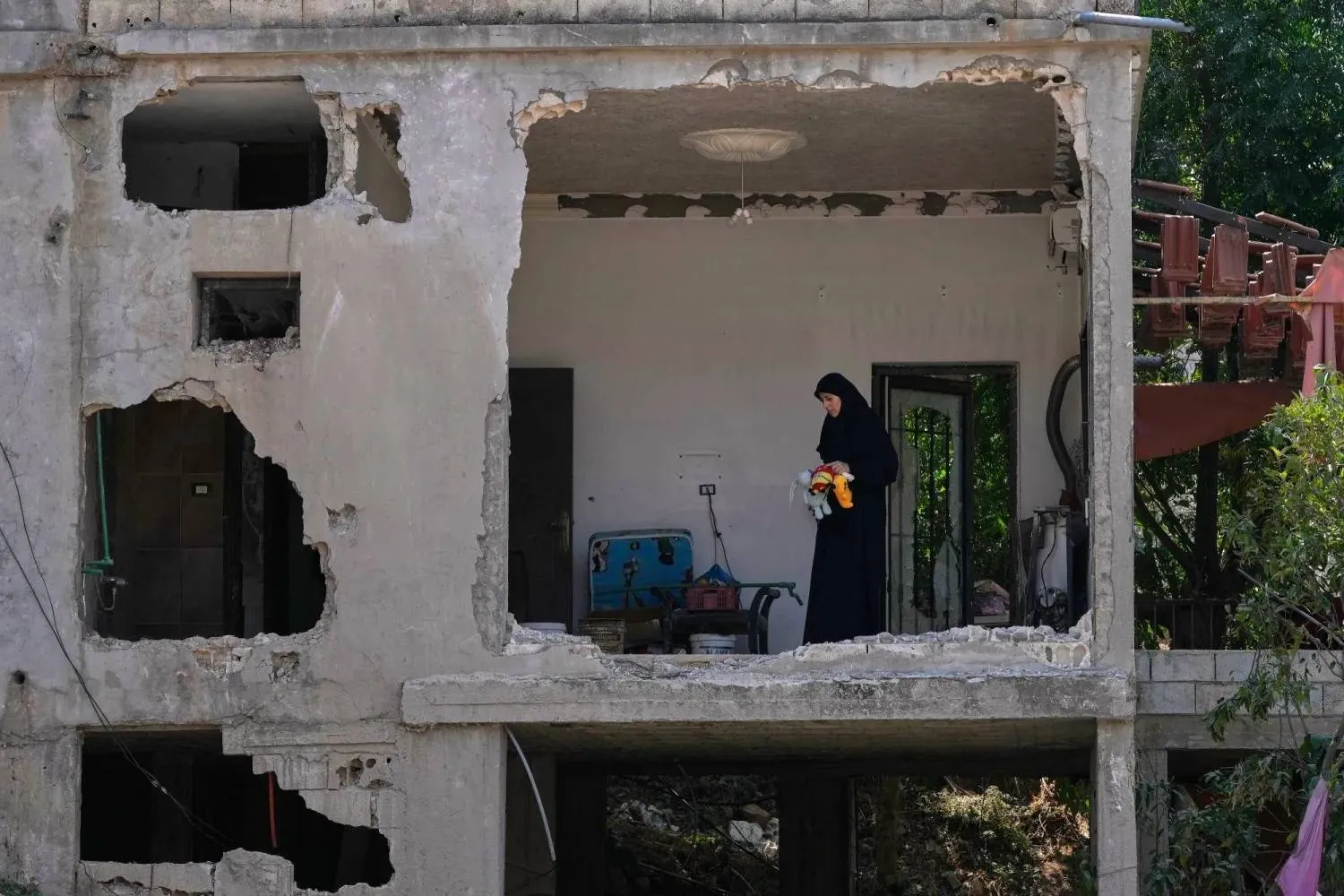
A Lebanese woman inspects damage caused by Israeli airstrikes on the southern Lebanese town of Arabsalim (AP)
TT

Israel Seeks New Rules of Engagement with Hezbollah Over Ali al-Taher

A Lebanese woman inspects damage caused by Israeli airstrikes on the southern Lebanese town of Arabsalim (AP)

Israel’s escalation in southern Lebanon on Thursday appeared aimed at establishing new rules of engagement with Hezbollah, under which it would launch airstrikes deeper into Lebanese territory if the group sought to prevent Israeli forces from advancing toward the strategic Ali al-Taher Heights.

This has unfolded alongside Iranian rules of engagement centered on threats of military intervention if Beirut or its southern suburbs are targeted.

A Lebanese woman was killed on Thursday in an Israeli strike on the southern Lebanese town of Arabsalim. The Israeli military said the strike was in response to Hezbollah launching two drones toward its forces in Ali al-Taher.

The strikes on the town marked a notable escalation after nearly two weeks in which detonations and airstrikes had remained confined to towns inside the Yellow Line and its surroundings, extending into Lebanese territory.

Rules of engagement with Hezbollah

Security sources in southern Lebanon viewed the latest escalation as an Israeli attempt to establish rules of engagement with Hezbollah by expanding the scope of strikes deeper into the south whenever Hezbollah fighters confront Israeli military attempts to seize the strategic heights.

The escalation has recurred whenever the Israeli military announces that its forces in the area have come under attack, the sources told Asharq Al-Awsat.

That was the case in mid-August, when the Israeli air force carried out deadly strikes on the towns of Ansar and Deir al-Zahrani in response to what it said was the wounding of three of its soldiers in Ali al-Taher.

Hezbollah has not claimed responsibility for any military operation against Israeli forces in the area, in line with a decision to maintain secrecy, according to sources familiar with the group’s political and media operations.

Israeli statements, however, point to Hezbollah military activity in the strategic heights whenever Israeli military vehicles attempt to advance there. Israeli media have reported that five explosive-laden drones have targeted Israeli troops in the area since the beginning of August.

Gradual encroachment

Israel insists on seizing the strategic heights east of the city of Nabatieh. Its efforts, however, have met with Hezbollah’s refusal to evacuate the area and hand over its facilities to the Lebanese army, in addition to Iranian threats to intervene militarily if Israel launches a large-scale operation.

Lebanese sources said the United States had curbed Israel’s push to seize the area through a major military operation, prompting Tel Aviv to pursue control through gradual encroachment.

Over the past two weeks, the Israeli military has stepped up operations aimed at “isolating” the Ali al-Taher Heights from their surroundings. It has repeatedly struck buildings within a three-kilometer radius, carrying out airstrikes on Nabatieh al-Fawqa, Dawhat Kfar Rumman and neighboring areas. The attacks destroyed dozens of homes, villas and other buildings in the area.

Detonations and incursions

The military activity has coincided with detonations and incursions deeper into Lebanese territory. The Israeli military carried out demolition operations in the towns of Haddatha, Talloussa and Mansouri, while Israeli forces advanced from Haddatha into Aita al-Jabal and set fire to areas on the town’s outskirts.

Israeli artillery also shelled Houla and Wadi al-Slouqi alongside machine-gun fire.

Lebanese officials have condemned the continued Israeli strikes on the south despite the two countries signing a US-sponsored framework agreement in June and engaging in direct negotiations. Hezbollah categorically rejects the talks and has also refused to surrender its weapons.

The Israeli military said on Friday that troops from the Golani Brigade combat team “continue to operate in the security zone in southern Lebanon to eliminate threats.”

“Over recent weeks, the troops have destroyed more than 400 terrorist infrastructure sites and located numerous weapons, including anti-tank missiles, anti-aircraft missiles, explosive devices, firearms and mortar shells,” it said in a statement.

Iranian rules of engagement

Since the ceasefire, Israeli military operations have been confined to southern Lebanon, while Iranian officials have threatened intervention if Beirut or its southern suburbs are targeted.

The latest remarks came from Major General Mohsen Rezaei, secretary of Iran’s Supreme National Security Council, in a television interview broadcast on Thursday night by Hezbollah-affiliated Al-Manar television.

Rezaei said Israel was “no longer capable of attacking Beirut’s southern suburbs or Beirut,” attributing this to “the losses Hezbollah inflicted on Israel over the past three or four months” and to Iran’s threat, which he said had been fully effective.

He said Beirut and its southern suburbs constituted a “red line for Iran,” adding that Tehran was “monitoring developments with the utmost seriousness” and that “Israel will find itself compelled to withdraw from the Lebanese territory it entered.”

Rezaei said Iran “does not interfere in the details of Hezbollah’s military structure or its field decisions,” adding that the group “now has military personnel capable of managing its affairs and making its own decisions, particularly with the rise of two new generations of young commanders.”


Tunisian Journalists Fear Jail Again as Freedoms Erode

Tunisian journalists participate in a rally called by the Tunisian journalists' union to demand the release of journalist Mohamed Yousfi, a vocal critic of President Kais Saied, in Tunis, Tunisia. September 8, 2026. REUTERS/ Jihed Abidellaoui
TT

Tunisian Journalists Fear Jail Again as Freedoms Erode

Tunisian journalists participate in a rally called by the Tunisian journalists' union to demand the release of journalist Mohamed Yousfi, a vocal critic of President Kais Saied, in Tunis, Tunisia. September 8, 2026. REUTERS/ Jihed Abidellaoui

In the garden of the independent outlet ‘Nawaat,’ about half a dozen journalists sit smoking, trading jokes and discussing investigations they plan to publish on subjects ranging from the quality of drinking water to conditions of prisons.

They know that any of the stories ⁠could lead to prosecution.

A Hard Test

Journalists in Tunisia who enjoyed a burst of press freedom after the 2011 Arab Spring are once again looking over their shoulders in the knowledge their work may land them in prison.

The 2011 overthrow of Zine El-Abidine Ben Ali unshackled Tunisia's media, but a decade later President Kais Saied's seizure of sweeping powers began eroding those gains.

Some 20 journalists face criminal charges over their reporting or social media posts, with four already imprisoned, according to Zied Dabbar, head of the National Syndicate of Tunisian Journalists, who called the situation unprecedented.

In return, Saied has said he is not a dictator and that journalists are free to criticize authorities and frequently do.

Authorities say prosecutions are impartial judicial matters and that no one is above the law.
The Tunisian prime minister's press office did not respond to Reuters’ requests for comment.

Now, independent media face a full-on crackdown, rights groups say, and Tunisia has tumbled more than 50 places in the past five years to 137th in Reporters Without Borders' press freedom index.

Shifting Minefield

“We are living in a grey area, as if we were in a shifting minefield, and we pay the price every day,” said Aymen Rezgui, editor-in-chief of Nawaat, reflecting on how at least limits were clear pre-2011 versus current uncertainty.

Rezgui said Nawaat regularly receives threats — anonymously or from government supporters on social media branding him a traitor — over reporting on issues ranging from prisons to power cuts and water shortages.

The outlet has also faced judicial restrictions, including a government order suspending activities for a month last year.

Journalists in Jail, Others Choose Exile

Many other journalists report similar pressures.

Last month, Mohamed Yousfi, editor-in-chief of independent news website Al-Qatiba, was arrested on his way to a private radio station for a live program. A judge has charged him with illicit enrichment, which he says is a fabrication.

Other jailed journalists and media figures include prominent broadcasters Mourad Zeghidi and Borhen Bsaies, who were first convicted of spreading false news and insulting the president, and later of tax evasion. ⁠They deny the charges and say they have been framed.

For some, leaving Tunisia has become the only option to avoid a similar fate, despite the personal cost.

In December 2025, Khaoula Boukrim, founder of independent website Tumedia and a prominent critic of the president, left for France fearing imminent arrest.

Months later, she was sentenced in absentia to four years in prison over writings critical of the judiciary and a system of governance she described as authoritarian.

Journalist Haythem Mekki has also left Tunisia after receiving a prison sentence following public comments he made denouncing conditions in a hospital morgue.

Beyond prosecutions, journalists are frequently prevented by police from working in public and are sometimes detained for hours, the journalists' syndicate says.

Most ministries no longer have press offices, while several international correspondents have been denied accreditation, further restricting independent coverage.

Political and critical programs have disappeared from many private radio stations. State media has ⁠increasingly marginalized dissenting voices, the syndicate says, though the TAP state news agency remains a rare exception, continuing to cover protests, opposition activities and civil society initiatives.


Israeli Threat to Expand Lebanon’s Occupation, Displace More Than a Million Lebanese

File photo of Israeli Defense Minister Israel Katz in the Tulkarm refugee camp in the northern West Bank (Israeli Army)
TT

Israeli Threat to Expand Lebanon’s Occupation, Displace More Than a Million Lebanese

File photo of Israeli Defense Minister Israel Katz in the Tulkarm refugee camp in the northern West Bank (Israeli Army)

Defense Minister Israel Katz has ⁠warned Hezbollah against attacking Israel, saying the Israeli army was capable of occupying more Lebanese territories and displacing more than a million Shiites.

"Hezbollah will suffer a severe blow and lose additional territories in southern Lebanon within the Nabatieh and Litani regions, which will become part of Israel's permanent security zone. The IDF (Israel Defense Forces) is prepared to carry out the maneuver," Katz said on Wednesday.

Speaking from the self-declared security zone Israeli forces are ⁠occupying in southern Lebanon, Katz said that a million Shiites would be displaced and that Hezbollah's stronghold in Beirut would not be spared.

Israel launched airstrikes and a ground invasion in southern Lebanon this year in parallel with the war in Iran, after Hezbollah fired into Israel in revenge ​for Israeli-American attacks against Tehran.

Hundreds of ​thousands of people from Lebanon's Shiite community were uprooted by the fighting.


UN Peacekeeping Chief Says Talks on Future of Lebanon Mission Must Begin Soon

 United Nations Under-Secretary-General for Peace Operations Jean-Pierre Lacroix in Beirut, speaks during an interview with The Associated Press, in Beirut, Wednesday, Oct. 14, 2026. (AP)
United Nations Under-Secretary-General for Peace Operations Jean-Pierre Lacroix in Beirut, speaks during an interview with The Associated Press, in Beirut, Wednesday, Oct. 14, 2026. (AP)
TT

UN Peacekeeping Chief Says Talks on Future of Lebanon Mission Must Begin Soon

 United Nations Under-Secretary-General for Peace Operations Jean-Pierre Lacroix in Beirut, speaks during an interview with The Associated Press, in Beirut, Wednesday, Oct. 14, 2026. (AP)
United Nations Under-Secretary-General for Peace Operations Jean-Pierre Lacroix in Beirut, speaks during an interview with The Associated Press, in Beirut, Wednesday, Oct. 14, 2026. (AP)

UN peacekeeping chief Jean-Pierre Lacroix on Wednesday urged the UN Security Council to begin negotiations on the future of peacekeepers deployed in Lebanon, as Beirut campaigns for an extension to the mandate set to expire at the end of this year.

The UN Interim Force in Lebanon (UNIFIL) has been deployed in southern Lebanon since 1978, but the Security Council last year ordered the mission to begin withdrawing at the end of 2026.

Since a new war erupted in March between Israel and Iran-backed Lebanese armed group Hezbollah, ‌the Lebanese government has ‌campaigned for an extension to UNIFIL's mandate, citing its ‌role ⁠in monitoring hostilities ⁠and facilitating aid deliveries to villages in Israeli-occupied zones.

UN Secretary-General Antonio Guterres earlier this year presented proposals for a continued uniformed UN presence in Lebanon, but no action has been taken yet, Lacroix told Reuters in Beirut.

"These proposals are on the table of the Security Council. There has been no movement in the Security Council until now, but I believe that the negotiations will begin ... shortly, in earnest," he said.

"I think ⁠it would be better to have a decision soon ‌rather than later, right? Because that would clarify ‌also the horizon for us, certainly from the more limited point of view of our ‌own planning," he said.

FORCES OPERATE HOTLINE TO EASE TENSIONS

Diplomats say the US ‌is not supportive of an extended mandate for UNIFIL, but Lacroix said it was important to focus on Lebanon’s request and that negotiations at the Security Council could yield a constructive outcome.

Some 7,500 UNIFIL peacekeepers are still deployed at about 50 positions in southern Lebanon, which ‌would be expected to be handed over to Lebanese army troops if no new UN force is agreed.

But since most ⁠of those ⁠posts lie in territory now occupied by the Israeli military, it remains unclear how Lebanese soldiers could deploy to take over the positions.

Lacroix said that clarity on whether a new UN force would deploy to southern Lebanon would help UNIFIL make sure it does not "leave those positions prematurely before we know what could come next".

In addition to facilitating aid deliveries and monitoring hostilities, the force operates a hotline to ease any tensions between the Lebanese and Israeli militaries.

Lacroix said the deconfliction role was particularly crucial given the presence of Israeli troops in a self-declared security zone deep in Lebanese territory.

He said that Israeli and Lebanese troops in the same geographic area presented "the risk of escalation, the risk of incidents getting out of control" and that "there is a need for a third party to de-escalate".
