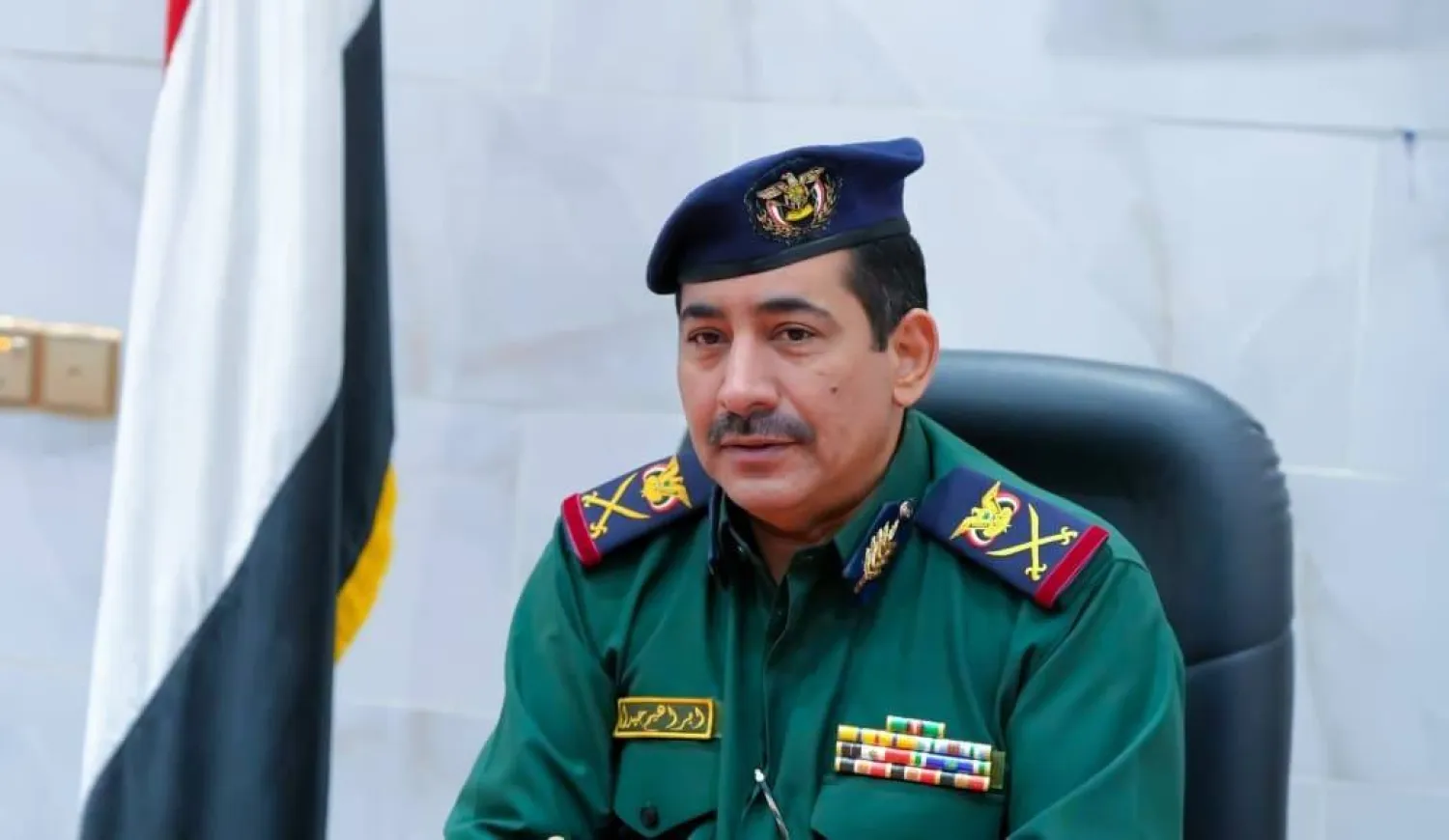
Yemen Interior Minister to Asharq Al-Awsat: Iran Seeking to Militarize Bab al-Mandeb Through the Houthis

Yemen’s interior minister warned that Iran was seeking to “militarize Bab al-Mandeb” through the Houthis. (Turky Al-Agili)
TT

Yemen Interior Minister to Asharq Al-Awsat: Iran Seeking to Militarize Bab al-Mandeb Through the Houthis

Yemen’s interior minister warned that Iran was seeking to “militarize Bab al-Mandeb” through the Houthis. (Turky Al-Agili)

Yemen’s Interior Minister Major General Ibrahim Haidan warned that Iran is seeking to establish long-term military influence over the Bab al-Mandeb Strait and its surrounding islands and coastlines by exporting to the Red Sea the model it developed to “militarize maritime corridors” in the Strait of Hormuz.

Haidan said experts from Iran’s Revolutionary Guards Corps (IRGC) were helping the Houthis strengthen their capabilities and build fortifications, operations rooms and facilities for missiles, drones and remotely guided boats.

“The danger is not limited to the threats that exist today, but extends to what is being built for the future,” Haidan told Asharq Al-Awsat.

He warned that continued Houthi control of strategic areas could give Iran leverage over one of the world’s most important shipping lanes and help it connect Yemen with the Horn of Africa through smuggling networks and armed groups.

His remarks followed sweeping government losses along Yemen’s western coast. In an offensive from Sept. 3 to 11, the Houthis seized Hays, Al-Khokha, Mokha and its port before advancing to Bab al-Mandeb, Mayyun Island and the remaining Yemeni islands in the southern Red Sea.

Haidan said security readiness had been raised in Aden, Lahj and areas behind the frontlines following the developments in Mokha and along the western coast.

The defense and interior ministries were coordinating through a joint operations room to prevent operatives and cells from infiltrating those areas or exploiting waves of displacement to carry out security breaches, he added.

‘Militarizing’ Bab al-Mandeb

Haidan placed the latest developments in a broader context, saying Yemen was “part of a regional and international security system” and that events there quickly reverberated around the world because of the Bab al-Mandeb Strait.

The gravest danger, he said, was the military infrastructure being built in the area for future use.

Experts linked to the IRGC were providing the Houthis with expertise and guidance to conduct operations and develop their military capabilities, he said.

Those efforts included building “capabilities, fortifications, bases, operations rooms and caves used to manufacture drones and remotely guided boats and to develop missiles” across Bab al-Mandeb and the surrounding islands, coastlines and highlands.

Haidan said Iran aimed to replicate in Bab al-Mandeb its experience of “militarizing maritime corridors” in the Strait of Hormuz.

That could turn an open international waterway into a source of influence and pressure for future use, he warned.

Iranian and Houthi assurances about the safety of navigation should not be treated as sufficient guarantees, he said, arguing that such messages merely gave the Houthis more time to expand their military systems and fortifications.
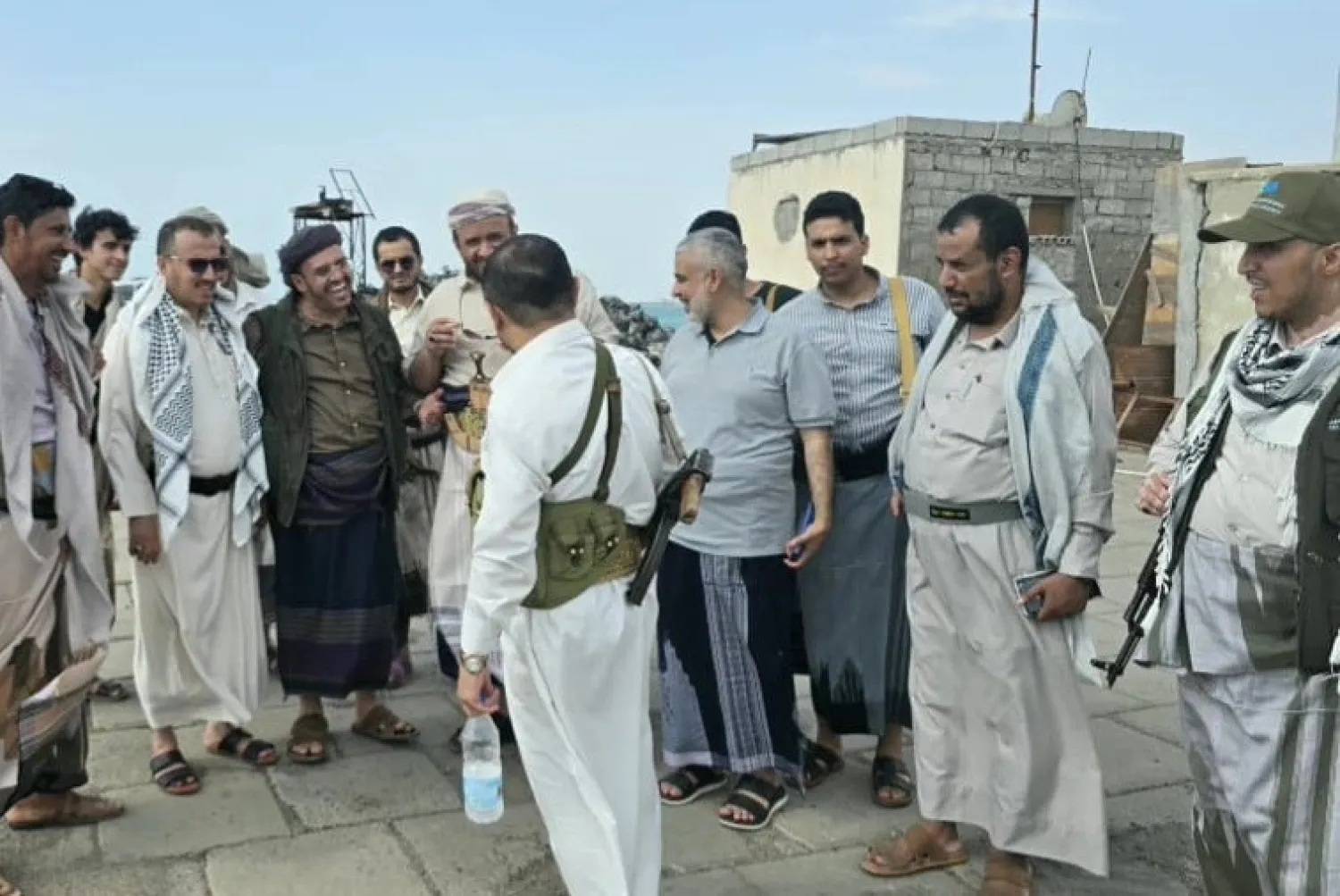
Houthi leaders at Mokha port after its capture (Houthi media)

Could Mayyun become another Larak?

Haidan outlined a more specific threat to the Red Sea islands, warning that additional time could allow the Houthis to build bases, hideouts and fortified caves, backed by advanced surveillance, tracking and jamming systems.

Mayyun Island, at the heart of Bab al-Mandeb, could take on a military role similar to that of Iran’s Larak Island in the Strait of Hormuz, he said.

Zuqar and the Hanish Islands, as well as the highlands and coastlines along the Red Sea, could also become part of an “integrated military system” if the Houthis consolidated their presence in the strait, he added.

From the Red Sea to the Horn of Africa

The danger extends beyond Bab al-Mandeb, according to Haidan.

Houthi control of the strait could give the Revolutionary Guards greater scope to connect Yemen with the Red Sea and the Horn of Africa, he said.

Smuggling networks and maritime routes could be used to move weapons, equipment and expertise, strengthen Houthi military and logistical capabilities and expand communication with armed groups and terrorist organizations operating in the Horn of Africa, particularly Somalia’s al Shabaab.

Haidan warned that those groups’ capabilities could merge with those of the Houthis and IRGC networks.

Such coordination could turn Bab al-Mandeb into “a foothold for multifaceted Iranian influence across several arenas” and give Tehran a strategic tool to deploy during any regional escalation, he said.
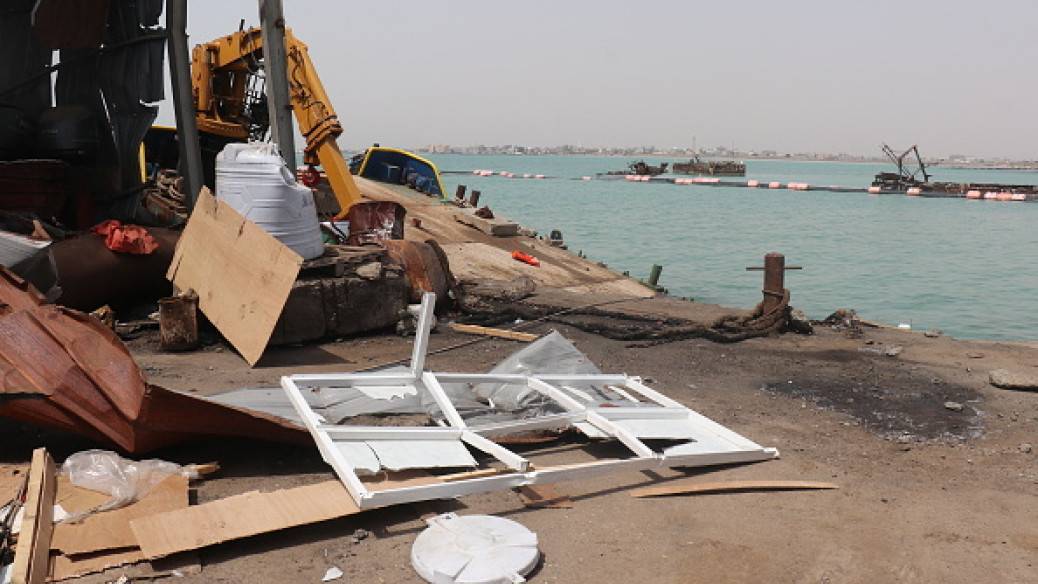
Destruction in Mokha after being attacked by the Houthis. (Getty Images)

Coastguard needs urgent support

Government forces continue to confront the Houthis and work to regain and secure lost territory, Haidan stressed.

He singled out smuggling as one of the main arteries for financing and supplying the Houthis.

Yemen’s coastguard was carrying out its duties despite limited resources, but needed “urgent, specialized support” from allied and friendly countries, he remarked.

That support should include maritime surveillance and reconnaissance capabilities, tracking and monitoring systems, patrol boats and modern equipment. Intelligence capabilities must also be strengthened to uncover smuggling networks, track their routes and intercept their shipments, he added.

Protecting Bab al-Mandeb and combating smuggling were no longer purely domestic Yemeni concerns, Haidan declared.

“The security of navigation and international trade routes begins with the state exercising sovereignty over its territory and waters,” he said.

Confronting the threats required regional and international support for the Yemeni state and stronger state capabilities, he added.

Securing Aden and Lahj

Security deployments have been reinforced at the entrances to Lahj province, the interim capital Aden and surrounding areas as displacement increased following the developments along the western coast, Haidan said.

The Interior Ministry treated the crisis as extending beyond the military frontlines. It acted simultaneously to protect displaced civilians and raise security readiness under plans prepared in advance for different scenarios.

The measures sought to balance the protection of displaced people with the need to stop the Houthis from exploiting their movement “for security purposes or to carry out infiltration and penetration operations,” he said.

Authorities have stepped up coordination and information-sharing among security agencies, local authorities and military units. They have also intensified preemptive intelligence efforts to prevent operatives from entering government-held areas or carrying out acts of sabotage.
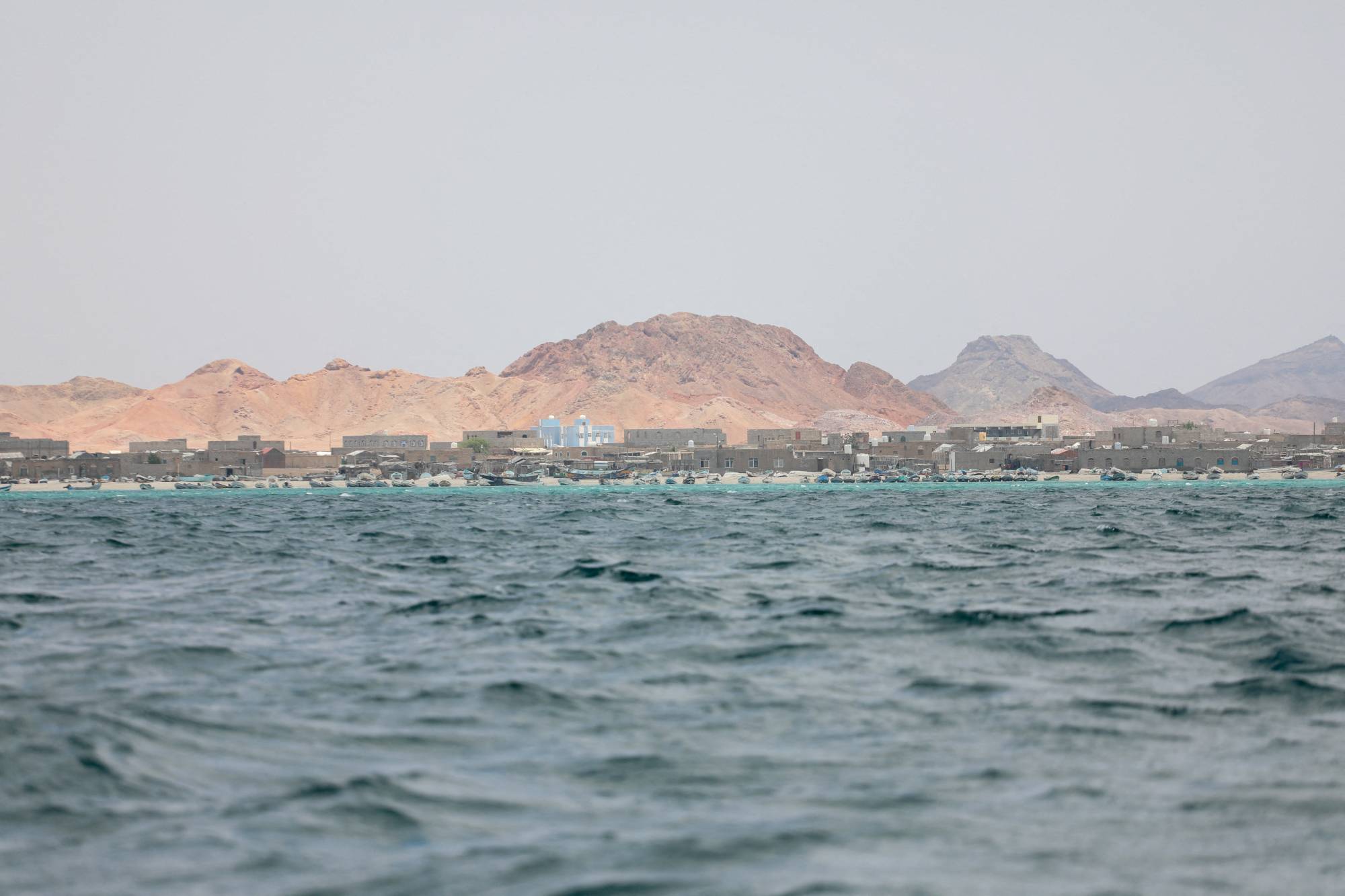
A view of a village on the coast of Bab al-Mandeb, Yemen April 2, 2026. (Reuters)

Joint operations room

The defense and interior ministries were coordinating through a “joint operations room,” Haidan said.

Its work included producing a unified assessment of the situation, assigning responsibilities and speeding up responses to developments on the ground.

Security and military services had also strengthened communication and information-sharing, focusing on frontlines, roads and areas that could be used to infiltrate operatives and cells or transport weapons and explosive devices.

Displacement remained “primarily a humanitarian issue,” Haidan said, but it also required careful security management to prevent it from being used as cover to infiltrate operatives or cells into government-held areas.

Sleeper cells and smuggling

Asked about the threats facing the security services, Haidan cited infiltration attempts and the potential use of displacement movements to conceal operatives or transport information and materials for acts of sabotage.

Sleeper cells, smuggling networks and organized crime also posed risks, he told Asharq Al-Awsat.

The heightened security measures in Aden and Lahj were largely “preventive and preemptive,” Haidan explained. They aimed to stop military pressure on the frontlines from spilling into cities while preserving a humanitarian approach toward displaced people.
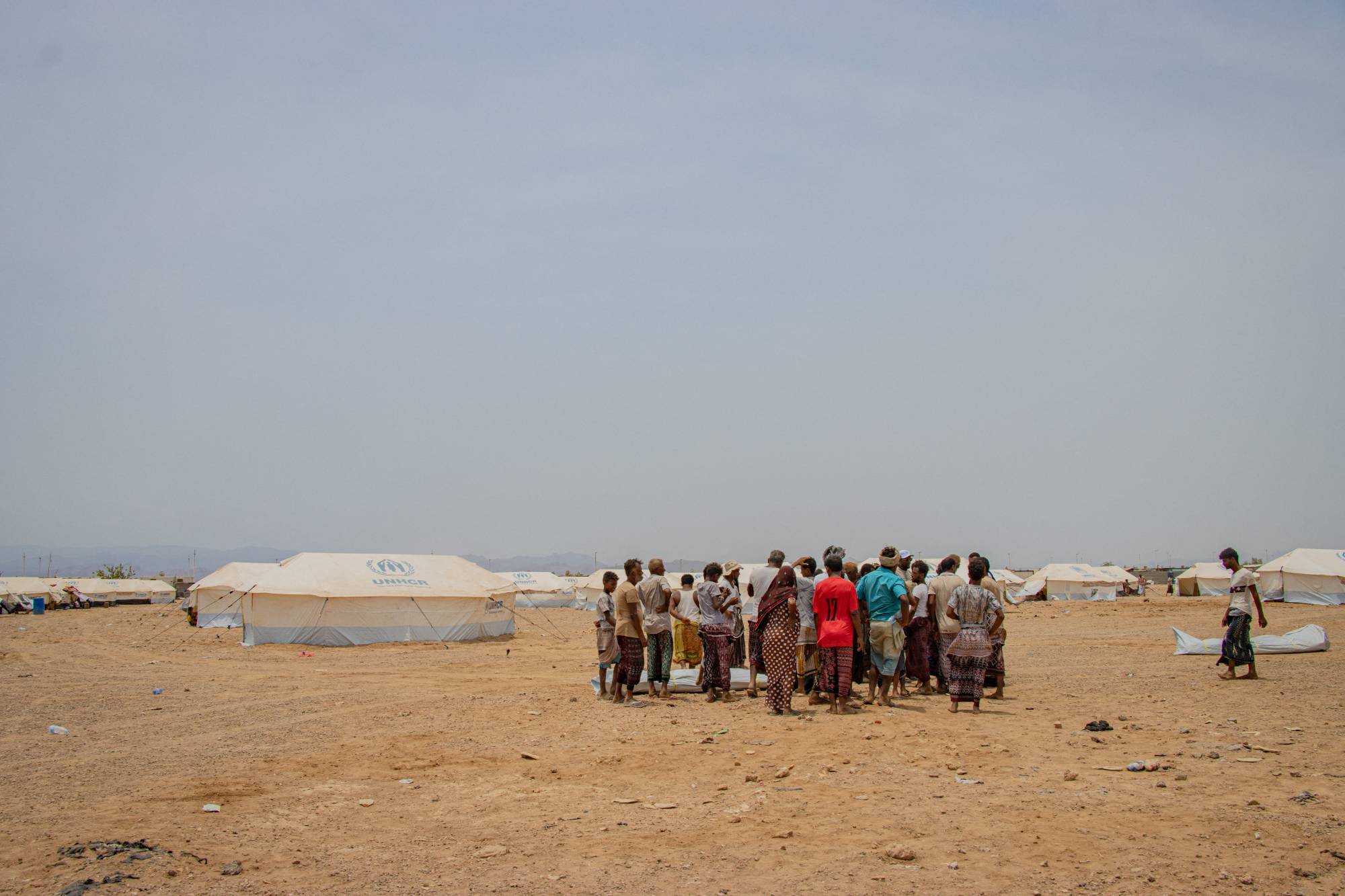
People fleeing clashes between Houthi militants and Yemeni government forces gather at the Markazi refugee camp after arriving in Djibouti, September 15, 2026. (Mylaèle Negga/International Organization for Migration/Handout via Reuters)

Mokha a ‘practical test’

Haidan described the events in Mokha as a “direct and practical test” of the security establishment’s readiness and the Interior Ministry’s contingency plans.

From the outset, those plans accounted for advances and retreats, shifting frontlines, widening displacement and mounting pressure on provinces behind the fronts, he said.

Protecting the home front was not a temporary task tied to a particular military development, but an “integral and permanent” part of the Interior Ministry’s work.

Resources and security deployments had been adjusted to battlefield developments, while information-sharing among security agencies, local authorities and military forces had been strengthened, he added.

‘Collusion’ with terrorist groups

Beyond the Houthi threat, Haidan warned that terrorist organizations, smuggling networks and organized crime groups could exploit the widening war, shifting frontlines and troop redeployments to create security vacuums.

He said there was “collusion” between the Houthis and those groups and networks. The relationship predated the latest developments and included links with Somalia’s al Shabaab.

Security agencies did not treat the Houthi threat, terrorism, organized crime and smuggling as separate files, but as “a single security system,” Haidan said.

That required heightened readiness, stronger deployments in sensitive areas and tighter monitoring of entry points, roads and smuggling routes to prevent the military developments from triggering a broader security crisis.



UN: Sudan’s Warring Parties Show No Serious Commitment to a Settlement

Rosemary DiCarlo, UN Under-Secretary-General for Political and Peacebuilding Affairs (AP)
TT

UN: Sudan’s Warring Parties Show No Serious Commitment to a Settlement

Rosemary DiCarlo, UN Under-Secretary-General for Political and Peacebuilding Affairs (AP)

Rosemary DiCarlo, UN Under-Secretary-General for Political and Peacebuilding Affairs, said Friday that Sudan’s warring parties showed no serious commitment to a negotiated settlement despite neither side being capable of securing a military victory, raising fears of further escalation in the coming months.

Briefing the Security Council, the UN under-secretary-general for political and peacebuilding affairs painted a bleak picture of a conflict fueled by continued arms supplies, recruitment and foreign support.

Her assessment came a day after Sudanese army chief Gen. Abdel Fattah al-Burhan disclosed that he had sent a message to US President Donald Trump expressing Sudan’s commitment to Washington-backed peace efforts.

Washington has not publicly responded to Burhan’s remarks. The army chief met Trump’s senior adviser for Arab and African affairs, Massad Boulos, in Egypt earlier this month.

Civilian toll mounts

DiCarlo told the council that conditions in Sudan continued to deteriorate, with little prospect of a breakthrough and no significant improvement in recent months.

Fighting had been particularly fierce in North Kordofan, South Kordofan and Blue Nile states, but violence was spreading well beyond those front lines.

Drone strikes and air raids had killed civilians at a displacement camp in Blue Nile, an artisanal gold mine in Red Sea state and several locations in North Kordofan, including schools, a courthouse, university accommodation and a shelter for displaced families.

She condemned a drone strike on two clearly marked World Food Program (WFP) trucks carrying food aid through an area subjected to repeated attacks by the Rapid Support Forces (RSF) and the Sudan People’s Liberation Movement-North (SPLM-N).

One driver was killed in the attack.

DiCarlo identified drone strikes as the leading cause of civilian casualties this year, calling for an immediate halt to such attacks and tighter restrictions on drone use.

She expressed concern that weapons continued to flow into Sudan while both sides recruited fighters, increasing the likelihood of further escalation.

Rather than seeking dialogue, military leaders appeared convinced they could make greater gains on the battlefield and achieve their objectives through force, provided foreign backing continued.

She urged the warring parties to abandon that calculation and called on outside powers to use their influence to end the conflict rather than fuel it.

DiCarlo also drew attention to growing insecurity along Sudan’s borders, particularly given the fragility of several neighboring countries.

Preventing the war from developing into a broader regional crisis must remain a collective priority, she stressed.

Diplomatic efforts continue

Despite the deadlock, DiCarlo reported continued UN coordination with the Quad, which is seeking to secure a humanitarian truce.

The United Nations stood ready to help implement any agreement, she stressed, emphasizing that further delays were unacceptable.

She also pointed to modest progress through the efforts of the UN secretary-general’s personal envoy for Sudan, Pekka Haavisto.

Both warring parties had established committees to consider the unilateral release of detainees and had negotiated prisoner exchanges.

Haavisto was also working with UNICEF to ensure that Sudanese students could take a unified, nationally recognized 12th-grade examination, while talks continued with Chad over arrangements for Sudanese refugee students.

Partners from the Quintet visited Khartoum in early September to consult Sudanese stakeholders, who consistently called for an end to the war and the restoration of civilian rule.

DiCarlo welcomed growing international engagement, citing the first joint meeting between the Quintet and the Quad during the UN General Assembly’s high-level week in September.

A Sudan Consultative Group meeting scheduled for Geneva next week would bring together both diplomatic groupings and other mediators.

Referring to the anniversary of the fall of El Fasher, DiCarlo called for much greater pressure on the warring parties and their supporters to end the fighting.

She emphasized that accountability was essential after the immense suffering endured by Sudanese civilians, who deserved peace and a genuine prospect of a better future.

US urges humanitarian truce

US Deputy Representative Jeff Bartos called for a humanitarian truce and an end to weapons flows into Sudan, pledging continued efforts to expand sanctions.

He described the Quintet’s work as the most credible path toward a peaceful political transition under civilian leadership.


Qatar Offers Comprehensive Plan to Ease Lebanon’s Electricity Crisis

Lebanese President Joseph Aoun welcomes Qatari Prime Minister and Foreign Minister Sheikh Mohammed bin Abdulrahman bin Jassim Al Thani in Beirut (AFP/Lebanese Presidency). 
TT

Qatar Offers Comprehensive Plan to Ease Lebanon’s Electricity Crisis

Lebanese President Joseph Aoun welcomes Qatari Prime Minister and Foreign Minister Sheikh Mohammed bin Abdulrahman bin Jassim Al Thani in Beirut (AFP/Lebanese Presidency). 

Lebanon and Qatar are close to reaching an agreement to overhaul Lebanon’s electricity sector, with Doha set to finance, develop and operate the project without requiring any upfront investment from the Lebanese treasury, Prime Minister Nawaf Salam announced Friday.

The announcement came during a visit to Beirut by Qatari Prime Minister and Foreign Minister Sheikh Mohammed bin Abdulrahman Al Thani, who unveiled plans for a major energy investment and broader cooperation, including energy interconnection projects linking Lebanon with Syria and Iraq.

Energy dominated the talks, alongside Israeli attacks in South Lebanon and Qatar’s continued support for the Lebanese Army.

Aoun calls for pressure on Israel

Al Thani began his visit at Baabda Palace, where President Joseph Aoun praised Qatar’s Emir Sheikh Tamim bin Hamad Al Thani and the Qatari leadership for their efforts to ease regional tensions and restore stability.

Aoun urged Doha to work with Arab and friendly countries to press Israel to halt its attacks in South Lebanon and implement the framework agreement reached through US-sponsored negotiations with Lebanon.

He described the mounting toll of Israeli operations, including casualties and widespread destruction in southern villages, and called for intensified diplomatic efforts to secure an Israeli withdrawal.

Aoun also reiterated Lebanon’s condemnation of attacks on Gulf countries, most recently Saudi Arabia, and reaffirmed solidarity with Gulf states.

Welcoming stronger bilateral ties, he highlighted Qatar’s willingness to help address Lebanon’s longstanding electricity crisis.

For his part, Al Thani reaffirmed Doha’s support for the Lebanese government’s efforts and called for Israel to withdraw from occupied Lebanese territory and hand over those areas to the Lebanese Army.

Qatar to finance and operate electricity project

At a joint news conference at the Grand Serail, Salam announced that the two governments were nearing an agreement to rehabilitate, develop and modernize Lebanon’s electricity generation infrastructure.

The proposed project would cover various sources of power generation and the infrastructure needed to support them, with the aim of providing a more reliable electricity supply at a lower cost.

Salam explained that the initiative would follow a build-operate-transfer (BOT) model, under which Qatar would finance, implement and operate the project before ownership is transferred.

Crucially, Lebanon would not have to provide any upfront capital investment, helping overcome the financial obstacles that have long hindered improvements to electricity supply.

Salam outlined the government’s priorities as increasing production, reducing costs and improving management, stressing that reliable electricity at affordable prices would encourage investment and help revive the economy.

The discussions also covered securing gas supplies and preparing an intergovernmental agreement to pave the way for a comprehensive solution to the electricity crisis.

Broader energy partnership

Al Thani confirmed that both countries had agreed on a comprehensive framework for energy cooperation, including a major investment project intended to benefit Lebanon’s economy and participating Qatari companies and institutions.

He reaffirmed Qatar’s commitment to standing alongside the Lebanese people during a difficult period for the region and expressed hope for closer cooperation across other sectors.

Turning to regional security, the Qatari prime minister urged all parties to implement UN Security Council Resolution 1701, called for Israel’s withdrawal from all occupied positions and stressed the importance of respecting existing agreements.

He also revealed that Doha was coordinating with Washington on reconstruction efforts in South Lebanon to enable displaced residents to return to their homes.

Qatar would continue supporting the Lebanese Army as a national institution responsible for safeguarding the country’s security and stability, he added.

Berri stresses support for army

Al Thani also met Parliament Speaker Nabih Berri to discuss political and security developments in Lebanon and the region, continued Israeli attacks and bilateral relations.

Berri expressed appreciation for Qatar’s longstanding support, particularly for South Lebanon, and its commitment to Lebanese sovereignty, the withdrawal of Israeli forces and the return of displaced residents.

He welcomed Doha’s willingness to contribute to economic recovery and reconstruction.

Both leaders agreed on the importance of strengthening national unity and supporting state institutions, particularly the Lebanese Army and security forces, as guarantors of stability and sovereignty.


Morocco Retains Key Ministers in New Government, Names Seven Women

Morocco’s King Mohammed VI presides over the appointment ceremony for members of the new government at the Royal Palace in Rabat on Friday (MAP). 
TT

Morocco Retains Key Ministers in New Government, Names Seven Women

Morocco’s King Mohammed VI presides over the appointment ceremony for members of the new government at the Royal Palace in Rabat on Friday (MAP). 

Morocco’s King Mohammed VI appointed a new government on Friday, retaining several key ministers while naming the country’s first female head of government and giving women seven positions in the cabinet.

The 32-member government, headed by Fatima Ezzahra El Mansouri, was sworn in at the Royal Palace in Rabat following parliamentary elections held on September 23.

The new administration combines experienced ministers with newcomers from political parties and technocratic backgrounds, reflecting an effort to balance continuity with fresh leadership as it seeks to accelerate reforms and improve public services.

Among the most prominent appointments was Fouzi Lekjaa, who was named minister of economy, finance and public sector performance after serving for years as minister delegate in charge of the budget.

His promotion, widely anticipated by political observers, reflects continued confidence in his ability to manage public finances and oversee major economic reforms.

In his previous role, Lekjaa gained extensive experience preparing annual budgets, monitoring their implementation and managing fiscal reforms.

He now faces the challenge of mobilizing resources, encouraging investment and financing social programs while maintaining macroeconomic stability.

His responsibilities will also include shaping the government’s fiscal policies and ensuring that development priorities remain compatible with sustainable public finances.

Key ministers retain portfolios

Nine ministers retained their positions in the new government, according to the Royal Cabinet’s announcement.

They include Interior Minister Abdelouafi Laftit, Foreign Minister Nasser Bourita, Justice Minister Abdellatif Ouahbi and Minister of Endowments and Islamic Affairs Ahmed Toufiq.

Nizar Baraka also remains minister of equipment and water, with forests added to his portfolio after previously falling under the Agriculture Ministry.

The appointments signal a preference for continuity in key government departments, even as other portfolios have been assigned to new figures.

Seven women in new cabinet

The government includes seven women, among them El Mansouri, who becomes the first woman to lead Morocco’s government.

The other six hold ministerial or minister delegate positions, giving women responsibilities across economic, social and administrative sectors.

Charafat Afailal was appointed minister of energy, mines and sustainable development, while Najwa Koukouss takes charge of family affairs, social development and equality.

Kouloub Faitah was named minister delegate to the head of government in charge of relations with parliament and civil society.

Madiha Khayr becomes minister delegate for vocational training and qualification, working under the minister of national education, preschool education, vocational training and qualification.

Fatima Saadi was appointed minister delegate for housing and urban policy under the minister responsible for national territorial planning, urban development, housing and urban policy.

Aicha Kelaa takes charge of administrative reform as minister delegate under the minister of artificial intelligence, digital transformation and administrative reform.

The appointments place women in positions spanning energy, social policy, parliamentary affairs, vocational training, housing and public administration.

El Mansouri’s historic appointment, alongside the broader female representation in the cabinet, has renewed debate over women’s participation in political leadership and government decision-making in Morocco.