


Araghchi Aide in Beirut Assesses Concerns of Shiite Duo

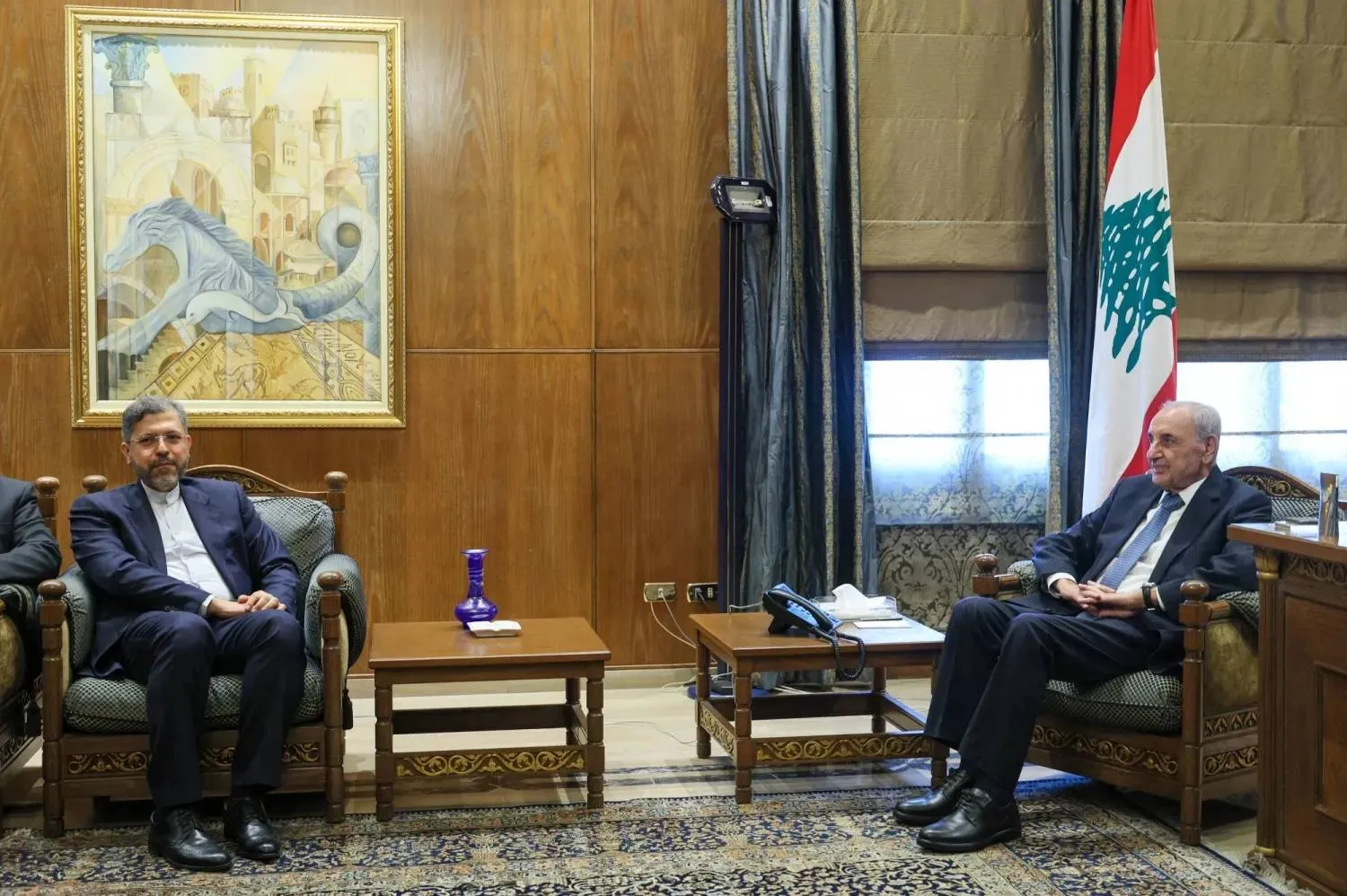
Lebanese Parliament Speaker Nabih Berri receives Iranian Deputy Foreign Minister Saeed Khatibzadeh in Beirut (EPA)
TT

Araghchi Aide in Beirut Assesses Concerns of Shiite Duo

Lebanese Parliament Speaker Nabih Berri receives Iranian Deputy Foreign Minister Saeed Khatibzadeh in Beirut (EPA)

Iranian Foreign Minister Abbas Araghchi’s call with Lebanese President Joseph Aoun coincided with the arrival in Beirut of his aide, Saeed Khatibzadeh, as Tehran moved to reassert its presence in Lebanon after a prolonged absence.

Well-informed Lebanese sources said the Iranian push came amid differences with Aoun and Prime Minister Nawaf Salam over their approach to Lebanon, while Tehran also sought to contain tensions caused by the withdrawal of Mohammad Reza Sheibani’s credentials as Iran’s ambassador to Lebanon.

Araghchi and Aoun agreed on the need to support diplomatic solutions as the best way to end conflicts in the region, according to the Lebanese presidency.

The sources told Asharq Al-Awsat that Araghchi told Aoun Iran remained committed to the Iranian-American “memorandum of understanding” and to implementing all its provisions, including one calling for an end to wars on all fronts, Lebanon among them.

He blamed the United States for the failure to implement the agreement, accusing Washington of imposing “impossible conditions whenever we come close to implementing it” and saying mediators had continued trying to persuade it to return to negotiations rather than threaten renewed war.

Political message

The sources said Araghchi’s call was intended to send a political message that Tehran remained present in the Lebanese file and that “the tension caused by the withdrawal of Ambassador Sheibani’s credentials is now behind us.”

They said the issue no longer blocked renewed contact with Aoun, who, along with most Lebanese political forces, remains committed to the “framework agreement” and has no intention of replacing it with the Iranian-American “memorandum of understanding.”

Hezbollah’s opponents, meanwhile, viewed Khatibzadeh’s Beirut visit as primarily Shi’ite-focused and aimed at assessing the concerns of the “Shiite duo,” Hezbollah and the Amal Movement.

The sources said that explained his meetings with Parliament Speaker Nabih Berri and Hezbollah’s leadership.

The contrast in tone was clear.

Diplomacy dominated Araghchi’s call with Aoun. Khatibzadeh, by contrast, spoke in much harsher terms.

He was quoted as telling journalists that “negotiations are pointless, and we are preparing for the worst-case scenarios,” and that direct talks between Lebanon and Israel would lead nowhere because Israel was “an occupying entity.”

He said Israel wanted to use negotiations as a first step toward expanding its dominance across the region and ultimately achieving what is known as “Greater Israel.”

“As long as the Israeli occupation remains in southern Lebanon, the resistance will remain, weapons will continue to be necessary, and anyone who cares about Lebanon’s interests should support this approach,” he was quoted as saying.

Asked about ties between Iran and Hezbollah, Khatibzadeh said the relationship was “not hierarchical, from the top down,” and that Iran did not interfere in Lebanese affairs, which were “left to the Lebanese themselves.”

He also claimed that “Hezbollah does not ask us what it should do, but it sometimes asks us how it can be more steadfast and tougher in confronting the enemy, while avoiding asking us about Lebanon’s internal affairs.”

Iran-US negotiations

Khatibzadeh also addressed Iranian-American negotiations, saying there was little prospect of an agreement.

“The chances of reaching an agreement are, so far, nonexistent, as shown by previous experience when Washington launched a war against us while negotiations were still underway,” he was quoted as telling journalists.

He also pointed to differences within the United States, saying one camp did not want to implement the provisions of the “memorandum of understanding,” while another had sought an agreement.

“The administration of US President Donald Trump is suffering from internal fragmentation. Otherwise, had it honored its commitments, we would have reached an agreement,” Khatibzadeh said.

He added that the United States’ power had been broken and would be broken again.

Asked about the direction of events in the region, he said “Political realism requires us to say that, until further notice, we have the right to prepare for the worst-case scenarios in the face of American threats.”

Iran’s relations with Syria

On Syria, Khatibzadeh said Iran was “in no hurry.”

“We are ready to communicate with Syria when it decides to do so. It is currently going through a sensitive and dangerous phase, and Türkiye committed a strategic mistake and contributed to the Israeli-American ‘puzzle,’ one result of which was that Syria handed Israel a gift,” he said.

The sources said, therefore, that Khatibzadeh’s meetings in Beirut reflected no change in Iran’s position.

His remarks, they said, were meant to stress Tehran’s adherence to its existing stance, which largely aligns with Hezbollah Secretary-General Naim Qassem’s rejection of the “framework agreement.”

The sources asked whether Khatibzadeh had carried a message aimed largely at stirring opposition to the “framework agreement,” without naming it directly, in contrast with Araghchi’s emphasis to Aoun on diplomatic solutions.

Araghchi’s diplomacy was thus met by a much harder line from his aide, raising the question of whether Khatibzadeh was conveying a message closer in substance to the position of Iran’s Revolutionary Guards than to that of the political camp Araghchi represents within the Iranian establishment.

Otherwise, the sources said, he would not have needed to make statements amounting to interference in Lebanese affairs, the kind of positions that have fueled the tensions still weighing on Lebanese-Iranian relations.

Those positions have been firmly rejected by a majority of Lebanese who support the “framework agreement” and back Aoun’s diplomatic approach after Hezbollah pursued the military option, leaving the country with incalculable human and material costs.



Al-Maliki Warns Houthis to Read Coalition Statement Carefully

Maj. Gen. Turki al-Maliki speaks during a news conference in Riyadh on Thursday (AP)
TT

Al-Maliki Warns Houthis to Read Coalition Statement Carefully

Maj. Gen. Turki al-Maliki speaks during a news conference in Riyadh on Thursday (AP)

Maj. Gen. Turki al-Maliki, spokesman for the Arab Coalition to Support Legitimacy in Yemen, warned the Houthis against targeting civilians and civilian facilities in Saudi Arabia, saying coalition forces were fully capable of confronting missiles, drones and cruise missiles.

Speaking at a news conference in Riyadh on Thursday evening, al-Maliki urged the Houthis to halt attacks on civilians and civilian infrastructure in the kingdom.

“The terrorist Houthi millitias must stop their attacks on civilians in Saudi Arabia, and they should carefully read the coalition’s statement — and between the lines,” he said.

Al-Maliki said the Houthis had obtained advanced technology with the help of regional parties, enabling them to acquire ballistic missiles, attack and suicide drones and explosive-laden fast boats.

He said the development placed responsibility on the international community to prevent terrorist groups from gaining access to advanced weapons and technology.

“The leadership of the coalition’s joint forces affirms that its operations will continue to deter the terrorist Houthi millitias from attempting to target civilians and civilian facilities in Saudi Arabia and from threatening freedom of navigation in the southern Red Sea and the Bab al-Mandab Strait,” he said.

Al-Maliki also reaffirmed support for Yemen’s internationally recognized government and armed forces “on all fronts,” along with round-the-clock air support for units on the ground.

19 killed, 364 injured

Al-Maliki said Houthi attacks on airports in the kingdom had killed 19 people and injured 364, adding that 1,104 missiles and 1,135 drones had been launched since operations began.

He said Houthi attempts to target Islam’s two holiest mosques reflected a systematic hostile approach and amounted to a “heinous act” aimed at pilgrims and visitors.

According to al-Maliki, Houthi violations since the 2022 truce included about 175 ballistic missiles, 330 drones, 2,229 projectiles launched from drones and 28,121 unidentified projectiles.

He stressed that Saudi Arabia had the intelligence capabilities to identify targets and confront threats.

“We have the capability to deal with these missiles, drones and cruise missiles,” he said.

During the news conference, al-Maliki showed footage of coalition aircraft striking ballistic missile launchers, weapons depots and facilities he said the Houthis used to support military operations.

He said coalition forces had also neutralized an imminent ballistic missile attack on the kingdom.

Attacks threaten passenger safety

Al-Maliki condemned Houthi attacks on civilians and civilian facilities in Saudi Arabia, including King Khalid International Airport in Riyadh, noting that thousands of passengers and civilians use such facilities every day.

He also pointed to attempted attacks on airports, ports and oil facilities in the kingdom.

Al-Maliki said Houthi attacks on civilians were a flagrant violation of international norms, adding that attacks on airports “undermine the kingdom’s security, threaten international air traffic and endanger the lives of passengers of various nationalities.”

He said the coalition had destroyed 127 storage facilities in mountainous areas and a launch platform in Yemen.

Al-Maliki said the Houthis had built mountain storage facilities concentrated in Sanaa, Saada and Amran, from which attacks were launched against Yemen and neighboring countries.

“The leadership of the coalition’s joint forces is working to dismantle this network and eliminate the experts and operators behind these capabilities by destroying mountain storage facilities and fixed and mobile launch platforms, based on an intelligence system operating around the clock,” he said.

Saudi defense systems on high alert

Al-Maliki said the Saudi armed forces had advanced, highly combat-ready systems, including air defenses capable of intercepting threats and thwarting attempted attacks.

He said the systems were designed to protect the kingdom’s sovereignty, security, strategic assets and holy sites, as well as citizens and residents.

“We have the capability to identify the locations used by the Houthi militias, and we are working to dismantle the terrorist network and eliminate the experts involved,” he said.

Al-Maliki again stressed the coalition’s strict commitment to international humanitarian law, saying it had taken all feasible precautions to avoid civilian casualties or damage while planning operations to neutralize Houthi capabilities used in attacks.


Morocco’s New Parliament Speaker: Ahmed Touizi’s Rise to the Top of the Legislature

Morocco’s new parliament speaker, Ahmed Touizi (AFP)
TT

Morocco’s New Parliament Speaker: Ahmed Touizi’s Rise to the Top of the Legislature

Morocco’s new parliament speaker, Ahmed Touizi (AFP)

Ahmed Touizi’s rise to become Morocco’s parliament speaker in October 2026 marks the opening of a new political phase after a reshaping of the country’s governing majority and opposition.

The elevation of the senior Authenticity and Modernity Party figure to lead the House of Representatives directly reflects the legislative election results and the balance of power among parties in parliament.

It also puts his long record in education, local government and regional administration under closer institutional scrutiny.

As Touizi begins his five-year term, he faces major organizational and constitutional challenges.

He must steer legislative debate with balance and manage competition between the governing majority and opposition groups at equal distance, safeguarding the rights of all sides while preserving the authority of the institution.

The parliamentary showdown and the numbers behind the vote

Touizi capped his political career by being elected parliament speaker at a plenary session on Tuesday, Oct. 13, 2026.

He secured what is regarded as the third-highest constitutional office in the state with an absolute majority of 220 votes, backed strongly by the parties in the new governing coalition.

His main rival, Idriss El Azami El Idrissi of the opposition Justice and Development Party, won 59 votes.

The ballot also carried a quieter political message. Of the 369 votes cast, 90 were blank or invalid, reflecting the scale of underlying tensions inside the legislature.

The House completed the formation of its constitutional bodies the following day. Lawmakers unanimously approved a single list with 293 votes, establishing the chamber’s bureau under the principle of proportional representation and appointing eight deputy speakers.

Mustapha Baitas of the National Rally of Independents was named first deputy speaker and Khalid Chennak of the Istiqlal Party was second deputy speaker.

They were joined by Abdellah Bouanou of the Justice and Development Party and Mohamed Ouzzine of the Popular Movement.

The restructuring also extended to the heads of the chamber’s nine permanent committees, the core engines of the legislative process.

Mohamed El Gharass of the Constitutional Union was appointed head of the Foreign Affairs Committee, Moncef Toub of the Istiqlal Party the Interior Committee, Mohamed Ghiyath of the National Rally of Independents the Justice and Legislation Committee, and Hicham El Mhajri of the Authenticity and Modernity Party the Finance Committee.

Mustapha Ibrahimi of the Justice and Development Party was named head of the Social Sectors Committee, Mohamed Al Aaraj of the Popular Movement the Productive Sectors Committee, Abdelhak Amghar of the Socialist Union of Popular Forces the Infrastructure Committee, Hassan Derham of the Party of Progress and Socialism the Education and Culture Committee, and Hanan El Masi of the Authenticity and Modernity Party the Public Finance Oversight Committee.

From the geographic margins to the top of the legislature

Touizi’s political career is closely tied to his stronghold in Al Haouz province, particularly the town of Ait Ourir near Marrakesh.

The mountainous, developing area was more than his birthplace and childhood home. It became his decisive electoral base and the platform from which he built his political influence.

That deep local connection gave him grassroots legitimacy, but it also brought persistent criticism. Local actors and opponents have argued that his record in local administration failed to deliver the hoped-for development gains in his hometown and surrounding areas.

From natural sciences teacher to politics

The new parliament speaker is 71 and was born in the 1950s, living through the major transformations of modern Morocco.

Touizi studied science before entering public service as a natural sciences teacher in Morocco’s public education system.

Throughout his career, he has repeatedly invoked his roots as an educator in his speeches. For years, that background shaped both his political rhetoric and his direct communication with ordinary citizens before he turned full-time to electoral and institutional politics.

Political pragmatism and a long journey across parties

Touizi’s partisan record shows clear political flexibility and an ability to adapt to shifts in Morocco’s party landscape and changing balances of power.

He began his political career in 1974 within organizations linked to the National Union of Popular Forces in Marrakesh, then associated with a radical leftist current.

As Morocco’s political landscape shifted, Touizi moved among several parties, including the Constitutional Union and the Popular Movement, before joining the liberal Authenticity and Modernity Party.

He rose through its ranks to become a member of its political bureau and one of the leading figures shaping its parliamentary balance.

From local government to the legislative engine room

Touizi has held a succession of local and legislative posts over several decades.

He served as president of the Ait Ourir municipal council for several consecutive terms, becoming a familiar figure in local administration.

He expanded that territorial influence when he was elected president of the Marrakesh-Tensift-Al Haouz regional council from 2011 to 2016, before Morocco adopted its current regional structure.

His career also extended to parliament. He spent years in the House of Councilors, where he served as a chamber quaestor, before moving to the House of Representatives as a lawmaker for the Al Haouz constituency.

He later headed the Authenticity and Modernity Party’s parliamentary group during the previous legislative term, gaining detailed knowledge of the inner workings of lawmaking and the balance between parliamentary blocs.

Taking the speaker’s chair and inheriting a long legacy

Touizi succeeds Rachid Talbi Alami of the National Rally of Independents as parliament speaker.

His election also places him in a long line of prominent figures who have led Morocco’s legislative institution since the early post-independence period.

They include Mehdi Ben Barka in the National Consultative Council, Abdelkrim Al Khatib, Dey Ould Sidi Baba and Ahmed Osman, who led the parliamentary institution for the longest uninterrupted period, as well as Abdelwahed Radi, Mustapha Mansouri, Karim Ghellab and Habib El Malki.


Fighting Deepens Pressure on Taiz as Houthi Leaders Captured

Yemeni government forces move near the Jabal Han front west of Taiz city (AFP)
TT

Fighting Deepens Pressure on Taiz as Houthi Leaders Captured

Yemeni government forces move near the Jabal Han front west of Taiz city (AFP)

Fighting between Yemeni government forces and the Houthi group intensified on several fronts as Operation “Dawn of Yemen” entered its 10th day, with the southwestern province of Taiz emerging as the main strategic and operational battleground.

The clashes have seen government forces capture Houthi security officials, while fighting has spread to neighboring Lahj province and to Marib and al-Jawf in northeastern Yemen.

Ground battles are raging on five main fronts around Taiz city, while government forces continue to track and strike Houthi positions and fighters in Lahj, Marib and al-Jawf.

At the same time, the humanitarian situation in Taiz is worsening, amid accusations that the Houthis have attacked civilians in incidents that killed and wounded several people.

The media center of the Taiz Military Axis said fierce clashes broke out between its forces, backed by the Popular Resistance, and the Houthis on fronts west and northwest of Taiz.

Fighting has continued since Wednesday morning on the al-Dhabab front west of the city and on the al-Aqroud and al-Shaqab fronts to the south, intensifying later in the day.

According to the center, warplanes struck a convoy of Houthi tanks, vehicles and armored vehicles in the Ras al-Najd area of al-Misrakh district.

It said aircraft also carried out two strikes on Houthi positions on Sofitel Hill east of Taiz city, followed by two more strikes on Wednesday evening targeting a tank and a vehicle on the al-Dhabab front.

The center said more than 200 Houthi fighters were killed or wounded. It also reported the destruction of a vehicle and an armed convoy, damage to two tanks and the downing of a drone.

Yemeni Presidential Leadership Council Chairman Rashad al-Alimi announced on the fifth of this month the launch of the large-scale “Dawn of Yemen” operation, aimed at restoring state institutions, recapturing the capital Sanaa, ending the Houthi takeover and returning weapons and decisions over war and peace to the constitutional state.

Security blow hits Houthis

The Taiz Military Axis media office described fighting on the al-Dhabab front as the bloodiest, saying the Houthis were trying to break through the city’s western entrance around the strategic Jabal Han area, Wadi Hadharan and the outskirts of al-Sayahi.

At the same time, the group launched a heavy-weapons assault on the Jawlat al-Qasr front east of the city, it said.

An operational statement issued by the Yemeni armed forces’ media center said troops had thwarted a Houthi flanking attack near the al-Hangar checkpoint at the city’s western entrance.

It said artillery destroyed three armored vehicles and two ammunition supply vehicles.

In a separate statement, the Fifth Presidential Guard Brigade said army units carried out a swift flanking operation west of Taiz, capturing five Houthi security officials.

Footage released by military media showed the capture of intelligence official Mohammed Saeed al-Junaid, director of a branch of what the Houthis call their “Preventive Security” service in the al-Hawban area east of the city.

Also captured was Akram Amer, director-general of the anti-narcotics department at the Interior Ministry run by the internationally unrecognized Houthi government.

After government forces said they had captured five Houthi officials and the Fifth Presidential Guard Brigade released video of the detainees, Abdulqader al-Murtada, head of the Houthi prisoners’ committee, acknowledged that those detained were Interior Ministry employees.

He said they had gone to Taiz to arrange and secure the central prison after taking control of it but lost their way because of overlapping front lines.

Fierce clashes are also continuing around the strategic Jabal Han area west of Taiz, where government forces said they had repelled repeated Houthi attacks over the previous 24 hours despite the mountain being hit by hundreds of shells.

Jabal Han overlooks the Hadharan and al-Rubaie areas, as well as the road linking Taiz with the interim capital Aden and the road to Hodeidah, making it a key point for supply lines.

Residential neighborhoods in Taiz city have meanwhile come under heavy Houthi shelling, increasing the risks facing tens of thousands of civilians.

Humanitarian concerns are mounting as the siege of the city continues alongside severe shortages of basic and medical supplies.

The Information and Training Center for Human Rights documented the killing and wounding of five civilians, including two children, after three Houthi mortar shells struck homes in the village of Aad in Sabir al-Mawadim district.

The shelling also caused extensive damage to 11 homes, which were partially destroyed.

In al-Wazi'iyah district, one civilian was killed and another wounded after being run over by a Houthi military vehicle.

Separately, a woman was killed and three of her female relatives were wounded when a Houthi landmine exploded in Wadi Usus in al-Shamayatayn district in the south of the province.

Fighting spreads beyond Taiz

In Marib, the media center of the Third Military Region said army artillery, backed by drones, struck Houthi fortifications on the northwestern axis, helping government forces advance on high ground overlooking the strategic Mas military camp in Madghal district.

An operational report said a Houthi military convoy carrying combat vehicles was destroyed on the al-Kasara, al-Zour and southern Harib fronts.

Video released by the Yemeni army also showed warplanes striking Houthi barracks and fortifications in the area of responsibility of the Seventh Military Region in Marib.

In al-Jawf province, platforms affiliated with Yemen’s Defense Ministry said air strikes hit a military barracks and a gathering point for Houthi vehicles east of al-Hazm, the provincial capital.

The strikes paved the way for government forces to advance toward the outskirts of the city, they said.

In Lahj province, military media for the Nation’s Shield Forces, together with the Southern Giants Brigades, said they had detected heavy Houthi military movements and reinforcements in the al-Aghbara and al-Mansoura areas and on the al-Mudaraba front.

According to the statement, the forces responded with direct preemptive artillery strikes aimed at preventing any breach that could threaten the strategic coastal route leading to the Bab al-Mandab Strait.

Separately, the Southern Giants Brigades rejected as false a video released by the Houthis claiming the group had fought its forces in Bab al-Mandab, seized military positions, destroyed and captured vehicles and taken members of the force prisoner.

The brigades said the footage was fabricated and that their forces remained in position and in full control of the situation in the Bab al-Mandab area.