

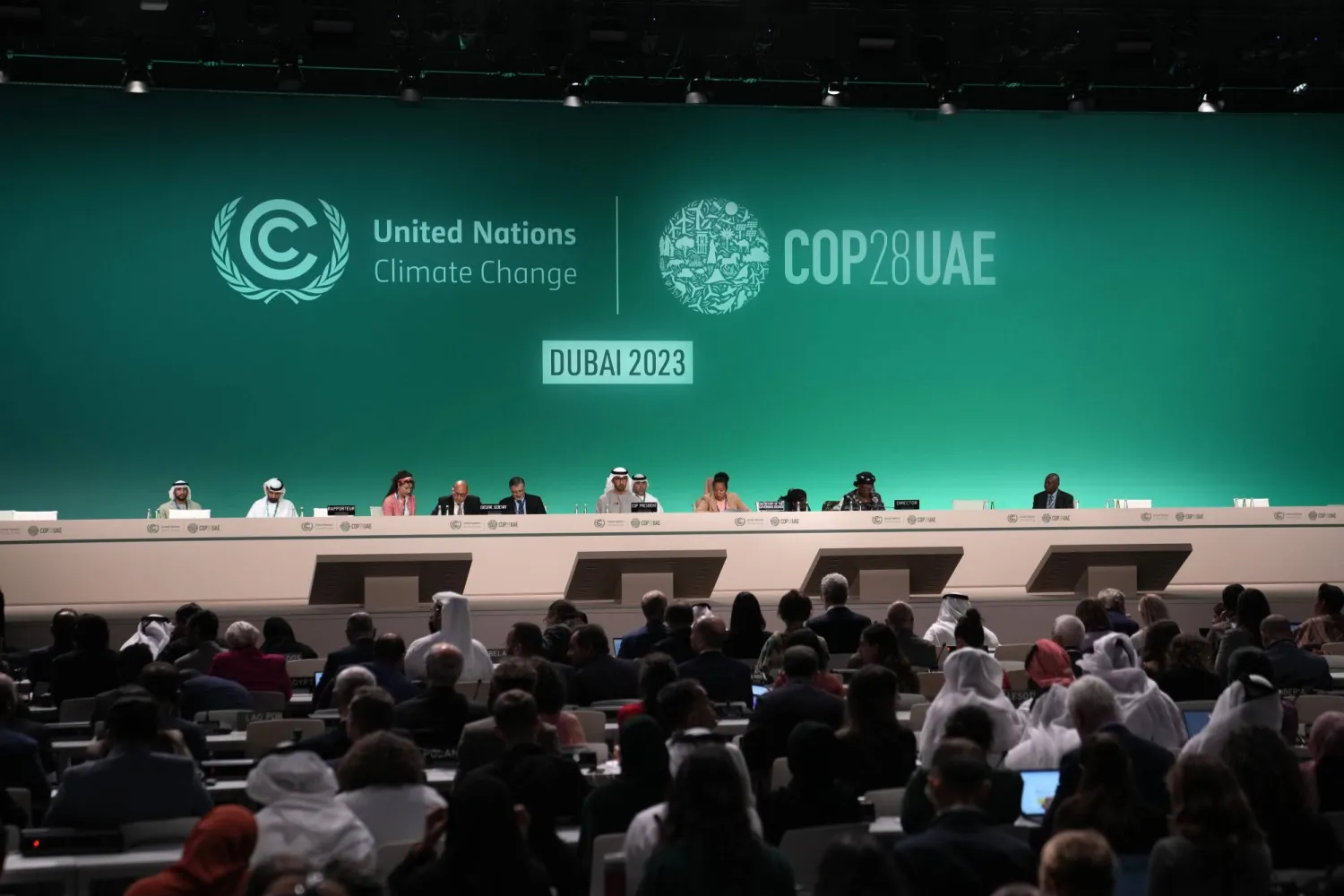

Delegates at UN Climate Talks in Dubai Agree to 'Transition Away' from Planet-warming Fossil Fuels

COP28 President Sultan al-Jaber attends a plenary session at the COP28 UN Climate Summit, Wednesday, Dec. 13, 2023, in Dubai, United Arab Emirates. (AP Photo/Kamran Jebreili)
TT

Delegates at UN Climate Talks in Dubai Agree to 'Transition Away' from Planet-warming Fossil Fuels

COP28 President Sultan al-Jaber attends a plenary session at the COP28 UN Climate Summit, Wednesday, Dec. 13, 2023, in Dubai, United Arab Emirates. (AP Photo/Kamran Jebreili)

United Nations climate negotiators directed the world on Wednesday to transition away from planet-warming fossil fuels in a move the talks chief called historic.
Within minutes of opening Wednesday’s session in Dubai, COP28 President Sultan al-Jaber gaveled approval of the central document — the global stocktake that says how off-track the world is on climate and how it will get back on track. Delegates stood and hugged each other.
“It is a plan that is led by the science,’’ al-Jaber said. “It is an enhanced, balanced, but make no mistake, a historic package to accelerate climate action. It is the UAE consensus.”
“We have language on fossil fuel in our final agreement for the first time ever,” said al-Jaber, who's also CEO of the UAE’s oil company.
United Nations Climate Secretary Simon Stiell told delegates their efforts were “needed to signal a hard stop to humanity’s core climate problem: fossil fuels and that planet-burning pollution".
Stiell cautioned people that what they adopted was a “climate action lifeline, not a finish line.”
The new deal had been floated early Wednesday and was stronger than a draft proposed days earlier.
The European Union's delegation celebrated the agreement as historic.
“I am in awe of the spirit of cooperation that has brought everybody together," United States Special Envoy John Kerry said. He said it shows that multilateralism can still work despite what the globe sees with wars in Ukraine and the Middle East. “This document sends very strong messages to the world.”
The deal also includes a call for tripling the use of renewable energy and doubling energy efficiency. Earlier in the talks, the conference adopted a special fund for poor nations hurt by climate change and nations put nearly $800 million in the fund.
United Nations Secretary-General Antonio Guterres said in a statement that “for the first time, the outcome recognizes the need to transition away from fossil fuels.”
“The era of fossil fuels must end – and it must end with justice and equity,” he said.
The deal doesn’t go so far as to seek a “phase-out” of fossil fuels, which more than 100 nations, like small island states and European nations, had pleaded for. Instead, it calls for “transitioning away from fossil fuels in energy systems, in a just, orderly and equitable manner, accelerating action in this critical decade.”
The deal says that the transition would be done in a way that gets the world to net zero greenhouse gas emissions in 2050 and follows the dictates of climate science. It projects a world peaking its ever-growing carbon pollution by the year 2025 to reach its agreed-upon threshold, but gives wiggle room to individual nations like China to peak later.
Intensive sessions with all sorts of delegates went well into the small hours of Wednesday morning. Then, the United Arab Emirates-led presidency presented delegates from nearly 200 nations a new central document — called the global stocktake — just after sunrise.

It was the third version presented in about two weeks and the word “oil” does not appear anywhere in the 21-page document, but “fossil fuels” appears twice.


Saudi Arabia Builds Momentum for Diverse, Sustainable Development Finance

Riyadh governor attends launch of Development Finance Conference Momentum 2025 (Asharq Al-Awsat)
TT

Saudi Arabia Builds Momentum for Diverse, Sustainable Development Finance

Riyadh governor attends launch of Development Finance Conference Momentum 2025 (Asharq Al-Awsat)

Saudi Arabia is moving into a pivotal phase driven by development financing that prioritizes impact, diversification, sustainability and the growth of human capital, while lifting overall quality of life.

This shift, which marks a move from traditional financial support to measurable and lasting results, was reflected in the announcement that the National Development Fund system delivered more than 52 billion riyals, 13.9 billion dollars, in financing in one year, adding around 47 billion riyals, 12.5 billion dollars, to non-oil GDP.

The figures were unveiled at the Development Finance Conference Momentum 2025.

The event opened on Tuesday in the Saudi capital under the patronage of Crown Prince and Prime Minister Prince Mohammed bin Salman and in the presence of Riyadh Governor Prince Faisal bin Bandar bin Abdulaziz, marking a development push aimed at creating opportunities and shaping the future.

The conference draws more than 150 speakers, 120 countries and 30 exhibitors to discuss global financing challenges and opportunities in industry, sustainability, innovation and economic resilience.

Development financing

Mohammed Al-Tuwaijri, Vice Chairman of the National Development Fund, stressed in his opening remarks the importance of this global platform, which he said launches a new phase in the development financing journey with the goal of achieving sustained impact.

He said, From Riyadh, and through this conference, the National Development Fund presents promising insights across development fields, with contributions from prominent speakers and experts from around the world. The fund is helping to generate new momentum for development.

Al-Tuwaijri said the fund system provided more than 52 billion riyals in financing in one year, adding about 47 billion riyals to non-oil GDP.

He added that the system, which includes 12 development funds, supported more than one million beneficiaries and enabled thousands of citizens to access financing and entrepreneurship opportunities, alongside quality projects that helped diversify the economy, enhance sustainability and create long term jobs.

Sustainable energy

He said the Tourism Development Fund supported more than two thousand tourism projects, while the Cultural Development Fund financed more than 1,500 cultural projects, and the Industrial Development Fund financed 400 projects during the same period.

He added that the industrial fund allocated more than 20 % of its portfolio to sustainable energy projects, including green hydrogen capacity of 3.8 gigawatts and solar power projects totaling 2.6 gigawatts, as part of the kingdom’s efforts to strengthen the global green economy.

Infrastructure investment

Investment Minister Khalid Al-Falih said the kingdom is a leading destination for global capital, particularly from advanced economies, adding that by 2030, or two years after, about one trillion dollars will be invested in infrastructure.

He said, Capital from advanced economies, such as Europe and Japan, is seeking destinations that offer long term certainty and stable returns, and Saudi Arabia is among the most prominent of these destinations.

Al-Falih said a large part of these investments is tied to pensions and insurance, which makes certainty about returns essential.

He noted that the kingdom is focused on developing sustainable infrastructure projects that include major airports, desalination, ports and distribution centers, in line with green financing standards to attract billions of dollars in investment that support Vision 2030.

Green bonds

Al-Falih said the kingdom holds the largest share of the market in green financing and represents two thirds of regional efforts, adding that the Public Investment Fund has several unique investment vehicles for century-long green bonds that have already begun trading.

He said these projects aim to deliver long term sustainability and enhance global capital participation in helping the kingdom achieve its medium and long term ambitions.

The workforce

Tourism Minister Ahmed Al-Khateeb said in a panel discussion on the sidelines of the conference that the tourism ecosystem employs about 10 % of the global workforce, or roughly 350 million people, and that the sector is one of the key drivers of diversifying the Saudi economy and advancing Vision 2030.

According to Al-Khateeb, Saudi tourism has seen unprecedented growth over the past decade, especially in the past five years. He chairs three of the twelve development funds in the kingdom, including the Tourism Development Fund, the Saudi Fund for Development and the Events Investment Fund.

He said the development funds play an important role locally, regionally and internationally, working with national and regional financing agencies such as the World Bank, other development funds in the region, the Islamic Development Fund and the French Development Agency, to support more than 800 projects that include clean water, hospitals, schools, roads and airports.

Tourism Development Fund

He said the Tourism Development Fund was created to stimulate the sector and is essential to achieving Vision 2030, noting that the private sector is the main player in tourism because of its major role in job creation.

The number of people working in tourism is expected to rise to about 500 million by 2034. Small and medium enterprises, which represent about 80 % of travel and tourism activity, will benefit greatly. The fund financed more than 10,000 SMEs over the past three years, he said.

Events Investment Fund

Al-Khateeb said the Events Investment Fund was created to develop events related infrastructure such as marinas, theaters and tourism facilities, and to finance the private sector to build and operate these sites at attractive financing costs, enabling investment in soft infrastructure after the government provides the hard infrastructure such as roads, airports and electricity.

He said developing mega projects such as the Red Sea project and its islands creates diverse jobs and helps diversify the economy and increase prosperity, noting that development financing plays a central role in unlocking economic and social value for any tourism site.

National strategy

He said Saudi tourism grew six % last year, nearly double the global average, and that tourism spending rose 11 % to 284 billion riyals, 75 billion dollars, in 2024, underscoring the sector’s strong investment potential over the next ten to twenty years.

He discussed the national tourism strategy launched in 2019, which focuses on visitor spending and its impact on GDP and employment. The tourism sector’s contribution to GDP rose from 3 % in 2019 to about 5 % last year, he said, with a target of reaching 10 % by 2030 and expanding later to 13 to 15 % to become the kingdom’s second largest economic contributor.

Al-Khateeb concluded by stressing the importance of planning for the next generation of tourism, including the use of artificial intelligence to enhance visitor experience and prioritizing the consumer. He said the kingdom is working to develop the sector in an innovative and sustainable way so it becomes a strong driver of the non-oil economy.


Saudi-Qatar Electric Rail Project to Deepen Economic, Logistics Ties

Signing of Saudi-Qatar high speed rail deal attended by Saudi Crown Prince and Qatar Emir (SPA)
TT

Saudi-Qatar Electric Rail Project to Deepen Economic, Logistics Ties

Signing of Saudi-Qatar high speed rail deal attended by Saudi Crown Prince and Qatar Emir (SPA)

Hussein al-Khawaja, chairman of the land transport committee at the Al-Ahsa Chamber, said the agreement to build a high speed electric passenger railway between Saudi Arabia and Qatar, the largest modern infrastructure venture ever undertaken by two Gulf states, ushers in a new chapter of economic and logistics integration.

He said the line will spur the movement of goods and travelers, energize commercial and tourism flows, strengthen cross border supply chains through more resilient logistics solutions, and lift bilateral trade by shortening delivery times and trimming the edges of operating costs.

He told Asharq Al-Awsat that the deal represents a major strategic leap within both countries’ efforts to deepen economic cooperation and developmental integration, cement social ties, and support sustainable development paths under Saudi Vision 2030 and Qatar National Vision 2030.

Al-Khawaja said the project will redefine travel between the two countries. It will give passengers and investors broader, faster and more flexible routes connecting business hubs and global aviation centers, with a capacity exceeding ten million passengers a year.

He said the venture’s projected economic return of about 115 billion riyals to the combined gross domestic product underscores its position as one of the most significant strategic projects driving regional development.

It is expected to generate around thirty thousand direct and indirect jobs in Saudi Arabia and Qatar during construction and operation.

Addressing the impact on Al-Ahsa, al-Khawaja said the project will help turn the province into a pivotal logistics and commercial corridor that links Gulf economies.

It will strengthen intra Gulf trade and economic integration and open the door to major infrastructure investments, reinforcing Al-Ahsa’s standing as a key geographic and strategic location and a promising commercial and logistics center.

He added that the railway will bolster the local economy’s capacity and growth, create new jobs, lower transport costs for goods and passengers, support the logistics sector and supply chains, spur local manufacturing, attract investment, reduce maintenance costs and expand tourism, while building a more competitive, integrated and sustainable economic landscape.


Gold Prices Dip as Markets Brace for 'Hawkish' Fed Tone

UK gold bars and gold Sovereign coins are displayed at Baird & Co in Hatton Garden in London, Britain, October 8, 2025. REUTERS/Hiba Kola
TT

Gold Prices Dip as Markets Brace for 'Hawkish' Fed Tone

UK gold bars and gold Sovereign coins are displayed at Baird & Co in Hatton Garden in London, Britain, October 8, 2025. REUTERS/Hiba Kola

Gold edged down on Tuesday as investors, having mostly priced in a Federal Reserve rate cut, looked ahead for clues that the US central bank might opt for a gentler-than-expected easing cycle when its two-day policy meeting begins later in the day.

Spot gold was down 0.3% to $4,174.91 per ounce, as of 0609 GMT. US gold futures for December delivery slipped 0.4% to $4,202.70 per ounce.

Investors are largely repositioning ahead of the Federal Reserve's policy meeting, OANDA senior market analyst Kelvin Wong said.

"Earlier in the month, Jerome Powell signalled hawkish rate-cut guidance during his press conference. So investors in the US Treasury market are adjusting their positions."

The benchmark US 10-year Treasury yields held near a 2-1/2-month peak hit on Monday, Reuters reported.

Analysts widely expect a "hawkish cut" this week accompanied by guidance and forecasts that signal a high threshold for further easing into next year.

Last week, data showed the US Personal Consumption Expenditures (PCE) Price Index, the Fed's preferred inflation gauge, landed in line with expectations, while consumer sentiment improved in December.

Private payrolls for November recorded their sharpest drop in more than 2-1/2 years, but jobless claims fell to a three-year low for the week ended November 28.

Markets now assign an 89% probability of a quarter-point cut at the Fed's December 9–10 meeting, according to CME's FedWatch Tool.

Lower interest rates tend to favor non-yielding assets such as gold.

Meanwhile, silver fell 0.6% to $57.76 per ounce. The white metal hit a record high of $59.32 on Friday.

"Right now, silver is more of a higher-beta play among precious metals," Wong said, adding that low inventories, strong industrial demand, and expectations of Fed rate cuts are driving its momentum, pushing it into risk-on mode and outperforming gold.

Platinum lost 0.2% to $1,638.35, while palladium shed 0.4% to $1,459.78.
