

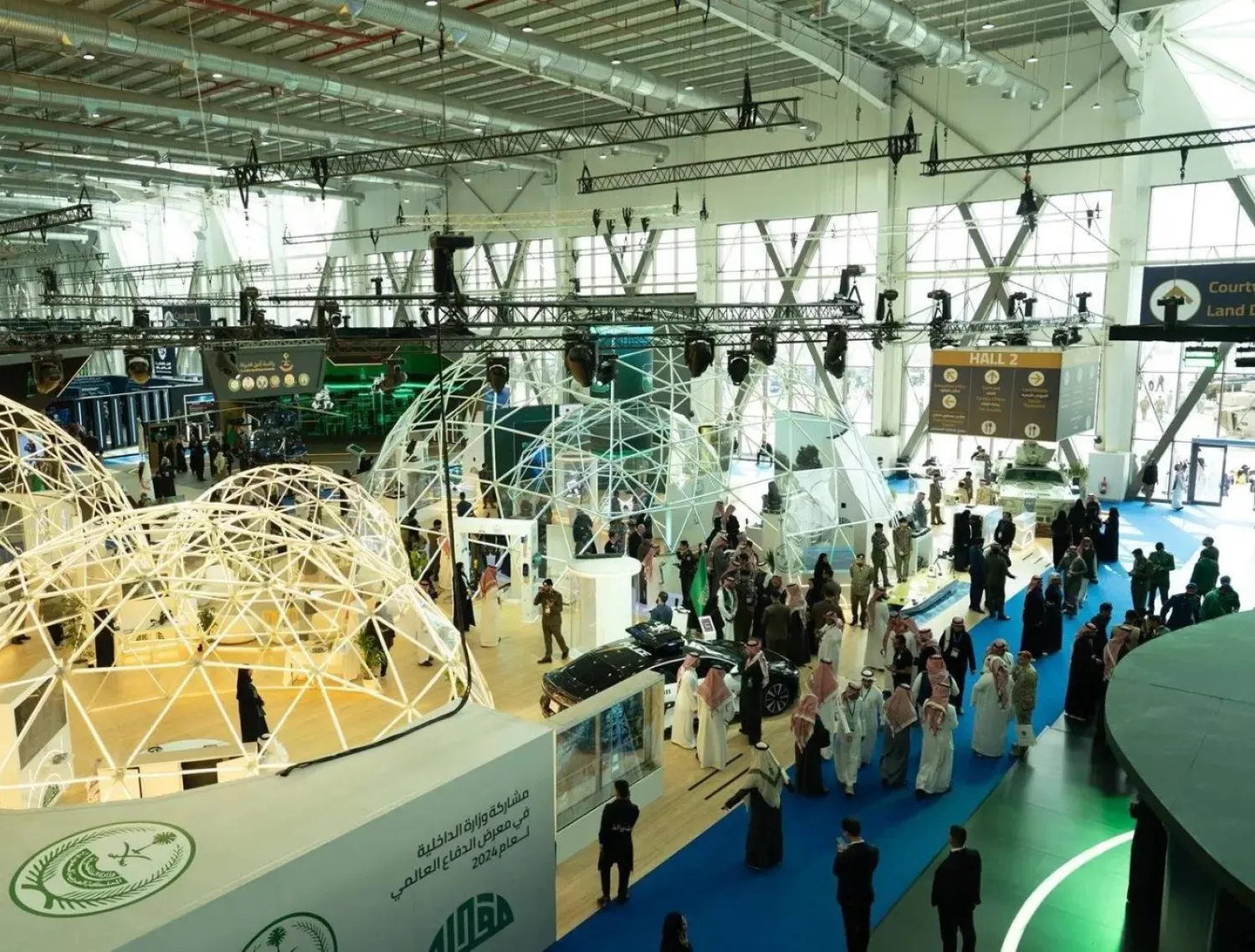

World Defense Show Concludes in Riyadh with $7 Bn Contracts

World Defense Show 2024 in Riyadh (SPA)
TT

World Defense Show Concludes in Riyadh with $7 Bn Contracts

World Defense Show 2024 in Riyadh (SPA)

The second edition of the World Defense Show 2024 concluded in Riyadh with the signing of 61 purchase contracts worth $7 billion.

Over 773 participants and more than 441 Saudi delegations representing 116 countries participated in the show, and more than 106,000 visitors arrived at the pavilion.

The show also witnessed the signing of 73 agreements, including 17 industrial participation agreements.

Governor of General Authority for Military Industries (GAMI) Ahmed al-Ohali asserted that the event succeeded in linking industry leaders with innovators worldwide.

Several Saudi investors participating in the show stressed the importance of the event, describing it as a platform for building alliances with international companies specialized in the defense and military industries.

They also indicated that it represented a chance for foreign investors to learn about Saudi projects and witness the changes and qualitative renaissance in the Kingdom.

The investors pointed out that this edition paved the way for global markets to enter the defense and security industry in the Kingdom.

The exhibition has also become an influential global platform for achieving communication, exchanging knowledge, and building business relationships worldwide.

It also enables exhibitors and investors to learn about this field's latest innovations and technologies.

Asharq Al-Awsat met with local company representatives on the sidelines of the event.

During the exclusive interviews, they stated that the pavilion brings together several major companies that lead the global defense industries.

They stressed that such a category accelerates the sector's localization process by more than 50 percent, according to the targets of Vision 2030 to reduce military spending.

GAMI governor said at the event's inauguration that the Kingdom has begun to reap the fruits of government support to increase and develop military-industrial capabilities to 13.6 percent by the end of 2022.

- Explore opportunities

The CEO of Aircraft Accessories and Components Company (AACC), Mansour al-Eid, told Asharq Al-Awsat that the exhibition is an opportunity to build alliances with international companies, as it brings all investors and those interested in the sector under one roof.

Eid noted that the event saves time, effort, and money, allowing local companies to search for partnerships with international capitals specialized in military industries.

He noted that 70% of the AACC alliances with its global counterparts occurred during this exhibition and other exhibitions in this field, including cooperation with Chinese, European, and Turkish companies.

Eid stressed that the second edition brought together many specialized international companies, providing an excellent opportunity for its local counterparts.

He pointed out that this edition allowed global markets to enter the defense and security industry market in the Kingdom.

- Artificial intelligence

Eid explained that localization of the industry boils down to qualifying Saudis to specialize in this industry, adding that the government is working in this direction.

The private sector has a significant role, said Eid, adding that it is the engine of the economy and develops the industry, asserting that "investing in mind" will positively impact national companies.

The CEO added that the percentage of Saudization in his company reached 67%, and Saudi youth are attracted to artificial intelligence and aircraft operations.

He added that employment in artificial intelligence is one of the jobs that most require a period to invest and develop human resources.

- Integration between entities

For his part, the Director of Aeronautical and Mechanical Engineering at Intra Defense Technologies, Asim al-Rebdi, told Asharq Al-Awsat that the exhibition in its current edition has many positive revenues centered around integration between relevant authorities, customers, and legislative authorities.

Rebdi indicated that Intra displayed national solutions, which the company worked to develop and manufacture to cover the needs of the armed forces and security agencies.

According to the expert, Intra relies on its national cadres to develop and manufacture drones to achieve the vision of localizing 50% of military spending by 2030.

It also highlights national capabilities in the military and security fields by including local companies.

He told Asharq Al-Awsat about Intra's Samoum, saying the Unmanned Aircraft System (UAS) is an operational-class drone equipped with advanced payloads and sensors, including radars and optical systems.

Samoum is the final developed model, and the device is now in the testing stages, said Rebdi, noting that the company aims to complete the project during the next year to be ready to enter into the service.



Microsoft Arabia: Saudi Arabia Accelerates AI Adoption, Turns It Into Competitive Edge

A Microsoft logo is seen a day after Microsoft Corp's $26.2 billion purchase of LinkedIn Corp, in Los Angeles, California, US, June 14, 2016. REUTERS/Lucy Nicholson
TT

Microsoft Arabia: Saudi Arabia Accelerates AI Adoption, Turns It Into Competitive Edge

A Microsoft logo is seen a day after Microsoft Corp's $26.2 billion purchase of LinkedIn Corp, in Los Angeles, California, US, June 14, 2016. REUTERS/Lucy Nicholson

Saudi Arabia has cemented its global standing in artificial intelligence after pouring significant investments into the sector in 2025, accelerating digital transformation and expanding real-world applications across government and the wider economy.

From education and manufacturing to energy and public services, AI is being deployed to advance the diversification goals of Saudi Vision 2030.

Turki Badhris, president of Microsoft Arabia, said the kingdom is experiencing unprecedented momentum in adopting AI as a strategic lever to raise competitiveness and improve performance across vital sectors.

Artificial intelligence has become central to the national transformation journey, he told Asharq Al-Awsat.

Linking transformation

Saudi Arabia’s overhaul spans digital government modernization, the construction of megacities and large-scale projects, industrial development, and the creation of new economic sectors, Badhris said.

AI, he added, is the connective tissue binding these efforts together by enabling smarter infrastructure and more efficient public services.

In 2025, Microsoft expanded cooperation with government and regulatory bodies, as well as major companies, to accelerate the adoption of AI and cloud computing across education, industry, financial services, and government operations.

Turning point year

Badhris described 2025 as a watershed for AI in the kingdom, marked by a shift to broad, sector-wide deployment.

In digital government, training programs implemented with the Digital Government Authority aim to equip more than 100,000 public sector employees with cloud and AI skills, enhancing service delivery and user experience.

In education, AI literacy initiatives have been scaled up in partnership with the Ministry of Education and the Ministry of Communications and Information Technology, alongside the rollout of generative AI tools and digital learning technologies in schools.

Manufacturers have adopted AI-driven predictive maintenance and real-time operational data analysis, cutting downtime and improving efficiency and reliability.

In energy and sustainability, AI solutions are being used to optimize water and energy asset management, including predictive maintenance and intelligent process control, delivering operational savings while supporting emissions reduction and sustainability targets.

Sovereign cloud push

Badhris said the launch of Microsoft’s cloud region in Saudi Arabia, planned for 2026, will mark a qualitative leap by allowing government entities and regulated sectors to run critical workloads in a secure local environment, ensuring data sovereignty and enabling low-latency innovation.

He added that regulatory frameworks developed by relevant authorities have bolstered trust in AI adoption by balancing individual protection with incentives for innovation.

From tools to partners

Looking ahead, Badhris said 2026 will see AI evolve from support tools into “work partners” capable of collaboration and initiative in complex tasks.

The shift will be felt across government services, industry, megaprojects such as Qiddiya and The Red Sea Project, and healthcare.

Advanced AI systems, he said, will sharpen operational efficiency, lift productivity, and enhance service quality, while moving from reactive oversight to proactive governance frameworks that ensure safe and responsible use.

Saudi Arabia, Badhris said, is not simply adopting AI but helping shape its future, investing in sovereign infrastructure, building national capabilities, and embedding responsible-use principles to drive sustainable economic growth and entrench its position as a global technology power.


Lockheed Martin: Saudi Arabia Is Strategic Choice for Global Defense Hub

Lockheed Martin took part in the recent World Defense Show in Riyadh. (Asharq Al-Awsat)
TT

Lockheed Martin: Saudi Arabia Is Strategic Choice for Global Defense Hub

Lockheed Martin took part in the recent World Defense Show in Riyadh. (Asharq Al-Awsat)

Saudi Arabia’s push to localize half of its defense spending under Vision 2030 is drawing deeper commitments from US defense giant Lockheed Martin, which says it will expand local manufacturing, transfer advanced technologies, and further integrate the Kingdom into its global aerospace and defense supply chains.

Building Saudi partnerships

Steve Sheehy, vice president for international business development at Lockheed Martin’s aeronautics division, said the company is stepping up efforts to partner with both established and emerging Saudi aerospace firms.

Lockheed Martin is looking to build partnerships across maintenance, repair and overhaul, as well as component manufacturing and repair, particularly in advanced avionics, Sheehy told Asharq Al-Awsat.

Speaking after the company’s participation in the World Defense Show in Riyadh, he said Lockheed Martin is also targeting emerging fields such as additive manufacturing, from plastics to metals, and advanced composite materials.

The goal, he said, is twofold: plug gaps in the company’s global supply chain while transferring know-how and strengthening local capabilities in a mutually beneficial model.

Sheehy described the Saudi aerospace sector as established and growing. He also noted that it has a solid base in maintenance and manufacturing, as well as a clear shift toward advanced technologies, creating room for deeper collaboration between national firms and global industry leaders.

Alignment with Vision 2030

Retired Brigadier General Joseph Rank, chief executive of Lockheed Martin in Saudi Arabia and Africa, said the company’s strategy in the Kingdom is rooted in a long-term partnership aligned with Vision 2030, especially the target of localizing 50 percent of defense spending.

Lockheed Martin, he said, is focused on transferring knowledge and advanced technologies, developing local industrial capabilities and building an integrated defense ecosystem that positions Saudi Arabia firmly within global supply chains.

Rank said the company is working closely with government entities and national companies to strengthen local manufacturing, empower Saudi talent and establish a sustainable industrial base that supports innovation and creates high-quality jobs.

Lockheed Martin is advancing manufacturing and repair work on defense equipment, including components of the THAAD air defense system, missile launch platforms, and interceptor missile canisters, in cooperation with Saudi partners, Rank said.

The company has also opened a maintenance center in Riyadh for the Sniper Advanced Targeting Pod system, the first of its kind in the Middle East, to enhance maintenance and technical support capabilities.

Beyond hardware, Lockheed Martin is investing in transferring and localizing advanced technologies in air defense, command and control, and digital manufacturing. It is also supporting science, technology, engineering and mathematics programs and hands-on training in cooperation with national universities.

Broad local network

Rank said the company relies on a wide network of partners in the Kingdom. At the forefront are the General Authority for Military Industries, the main government partner in localization agreements, and Saudi Arabian Military Industries, a key manufacturing and technology transfer partner.

Other collaborators include the Advanced Electronics Company for advanced systems maintenance, the Middle East Propulsion Company and AIC Steel for producing THAAD components and platforms, and the National Company for Mechanical Systems for advanced manufacturing technologies.

Academic partnerships extend to King Abdullah University of Science and Technology, King Saud University, King Fahd University of Petroleum and Minerals, and Princess Nourah bint Abdulrahman University, supporting research and developing national talent.

Localizing aerospace manufacturing

Rank said localizing aerospace manufacturing is a strategic priority. Lockheed Martin has launched projects to produce interceptor missile launch platforms and canisters inside the Kingdom and awarded contracts for key components to Saudi companies, qualifying them to join its global supply network beyond the US.

The company is evaluating and qualifying hundreds of Saudi firms to produce defense equipment to international standards, focusing on technology transfer and building local expertise as a step toward manufacturing more integrated systems in the future.

Company officials said the approach goes beyond supplying systems. It centers on technology transfer, digital manufacturing, and command-and-control systems, laying the groundwork for the production of integrated systems in the Kingdom and strengthening Saudi Arabia’s position as a regional hub for aerospace and defense.


Türkiye TPAO, Shell Sign Deal to Carry out Exploration Work offshore Bulgaria

A Shell logo is seen at a gas station in Buenos Aires, Argentina, March 12, 2018. (Reuters)
TT

Türkiye TPAO, Shell Sign Deal to Carry out Exploration Work offshore Bulgaria

A Shell logo is seen at a gas station in Buenos Aires, Argentina, March 12, 2018. (Reuters)

Türkiye Petrolleri (TPAO) has signed a partnership agreement with Shell to carry out exploration work in Bulgaria's maritime zone, the Turkish energy ministry and British oil major said on Wednesday.

European Union member Bulgaria, which had been totally dependent on Russian gas until 2022, has been seeking to diversify its gas supplies and find cheaper sources, Reuters reported.

TPAO and Shell will jointly explore the Khan Tervel block, located near Türkiye's Sakarya gas field, and will hold a five-year licence in Bulgaria's exclusive economic zone, Minister Alparslan Bayraktar said.

Shell will continue as operator of the block, while TPAO will take a 33% interest in the licence, a Shell spokesperson said.

Since the start of this year, TPAO has signed energy cooperation agreements with ExxonMobil, Chevron and BP for possible exploration work in the Black Sea and the Mediterranean.

In April, Shell signed a contract with Bulgaria's government to allow the oil major to explore 4,000 square metres in the block.