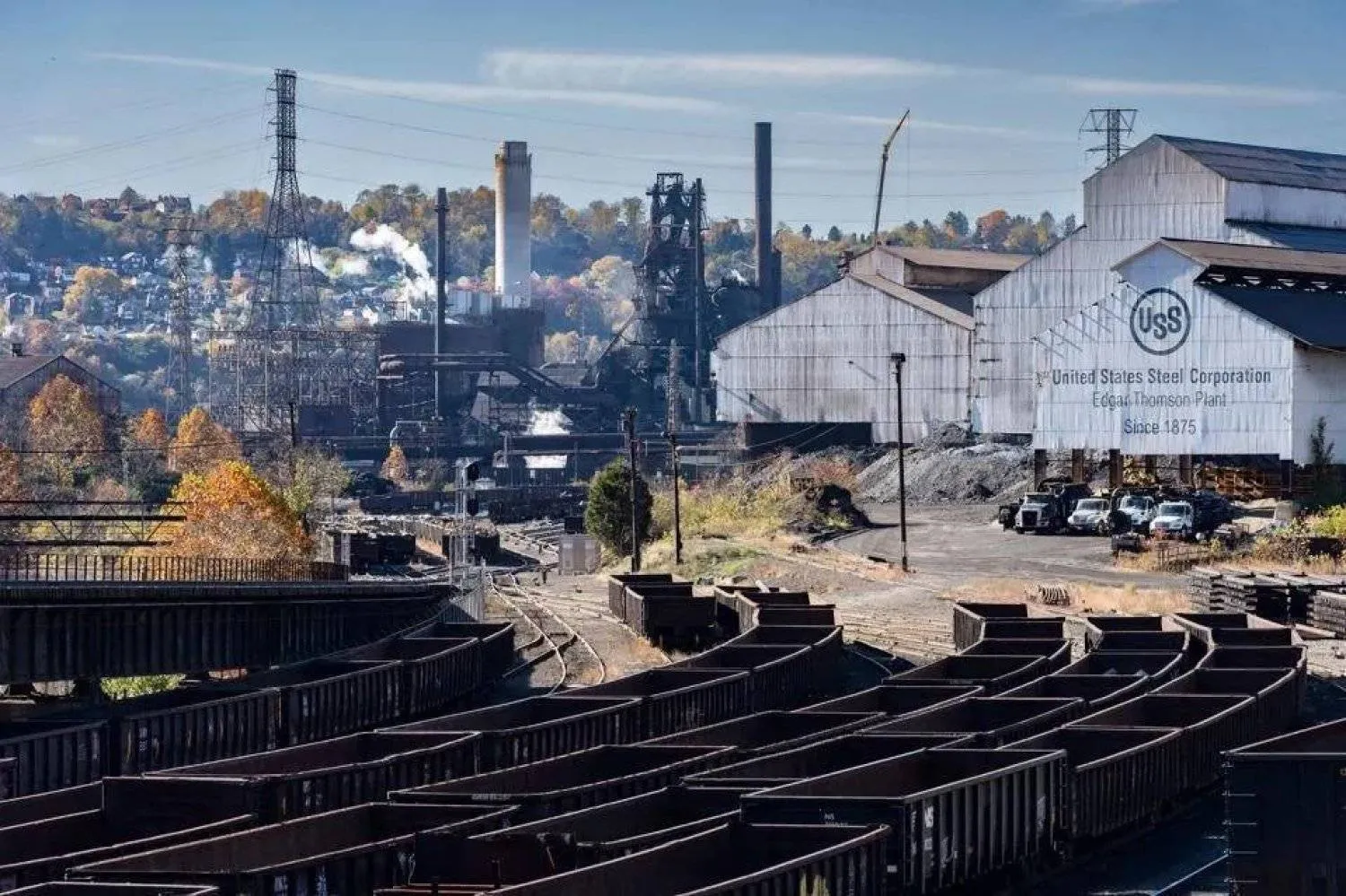
Biden Opposes Plan to Sell US Steel to Japanese Firm

By opposing the merger, Biden has chosen to support unionized workers in a critical election year. AFP
TT

Biden Opposes Plan to Sell US Steel to Japanese Firm

By opposing the merger, Biden has chosen to support unionized workers in a critical election year. AFP

President Joe Biden came out in opposition to the planned sale of US Steel to Nippon Steel of Japan, saying on Thursday that the US needs to "maintain strong American steel companies powered by American steel workers.”
In a statement, Biden added: “US Steel has been an iconic American steel company for more than a century, and it is vital for it to remain an American steel company that is domestically owned and operated."
By opposing the merger, Biden has chosen to support unionized workers in a critical election year at the risk of upsetting the business community and an essential ally in Japan, The Associated Press reported. Thursday's announcement, coming as Biden is campaigning in the Midwest, could have ripples in his race against the presumptive Republican presidential nominee, Donald Trump.
The Democratic president has made the restoration of American manufacturing a cornerstone of his agenda as he seeks reelection, and he has the endorsements of the AFL-CIO and several other prominent unions. The White House said Thursday that Biden called David McCall, president of United Steelworkers, to reiterate his support for its members.
Nippon Steel announced in December that it planned to buy the Pittsburgh-based steel producer for $14.1 billion in cash, raising concerns about what the transaction could mean for unionized workers, supply chains and US national security.
The Japanese company reiterated Friday how the deal benefits US Steel, union workers, the American steel industry and national security.
“Nippon Steel will advance American priorities by driving greater quality and competitiveness for customers in the critical industries that rely on American steel while strengthening American supply chains and economic defenses against China,” it said in a statement out of Tokyo.
“No other US steel company on its own can meet this challenge while also meeting antitrust requirements,” it said, stressing it already employs 4,000 American workers.
The company has also committed to keeping the US Steel name and Pittsburgh headquarters.
The company, which is the world’s fourth largest steel producer, launched a website with supportive statements from Larry Summers, the former treasury secretary, and Pat Toomey, a Republican and former senator from Pennsylvania.
Shortly after the steel deal was announced, the White House indicated it would be under review by the secretive Committee on Foreign Investment in the United States. The government does not officially provide updates on the CFIUS review process.
Biden has a big megaphone to weigh in on the matter, but he is not intervening in the review process or formally blocking the deal, according to a person familiar with deliberations who insisted on anonymity to discuss the situation.
When asked about the deal on Thursday, White House national security spokesman John Kirby declined to say if the president wanted to stop it outright or would be amendable to changes in its structure. But Kirby told reporters that the United States sees its alliance with Japan as “stronger than it's ever been.”
Still, the president holds sway over CFIUS. The treasury secretary leads the committee, which is also composed of the heads of federal agencies and, as deemed appropriate, directors of White House councils on the economy and national security.
Trump said earlier this year after meeting with the Teamsters union that he would stop the US Steel acquisition: “I would block it. I think it’s a horrible thing, when Japan buys US Steel. I would block it instantaneously."
Biden traveled Thursday to Saginaw, Michigan, which was once home to multiple General Motors plants and where he hopes his backing from union workers can resonate with voters.
The city is in a swing county that narrowly backed Trump in 2016 and then flipped to Biden in 2020, making it a crucial contest in this year's presidential race.
Biden has a close relationship with the United Steelworkers. He gave the union members “personal assurances" that he has their backs, according to a February statement by the union about Nippon Steel's plans. US Steel is headquartered in Pennsylvania, another key state in this year's election.
The United Steelworkers issued a statement last week after meeting with representatives from Nippon Steel that it had concerns about whether the company would honor existing labor agreements and about the company's financial transparency, adding that there were “barriers” to closing a merger.
The US considers Japan to be one of its closest allies and a key partner in countering China's ambitions and influence in Asia. Biden has visited the country twice as president and will host Japanese Prime Minister Fumio Kishida at the White House on April 10.
But Nippon Steel's connections to China have raised concerns within the Biden administration. More than half the steel produced globally comes from China, according to the World Steel Association. India is the second-largest producer, followed by Japan and the United States.
The US Chamber of Commerce warned in a February blog post that it would be foolhardy of the Biden administration to block the deal. Doing so could hurt foreign investment into the United States, cause other countries to block the overseas investments that US companies want to make and undermine the US-Japan alliance, the chamber said.
John Murphy, the head of international issues for the chamber, said Thursday that it was “inappropriate and counterproductive” of Biden to politicize the CFIUS review.
“It’s imperative that the CFIUS review proceed; and if, as expected, it reveals no national security concerns, the sale should proceed,” Murphy said.
But Sen. Bob Casey, D-Pennsylvania, who is up for reelection, applauded Biden's statement, saying, “I’ll work like hell against any deal that leaves our Steelworkers behind.”



Microsoft Arabia: Saudi Arabia Accelerates AI Adoption, Turns It Into Competitive Edge

A Microsoft logo is seen a day after Microsoft Corp's $26.2 billion purchase of LinkedIn Corp, in Los Angeles, California, US, June 14, 2016. REUTERS/Lucy Nicholson
TT

Microsoft Arabia: Saudi Arabia Accelerates AI Adoption, Turns It Into Competitive Edge

A Microsoft logo is seen a day after Microsoft Corp's $26.2 billion purchase of LinkedIn Corp, in Los Angeles, California, US, June 14, 2016. REUTERS/Lucy Nicholson

Saudi Arabia has cemented its global standing in artificial intelligence after pouring significant investments into the sector in 2025, accelerating digital transformation and expanding real-world applications across government and the wider economy.

From education and manufacturing to energy and public services, AI is being deployed to advance the diversification goals of Saudi Vision 2030.

Turki Badhris, president of Microsoft Arabia, said the kingdom is experiencing unprecedented momentum in adopting AI as a strategic lever to raise competitiveness and improve performance across vital sectors.

Artificial intelligence has become central to the national transformation journey, he told Asharq Al-Awsat.

Linking transformation

Saudi Arabia’s overhaul spans digital government modernization, the construction of megacities and large-scale projects, industrial development, and the creation of new economic sectors, Badhris said.

AI, he added, is the connective tissue binding these efforts together by enabling smarter infrastructure and more efficient public services.

In 2025, Microsoft expanded cooperation with government and regulatory bodies, as well as major companies, to accelerate the adoption of AI and cloud computing across education, industry, financial services, and government operations.

Turning point year

Badhris described 2025 as a watershed for AI in the kingdom, marked by a shift to broad, sector-wide deployment.

In digital government, training programs implemented with the Digital Government Authority aim to equip more than 100,000 public sector employees with cloud and AI skills, enhancing service delivery and user experience.

In education, AI literacy initiatives have been scaled up in partnership with the Ministry of Education and the Ministry of Communications and Information Technology, alongside the rollout of generative AI tools and digital learning technologies in schools.

Manufacturers have adopted AI-driven predictive maintenance and real-time operational data analysis, cutting downtime and improving efficiency and reliability.

In energy and sustainability, AI solutions are being used to optimize water and energy asset management, including predictive maintenance and intelligent process control, delivering operational savings while supporting emissions reduction and sustainability targets.

Sovereign cloud push

Badhris said the launch of Microsoft’s cloud region in Saudi Arabia, planned for 2026, will mark a qualitative leap by allowing government entities and regulated sectors to run critical workloads in a secure local environment, ensuring data sovereignty and enabling low-latency innovation.

He added that regulatory frameworks developed by relevant authorities have bolstered trust in AI adoption by balancing individual protection with incentives for innovation.

From tools to partners

Looking ahead, Badhris said 2026 will see AI evolve from support tools into “work partners” capable of collaboration and initiative in complex tasks.

The shift will be felt across government services, industry, megaprojects such as Qiddiya and The Red Sea Project, and healthcare.

Advanced AI systems, he said, will sharpen operational efficiency, lift productivity, and enhance service quality, while moving from reactive oversight to proactive governance frameworks that ensure safe and responsible use.

Saudi Arabia, Badhris said, is not simply adopting AI but helping shape its future, investing in sovereign infrastructure, building national capabilities, and embedding responsible-use principles to drive sustainable economic growth and entrench its position as a global technology power.


Lockheed Martin: Saudi Arabia Is Strategic Choice for Global Defense Hub

Lockheed Martin took part in the recent World Defense Show in Riyadh. (Asharq Al-Awsat)
TT

Lockheed Martin: Saudi Arabia Is Strategic Choice for Global Defense Hub

Lockheed Martin took part in the recent World Defense Show in Riyadh. (Asharq Al-Awsat)

Saudi Arabia’s push to localize half of its defense spending under Vision 2030 is drawing deeper commitments from US defense giant Lockheed Martin, which says it will expand local manufacturing, transfer advanced technologies, and further integrate the Kingdom into its global aerospace and defense supply chains.

Building Saudi partnerships

Steve Sheehy, vice president for international business development at Lockheed Martin’s aeronautics division, said the company is stepping up efforts to partner with both established and emerging Saudi aerospace firms.

Lockheed Martin is looking to build partnerships across maintenance, repair and overhaul, as well as component manufacturing and repair, particularly in advanced avionics, Sheehy told Asharq Al-Awsat.

Speaking after the company’s participation in the World Defense Show in Riyadh, he said Lockheed Martin is also targeting emerging fields such as additive manufacturing, from plastics to metals, and advanced composite materials.

The goal, he said, is twofold: plug gaps in the company’s global supply chain while transferring know-how and strengthening local capabilities in a mutually beneficial model.

Sheehy described the Saudi aerospace sector as established and growing. He also noted that it has a solid base in maintenance and manufacturing, as well as a clear shift toward advanced technologies, creating room for deeper collaboration between national firms and global industry leaders.

Alignment with Vision 2030

Retired Brigadier General Joseph Rank, chief executive of Lockheed Martin in Saudi Arabia and Africa, said the company’s strategy in the Kingdom is rooted in a long-term partnership aligned with Vision 2030, especially the target of localizing 50 percent of defense spending.

Lockheed Martin, he said, is focused on transferring knowledge and advanced technologies, developing local industrial capabilities and building an integrated defense ecosystem that positions Saudi Arabia firmly within global supply chains.

Rank said the company is working closely with government entities and national companies to strengthen local manufacturing, empower Saudi talent and establish a sustainable industrial base that supports innovation and creates high-quality jobs.

Lockheed Martin is advancing manufacturing and repair work on defense equipment, including components of the THAAD air defense system, missile launch platforms, and interceptor missile canisters, in cooperation with Saudi partners, Rank said.

The company has also opened a maintenance center in Riyadh for the Sniper Advanced Targeting Pod system, the first of its kind in the Middle East, to enhance maintenance and technical support capabilities.

Beyond hardware, Lockheed Martin is investing in transferring and localizing advanced technologies in air defense, command and control, and digital manufacturing. It is also supporting science, technology, engineering and mathematics programs and hands-on training in cooperation with national universities.

Broad local network

Rank said the company relies on a wide network of partners in the Kingdom. At the forefront are the General Authority for Military Industries, the main government partner in localization agreements, and Saudi Arabian Military Industries, a key manufacturing and technology transfer partner.

Other collaborators include the Advanced Electronics Company for advanced systems maintenance, the Middle East Propulsion Company and AIC Steel for producing THAAD components and platforms, and the National Company for Mechanical Systems for advanced manufacturing technologies.

Academic partnerships extend to King Abdullah University of Science and Technology, King Saud University, King Fahd University of Petroleum and Minerals, and Princess Nourah bint Abdulrahman University, supporting research and developing national talent.

Localizing aerospace manufacturing

Rank said localizing aerospace manufacturing is a strategic priority. Lockheed Martin has launched projects to produce interceptor missile launch platforms and canisters inside the Kingdom and awarded contracts for key components to Saudi companies, qualifying them to join its global supply network beyond the US.

The company is evaluating and qualifying hundreds of Saudi firms to produce defense equipment to international standards, focusing on technology transfer and building local expertise as a step toward manufacturing more integrated systems in the future.

Company officials said the approach goes beyond supplying systems. It centers on technology transfer, digital manufacturing, and command-and-control systems, laying the groundwork for the production of integrated systems in the Kingdom and strengthening Saudi Arabia’s position as a regional hub for aerospace and defense.


Türkiye TPAO, Shell Sign Deal to Carry out Exploration Work offshore Bulgaria

A Shell logo is seen at a gas station in Buenos Aires, Argentina, March 12, 2018. (Reuters)
TT

Türkiye TPAO, Shell Sign Deal to Carry out Exploration Work offshore Bulgaria

A Shell logo is seen at a gas station in Buenos Aires, Argentina, March 12, 2018. (Reuters)

Türkiye Petrolleri (TPAO) has signed a partnership agreement with Shell to carry out exploration work in Bulgaria's maritime zone, the Turkish energy ministry and British oil major said on Wednesday.

European Union member Bulgaria, which had been totally dependent on Russian gas until 2022, has been seeking to diversify its gas supplies and find cheaper sources, Reuters reported.

TPAO and Shell will jointly explore the Khan Tervel block, located near Türkiye's Sakarya gas field, and will hold a five-year licence in Bulgaria's exclusive economic zone, Minister Alparslan Bayraktar said.

Shell will continue as operator of the block, while TPAO will take a 33% interest in the licence, a Shell spokesperson said.

Since the start of this year, TPAO has signed energy cooperation agreements with ExxonMobil, Chevron and BP for possible exploration work in the Black Sea and the Mediterranean.

In April, Shell signed a contract with Bulgaria's government to allow the oil major to explore 4,000 square metres in the block.