


Biden to Face Oil Challenges with Iran Without Antagonizing China

A gas flare on an oil production platform is seen alongside an Iranian flag in the Gulf July 25, 2005. Reuters
TT

Biden to Face Oil Challenges with Iran Without Antagonizing China

A gas flare on an oil production platform is seen alongside an Iranian flag in the Gulf July 25, 2005. Reuters

In the wake of Iran's April 13 attack on Israel, experts are divided on whether the US will tighten oil-related sanctions on Tehran, with some expecting swift action to expand sanctions and others expecting lax enforcement of existing sanctions.

On Monday, the US House of Representatives overwhelmingly passed legislation aimed at countering China’s purchase of Iranian crude oil as part of a package of bills being brought to the floor in response to Iran’s attack on Israel.

The legislation was approved by a 383-11 vote, surpassing the requisite number needed to overcome a presidential veto. The legislation moves to the Senate where it faces an uncertain fate, according to Bloomberg.

The bill would expand secondary sanctions against Iran to cover all transactions between Chinese financial institutions and sanctioned Iranian banks used to purchase petroleum and petroleum products.

About 80% of Iran’s roughly 1.5 million barrels a day of oil exports are sent to independent refineries in China known as “teapots,” according to a summary of the Iran-China Energy Sanctions Act of 2023.

The bill, introduced by New York Republican Representative Mike Lawler, clarifies that any transaction by a Chinese financial institution for the purchase of oil from Iran qualifies as a “significant financial transaction” for sanctions purposes.

In a statement, Lawler said, “For years, Iran have funded Hamas, Hezbollah, the Houthis, and other terrorist organizations. They backed Hamas' barbaric October 7 attack against Israel.”

He added that all of this is made possible by the money Iran receives from its illicit oil trade - which has amounted to over $88 billion since Biden took office.

“The Iran-China Energy Sanctions Act, along with the SHIP Act we passed last November and which is finally coming up in the Senate Foreign Relations Committee tomorrow (Tuesday), will kneecap Iran's ability to export murder and instability across the region,” Lawler said.

“Enough is enough. We must hold Iran and its backers accountable - especially China, the number one purchaser of Iranian petroleum. These two bills will do exactly that and I urge the Senate to pass them both as soon as possible.”

David Goldwyn, chairman of the S&P Atlantic Council Global Energy Center's Energy Advisory Group, said on Tuesday, “I expect the [US Department of Treasury] to quickly ramp up and expand sanctions on Iran's oil trade both as a direct response to Iran's drone and missile attack on Israel, and as a means to forestall a more escalatory response by Israel.”

The US may crack down on participation of US and European insurance clubs in the Iran-China oil trade, Goldwyn said. “China has been a free rider on US diplomatic efforts to contain tensions in the Middle East and has benefited from flouting US sanctions on Iran, Russia and Venezuela,” he said.

Additional Sanctions

Earlier in the day, US Treasury Secretary Janet L. Yellen said additional sanctions on Iran would be forthcoming in retaliation for its attack against Israel over the weekend.

Market Impact

But like the Russia price cap policy, new measures against Iran will likely reduce Iran's income more than it will reduce oil flows, Goldwyn said. “The impact on prices should therefore be marginal,” he said.

Rachel Ziemba, senior advisor at political risk consultancy Horizon Engage, said there could be some additional sanctions enforcement with a focus on targets linked to the Revolutionary Guard Corps and regional proxies. “But I don't think it will be material to the oil markets,” she added.

In an April 15 note, Rapidan Energy Group said that lawmakers may be using the votes to pressure the Biden administration to enforce oil sanctions more aggressively. “However, these bills largely restate existing authorities and, as such, are mostly political messaging to signal support for Israel,” Rapidan said.

To avoid US sanctions, China already channels all Iran transactions through banks that are not exposed to the US financial system, it said.

Brenda Shaffer, an energy expert at the US Naval Postgraduate School, said the US will likely maintain its soft enforcement of Iran oil sanctions, in part to avoid an oil price spike.

“Regardless of potential new declarations, the Biden administration will not enforce sanctions in a serious manner in an election year, when there are formally sanctions on Iran, Russia and Venezuela, and the Strategic Petroleum Reserve is low,” Shaffer said.

Washington has even asked Ukraine not to attack Russian energy supplies, despite its effectiveness in battle, due to fears of a rise in the global oil price, Shaffer said. “The administration has not even taken serious steps to neutralize Iran's proxy—the Houthis—disruption of global shipping,” she said.

Speaking to Fox News on Sunday, Representative Steve Scalise the No. 2 House Republican, said the administration had made it easier for Iran to sell its oil, generating revenues that were being used to “go fund terrorist activity.”

Several regional analysts said they doubted Biden would take significant action to ramp up enforcement of existing US sanctions to choke off Iran's crude exports, the lifeblood of its economy.

“Even if these bills pass, it's hard to see the Biden administration going into overdrive, to try to spring into action or enforce existing sanctions or new ones to try to cut or curb (Iranian oil exports) in any meaningful way,” said Scott Modell, a former CIA officer, now CEO of Rapidan Energy Group.

The China Factor

Aggressively enforcing sanctions could also destabilize the US-China relationship, which Chinese and US officials have tried to repair following a rocky period after the US last year downed a suspected Chinese surveillance balloon that crossed US territory.

Tanker tracking specialist Vortexa Analytics estimated China acquired a record 55.6 million metric tons or 1.11 million barrels of Iranian crude a day last year. That amounted to roughly 90% of Iran's crude oil exports and 10% of China's oil imports.

Several analysts suggested Washington might take some action to cut Iran's oil exports in part to temper any Israeli reaction to the Iranian strikes, which could escalate the conflict.

But they said this would fall short of dramatic action such as sanctioning a major Chinese financial institution and instead could involve targeting Chinese or other entities engaged in such trade.

“If you really want to go after Iran's oil exports yes, you would have to take meaningful action against China,” said one source familiar with the issue.

“Are you really going to go after the big banks? Are you going to do something that the administration has not done and even the Trump administration did not do?” he added.

Jon Alterman, a Middle East analyst at the Center for Strategic and International Studies, said there were limits to what Washington can do to impose sanctions and that evaders are adept at finding loopholes.

“I'd expect to see a gesture in the direction of (imposing) economic consequences on Iran, but I don't expect the White House — or any future White House — to be able to completely turn off the spigot of Iranian oil,” he said.

Iranian Oil Exports

Iran, the third largest producer in the Organization of the Petroleum Exporting Countries (OPEC), produces about 3 million barrels of oil per day (bpd), or around 3% of total world output, according to Reuters.

The US has sought to limit Iran's oil exports since President Donald Trump exited a 2015 nuclear accord between Western powers and Iran in 2018 and re-imposed sanctions aimed at curbing Iran's revenue.

During Trump's term, Iran's oil exports slowed to a trickle.

They have risen during Biden's tenure as analysts say sanctions have been less rigorously enforced, Iran has succeeded in evading them, and as China has become a major buyer, according to industry trackers.

Although a member of OPEC and OPEC+ - which brings together OPEC and allies, including Russia - Iran, because of the sanctions imposed on it, is exempt from the group’s output restrictions that are designed to support the oil market.

Rising Output

Driven by strong Chinese demand last year and continuing into 2024, Iran's crude exports in March averaged 1.61 million bpd according to industry analysts Kpler, the highest since May 2023 when they were 1.68 million bpd, the highest since 2018.

The peaks of 2018 reflected the easing of sanctions that followed the 2015 nuclear deal with Iran.

Iranian crude and condensate exports reached 2.8 million bpd in May 2018, the highest since at least 2013 according to industry analysts Kpler.

In May 2018, the crude oil portion of Iran's exports was 2.51 million bpd, Kpler found. According to OPEC data, that was the most since 2011 when Iran exported 2.54 million bpd on average.

Iran's oil production reached all-time highs in the 1970s with a peak of 6.02 million bpd in 1974, according to OPEC data. That amounted to over 10% of world output at the time.

Trump and Biden

Also in May 2018, the United States under Trump's presidency unilaterally withdrew from the 2015 deal and re-imposed sanctions, aiming to cut Iran's oil sales to zero.

Iran stopped providing data on its oil exports, but assessments based on tanker tracking show they fell sharply in the next two years to below 200,000 bpd in some months of 2020, the lowest since at least 1980 according to OPEC data.

In late 2020, Biden won the US presidential election.

In January-March 2021, China increased its imports of Iranian oil to almost 800,000 bpd in January and almost 1 million bpd in March, although imports dropped again in April of that year.

In 2021, Iran and the US began indirect talks meant to bring both countries back into full compliance with the 2015 nuclear deal. Iranian exports rose during 2022, ending the year above 1 million bpd.

Analysts have said the higher exports appear to be partly a result of Iran's success in evading US sanctions.

Iran has for years evaded sanctions through ship-to-ship transfers and “spoofing” - or manipulating GPS transponders so that ships show up in different positions - and the country is getting better at such tactics, analysts have said.

Analysts have also said the rise in exports appears to be the result of US discretion in enforcing the sanctions.

Saudi Arabia Launches First Endowment Fund for Environmental, Water and Agricultural Sustainability

The launch of the Namaa Endowment Fund (Asharq Al-Awsat)
TT

Saudi Arabia Launches First Endowment Fund for Environmental, Water and Agricultural Sustainability

The launch of the Namaa Endowment Fund (Asharq Al-Awsat)

Saudi Arabia has launched its first endowment fund dedicated to advancing environmental, water and agricultural sustainability, reinforcing efforts to strengthen the Kingdom’s non-profit sector and long-term development.

Minister of Environment, Water and Agriculture Eng. Abdulrahman Al-Fadhli on Tuesday inaugurated the Namaa Endowment Fund at the ministry’s headquarters, in the presence of senior officials and stakeholders.

The fund is designed to support economic and social development goals, address community needs, increase the non-profit sector’s contribution to GDP, and promote sustainable management of environmental, water and agricultural resources.

Al-Fadhli said the fund represents a new model of institutional endowment work and a practical mechanism to expand developmental impact while ensuring the sustainability of non-profit initiatives.

Developed in partnership with the General Authority for Awqaf, the fund aims to build assets commensurate with its ambitions, enabling higher returns and a wider impact over the long term.

It will pursue carefully structured investments that balance financial performance with developmental outcomes, with the potential to own or benefit from real estate assets that can be used by non-profit organizations.

Encouraging Private-Sector Participation

Al-Fadhli added that the ministry, in cooperation with the General Authority for Awqaf, the Capital Market Authority and AlAhli Capital, will support the fund and encourage contributions from the private sector, business leaders and the wider public.

Contributions will be made through a licensed digital platform under strict financial governance. He called on all segments of society to contribute in support of sustainable development across the environment, water and agriculture sectors.

Namaa will finance endowment initiatives within the ministry’s ecosystem, including the non-profit institutions Reef, Morooj and Saqaya. Its focus areas include water provision and conservation, afforestation, biodiversity protection, vegetation cover, the circular economy, sustainable agriculture and irrigation, and reducing food loss and waste.

Emad Alkharashi, Governor of the General Authority for Awqaf, announced an initial contribution of SAR100 million, describing it as a foundation for a sustainable endowment model.

He said the fund combines the legacy of endowments with modern investment practices to protect natural resources, strengthen food security and ensure lasting developmental impact.

Alkharashi added that the partnership with the ministry maximizes results and positions the fund as a model for directing endowments toward high-impact, long-term priorities through a transparent, well-governed institutional framework.


Makkah Gears Up for Ramadan with Tourism Drive, Record Hospitality Growth  

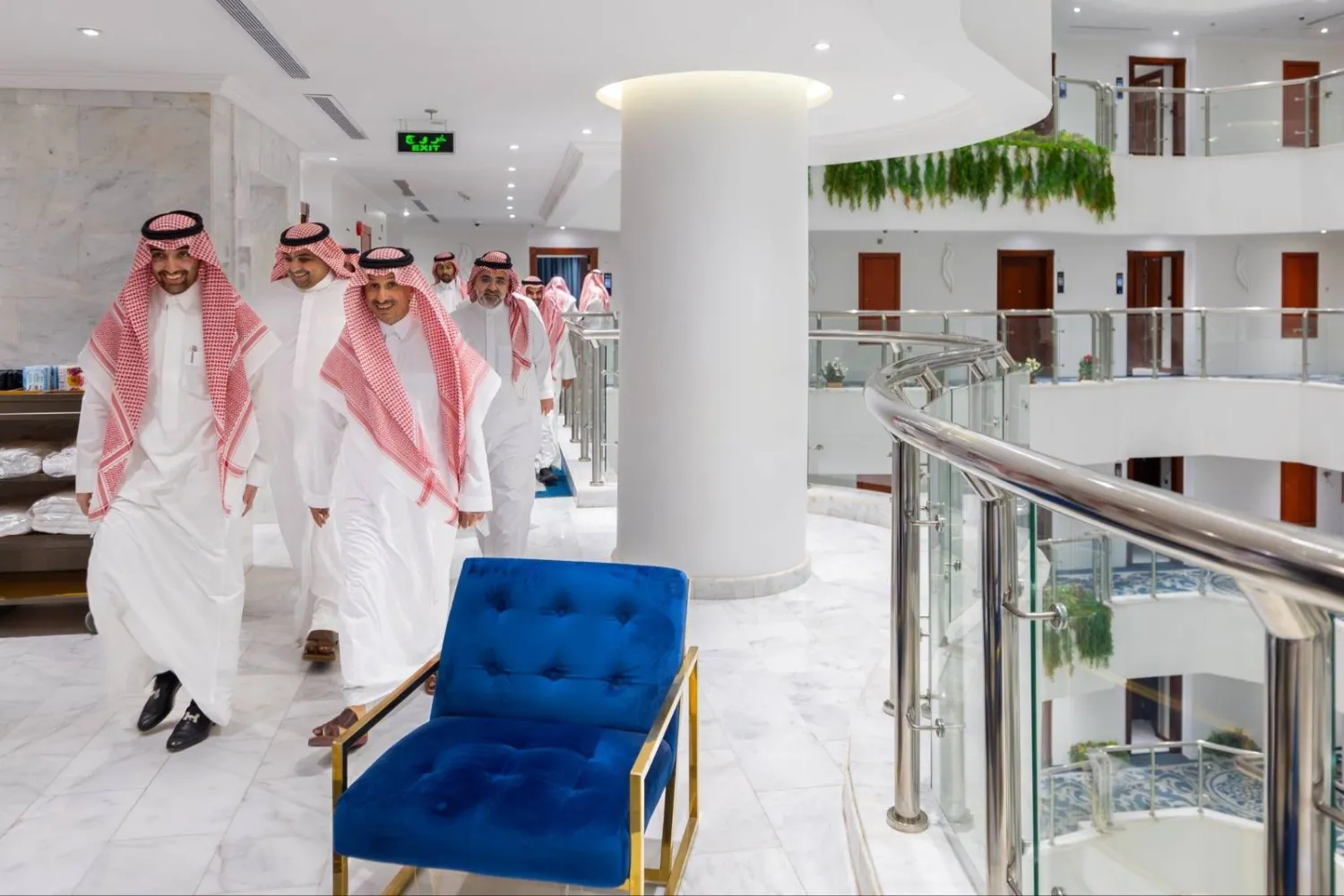
Tourism Minister Ahmed Al-Khateeb and other officials during his inspection tour on Tuesday. (Asharq Al-Awsat)
TT

Makkah Gears Up for Ramadan with Tourism Drive, Record Hospitality Growth  

Tourism Minister Ahmed Al-Khateeb and other officials during his inspection tour on Tuesday. (Asharq Al-Awsat)

Saudi Arabia’s Ministry of Tourism has raised the readiness of Makkah’s hospitality sector to its highest level ahead of the holy month of Ramadan, stressing that serving pilgrims and visitors remains a top national priority.

Makkah is preparing to receive worshippers and visitors amid a marked expansion in hospitality capacity. The city now has more than 2,200 licensed accommodation facilities, reflecting growth of 35 percent over the past year. The number of licensed hotel rooms has exceeded 380,000, up 25 percent, while total domestic and inbound tourism spending is projected to surpass SAR 143 billion ($38.1 billion) in 2025.

The wider Makkah region recorded unprecedented performance indicators last year, both in visitor numbers and tourism spending, underscoring sustained growth and operational readiness.

Total domestic and international visitors exceeded 50 million, marking a 14 percent increase compared with 2024.

Tourism Minister Ahmed Al-Khateeb announced the figures during an annual inspection tour on Tuesday, stressing that the indicators reflect a major expansion in accommodation capacity and record growth in visitor numbers.

The tour included inspections of temporary lodging facilities designated for pilgrims, part of a proactive plan to increase capacity during peak seasons, alongside early preparations for the upcoming Hajj.

Vision 2030 targets surpassed

Official data has shown that Saudi Arabia has exceeded its Vision 2030 targets for the Umrah. The number of pilgrims arriving from abroad rose from 8.5 million in 2019 to more than 18 million in 2025, surpassing the original goal of 15 million by 2030.

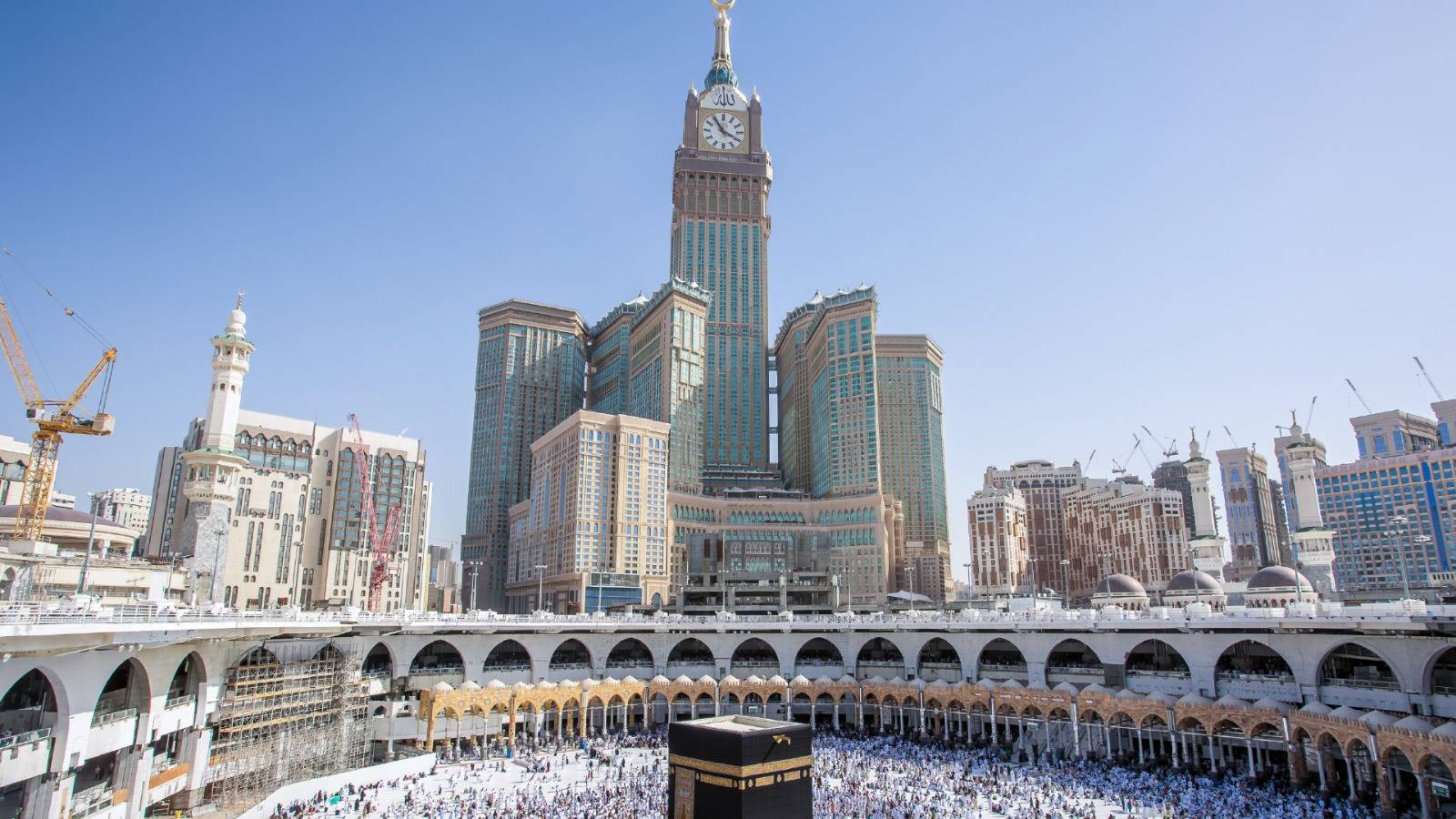
A number of hotels surrounding the Grand Mosque in Makkah. (General Authority for Awqaf)

Service quality indicators improved as well, with pilgrim satisfaction reaching 94 percent, exceeding Vision 2030 benchmarks.

Workforce development kept pace with demand, as the number of licensed tour guides rose to more than 980, a 23 percent increase.

Masar Mall project

Al-Khateeb announced a joint financing agreement between the Tourism Development Fund and the Arab National Bank with Hamat Holding to support the Masar Mall project. The development carries a total cost of SAR 936 million (about $250 million).

The project is expected to become the largest shopping center in Makkah with the capacity to accommodate around 20 million visitors annually.

Its location near the Haramain High-Speed Railway station and a direct pedestrian link to the Grand Mosque are expected to strengthen the city’s commercial and tourism infrastructure.

Jeddah: Gateway to pilgrims

Meanwhile, Jeddah continues to consolidate its position as a complementary destination to Makkah and a primary gateway for pilgrims, while also expanding its role as a coastal tourism hub.

The city welcomed more than 13 million domestic and international visitors in 2025, a 10 percent increase from 2024. Tourism spending reached SAR 28 billion ($7.47 billion), up 6 percent year on year.

Jeddah’s hospitality sector also expanded, with more than 500 licensed facilities and over 33,000 licensed rooms.

The city is currently developing 46 tourism projects valued at SAR 21 billion ($5.6 billion) and expected to add more than 11,000 hotel rooms and further strengthen its tourism infrastructure and economic value.


ECB President Lagarde Reportedly Plans to Quit Before Macron's Term Ends

FILE PHOTO: European Central Bank (ECB) President Christine Lagarde addresses the press following the ECB's Governing Council meeting, at the ECB headquarters in Frankfurt, Germany, February 5, 2026. REUTERS/Jana Rodenbusch/File Photo
TT

ECB President Lagarde Reportedly Plans to Quit Before Macron's Term Ends

FILE PHOTO: European Central Bank (ECB) President Christine Lagarde addresses the press following the ECB's Governing Council meeting, at the ECB headquarters in Frankfurt, Germany, February 5, 2026. REUTERS/Jana Rodenbusch/File Photo

European Central Bank President Christine Lagarde plans to leave her job before next year's French presidential election to allow Emmanuel Macron to have an input into picking her successor, the Financial Times reported on Wednesday.

Lagarde's term is due to end in October 2027 but some fear that the far right may win the French presidential race ‌in the spring of ‌2027, complicating the selection for the ‌new ⁠leader of Europe's most ⁠important financial institution.

Citing a person familiar with the matter, the FT said Lagarde has not yet decided on the exact timing of her departure but was keen on Macron and German Chancellor Friedrich Merz to be the key deciders in who succeeds her. Macron cannot run again for a third term.

"President Lagarde is ⁠totally focused on her mission and has not ‌taken any decision regarding the end ‌of her term," Reuters quoted an ECB spokesperson as saying.

The FT report comes only ‌a week after Bank of France Governor Francois Villeroy de Galhau ‌said he would step down in June this year, more than a year before the end of his term, allowing Macron to name his replacement before the presidential election that the far-right could win.

While it ‌will be up to all leaders from the 21-nation euro zone to pick Lagarde's successor, ⁠past practice ⁠suggests that any successful candidate must have both German and French support to clinch the role.

There are no formal candidates for the job yet but several names have been floating among ECB circles as potential ECB presidents. The most prominent among these are former Dutch central bank chief Klaas Knot and Bank for International Settlements General Manager Pablo Hernandez de Cos.

Lagarde's non-renewable term at the ECB runs until October 31, 2027. Prior to heading the ECB, she was managing director of the International Monetary Fund from 2011 to 2019 and before that, the French finance minister.
