


UK Economy in October Suffers 1st Back-to-back Declines Since 2020

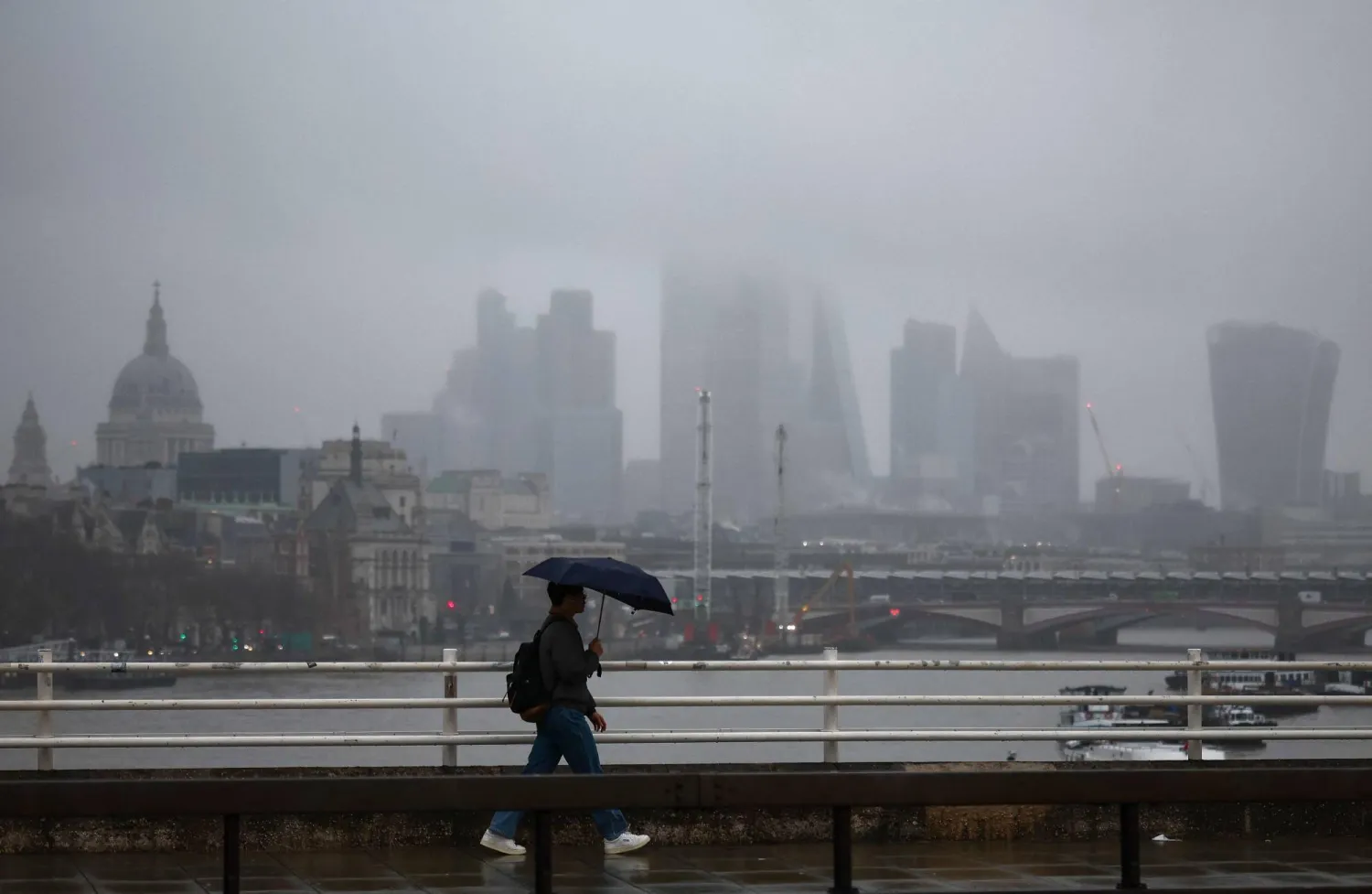
A pedestrian walks across Waterloo Bridge in the drizzle with the buildings of the City of London financial district behind, in London on December 13, 2024. (Photo by HENRY NICHOLLS / AFP)
TT

UK Economy in October Suffers 1st Back-to-back Declines Since 2020

A pedestrian walks across Waterloo Bridge in the drizzle with the buildings of the City of London financial district behind, in London on December 13, 2024. (Photo by HENRY NICHOLLS / AFP)

Britain's economy shrank for a second month in a row in October in the run-up to the government's first budget, the first back-to-back falls in output since the onset of the COVID-19 pandemic and a setback for new finance minister Rachel Reeves.

Gross domestic product contracted by 0.1% month-on-month in October, as it did in September, Reuters quoted the Office for National Statistics as saying.
It was the first consecutive drop in monthly GDP - which is volatile and prone to revision - since March and April 2020, when Britain enforced its first coronavirus lockdown.
Economists polled by Reuters had forecast a monthly expansion of 0.1%.
The ONS said there was "mixed" anecdotal evidence from companies that turnover had been affected by companies waiting for the budget statement, which imposed large tax rises on businesses. Others brought forward activity.
The services sector flatlined, while output in the manufacturing and construction industries declined in October's data, which measured the economy in the weeks before Reeves' budget statement on Oct. 30.
Reeves and Prime Minister Keir Starmer - who made stronger economic growth the centrepiece of the Labour Party's election campaign this year - had warned that the budget would include painful tax increases.
Friday's data adds to a run of worse-than-expected figures for Britain's economy, with business surveys and retail sales readings also falling flat.
"While the figures this month are disappointing, we have put in place policies to deliver long-term economic growth," Reeves said in a statement.
Most forecasters think the budget's boost to public investment and spending will yield faster economic growth in 2025, although business groups say employers will struggle with higher social security contributions.
Confidence among consumers rose modestly in December, in a survey published on Friday, offering Reeves a crumb of comfort after a torrent of glum business surveys.
The S&P Global PMI report showed the first contraction in private sector activity in November in over a year.
Sterling fell by more than a third of a cent against the US dollar after the GDP data before recovering partially. Investors continued to price in around three quarter-point cuts in Bank of England interest rates by the end of next year.
Paul Dales, chief UK economist at consultancy Capital Economics, said the BoE was unlikely to be sufficiently worried about the GDP data to cut rates at its meeting on Thursday.
"That said, we're not as confident about that as we were before this data release," he added.
Last month, the BoE trimmed its annual growth forecast for 2024 to 1% from 1.25% but predicted a stronger 2025 with 1.5% growth, reflecting a short-term boost to the economy from Reeves' budget.
Britain's economic output has grown slowly since the pandemic. Only Germany, which was also hit hard by surging energy costs after Russia's invasion of Ukraine, has done noticeably worse among the largest advanced economies.
Separate ONS trade data showed imports and exports of goods fell in October. Exports to the European Union were higher than exports to the rest of the world for the first time in nearly a year.




Capricorn Energy Sees Production Boost, Driven by Growth in Egypt

People run to catch a tram in the coastal city of Alexandria, on February 18, 2026. (Photo by Khaled DESOUKI / AFP)
TT

Capricorn Energy Sees Production Boost, Driven by Growth in Egypt

People run to catch a tram in the coastal city of Alexandria, on February 18, 2026. (Photo by Khaled DESOUKI / AFP)

Oil producer Capricorn Energy said on Monday it expects higher production in 2026 compared with last year, supported by the expansion of its Egypt operations.

In May, the Scottish company and Egyptian General Petroleum Corporation (EGPC) agreed to merge eight concessions ⁠in Egypt into a ⁠single deal under a joint venture with Cheiron Oil and Gas.

Capricorn expects 2026 production in the range of 18,000-22,000 barrels ⁠of oil equivalent per day (boepd), boosted by the agreement with EGPC and growth in the region.

Capricorn CEO Randy Neely said, "We have entered 2026 with strong momentum as our 2025 exit rate of 21,003 boepd and robust balance sheet ⁠position ⁠us to capitalize on development opportunities on the merged concession."

According to Reuters, Capricorn Energy also said it continues to evaluate M&A opportunities in the UK North Sea, Egypt and general MENA region.

The company forecast 2025 production between 17,000 and 21,000 boepd.


US to Stop Collecting Tariffs Deemed Illegal by Supreme Court on Tuesday

LOS ANGELES, CALIFORNIA - FEBRUARY 20: Shipping containers stand stacked while others rest on truck transport chassis at the Port of Los Angeles on February 20, 2026 in Los Angeles, California. Mario Tama/Getty Images/AFP
TT

US to Stop Collecting Tariffs Deemed Illegal by Supreme Court on Tuesday

LOS ANGELES, CALIFORNIA - FEBRUARY 20: Shipping containers stand stacked while others rest on truck transport chassis at the Port of Los Angeles on February 20, 2026 in Los Angeles, California. Mario Tama/Getty Images/AFP

The US Customs and Border Protection agency said it will halt collections of tariffs imposed under the International Emergency Economic Powers Act at 12:01 a.m. EST (0501 GMT) on Tuesday, more than three days after the Supreme Court declared the duties illegal.

The agency said in a message to shippers on its Cargo Systems ‌Messaging Service (CSMS) ‌that it will de-activate all tariff ‌codes ⁠associated with President ⁠Donald Trump's prior IEEPA-related orders as of Tuesday.

The IEEPA tariff collection halt coincides with Trump's imposition of a new, 15% global tariff under a different legal authority to replace the ones struck down by the Supreme ⁠Court on Friday.

CBP gave no reason why ‌it was continuing ‌to collect the tariffs at ports of entry days ‌after the Supreme Court's ruling, and its message ‌offered no information about possible refunds for importers.

The message noted that the collection halt does not affect any other tariffs imposed by Trump, including ‌those under the Section 232 national security statute and the Section 301 unfair ⁠trade practices ⁠statute.

"CBP will provide additional guidance to the trade community through CSMS messages as appropriate," the agency said.

Reuters reported on Friday that the Supreme Court decision made more than $175 billion in US Treasury revenue generated by the IEEPA tariffs subject to potential refunds, based on an estimate by Penn-Wharton Budget Model economists.

Their estimate from a ground-up forecasting model showed that IEEPA-based tariffs were generating more than $500 million per day in gross revenue.


Gold Climbs to 3-week High as US Tariff Ruling Stokes Uncertainty

A vendor displays gold bracelets for sale in a gold shop at the Grand Bazaar in Istanbul (AFP)
TT

Gold Climbs to 3-week High as US Tariff Ruling Stokes Uncertainty

A vendor displays gold bracelets for sale in a gold shop at the Grand Bazaar in Istanbul (AFP)

Gold climbed to a three-week high on Monday as uncertainty stoked by the US Supreme Court's decision to strike down a vast swathe of President Donald Trump's tariffs pressured the dollar and pushed investors to the safety of bullion.

Spot gold climbed 1.1% to $5,158.29 per ounce by 0558 GMT, having earlier hit its highest since January 30. ‌US gold futures for ‌April delivery were up 2% at $5,180.40.

"The court's ‌tariff ⁠ruling has, aside ⁠from earning the ire of the US president, added another layer of uncertainty to global markets, with traders again turning to gold as a defensive play," said Tim Waterer, chief market analyst at KCM Trade.

The US Supreme Court struck down Trump's sweeping tariffs that he pursued under a law meant for use in national emergencies, ⁠handing the Republican president a stinging defeat in ‌a landmark ruling on Friday ‌with major implications for the global economy.

After the court ruling, Trump said ‌he would raise a temporary tariff from 10% to 15% ‌on US imports from all countries.

Wall Street futures and the dollar slid in Asia on Monday as murkiness around US tariffs revived the "sell America" trade, Reuters reported.

"Whether gold can claw its way back above $5,400 in the near-term ‌may rest on how long tariff uncertainty lingers and whether the US engages in military action ⁠against Iran," Waterer ⁠said.

Iran has indicated it is prepared to make concessions on its nuclear program in talks with the US in return for the lifting of sanctions and recognition of its right to enrich uranium, as it seeks to avert a US attack.

Meanwhile, data on Friday showed that underlying US inflation increased more than expected in December, and signs are pointing to a further acceleration in January, which would strengthen expectations that the Federal Reserve won't cut interest rates before June.

Spot silver climbed 2.9% to $86.98 per ounce, a more than two-week high.
Spot platinum edged 0.1% higher to $2,158.55 per ounce, while palladium slipped 0.2% to $1,745.09.