China Seeks to Bolster Ports and Aviation Hubs in Western Regionshttps://english.aawsat.com/business/5098125-china-seeks-bolster-ports-and-aviation-hubs-western-regions
China Seeks to Bolster Ports and Aviation Hubs in Western Regions
The city skyline is reflected in a pool left on the dry riverbed of the receding Jialing river, a tributary of the Yangtze, that is approaching record-low water levels during a regional drought in Chongqing, China, August 20, 2022. (Reuters)
TT
TT
China Seeks to Bolster Ports and Aviation Hubs in Western Regions
The city skyline is reflected in a pool left on the dry riverbed of the receding Jialing river, a tributary of the Yangtze, that is approaching record-low water levels during a regional drought in Chongqing, China, August 20, 2022. (Reuters)
China said on Sunday it would launch 15 measures to bolster the development of its western provinces with the construction of logistical infrastructure such as ports and aviation hubs.
The General Administration of Customs said the measures would enhance the integration of rail, air, river and sea links in China's west, state media reported.
The measures are to include enhancing international aviation hubs in cities including Chengdu, Chongqing, Kunming, Xi'an and Urumqi, while developing comprehensive bonded zones, and integrating these with ports and other transport links.
A number of ports would also be built and expanded.
China has long sought to bolster the economic heft of its western regions, which have markedly lagged coastal provinces.
China's western regions comprise around two-thirds of the country's land area and include regions such as Sichuan, Chongqing, Yunnan, Xinjiang and Tibet.
China's Politburo last year called for a "new urbanization" of western China to revitalize rural areas, expand poverty alleviation efforts and strengthen energy resources. Efforts have also been made to increase linkages to Europe and South Asia through trade corridors including rail freight routes.
IEA: Australian Energy, Uranium Seen in Demand Post Iran Crisishttps://english.aawsat.com/business/5254562-iea-australian-energy-uranium-seen-demand-post-iran-crisis
International Energy Agency Executive Director Fatih Birol, right, speaks with Australian Prime Minister Anthony Albanese in Canberra, Australia, Monday, March 23, 2026. (Lukas Coch/AAP Image via AP)
IEA: Australian Energy, Uranium Seen in Demand Post Iran Crisis
International Energy Agency Executive Director Fatih Birol, right, speaks with Australian Prime Minister Anthony Albanese in Canberra, Australia, Monday, March 23, 2026. (Lukas Coch/AAP Image via AP)
Australia is a crucial source of minerals, including for nuclear power, to help stave off a bigger supply shock than the world is currently facing in energy due to the Iran war, the head of the International Energy Agency said on Tuesday.
The world is facing its worst-ever energy shock due to the US-Israeli war on Iran, losing the equivalent of 10 million barrels of oil a day, said Fatih Birol, the IEA's executive director.
"We are going to see that this energy security challenge that we are facing today might well be a small one compared to the critical minerals challenges we may face in the future if we don’t take the necessary measures in terms of diversification of critical minerals, especially in refining and processing," he said.
A single country controls more than 80% of the world's refining and critical minerals processing, he said, referring to China.
"It is good that ... the world has an energy supplier that is reliable and doesn’t use energy as a weapon," he said, referring to Russia. According to Reuters, he spoke at the Minerals Week conference in Canberra.
"The world should be thankful to Australia for producing energy, uranium."
Australia’s uranium reserves are the world’s largest, accounting for about a third of global supplies, according to figures from the Minerals Council of Australia (MCA). Australia is also the world’s fourth-largest uranium producer behind Kazakhstan, Canada and Namibia, the MCA said. Australia banned nuclear power for domestic energy generation more than a quarter of a century ago.
"There will be a policy response to this crisis globally," Birol said, adding that countries would turn to nuclear power.
"In this policy response, one of the beneficiaries will be small module reactors coming on to the market," he said, pointing to production from the US, Britain, France and South Korea.
"Nuclear will come back, this will accelerate," he said. "Australia being a major supplier, there will be opportunities." Other opportunities for Australia will come from greater demand for its natural gas, given the damage to Middle Eastern facilities.
"So more LNG from Australia will definitely be imported," he said.
There will also be increasing demand for electric vehicles, he said. Australia has the critical minerals to support EV batteries and demand for its copper will also grow due to electrification.
"We need grids around the world, this means copper," he said.
Australia, EU Agree Sweeping New Trade Pact 8 Years in the Workshttps://english.aawsat.com/business/5254561-australia-eu-agree-sweeping-new-trade-pact-8-years-works
24 March 2026, Australia, Canberra: Australian Prime Minister Anthony Albanese and EU Commission President Ursula von der Leyen walk together after an address to Members and Senators during a joint sitting in the House of Representatives at the Parliament House in Canberra. Photo: Lukas Coch/AAP/dpa
Australia, EU Agree Sweeping New Trade Pact 8 Years in the Works
24 March 2026, Australia, Canberra: Australian Prime Minister Anthony Albanese and EU Commission President Ursula von der Leyen walk together after an address to Members and Senators during a joint sitting in the House of Representatives at the Parliament House in Canberra. Photo: Lukas Coch/AAP/dpa
The European Union and Australia struck a long-awaited free-trade deal on Tuesday, while also agreeing to boost defense cooperation and access to rare earth minerals in the face of global uncertainty over trade.
EU chief Ursula von der Leyen's visit to Australia comes as the 27-nation bloc and the import-reliant nation navigate renewed energy vulnerability sparked by the war in the Middle East.
The accord is the latest agreed by Brussels in a push to diversify trade as Europe faces challenges from the United States and China.
Key sticking points on Australian use of European geographical names as well as how much beef can be exported to the continent were overcome to reach the deal after eight years of negotiations.
Another compromise will see Australian winemakers allowed to use the term "prosecco" domestically, but they must stop using it for exports after 10 years.
Australia will also be allowed to keep using some geographical names, such as feta and gruyere, in cases where producers have used the name for at least five years.
And European car makers will benefit from Australia raising the threshold for a luxury car tax on electric vehicles -- three-quarters will now be exempt.
The two sides also agreed to step up defense cooperation as well as critical raw materials.
Addressing the Australian parliament on Tuesday, von der Leyen described a world that was "brutal, harsh and unforgiving".
In that context, she said the EU and Australia were bound by common values and must work together to mitigate over-reliance on countries like China for critical minerals.
"We cannot be over dependent on any supplier for such crucial ingredients, and that is precisely why we need each other," AFP quoted her as saying.
"Our security is your security, and with our new security and defense partnership, we have each other's back."
She told lawmakers Tuesday's agreement on trade was a "fair deal, and one that delivers for your businesses and one that delivers for our businesses".
Under the deal, the EU said it expected exports to Australia to grow by a third over a decade.
The quota of Australian beef allowed into the bloc will increase more than 10 times the current level over the next decade, although that falls short of what Australian farmers had been seeking.
Australia's National Farmers' Federation said it was "extremely disappointed" by the outcome of the deal.
"What the Australian government has accepted today appears to offer no material change for key agricultural commodities as what the government rightly rejected in October 2023," president Hamish McIntyre said.
EU firms exported 37 billion euros (US$42.9 billion) of goods to Australia last year, and 31 billion euros of services in 2024.
And Australia said the deal could add AU$7.8 billion (US$5.4 billion) to its gross domestic product by 2030.
Australia's largest export market is China and the United States is its largest source of investment.
But Canberra has redoubled efforts to diversify export markets for farmers since a 2020 dispute with Beijing saw agriculture shipments blocked for several years, and last year's global imposition of US tariffs.
Likewise, the European Union is on a drive to strike new partnerships in the face of US levies and Chinese export controls.
Von der Leyen's visit was overshadowed by the war in the Middle East, which has sent oil prices soaring.
The EU chief this month said the conflict had served as a "stark reminder" of Europe's vulnerabilities.
And on Tuesday she called for an immediate end to hostilities in the face of a "critical" situation for energy supply chains globally.
Australia -- which is heavily reliant on fuel from abroad -- has also felt the pressure from the global energy squeeze.
Policy Resilience and Transport Lifelines: Saudi Arabia’s Shield Against the Hormuz Crisishttps://english.aawsat.com/business/5254372-policy-resilience-and-transport-lifelines-saudi-arabia%E2%80%99s-shield-against-hormuz
Policy Resilience and Transport Lifelines: Saudi Arabia’s Shield Against the Hormuz Crisis
Saudi Arabia's capital Riyadh (SPA)
As the world grapples with unprecedented turbulence fueled by the US-Israeli-Iranian confrontation, and as global supply chains reel from the closure of the Strait of Hormuz, the Saudi economy has emerged as an exceptional model of resilience. This stability is no coincidence; rather, it is the fruit of proactive policies and early investments in diversifying transport arteries and logistics. This strategic integration has allowed the Kingdom to transform its geography from a point of dependency on threatened waterways into an impregnable economic fortress. Through land, sea, and air routes that have become "alternative lifelines," the Kingdom has not only ensured the flow of energy but also secured the region’s needs for food and medicine, cementing its status as a vital logistical hub amidst the surging waves of conflict.
Economic experts believe that the efficacy of Saudi economic policies, coupled with the cultivation of inherent strengths and diverse transport and export options, has contributed significantly to the economy's ability to withstand the repercussions of the ongoing regional conflict.
Policy Efficacy and Strategic Strength
In this context, Fadl bin Saad Al-Buainain, a member of the Shura Council and economic consultant, affirmed that the Saudi economy is characterized by strength, durability, and sustainability. He noted its capacity to adapt to emergency shifts by leveraging its fundamental assets, thereby mitigating the impact of the current crisis despite its high risks.
Al-Buainain emphasized that the sheer depth and scale of the Saudi economy allow it to absorb sudden shocks and even convert them into opportunities to address any emerging shortages. He pointed out that the strategic vision for the oil sector and "qualitative hedging" to ensure supply security have created critical alternatives for oil exports following the closure of the Strait of Hormuz.
According to Al-Buainain, the sustainability of exports has bolstered the reliability of Saudi Aramco and maintained government revenues, while maximizing gains from high oil prices to compensate for any reduction in exported volumes.
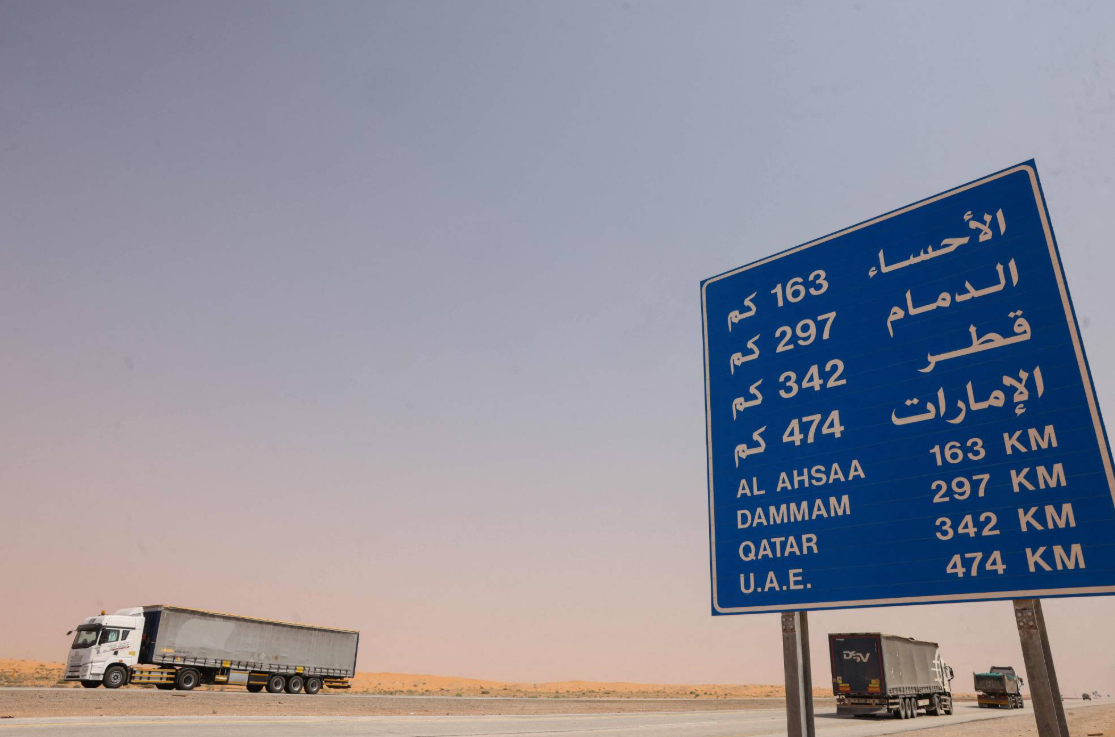
Trucks on the highway between Riyadh and Al-Ahsa, about 200 kilometers east of the Saudi capital (AFP)
The Pivotal Role of "Vision 2030"
Al-Buainain underscored the fundamental role of reforms stemming from Saudi Vision 2030 in enhancing economic diversification and strategic hedging across financial and oil sectors. He noted that prudent management, directly overseen by Crown Prince Mohammed bin Salman, served as the first line of defense against the crisis.
He cited S&P Global Ratings' affirmation of the Kingdom’s "A+" credit rating with a "Stable" outlook as the "strongest neutral evidence of economic durability and efficiency." He also highlighted the defensive aspect, stating: "The readiness of the military sectors was the most critical factor in protecting oil installations and achieving economic security," noting that the Kingdom’s Red Sea coastline has been vital in sustaining trade lines and protecting regional commerce.
A Logistical Platform and Humanitarian Responsibility
According to Al-Buainain, the Kingdom has transformed into a global logistics platform, opening its airports and ports as alternatives for neighboring countries. This has guaranteed the sustainability of food and medicine supply chains, providing much-needed stability to Gulf markets. In the energy sector, Saudi Arabia continued to meet customer demands and even offered additional barrels on the spot market, utilizing the East-West Pipeline and overseas storage reserves.
"In the transport and logistics sector, the Kingdom successfully managed the situation of stranded individuals, returning them to their home countries and ensuring the operation of Gulf airlines by opening alternative airports," Al-Buainain added.
He further revealed a massive humanitarian and logistical role played by Saudi ports in the Eastern Province, which provided food, medicine, and fuel to approximately 3,200 stranded ships and 40,000 sailors in the Arabian Gulf following Iranian threats to maritime safety. He stressed that "the Kingdom's humanitarian efforts do not waver, even under the darkest circumstances and in the face of barbaric acts that violate international law."
Stability in the Face of Crisis
For his part, Engineer Abdullah Al-Mobty, Chairman of the Abha Chamber and former Head of the Federation of Saudi Chambers, told Asharq Al-Awsat that the nature of the Saudi economy has made it resilient against the fallout of the US-Israeli-Iranian confrontation. He noted that the Kingdom has shown remarkable stability throughout historical crises thanks to a "clear vision set by the leadership to strengthen the economy through wise methodologies and plans."
Al-Mobty attributed this resilience to Riyadh’s role as a "reliable strategic depth," maintaining the best possible economic position even during a war of this magnitude. He noted that Saudi Arabia views proactive planning and foresight as an integral part of its commitment to the nation and its citizens' interests.
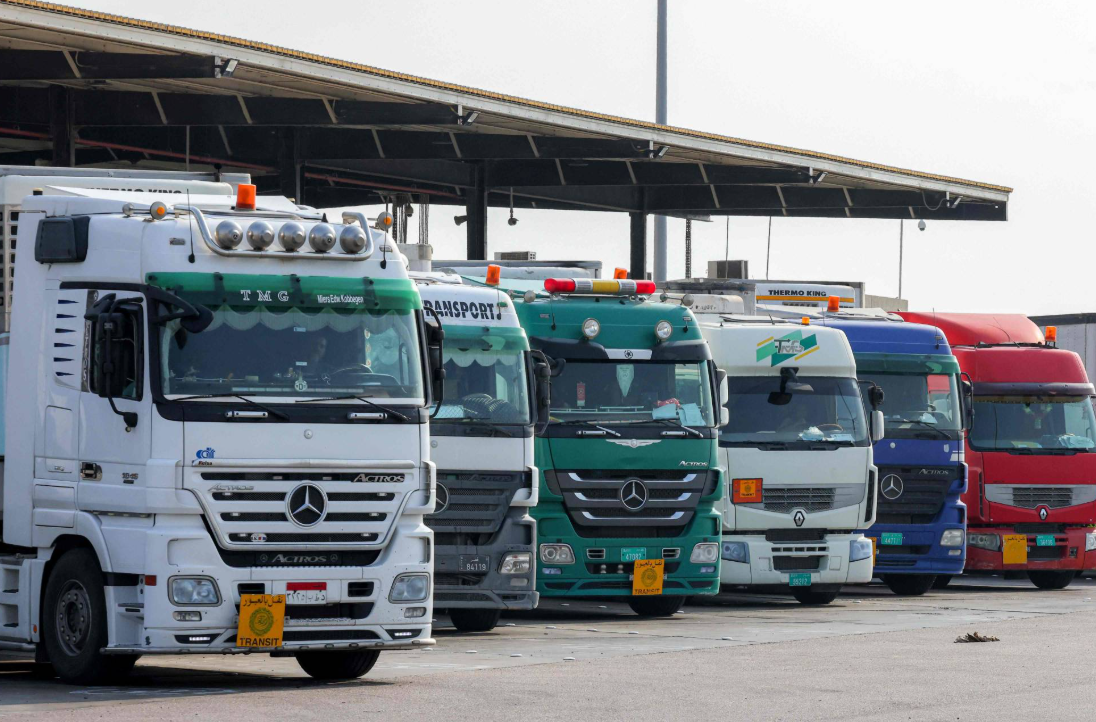
Trucks loaded with goods wait to cross into Qatar at the Salwa border crossing in eastern Saudi Arabia (AFP)
Land Transport Solutions
Al-Mobty emphasized that the Kingdom has never been an advocate of war; instead, its vision focused on creating strategic alternatives. He pointed to the Kingdom's ability to bypass the Strait of Hormuz by pumping crude via the Red Sea and securing the delivery of essential supplies to Gulf states through existing infrastructure.
"One of the immediate results we witnessed was the efficiency of the Saudi land transport sector," Al-Mobty stated. "It responded instantly and with massive capacity to cover the needs of the UAE and neighboring countries, both in passenger transport and securing supply chains. This proved the Kingdom’s success in turning its geographical location into an economic fortress for the region."
The Capacity to Absorb Shocks
Abdullah bin Zaid Al-Mulihi, CEO of Saudi Techno Excellence Company, stressed that the effectiveness of the Kingdom's plans in managing economic, trade, and investment sectors has granted it an exceptional ability to face the massive challenges currently paralyzing global and regional economies.
Al-Mulihi explained to Asharq Al-Awsat that Saudi economic policies are designed with high flexibility to absorb crises, citing the Kingdom's historical resilience during the 2008 global financial crisis. He noted that policies promoting diversification and advanced infrastructure, including land and sea ports, have optimized the Kingdom's unique geography.
"The multiplicity of transport and export options is what achieved this strategic resilience," Al-Mulihi said. He added that the Saudi land transport sector has become the "driving engine" of the region's economy, experiencing a strong boom as it secures the movement of goods and people, particularly to the UAE, reinforcing the sector as a primary pillar in confronting the current crisis.
لم تشترك بعد
انشئ حساباً خاصاً بك لتحصل على أخبار مخصصة لك ولتتمتع بخاصية حفظ المقالات وتتلقى نشراتنا البريدية المتنوعة