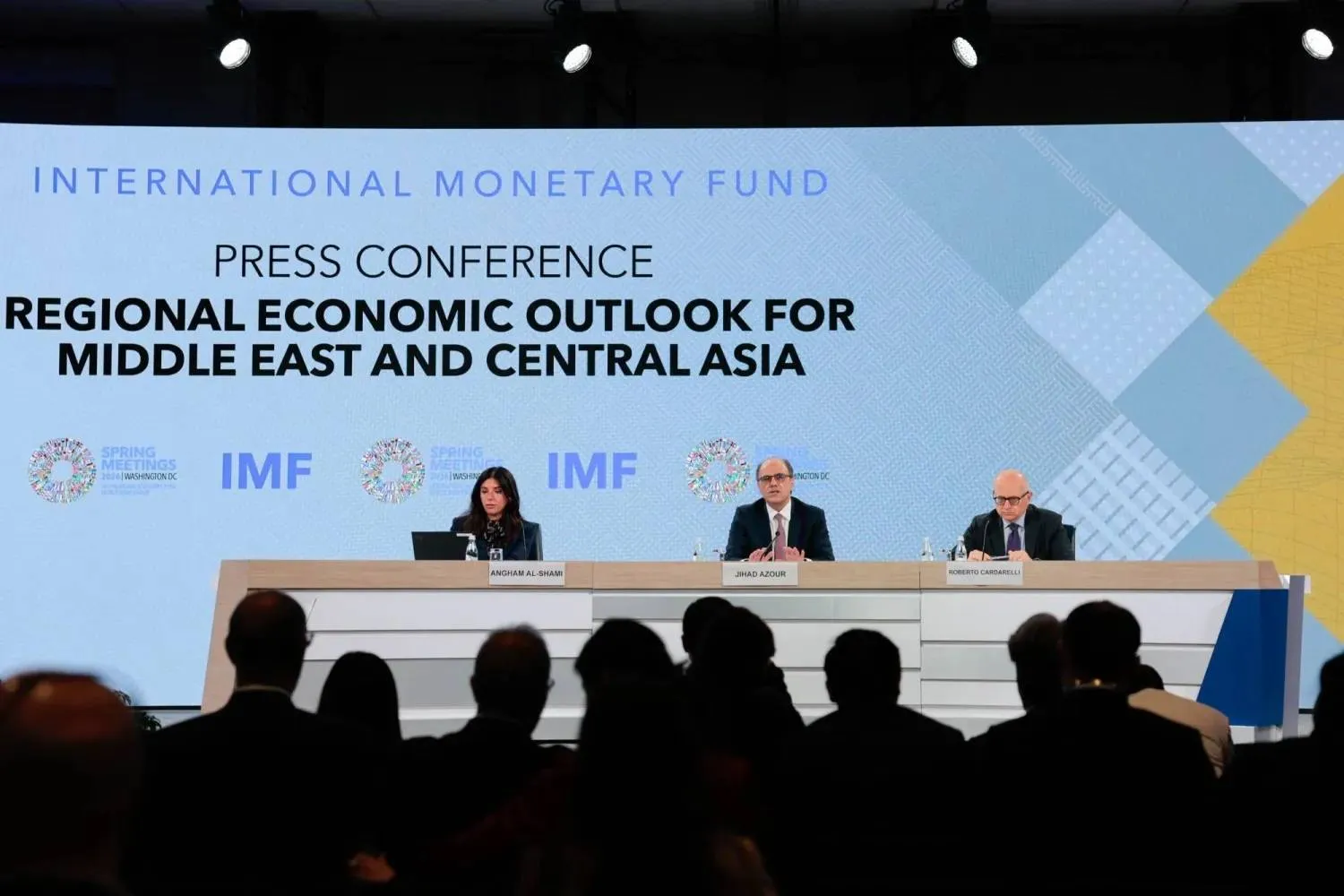
The International Monetary Fund said the Middle East, North Africa, and Pakistan were facing a pivotal and exceptionally difficult moment in their modern economic history after the war that broke out on Feb. 28, 2026, describing it as a severe and multifaceted shock to one of the world’s most strategically important economic corridors.
The IMF said the conflict was not merely a border crisis but had disrupted “three pillars of stability, energy markets, trade routes, and business confidence,” triggering a global energy shock and weakening supply chains.
Amid these challenges, Saudi Arabia’s economy emerged as a model of resilience, showing what the IMF described as “exceptional sturdiness” that enabled it to absorb the impact of disruptions to the Strait of Hormuz and a decline in regional output, supported by the pillars of Vision 2030, which strengthened fiscal discipline and logistical flexibility.
Jihad Azour, director of the IMF’s Middle East and Central Asia Department, said while presenting an update of the Regional Economic Outlook in Washington, on the sidelines of the IMF and World Bank Spring Meetings, that the war was reshaping the region’s economic outlook.
At the center of the shock was energy, he said, noting that the Strait of Hormuz, “the world’s most critical energy chokepoint, through which roughly one-fifth of global oil supply and about one-quarter of global LNG trade normally transit,” had come close to a standstill.
He said disruptions and shutdowns had cut oil and gas output across Gulf Cooperation Council countries, pushing Brent crude above $100 a barrel, while “European gas prices rose by roughly 60 percent, exceeding the spike observed after Russia’s invasion of Ukraine,” putting global energy security at risk.
He said energy disruptions caused by the war would weigh heavily on Gulf exporters, while oil-importing countries such as Egypt and Jordan were facing higher commodity prices and weaker remittance flows.
More broadly, the Middle East and North Africa region is expected to see a marked slowdown in growth this year, with real GDP projected at about 1.1%, significantly below pre-war forecasts, before a recovery in 2027, according to the IMF.
Azour said the shock extended beyond oil and gas, noting that “commodity disruptions extend beyond oil and gas,” affecting fertilizers, chemicals, and other products in which the region holds a strategic position.
He warned that rising food costs were directly threatening vulnerable populations, saying that “these price increases translate directly into higher food costs for some of the world’s most vulnerable populations,” particularly in import-dependent economies across the region and beyond.
He added that the conflict had also affected services, saying, “air traffic collapsed at major Gulf hubs, maritime insurance premiums surged, shipping routes lengthened, and logistics chains weakened,” highlighting the broad impact on aviation and logistics.
The IMF said some oil-importing economies in the region relied heavily on Gulf countries for energy imports and financial flows, leaving them exposed if the conflict intensified or persisted.
Saudi experience
Azour said one of the most important lessons from the war and the disruption of the Strait of Hormuz was the need to diversify trade routes.
“This shock underscores the importance of building greater resilience and strengthening integration,” he said, adding that this includes “diversifying trade routes and deepening regional cooperation,” to ensure the continued flow of goods and energy.
He said Saudi Arabia’s approach under its strategic vision went beyond infrastructure development to a broader reshaping of logistics networks. By expanding alternative ports on the Red Sea and strengthening land and rail connectivity, the kingdom reduced its reliance on a single maritime chokepoint.
He said this ability to create parallel trade routes allowed Saudi trade to continue effectively despite disruptions to regional corridors, offering a model for protecting economic security and ensuring uninterrupted supply flows.
Egypt
Azour said economic reforms implemented by Egypt, along with stronger policy buffers, were helping the country better manage external shocks.
He said allowing the exchange rate to become more flexible helped absorb shocks, while higher reserves provided reassurance to markets.
Regional divergence
The IMF report highlighted a sharp divergence across countries. Qatar faced a steep downgrade to growth forecasts due to damage to its gas infrastructure, while Oman showed relative resilience given its geographic position outside the Strait of Hormuz.
At the same time, financing pressures increased on Egypt, Pakistan, and Jordan as sovereign spreads widened, prompting Azour to stress that the IMF stood ready to support countries.
He said that if oil production recovered and the Strait of Hormuz fully reopened, countries would be able to increase output quickly, adding that higher oil prices compared with pre-2026 levels would help producers recover some of their losses from the crisis.